





























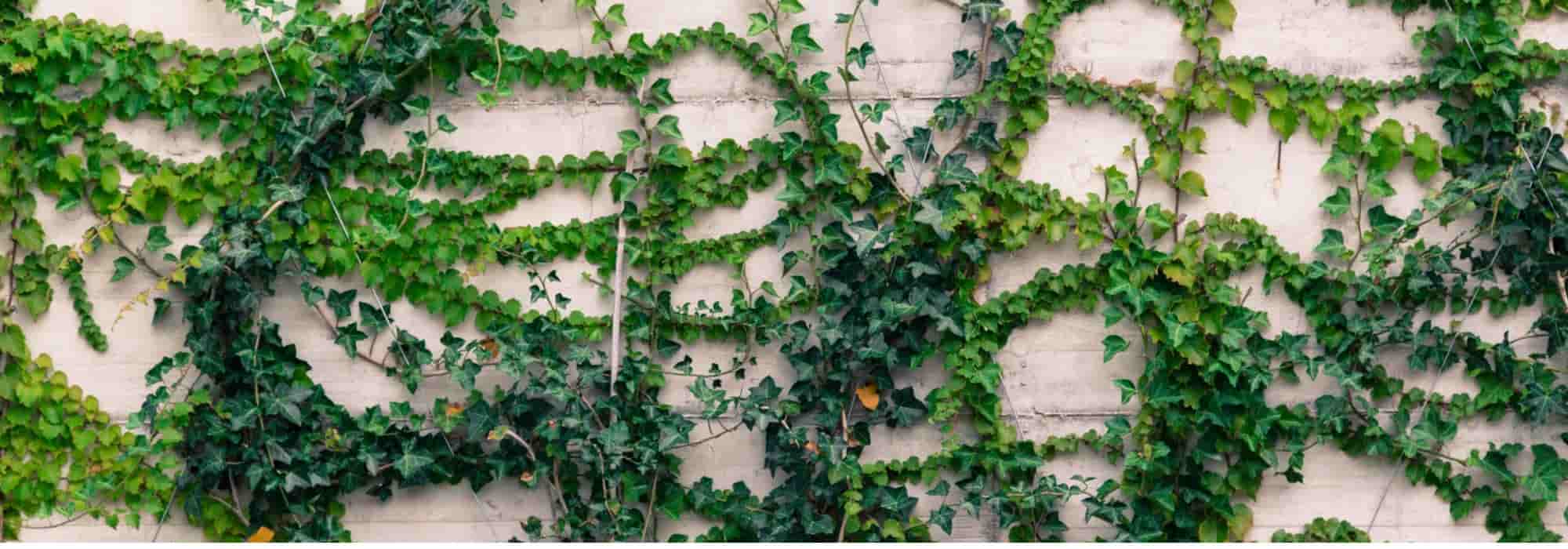
The benefits of climbing plants in permaculture
In permaculture (or not), growing a garden vertically is always a wise choice.
Contents
At first glance, a gardener’s immediate reaction to an unsightly, damaged, or dirty wall is to look for a climbing plant to cover and hide it. This is both legitimate and wise. However, these climbing plants can serve a thousand other functions, particularly in terms of permaculture. To recap, permaculture aims for food autonomy through space densification. In summary, it involves growing (almost) everywhere to maximise space while respecting nature, humans, animals, and plants. Often, it’s simply a matter of looking around for inspiration from nature: each plant finds its place naturally by utilising its potential.
But let’s return to our climbing plants. In this concept of space densification for permaculture purposes, they have a significant role to play. They are even essential for anyone wanting to “exploit” the potential of their land. Let’s explore together why climbing plants are indispensable in permaculture and how to plant them. And most importantly, which climbing plants to grow in your vegetable garden or garden.

How are climbing plants useful in permaculture?
In permaculture, the goal is to optimise space to the maximum, densifying crops to promote food autonomy. This densification also helps improve soil fertility. To densify and make the most of the space available to each gardener (while respecting the land and the environment, of course!), several techniques can be implemented in permaculture, such as crop succession, companion planting, and mound gardening…
The planting of climbing plants also fits into this concept of densification. Indeed, climbing plants allow for the occupation of another dimension, the vertical, which is often underutilised. Climbing plants colonise heights with minimal ground occupation. In a vegetable garden or even an ornamental garden, everything is usable: a house wall or garden shed, a fence, a trellis, stakes or posts, an arbour, a pergola, a balcony railing, dead trees…
Moreover, these climbing plants serve multiple functions: they can be edible, even medicinal, producing fruits or edible berries, their flowers are often highly melliferous and nectariferous, attracting swarms of foraging and pollinating insects. They are also a source of biodiversity, providing shelter for a multitude of insects, as well as lizards, birds… Finally, they have a significant aesthetic function by concealing sometimes unsightly supports.
In addition to these advantages, we can add:
- Their generally quite rapid growth
- The fact that they can shade other crops that are sensitive to scorching sun
- The minimal maintenance they require
- The fact that they are often less prone to diseases since their foliage is not in contact with the soil (which can harbour fungi) and its moisture
In permaculture, one can go further by creating a forest garden, also known as a food forest, where trees, climbing plants, vegetables, and aromatic plants are mixed… cultivated in 7 strata. Climbing plants play an important role here. Sophie explains how to create a forest garden.
Read also
6 climbing plants with decorative fruitsThe different types of climbing plants
There are hundreds of species and varieties of climbing plants. To make the most of their potential, it is essential to differentiate between all these species and varieties, and especially to understand how they will ascend vertically. Often, they require support; otherwise, they may flop pitifully (although some of these climbing plants can also serve as excellent groundcovers, but that is not the focus of this text!).
Beyond the fact that these climbing plants can be annual (runner beans, Spanish beans, peas, squashes…) or perennial, nature has equipped them with various means to grow upwards:
- Some manage on their own and simply use their stems to climb (tomatoes, beans…), while others have thorns that provide additional help (climbing roses, brambles…). However, they still need a support, which can be a simple stake, trellis, or teepee…
- Some climb the support they find using suckers or climbing roots they produce. They are very opportunistic and can ascend along a wall without assistance. The most notable example is ivy, but also Virginia creeper, trumpet vine, and climbing hydrangea…
- Other climbing plants have tendrils that they wrap around a support. These include climbing plants like grapevines, chayote, squashes, cucumbers, and passionflowers…
- The most robust climbing plants, therefore the ones to watch closely, are woody voluble plants. These are climbers with deciduous or evergreen foliage whose stems contain lignin. As they climb, these stems turn into wood, becoming harder over time and with growth. This is why it is essential to provide them with very sturdy supports that will not give way under the strength of these solid stems. Among these woody climbing plants, we can mention wisteria, which is by far the most robust.
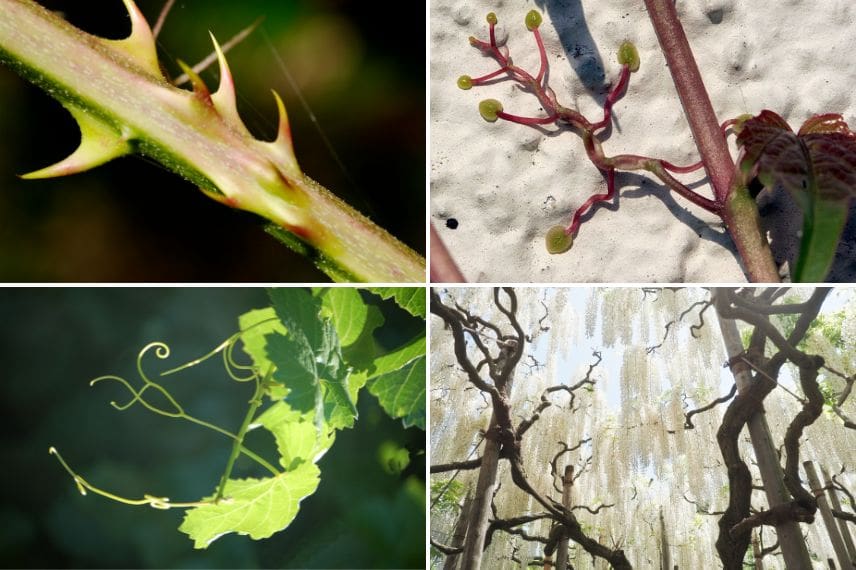 The different types of climbing plant attachments
Depending on the type of climbing plants, the goal is to choose the best support. In this regard, anything is possible in a garden or vegetable patch: cut tree branches (for small peas), wooden stakes or posts, bamboo (tied in a teepee for beans), construction rods, mesh, wooden trellis, metal cables along a wall, a wire cage (for tomatoes)… A garden shed, gutters, a water collection tank, the fencing of a chicken coop, a dead tree… can also be used as supports for climbing plants. The most important thing is to provide a support strong enough for the plant. Thus, a wisteria will not settle for simple wooden battens. Similarly, kiwi (Actinidia) will need a sufficiently sturdy support.
Discover other Climbers
View all →
Available in 0 sizes
Available in 0 sizes

Available in 0 sizes
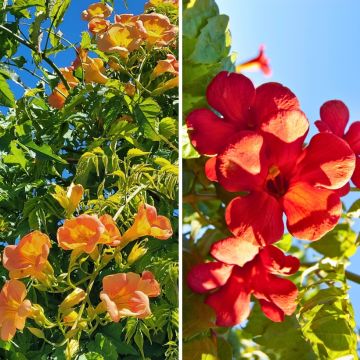
Available in 0 sizes
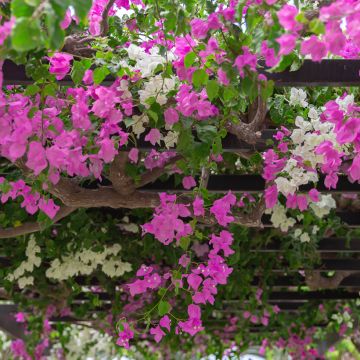
Available in 0 sizes
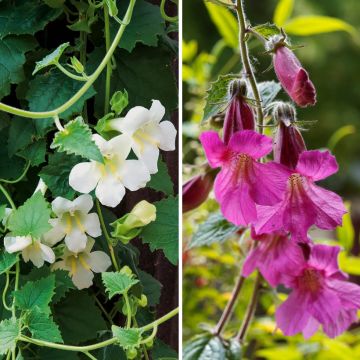
Available in 0 sizes
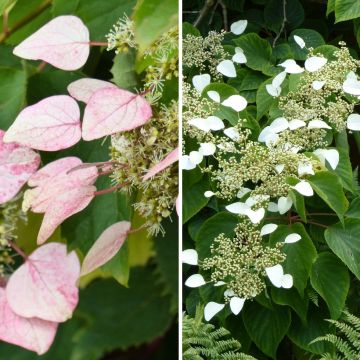
Available in 0 sizes
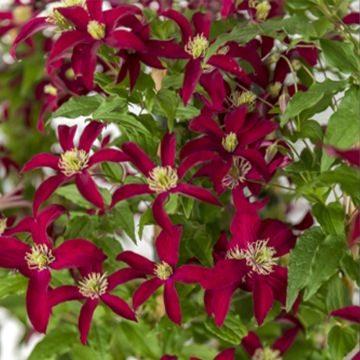
Available in 1 sizes
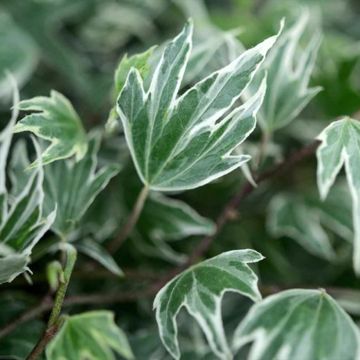
Available in 1 sizes
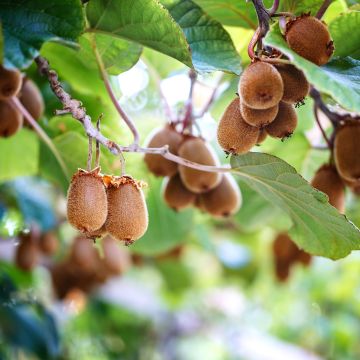
Available in 2 sizes
Which climbing plants in permaculture?
The gardener, inspired by permaculture, immediately turns to climbing edible plants that can find their place in the vegetable garden, but also elsewhere on a plot. In the vegetable garden, cucurbits are champions of climbing. One can thus grow certain squashes, cucumbers, melons, and watermelons if the climate is favourable, as well as climbing beans, whether they are string, snap, or shelling types, Spanish beans that combine utility with pleasure, snap or shelling peas, Chinese yam (Dioscorea batatas), white or red Malabar spinach, Caucasian climbing spinach (Hablitzia tamnoides), chayote… or even the tuberous glycine (Apios americana), widely cultivated in permaculture within the forest garden concept for its elongated tubers.
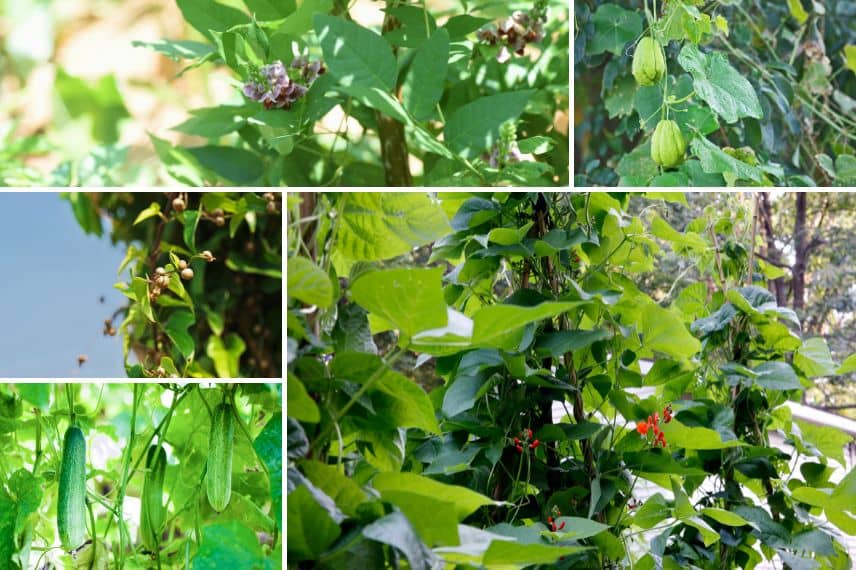
Tuberous glycine (Apios americana), chayote, Chinese yam, cucumber, and Spanish bean
On the side of climbing plants that produce fruits, the choice is vast. One can obviously mention brambles (Rubus fruticosus) that offer blackberries, Actinidias that produce kiwis and hardy kiwis, vines, Passiflora edulis (passion fruit), Schisandra chinensis which produces five-flavour berries, the blue honeysuckle (Lonicera caerulea kamtschatica) that offers May berries, the Chinese blue vine (Holboellia)… One can also plant tuberous nasturtiums for their edible flowers…
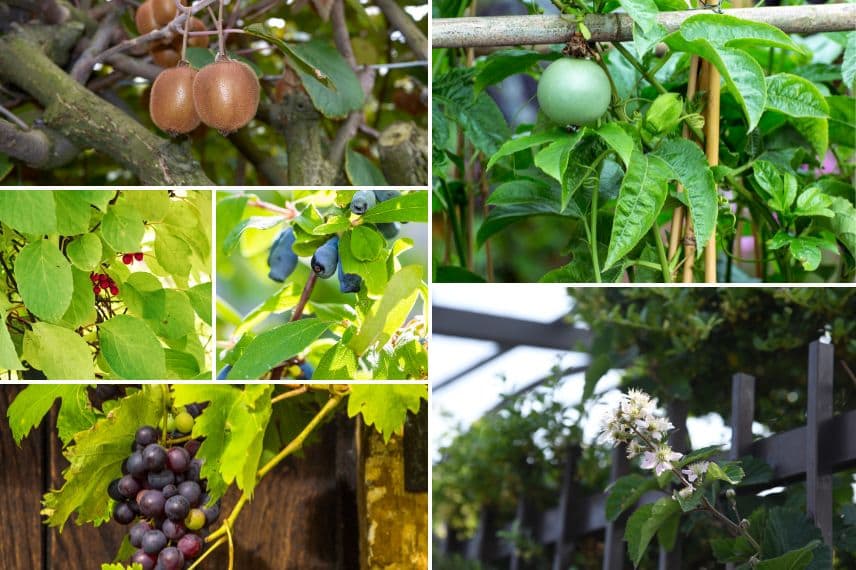
Kiwi, passion fruit from Passiflora edulis, five-flavour berries from Schisandra chinensis, May berries from Lonicera caerulea kamtschatica, vine, and bramble
- Subscribe!
- Contents

Comments