





























Succeeding in Growing Broad Beans
To enjoy its delicious taste
Contents
The broad bean is a legume that has been cultivated since ancient times and is highly valued in many regions of the world. Considered a starchy food, it is most often consumed fresh in France. The broad bean carries an air of mystery regarding its use, remaining somewhat unfamiliar. Should the skin be removed before enjoying it? This is one of the recurring questions. What is particularly interesting about the broad bean, and perhaps this is what confuses people, is that it can be consumed both fresh and dried. Fresh, like peas, after a brief cooking in water. Dried, like chickpeas, after soaking and long cooking. Its flavour is very different in both cases, as are the ways to prepare and accompany it.
Personally, I have vivid memories of the broad bean soup I enjoyed several times for breakfast in Morocco. Made with dried broad beans, it is thick, beige in colour, very creamy, sweet yet robust, with a unique taste, enhanced by a drizzle of olive oil. This hearty breakfast for workers helps to prepare for a day of physical effort, accompanied by mint tea. I later discovered the pleasure of fresh, green broad beans, like young spring vegetables, filled with the first rays of sunshine.
It is not so common on market stalls, or not for long and not at all these stages of consumption. Discover our tips for growing broad beans in the vegetable garden and enjoying them in all their forms.
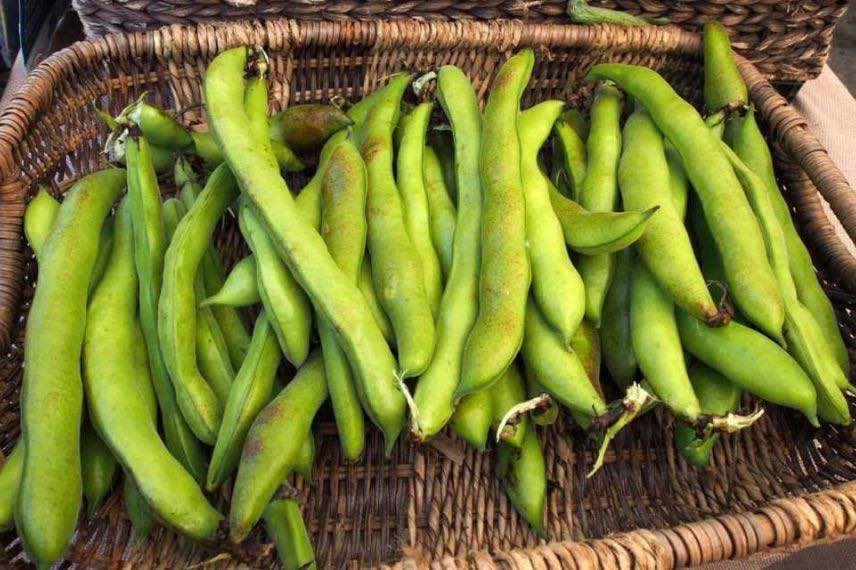
A basket of broad beans after harvest

What is the broad bean?
The broad bean, Vicia faba var. faba, is a legume that appears in spring, alongside green peas, to be consumed fresh from the end of April in the more southern regions. It is one of those vegetables that celebrate renewal after winter, along with the so-called “new vegetables.” As it is a legume, it can also be consumed after drying and rehydration, followed by long cooking.
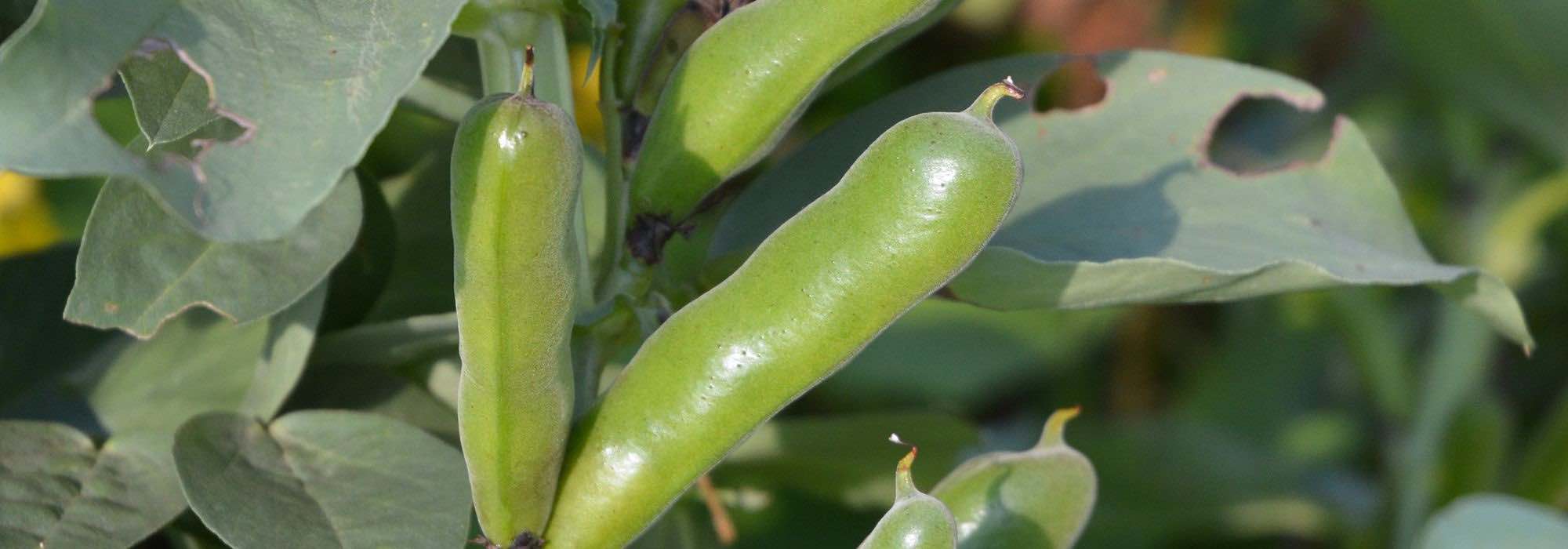
Consumed worldwide, it is native to the Near East. It belongs to the family of Fabaceae and is an annual herbaceous plant. It forms a robust plant with an upright habit, producing stems that can exceed 1 m in height. It blooms with papilionaceous flowers. The fruit is a pod that contains flattened seeds, which are surrounded by a thick skin, the integument. There are many varieties, with pod sizes and seed colours varying from white, green, red to brown.
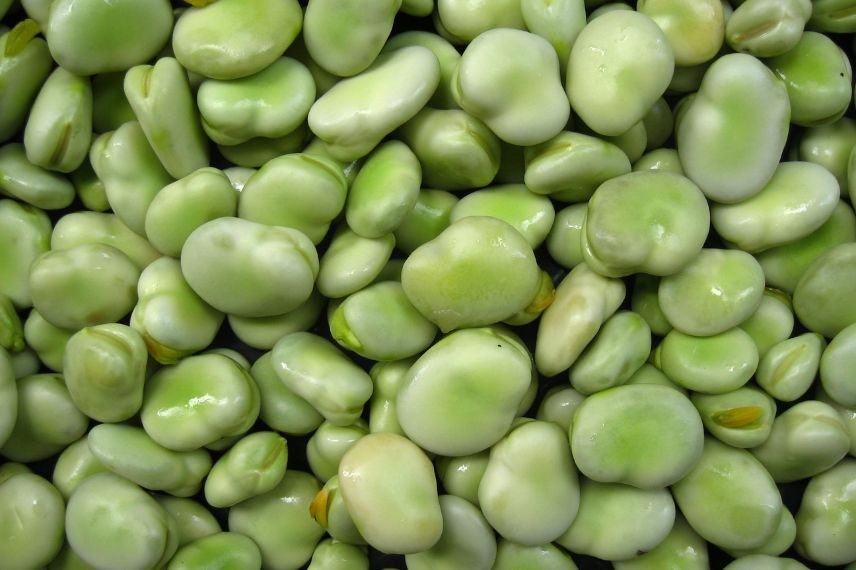
Shelled broad beans with the integument
Read also
Broad bean: to sow, to grow, to harvestWhy grow broad beans?
The broad bean is very interesting to grow for several reasons:
- For the pleasure of consuming them at all stages of their ripeness: very fresh and tender when eaten raw with salt, young, in whole pods, or later, dried.
- Because its cultivation is simple.
- Because it is nutritionally interesting: it is the legume richest in protein, with a content of about 25%. It also contains vitamins C, E, and B, which help the body better assimilate proteins. It is rich in trace elements, iron, and magnesium.
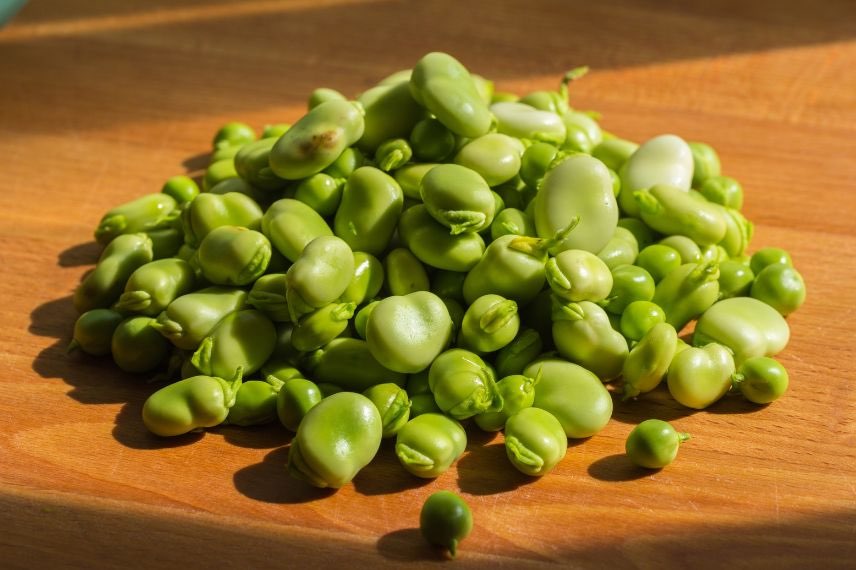
Skinless broad beans, delicious to eat raw or blanched for a few minutes in water
Where to sow?
Growing broad beans is easy if your soil is clayey, deep, moist, and slightly calcareous. They do not like acidic soils. Like all Fabaceae, they are not greedy, so there is no need to provide organic fertilisation.
Choose a sunny location for the broad bean.
Read also
5 good reasons to grow legumesWhen to sow?
Fava bean cultivation is carried out by sowing. This is done at different times depending on the regions. In mild climates, in the South and by the sea, sowing takes place from late October to late November. Under cover, this autumn sowing can be practised in all regions. Harvesting then occurs from mid-May to late June.
For direct sowing in open ground, in colder regions, it is done from early February to May for a harvest from mid-June to late August.
Young fava plants can tolerate negative temperatures down to -5° C, but they cannot withstand several days at -5° C. If frost is forecast, you can shelter them under a tunnel.
How to sow broad beans in the vegetable garden?
- Prepare a flowerbed for sowing by loosening the soil with a broad fork or rake.
- Weed carefully, removing any stones.
- Level with a rake and a hoe.
- Draw furrows 3 to 4 cm deep, spacing them 40 to 50 cm apart.
- Sow in rows, spacing the seeds 5 cm apart, and cover with fine soil.
- Fertilising is unnecessary.
- Firm down and water gently.
- Apply a mulch to retain soil moisture and limit the growth of adventive plants.
Once the seeds are sown, the broad bean begins to germinate at +8° C and above. Germination takes between 8 and 30 days, depending on temperatures.
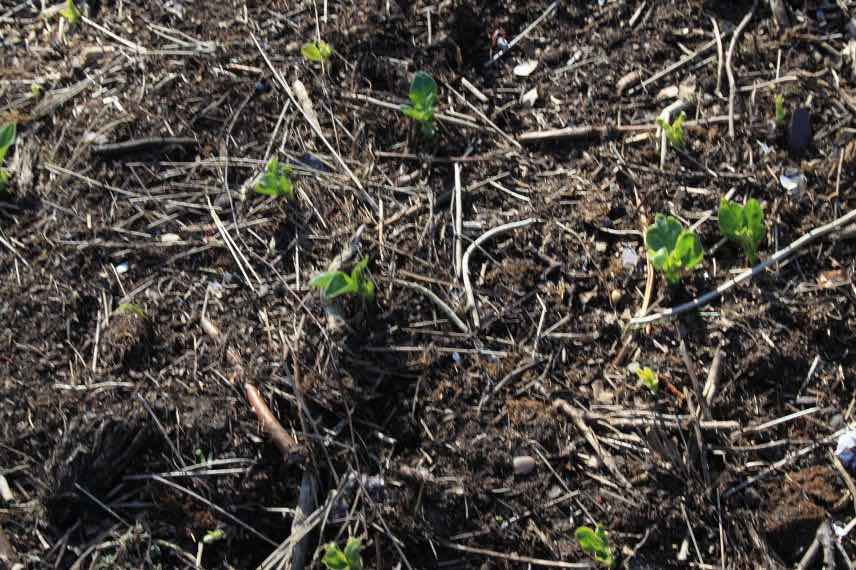
First germination of broad bean seeds in open ground
For an autumn sowing under cover:
- Sow the seeds in trays or pots under cover.
- Cover with a thin layer of potting soil and water.
- When the seedlings have 3 or 4 leaves, transplant them into pots, still under cover.
Transplant the plants into open ground once winter has passed. As mentioned earlier, young plants can withstand a few light and brief frosts. Therefore, you can transplant them quite early in the garden.
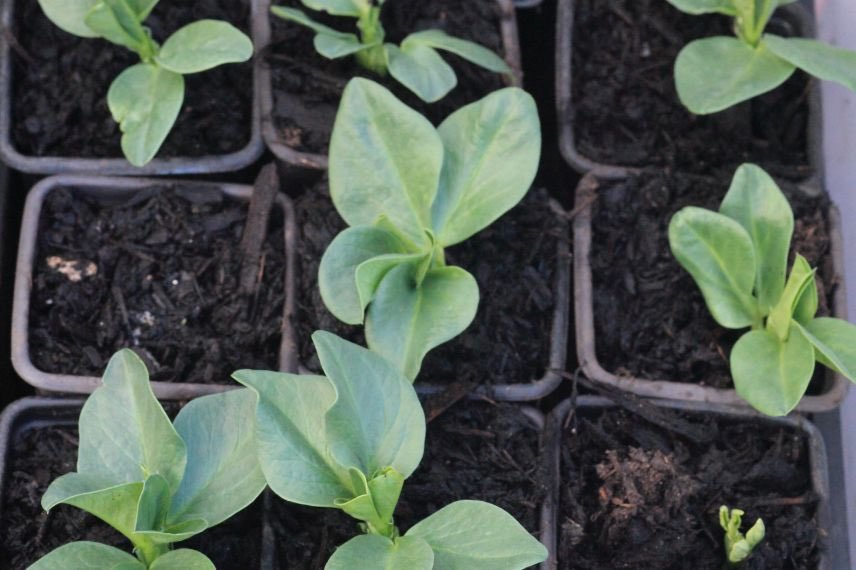
Sowing under cover at the 4-leaf stage
Associations
The broad bean readily associates with lettuces and cabbage, promoting their growth.
The broad bean strongly attracts aphids. To deter them, you can plant phacelia and rocket between the rows of broad beans. Ideally, in a mild climate, sow cultivated rocket in autumn to see it flower in spring. Its nectar will attract many beneficial insects that are useful for repelling the first black aphids from the broad bean.
→ See the chapter on broad bean pests in the “sow, grow and harvest broad beans” guide for everything you need to know about managing aphids.
Maintenance and harvest
For maintenance, as the plants grow, regularly hoe and mound the bases. This encourages the formation of new roots and improves the stability of the elongating plants.
At flowering time, pinch the top of the plant to promote pod formation. This involves pinching between two fingers or using pruning shears or a knife.
If hilling is not sufficient to keep the plant upright, it is necessary to stake the beans. This is done by placing stakes at the ends of the row and intermediate stakes along the row. Tie a string between the stakes to support and keep the plants upright.
Harvesting begins in May for autumn sowings and in June for spring sowings. The harvest occurs at different stages of ripeness, which vary depending on how you wish to consume them. The first stage is that of young, tender pods, which can be eaten whole. The second stage, with larger, firmer pods, allows for the consumption of fresh beans inside the still green pods. Finally, the last stage is the end of ripeness of the pod, which has changed to a light brown colour. The beans inside the pod are dry, depending on the timing of the legumes.
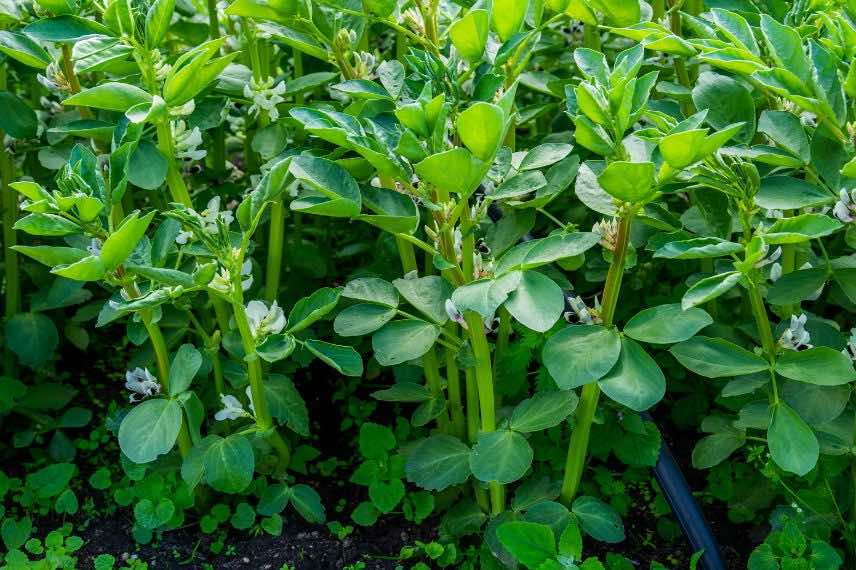
Bean plants in flower
Conservation
Fresh broad beans can be stored for a few days in the vegetable drawer of your refrigerator. You can also successfully freeze them.
Dry broad beans can be stored for at least a year. Once the beans are ripe on the plant, they should be harvested without delay and placed in the freezer for a minimum of 48 hours. It is important to carry out this operation as quickly as possible to stop the larval development of bruchids in the beans. The broad bean weevil, Bruchus rufimanus, is a beetle that completes its larval cycle inside the beans.
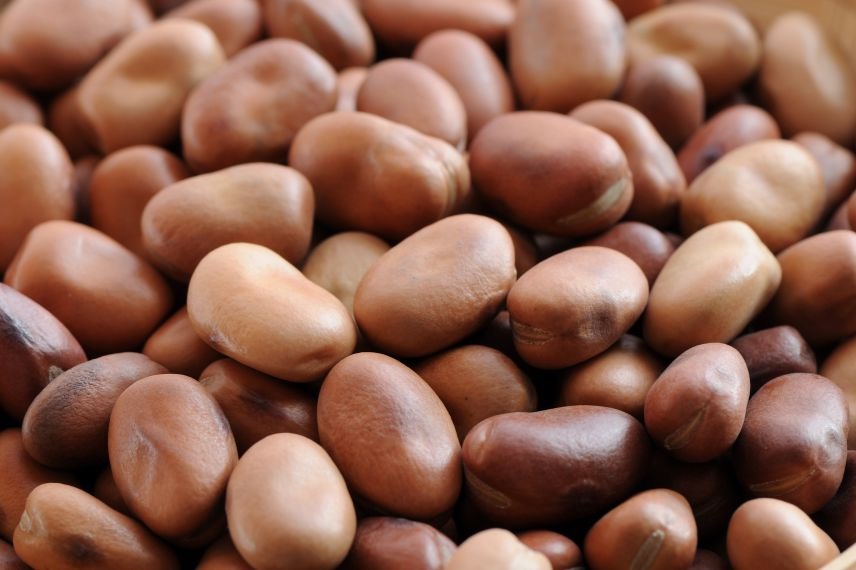
Dry broad beans
How to consume broad beans?
Broad beans can be consumed both raw and cooked.
To prepare broad beans, you first need to shell them and then remove the skin surrounding each seed, the integument. This process is made easier by blanching the beans for a few moments in boiling water.
If you harvest them very young, you may skip the second peeling. You can then enjoy them raw with salt, just like radishes. Generally, you need 1 kg of raw broad beans to obtain 250 g of peeled beans.
To consume dried broad beans, soak them overnight in three times their volume of water, then cook them for 1 hour and 30 minutes. After cooling, peel them before cooking.
There are many recipes, particularly in Middle Eastern cuisine, for preparing dried broad beans. Provençal cuisine, on the other hand, is fond of fresh broad beans. In Morocco, they are also used fresh in tagines.
- Subscribe!
- Contents

Comments