





























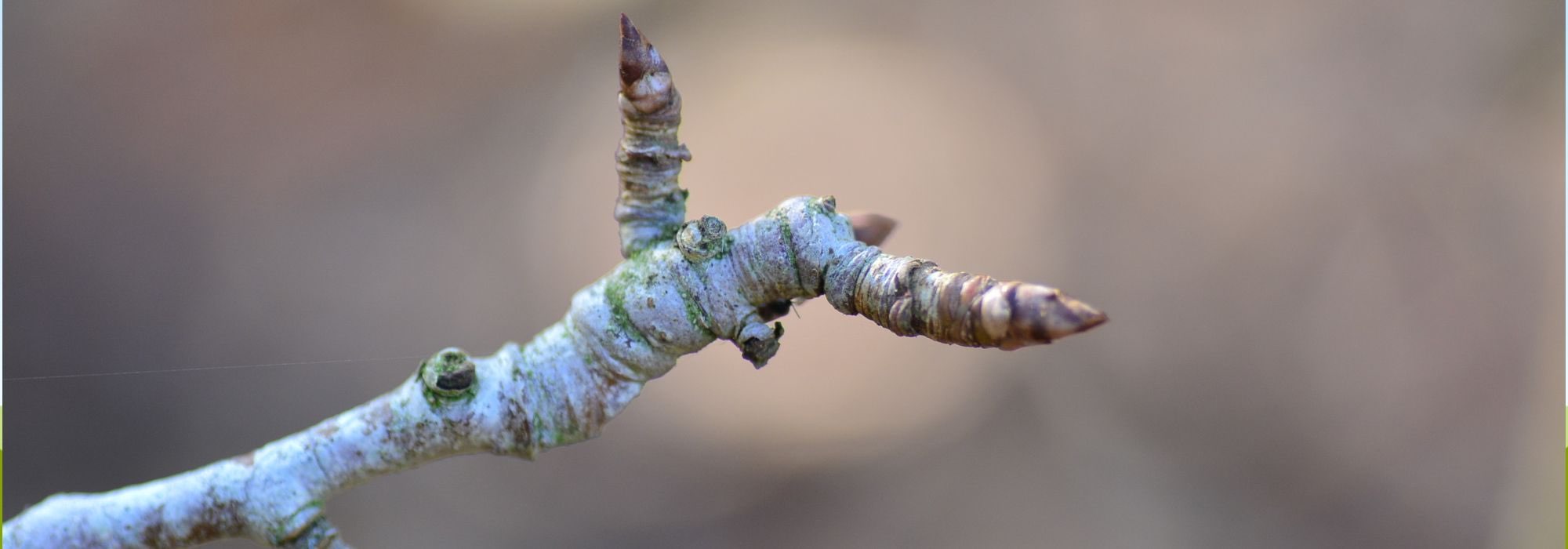
Recognising the different buds and shoots on fruit trees for successful pruning
All you need to know about your fruit trees
Contents
When pruning a fruit tree, it’s best to know its small glossary of various organs, so you can recognise them and thus know which branches to prune. On a fruit tree there are scaffold branches, the main ones that form the tree’s structure, and secondary branches. On these branches grow various organs, some are used for fruiting, others for growth (shoots). It is therefore important to distinguish them to determine whether the tree’s organs are for fruiting or for wood, and prune properly. In pruning practices such as espalier pruning, this is all the more important. As a reminder, fruit buds are initially flower buds. Flowers are the tree’s reproductive organs and contain male and female organs that enable fertilisation and fruit production. Fruits are the organs that contain the tree’s seeds.
By understanding the various shoots and buds of fruit trees, one can better understand how they function and their life cycle. This knowledge is useful for the cultivation and upkeep of these trees.

Some general reminders on pruning
Taking the example of the apple tree: pruning an apple tree is an important step in producing high-quality fruit, achieving homogeneous growth of the tree and preventing the development of diseases.
- If you want to encourage fruiting, it is recommended to remove branches that grow inwards towards the centre of the tree or that cross each other. It is also advisable to open up the centre of the tree to allow air circulation and light penetration. Finally, it is important to shorten the shoots that bore fruit in the previous year, as they are the ones that will bear fruit this year.
- If you want to encourage the tree’s growth, it is recommended to remove the lower branches and the suckers, i.e., the shoots that develop at the base of the tree. It is also advised to shorten the lateral branches to stimulate the growth of the buds located at the base of these branches.
Read also
Fruit trees for beginnersWood-producing organs, consisting of buds intended to produce the tree's growth shoots
Also known as vegetative organs because they are sterile, here are the woody production organs:
The shoot
A shoot on a fruit tree is a small stem that develops from a branch, 10 to 25 cm long, soft and flexible. It ends with a wood eye, that is, a bud, in the form of a very fine brush.
The sucker
A sucker is a vigorous shoot that grows from the stump or from the base of a branch of a fruit tree. Suckers are vertical shoots that grow from the base of a branch. They tend to grow vertically and without branching, on a shiny wood, reaching 50 cm to 2 m if left to grow. Suckers should be removed by cutting them at their base with pruning shears or a lopper.
It is important to remove suckers, as they can weaken the tree by using nutrients and water that the fruit-bearing branches need to provide a plentiful and high-quality harvest. In addition, suckers can make pruning and harvesting of the tree more difficult.
The wood shoot
A wood shoot is a branch from the previous year that did not bear fruit. It is also called growth shoots. It is found installed vertically or horizontally on the training framework. It is generally larger than a fruit shoot and often more woody and thicker. It is exclusively bearing wood eyes.
The wood eye
To finish on the woody production organs, wood eyes or vegetative buds can be identified as small brownish bumps on the tree’s wood, arranged in a tight triangle against the branch. They have a shiny or downy appearance. Wood eyes develop into new growth shoots.
Mixed production organs, with wood organs and fruiting organs
Excepté le dard, mixte, qui peut évoluer dans les deux sens, les autres organes présentés dans ce chapitre sont des organes fructifères, donc fertiles :
The crowned shoot and lambourde
Similar to the shoot, the crowned shoot is, however, terminated by an eye to flowers, more swollen. Practice distinguishing a shoot from a crowned shoot to tell apart a flower eye from a wood eye.
A lambourde, on the other hand, is a kind of crowned shoot very short, as it bears only one flowering eye at its tip. The lambourde is thus similar to a crowned dart (see below), except that it has evolved directly into productive shoots. Unlike the dart which may evolve later into a wood bud or a flower bud.
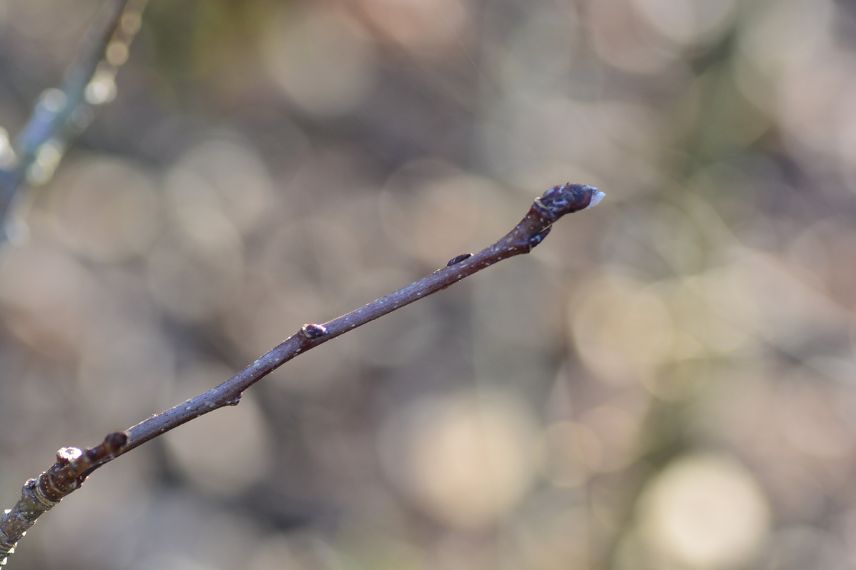
A crowned apple shoot
The dart
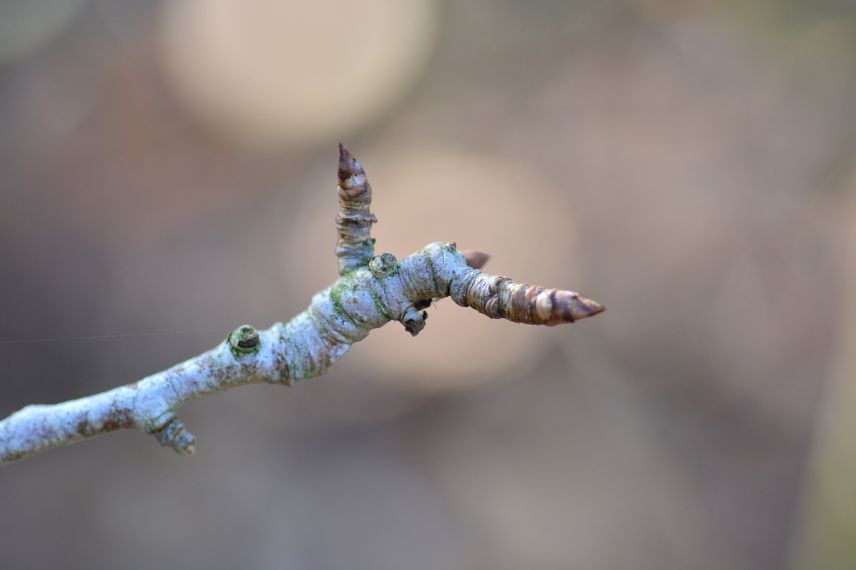
The term “dart” on a stone fruit tree is used to describe a small vertical shoot that grows from a ramification, slightly detached from it. Its tip is protruding and pointed. Intermediary between a wood eye and a fruit eye, its vocation is undecided. It would therefore have its place in both chapters. It can evolve in either direction. If the dart evolves into a flower eye, it will then be called a “crowned dart”.
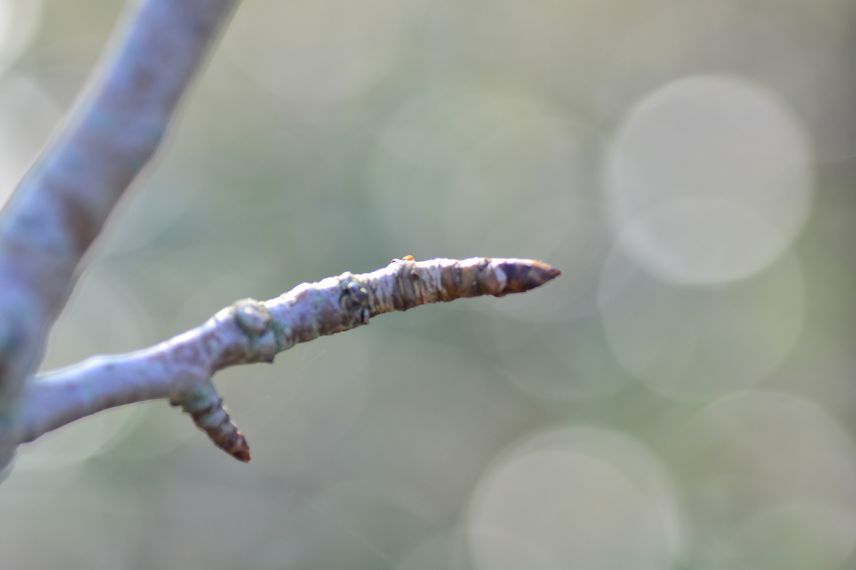
A pear tree dart
The flower eye
Before opening, it is already significantly more rounded than the wood eye, as it contains several flowers waiting to unfold. The flower eyes have a characteristic pine cone shape, with scales that detach to permit the flowers to open in the following spring.
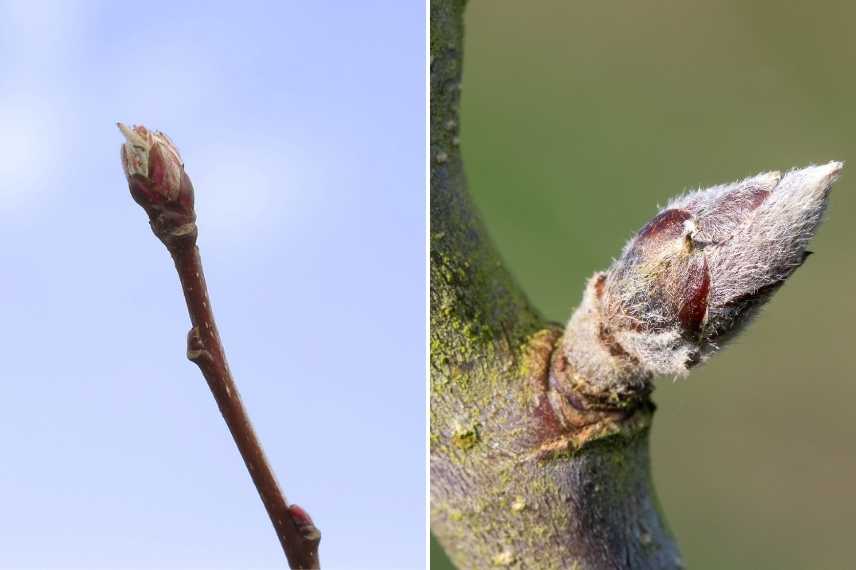
On the left, you can distinguish a terminal flower eye and two wood eyes along the stem. On the right, you can observe a crowned dart, perpendicular to the branch (formerly a dart that evolved into a flower eye).
The pouch
The pouch on a stone fruit tree is an enlargement or widening that forms at the base of the fruit’s pedicel. It is a pocket-like structure that contains the seeds of the fruit, as well as hormones and nutrients necessary for the fruit’s development.
To recognise it, it is a well-swollen organ that bears fruit every year.
The pouch is produced from the floral receptacle, the part of the apple tree that supports the floral parts. After pollination, the floral parts begin to develop and the pouch forms around the fruit’s pedicel. The pouch grows as the fruit develops, and when the fruit is ripe, it detaches easily from the tree.
A pear tree pouch
The spur
For stone fruit trees, it is a fairly short shoot, composed of the organs described above, including flowering buds, more or less numerous, with the exception of the gourmand and the wood ramification. It is therefore the reproductive organ par excellence.
Unlike the wood shoots, which grow more slowly and produce wood for the tree, spur shoots have faster growth and produce flowering buds, which then yield fruit. A spur can bear several types of buds: darts, shoots, pouches or lambourdes.
The chiffonne and the May bouquet
This is a term that you will find on stone fruit trees (cherry, plum, mirabelle, peach…). A chiffonne bears floral buds at its base and vegetative buds at the tip.
Also on stone fruit trees, a May bouquet resembles an extremely short chiffonne, sometimes directly on the trunk or the large branches: a May bouquet gathers floral buds in a cluster and a vegetative bud at the tip.
- Subscribe!
- Contents
Comments