





























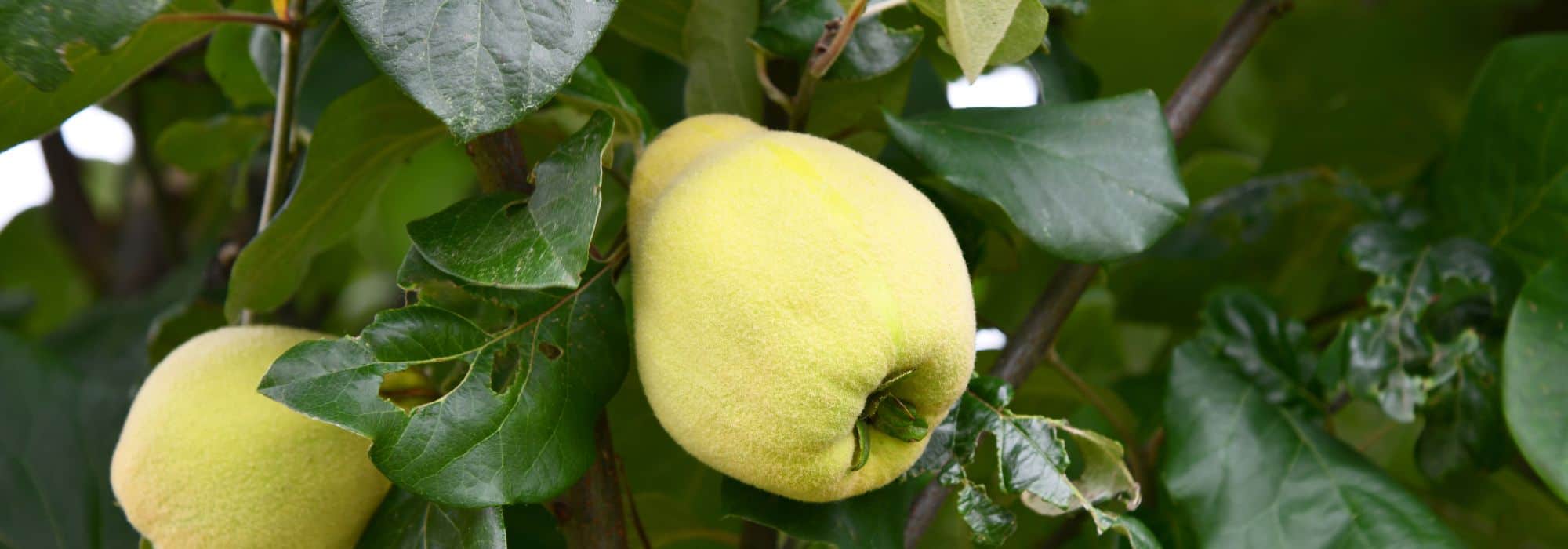
Quince tree: how to choose the right variety?
Our buying guide
Contents
Golden apples or Cydonian pears—two names used to designate quinces, these fruits whose epidermis is yellow and fragrant, edible only when cooked. These terms recall the glorious history of these fruits, offered by Paris to Aphrodite, and revered by the Greeks in Antiquity. Behind this divine fruit lies a self-fertile tree in the Rosaceae family, the quince tree (quince tree (Cydonia oblonga), with a touch of old-fashioned charm, but which certainly deserves a place in gardens and orchards. Easy to grow, the quince tree is an undemanding fruit tree, hardy to frost, not particular about soil, and which does not require any particular pruning. The quince tree is also a very decorative tree throughout the seasons: it opens with a beautiful and abundant spring flowering in a rich pink, before offering, between October and November, handsome fruits in a lovely yellow. As for its foliage, it takes on magnificent autumn colours before falling.
If its ornamental qualities are appreciable, the quince tree is also grown for its fruits, excellent in jams, jellies, fruit pastes, or to accompany a savoury dish. It remains to choose the variety best suited to your cultivation or climatic conditions, your wishes or needs.
Discover our selection of quince trees according to criteria of flavour, productivity, hardiness or storage.

Depending on the shape, size and flavour of the fruit
Raw quince is very hard and has a harsh, very unpleasant flavour. But once cooked, it yields a truly exceptional flavour, elevated in jams, jellies and quince pastes… Adding a few quinces to a simple apple compote is culinary bliss, as the flesh of the quince is fragrant and aromatic. It is also a fruit rich in tannins, fibre and pectin (with strong gelling properties), which confer numerous health benefits. Depending on the varieties, quince fruits take two distinct forms: either they are apple-shaped, i.e., in the shape of apples, hence rather round, or they are pear-shaped, i.e., more elongated.
If you are looking for a quince tree with particularly fragrant and aromatic fruit, the quince tree ‘Champion’ stands out. It indeed yields pear-shaped quinces of very large calibre, capable of reaching 500–600 grams. The quinces of this variety display a very regular shape and an epidermis that is dark yellow on the sun-facing side and lighter yellow on the shaded side. Unribbed and free from down, these fruits stand out for their very fragrant flesh, perfect for making delicious quince pastes. ‘Champion’ is an old variety originating from New Jersey, perfectly acclimatised to our territory, unanimously recognised for the flavour of its fruits.
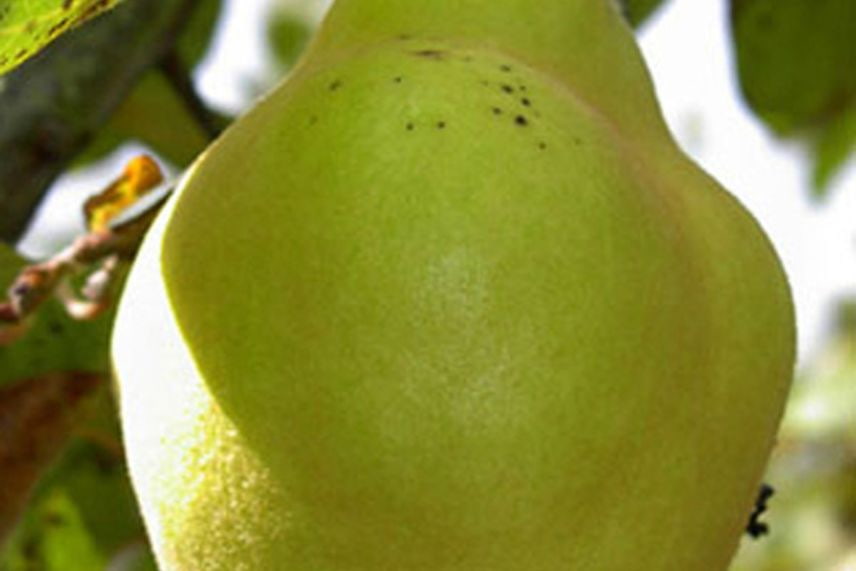
The ‘Champion’ variety yields non-ribbed, large-calibre fruits of excellent flavour
Another quince tree can be chosen for its flavour, the Portugal variety. This variety produces medium-sized fruits, more round than elongated, fairly irregular, ribbed, with flesh of a very fragrant flavour, because less astringent than that of the other varieties, and extremely juicy, fine and delicate. This flesh has a pretty yellow-orange colour.
Finally, a last variety also stands out for its taste: the quince tree ‘Leskovac’. This variety yields fruits of very irregular shape, with a green-yellow downy epidermis. Its flesh is a fairly pale yellow, very juicy, and above all particularly fragrant and sweet. These fruits also stand out for their quite exceptional size, as they can weigh up to 1.5 kg.
Read also
Quince tree: planting, pruning and careAccording to productivity
If the Champion variety is renowned for the remarkable flavour of its fruit, the Vranja variety, also known as the “Giant of Vranja” or “Monstrous of Vranja”, is renowned for the size of its fruit and its productivity. Indeed, from October, this variety yields quinces of very large size, rather elongated in shape, pear-shaped and often irregular. Originating from Serbia, this variety, easily recognisable by its large pendulous leaves, is recognised as very productive. Its quinces, highly aromatic on the tree, have pale yellow flesh, fragrant, with relatively thin skin, which makes peeling easier. Its production is also very regular, but sometimes somewhat heterogeneous since the fruits weigh between 200 g and 800 g.
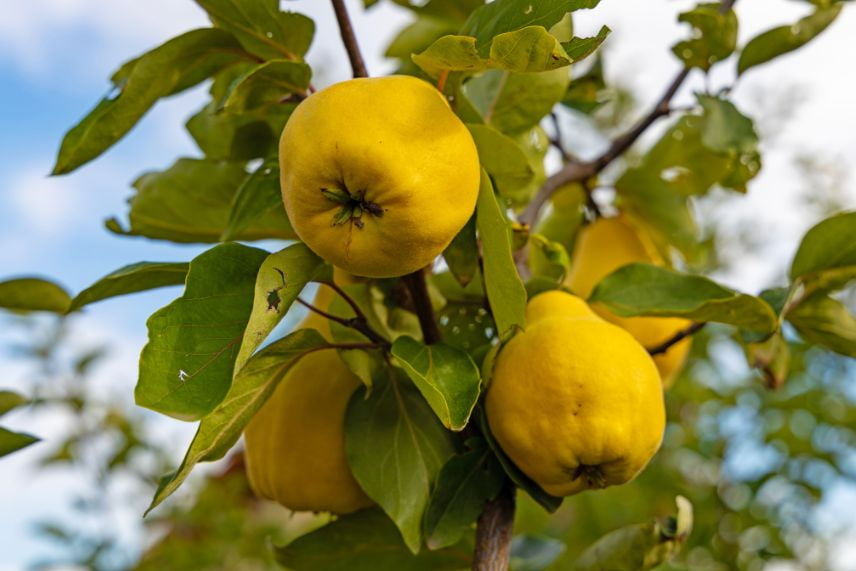
The Vranja variety is known for its excellent productivity
In terms of productivity, one can also highlight ‘Rea’s Mammoth’, an old variety that appeared in the United States around 1900, which yields, in early November, very large round, ribbed quinces, slightly flattened at the base, yellow and fragrant, weighing around 600 g and with a diameter between 8 and 10 cm. Their skin is fairly thick, bearing a handsome golden-yellow hue, covered by a downy film. As for the flesh, it is rather pale yellow.
The ‘Champion’ variety also ranks among the most productive varieties, mainly due to the size of its fruit.
According to the habit and pruning of the quince tree
Originating from the Middle East and the temperate regions of the Caucasus and Iran, the quince tree forms an erect and bushy habit, quite gnarled. At maturity, it will reach 4 to 6 m in height and a spread of 2 to 2.5 m. These dimensions therefore permit planting it in an orchard, at least 4 to 7 m from other fruit trees. Alternatively, it can also be grown as a free hedge, where its colourful and fragrant flowering will be a delight in April–May.
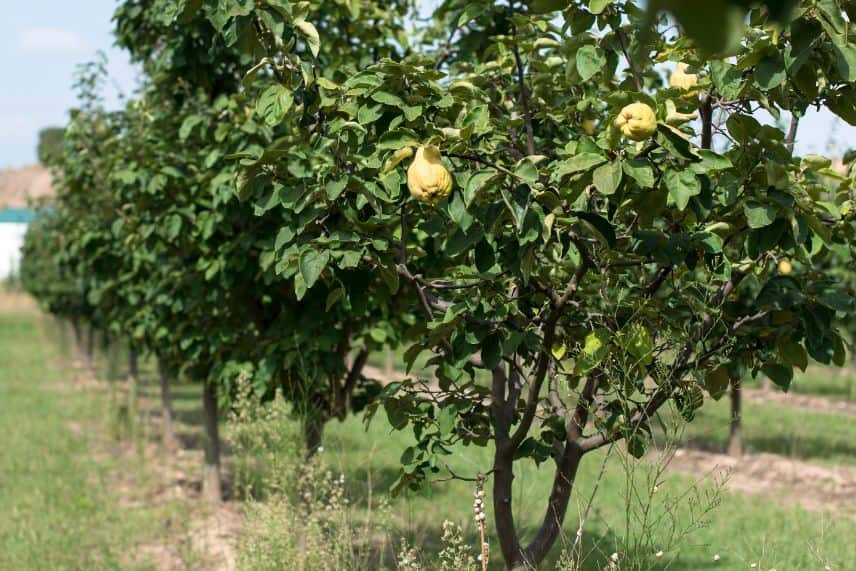 The quince tree has a habit that is rather erect and bushy</caption]
The variety ‘Vranja’ stands out for its very erect habit. At maturity, it will reach a height of 4 m and a width of 2 m, depending on cultural conditions. It is also an easy-to-train variety, ideal for growing on a stem. ‘Champion’ shows roughly the same dimensions at maturity, but a much more spreading habit, with a rounded crown. The variety ‘Rea’s Mammoth’ benefits from a much more spreading habit and smaller leaves. As for ‘Portugal’, it forms a bushy tree, ideal for hedging.
Most quince trees can be trained as a palmette against a wall.
Read also
Diseases and pests of the quince treeAccording to vigour and disease resistance
If you’re looking for a vigorous, healthy quince tree that is highly resistant to disease, two varieties stand out: ‘Portugal’ and ‘Vranja’. ‘Vranja’ indeed forms a powerful, vigorous tree, with long branches bearing pendulous leaves. ‘Portugal’, with its bushy habit, also proves very vigorous as it can reach 7 m in height.
‘Leskovacz’ also displays notable vigour, allowing it to develop multiple trunks and reach a height of 4.50 m and a width of 2.50 m. It is also a variety of particular interest for its resistance to scab, a common fungal disease among fruit trees, notably apples, pears and quince trees. This scab is identified by brown or black spots that appear on the buds, leaves and fruit. This scab affects production, as the fruits deform and fall.
As its name suggests, the variety ‘Robusta’ is characterised by its strong vigour and good resistance to diseases such as fire blight or entomosporiosis while producing large quinces. ‘Aromatnaya’ is likewise.
By contrast, the varieties ‘Champion’ and ‘Rea’s Mammoth’ display medium vigour.
Further reading: Diseases and pests of the quince tree.
According to hardiness
The quince tree is a particularly hardy fruit tree that can withstand temperatures down to -25 °C. That is why it adapts and can be cultivated anywhere in France, provided it is planted in a sunny spot well sheltered from cold winds. In France, the quince tree has become widespread in the south where it particularly enjoys full sun.
Moreover, with its relatively late flowering, generally in April–May, it is less sensitive to spring frosts. Thanks to its precocity, the ‘Portugal’ variety is particularly suited to the south of France. Although hardy, this quince tree flowers quite early in April, which makes its beautiful white corollas washed with pale pink susceptible to late frosts in certain regions. The harvest of fruit also occurs earlier, late September or early October.
On the other hand, ‘Champion’ is a variety with late maturity, finishing late October to early November, which proves extremely hardy.
According to fruit storage
Quinces are autumn fruits, just like apples and pears. Depending on variety and region, harvest occurs between late September and November, generally before frosts. Quinces are harvested at full ripeness. It’s often the shedding of the first fruits that signals the green light for harvest. Specifically, a quince is ripe when it has developed its pretty yellow colour, more or less golden. Similarly, the bloom covering the epidermis to protect the fruit from the cold can be rubbed off quite easily.
Unlike apples and pears, quinces can be stored for up to two months. To keep them longer, it’s best to harvest before they reach ripeness. Too ripe, they rot quite quickly. Likewise, they should be stored on slatted racks in a room kept at 12–14°C, ventilated and dark. Storing on newspaper in a crate is also possible.
All varieties keep well under these conditions, but ‘Rea’s Mammoth’ is the best for storage.
- Subscribe!
- Contents
Comments