





























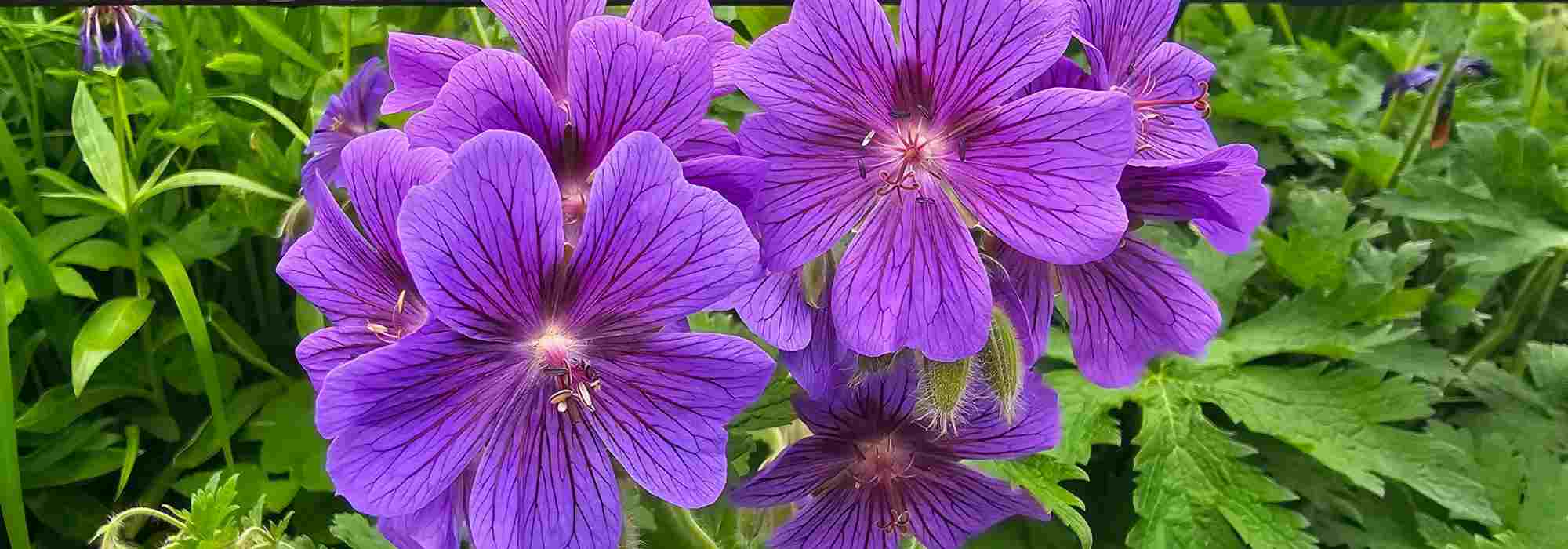
Plants that tolerate both shade and full sun.
Plants highly tolerant of a range of exposures
Contents
It sometimes happens that some gardens or planted areas end up in total shade in winter and in blazing sun in summer. This calls for plants that are completely adaptable and versatile in bright light. They will need to thrive in both summer heat and ample shade in winter.
Which plants, bushes and perennials are therefore perfectly flexible, as comfortable in shade as in full sun? We reveal a few of them.

The challenge of gardens exposed to both shade and sun
We all observe it in midsummer: Some borders, terraces, courtyards or gardens find themselves, with the arrival of summer, in the full heat, enduring strong sun exposure and a thermometer that climbs quickly. By contrast, in winter, these same spaces remain plunged in cold and shade for long weeks.
This contrast is of course explained by the sun’s trajectory, which peaks in the sky during the months of June to August under our European latitudes. The sun’s path is then less hindered, particularly in regions where housing is low, with no upper nival zone as in the south or along the Atlantic, where the built environment ordinarily provides a dense shadow on the flower beds along the house. The presence of evergreen trees such as conifers can also cause winter to cast thick shade in the garden, transforming into a sunlit zone at the summer solstice.
These seasonal variations pose a small challenge for landscaping and maintenance of some highly exposed borders, prompting us to seek plants perfectly adaptable to this wide range of exposures.
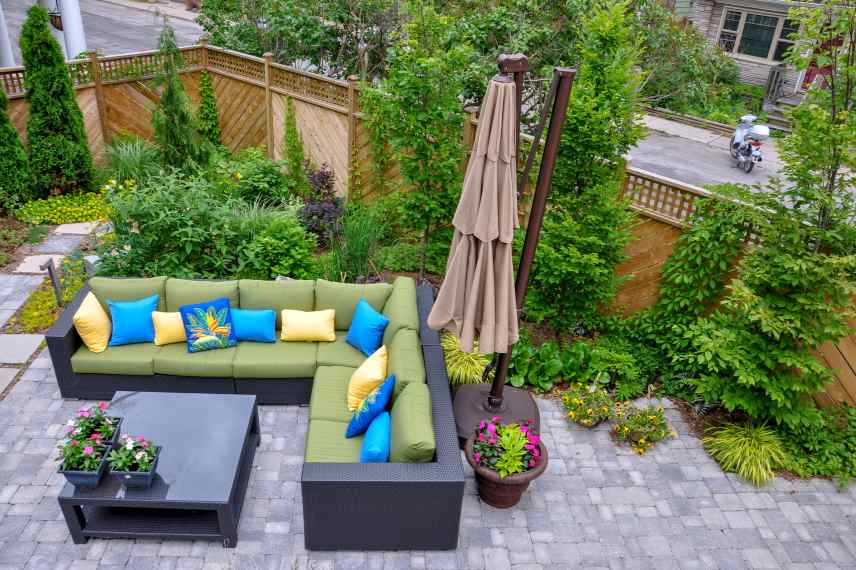
In urban areas in particular, some gardens find themselves in full sun as summer arrives
Conditions for this to work
Adaptability of plants to sun and shade
In gardens that experience extreme variations in exposure, plants able to thrive must be highly adaptable. Their ability to tolerate these conditions often depends on common physiological characteristics, such as thick or waxy leaves, which protect them from both winter cold and summer heat. We therefore often find robust shrubs, with evergreen foliage, or even tough and glossy leaves that perform well in both shade and sun. The waxy cuticle helps to reduce water loss and provides some protection against intense UV rays and drought, as it is in summer that the issue of heat resistance arises.
Among the so-called “soft” plants, the non-woody perennials, the list is shorter, but not to be neglected for the appeal of their flowering, as we will see in the plant selection. Notably, there are some semi-evergreen plants entering dormancy during periods of summer drought. Also those that wake up a little later when semi-shade begins to appear in this shaded area in winter. This is the case, for example, Persicarias.
Note that many of these adaptable plants flower mid-season, in spring or autumn. Solid-colour foliage that thrives in shady exposure is generally much more tolerant of strong light and heat than variegated foliage, which is prone to scorching.
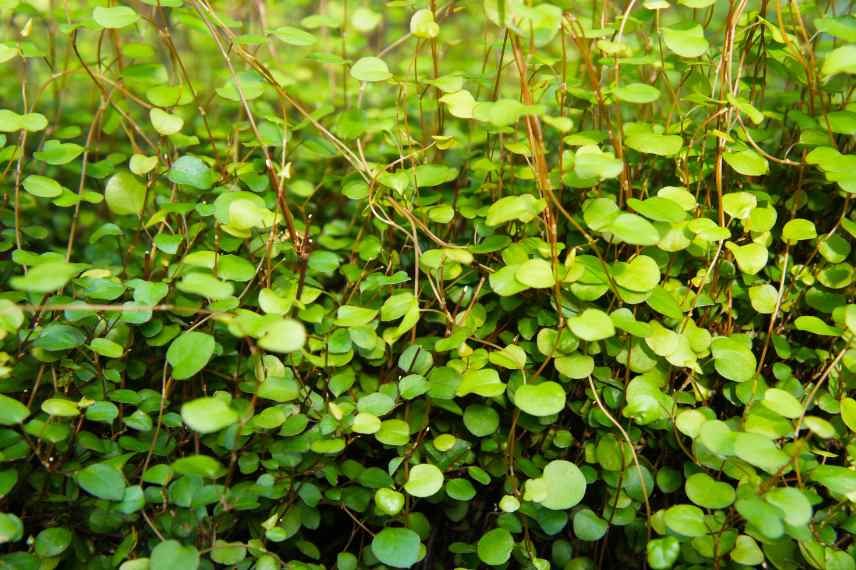
Among the good options are evergreen-leaved plants such as Muehlenbeckia, which always cope well in shade and heat.
Influence of climate and growing region
Bien entendu, une plante ne se comportera pas de la même façon à Marseille qu’à Cherbourg. The amount of sunlight, rainfall and humidity play a significant role in how well the plant will adapt to radically opposing exposure conditions.
Favourable environmental conditions
Pour que ces plantes s’épanouissent aussi bien à l’ombre qu’au soleil, certaines conditions environnementales doivent néanmoins être remplies.
- A soil that stays cool enough in summer is crucial to helping shade-tolerant plants cope better with full sun.
- In hotter climates, it may sometimes be necessary to provide protection against the intense afternoon sun to prevent the more tender leaves of some plants from scorching.
Cultivation and maintenance strategies
Finally, on a terrace or a small urban garden, you could consider a modular container garden to suit your needs. It allows you to protect the most fragile foliage by moving them with the seasons, placing them more in sun or shade as summer arrives. A potted plant that you particularly value in winter in shade could, in the same approach, join a more shaded border in summer to protect it.
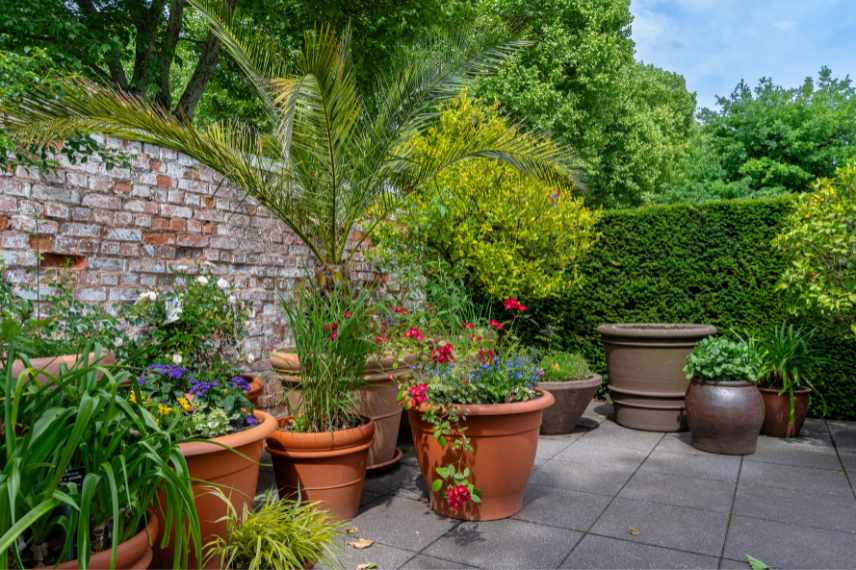 Container gardening remains the solution for small spaces where you can move them easily according to the level of light.
A few examples of plants that thrive in all exposures.
As we’ve just seen, evergreen shrubs and hardy perennials are often the best candidates. We’ll go for the shrubs and perennials which are least demanding in terms of cultivation and exposure.
Here are a few proven plants that will thrive in conditions from extreme sun to almost no sun:
Shrubs
- Pittosporum, small-leaved (Pittosporum tenuifolium), forming masses of lush foliage with an exotic effect, ideal for coastal conditions and mild climates.
- Muehlenbeckia, ideal for creeping as a groundcover or for spilling over a wall or a freestanding planter.
- Lonicera nitida and Lonicera pileata, perfect as topiary or small clipped or free-form hedges, and in rockeries or banks. The variety ‘Ernest Wilson‘ is a fine alternative to boxwood.
- Boxwood, indeed, one of the shrubs most tolerant of exposure conditions.
- Common holly (Ilex aquifolium).
- the St John’s wort, true all-rounders! I recommend the Hypericum inodorum for enjoying their pretty fruiting (but avoid too dense shade in winter).
- The Choisya ternata, choosing the standard species (the ‘Sundance’ scorches easily in sun).
- The spindle trees: Japanese spindle with evergreen foliage or European spindle with deciduous foliage, spectacular in autumn.
- L’ Osmanthus, in particular the Burkwood Osmanthus, with very fragrant flowers in mid‑spring.
- The Aucubas chosen from green and solid-colour varieties, ensuring they receive enough water to avoid water stress in southern regions.
- The Laurustinus, a timeless classic, sometimes misused, to be incorporated into multi-species hedges.
- A further laurel, the bay laurel, the culinary herb, also adaptable.
- Mahonias: Mahonia x medi a, lomariifolia and ‘Wagneri Fireflame’ for example, which will flower a little less in winter in dense shade.
- Winter Jasmine (Jasminum nudiflorum), an adaptable, though it flowers little in winter in shade.
- Skimmia japonica, can be an option in cooler climates, where the sun is not scorching in summer.
- The Cotoneaster, interesting for its red berries that persist for a long time and delight birds in autumn and winter…
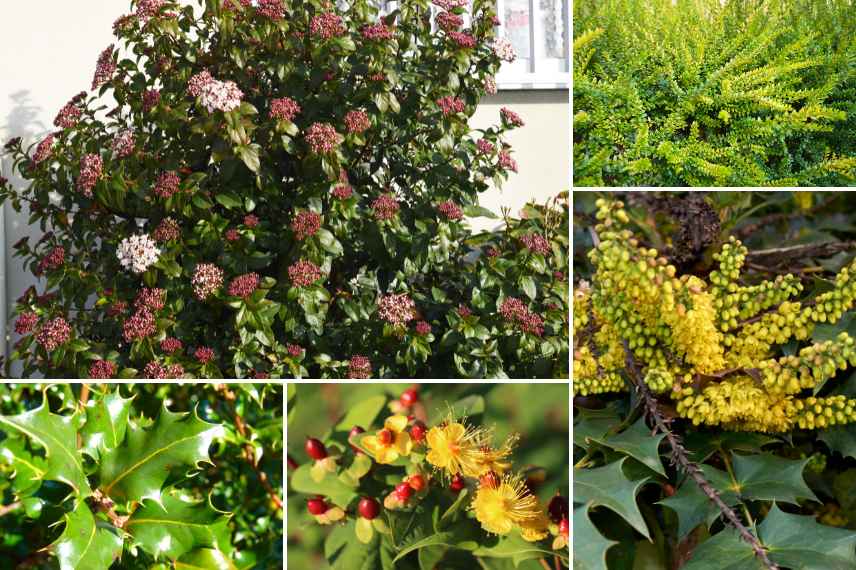
Laurustinus, Lonicera nitida, common holly, St John’s wort and Mahonia
Perennials
Hardy, these pretty perennials will also brave the alternating winter shade and a soil that dries out under the sun in summer, bringing the coolness of their flowering:
- Hardy geraniums whose champions for tolerating sun and shade include the Geranium oxonianum and the Geranium macrorrhizum, but also the Geranium endressii.
- Epimediums, groundcover as lovely for their foliage as for their delicate spring flowers.
- Bergenias, very versatile, tolerating a wide range of light conditions and drought once established.
- Many Persicarias including Persicaria virginiana var. filiformis, or other Persicarias such as affinis and amplexicaulis.
- The Japanese anemones hybrids, such as those in the Swan series (‘Ruffled Swan‘ or ‘Elfin Swan’), which flower for a long time.
- Some hostas among those with light green or yellow foliage, such as ‘Fire Island’ and ideally Hosta plantaginea and ‘Venus‘, fragrant!
- Heucheras purples such as ‘Sloeberry‘ and those with green foliage.
- Astranthas, wonderful spring flowers, also tolerate all exposures, but should have some sun from spring onwards.
- The Lily of the Valley (Convallaria majalis), yes, not always considered, but it goes dormant in summer, tolerating sunny summer conditions.
- Liriopes, which tolerate heat reasonably well if the soil remains cool in summer, such as the cultivar ‘Majestic‘.
- A few ferns such as the German fern (Matteuccia struthiopteris), Dryopteris filix-mas or Osmunda regalis.
- Perenne vincas (Vinca sp.) with blue, white or purple flowers, used as groundcover.
- Acanthus mollis, finally, which will flower less in spring but will also go dormant in summer.
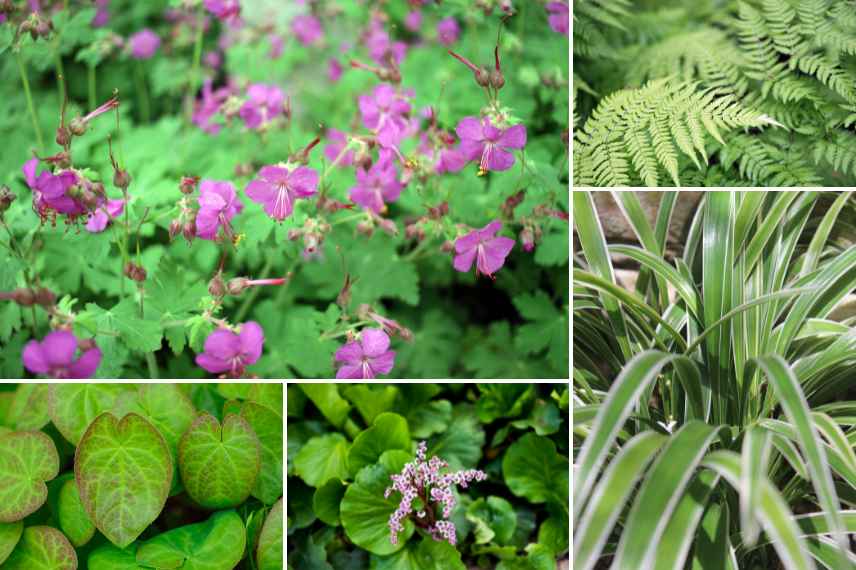
Hardy geranium (here macrorrhizum), Dryopteris, Epimedium, Bergenia and Carex morrowii
Grasses
- Carex, including the very adaptable Carex morrowii or the Carex comans ‘Bronze Form’, but also the hybrids of Carex oshimensis and Carex muskingumensis.
- The Sesleria are other taller, evergreen grasses, also tolerating various exposure conditions.
- Subscribe!
- Contents
Comments