






























Pittosporum for pots: make the best choice!
Compact varieties, cultivation tips and maintenance actions
Contents
Pittosporum are evergreen shrubs, valued for their evergreen foliage, decorative in all seasons. But we also love them for their delicate spring flowering, often fragrant.
They are true trees in their native ranges (New Zealand, Australia, New Caledonia, Japan or China, depending on the species), capable of reaching nearly 20 metres. In our latitudes, they generally top out at 4 to 5 metres. But did you know there are also more compact varieties, such as the Dwarf Pittosporum, which are perfect for small gardens or for growing in pots? Discover their many advantages, the best varieties to choose and how to grow them easily.

Why choosing Pittosporum for a pot?
Pittosporums offer a wealth of decorative assets and display a beautiful diversity. They have an elegant evergreen foliage, shiny and dense, which brightens the space year-round, even in winter. This foliage comes in several forms and colours, ranging from the classic green to variegated foliage, including more unusual colours, such as purple.
Next, they reward us with a pretty spring flowering in bell-shaped clusters between May and June, which can be white, yellow or even purple. Most give off strong notes of orange blossom or honey, very pleasant to smell. The flowers are also appreciated by pollinators.
Easy to grow, this bush tolerates pruning well, which allows better control of its growth and even to train it into topiary. It also tolerates sea spray (perfect for coastal gardens) and drought (ideal for a dry garden).
Small varieties, not exceeding 2 metres in height, can be integrated into the tightest spaces: balcony, patio, terrace or small town garden. They will help to green the space as well as to delineate areas or to screen from neighbours.
Pittosporums are plants suited to a mild climate, which enjoy sunny positions. Their only drawback? They are generally only hardy to around -7°C. But The option of growing them in pots allows them to be wintered over easily in regions with harsh winters.
The best Pittosporum varieties for pots
As discussed, Pittosporums offer varieties that differ in habit, foliage or flowering.
Very compact dwarf Pittosporums
If you’re looking for truly compact dwarf Pittosporums that don’t take up much space, opt for the Pittosporum tenuifolium ‘Golf ball’, with small, round, leathery leaves. It stays under 80 cm across, which makes it a real ball-shaped plant easy to place anywhere.
Also consider ‘Midget’, equally small and forming a dense shrub, a perfect alternative to boxwood.
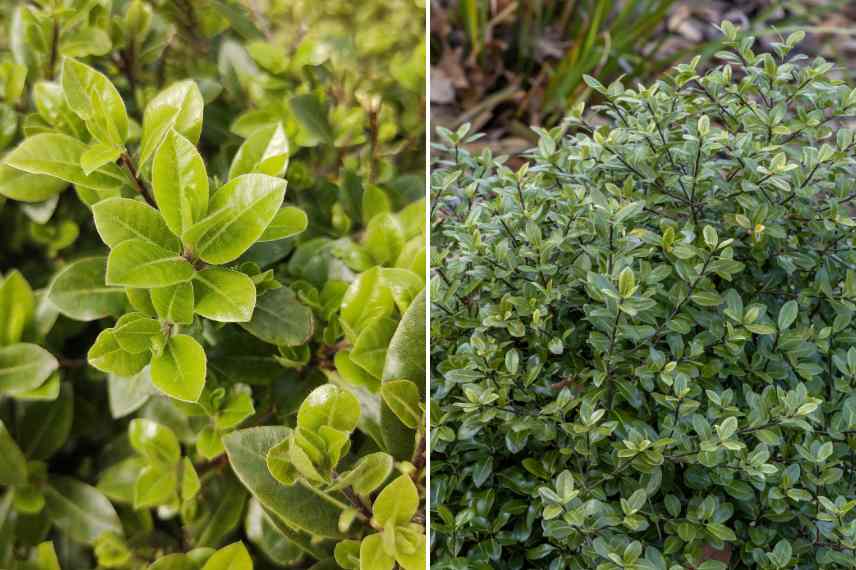
Pittosporum tenuifolium ‘Midget’ on the left and ‘Golf Ball’ on the right
Pittosporums for pots with coloured foliage
The Pittosporum tobira or Japanese pittosporums stand out for their longer, very bright green leaves. But they can occasionally be variegated, as in the dwarf variety ‘Neige du mont Ventoux’. It does not exceed 1 metre across and bears foliage green margined with cream, then white.
For more colourful foliage, head toward the Pittosporum tenuifolium or small-leaved pittosporums, very round and leathery leaves. They originate from New Zealand, Australia and New Caledonia. This is the case with ‘Silver Ball’ (also 80 cm across), which produces glossy leaves in a green-grey shade margined with white.
The variety ‘Irene Patterson’ is a touch taller (1.5 metres tall by 1 metre wide) and displays foliage almost silvery, speckled with white and pale almond green, sometimes with hints of pink. A Pittosporum ideal for brightening small spaces, and perfect for container growing.
For its part, the aptly named ‘Golden Ball’ indeed forms a ball-shaped shrub almost golden, with foliage naturally yellow margined with green. Plan for about 80 cm across.
Very original, ‘Bannow Bay’ opts for foliage that changes with the seasons. In spring, it first shows green margins with white. The leaves then acquire pink splashes, before turning to purple. This variety, never dull, reaches 80 cm in height with a spread of 1 metre at maturity.
Let’s not forget the Pittosporum tenuifolium ‘Tom Thumb’, with handsome undulate foliage turning bronze-purple with metallic sheen.
A little more imposing (2 metres tall by 1 metre across), the cultivar ‘Elisabeth’ will light up the area with foliage variegated with cream-pink margins, turning to pink-red in winter. It will look very striking in a pretty planter or a large container.
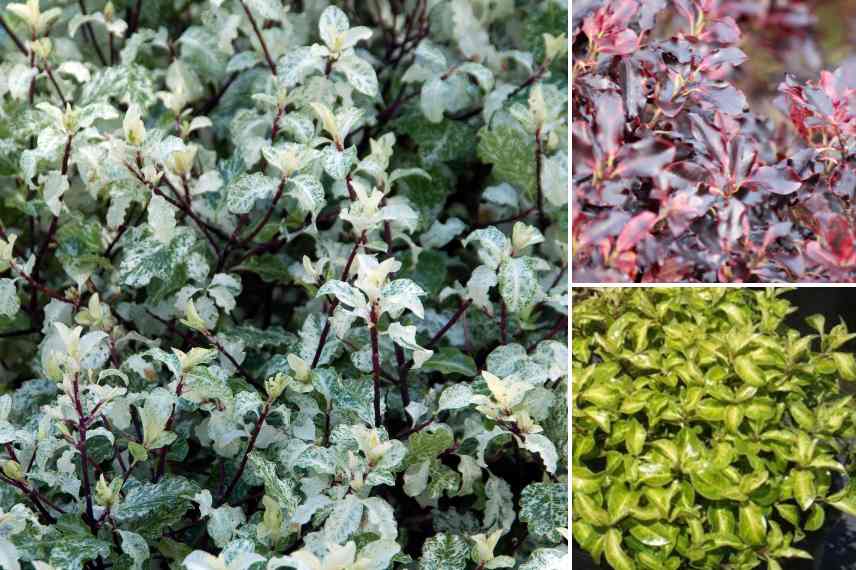
Pittosporum ‘Irene Patterson’, ‘Tom Thumb’ and ‘Golden Ball’
Pittosporums for pots with well‑scented flowering
Some Pittosporums also reward us with flowering that perfumes the space and will benefit from being placed near areas of foot traffic.
Among them, include Pittosporum tobira Nanum for its very fragrant white bell-shaped flowers, which exhale intense notes of orange blossoms, and the ‘Midget’, which also stands out with flowering that exudes delicious notes of vanilla and honey, especially in the evening. This is likewise the case with ‘Silver Ball’.
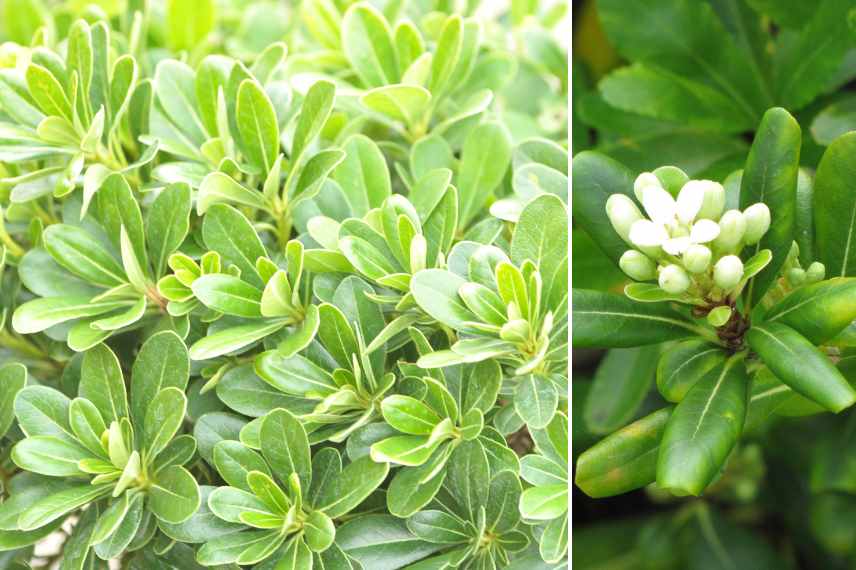
The dwarf version of Pittosporum tobira: undeniably the most fragrant of them all!
Very hardy Pittosporums for pots
If you’re looking for one of the hardiest potted Pittosporums, opt for ‘Golf Ball’ or ‘Golden Ball’, which can withstand frosts down to around -10°C. They will, however, need to be planted in well-drained soil (where water does not stagnate) and in a sheltered spot away from prevailing winds. On the other hand, avoid varieties such as ‘Nanum’, which do not tolerate frosts above -6°C. Remember that hardiness of plants is more limited when grown in pots.
How to grow Pittosporum in a pot?
To grow your Pittosporum in a pot, choose a container at least 60 cm deep or an orangery-style tub. It must be perforated, as the bush cannot tolerate waterlogging.
For the soil (the soil in which it will grow), Choose a potting mix for container plants or mix garden soil with coarse sand. Install a drainage layer at the bottom of the pot (gravel bed or clay balls).
Planting should ideally take place in spring.
Place your Pittosporum in a pot in a sunny position, or in semi-shade in hot southern regions of the south, but always sheltered from cold winds. If placed near walkways, you will enjoy the fragrance of the flowering even more.
To learn all the planting steps, don’t hesitate to read our article “Growing a Pittosporum in a Pot”.
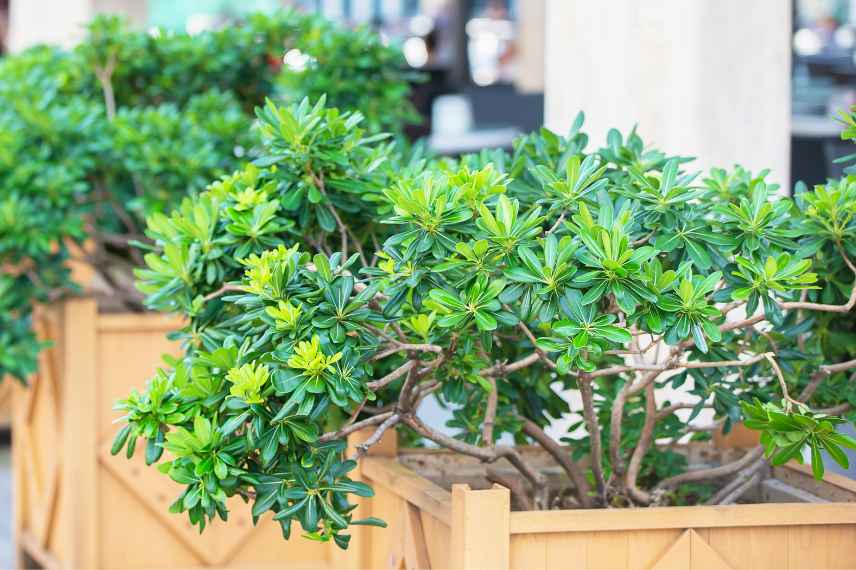
The Pittosporum tobira can certainly be grown in a large pot, or here in an orangery-style crate
Read also
How to choose your Pittosporum ?Caring for Pittosporum in pots
Pittosporum is not very demanding. Water as soon as the top few centimetres of the substrate are dry.
In spring and summer, you can apply liquid or solid fertilisers to promote the health of your Pittosporum’s foliage.
Even though the bush tolerates poor soils, the substrate quickly depletes its nutrient reserves when grown in a pot.
Repotting is carried out on average every three years, into a larger container.
To prune your Pittosporum and help it maintain a harmonious shape, wait until the end of flowering.
Outside regions with mild winters, potted Pittosporum should be overwintered in a bright, frost-free place.
- Subscribe!
- Contents
Comments