





























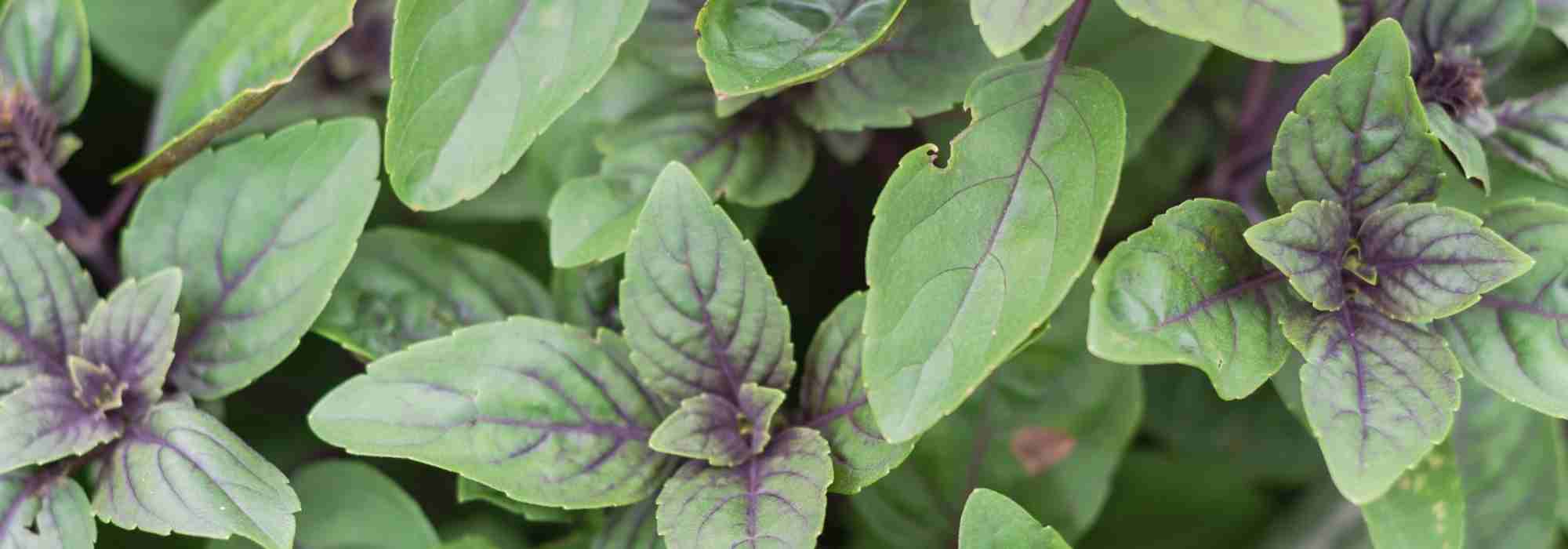
Perennial basil: a sustainable alternative to common basil
Everything you need to know about growing perennial basil
Contents
A summer without tomatoes (from the garden), basil and mozzarella is not a proper summer! Basil (Ocimum basilicum), an aromatic herb emblematic of gardens and cuisines around the world, is valued for its intense aroma and delicate flavour, and is an essential part of the kitchen garden. But once the summer ends, the basil dies. In fact, common basil is an annual plant that disappears at the first frosts. Yet, there is an alternative for those who want a longer-lasting basil: perennial basil (Ocimum kilimandscharicum), also known as perpetual basil. This latter offers greater hardiness and a longer harvest period, making it an attractive choice for gardeners keen to grow aromatics all year round.
Discover how to plant, grow and care for this perennial basil which flavour differs slightly from common basil.

What exactly is this perennial basil?
As its name suggests, perennial basil is a perennial plant, aromatic, culinary and ornamental. This basil, a member of the Lamiaceae family like its cousin the common basil (Ocimum basilicum), has several species, varieties and hybrids. However, the most widespread of them all is certainly the Kenya basil (Ocimum kilimandscharicum) with its ‘Magic Mountain’ variety, which takes the form of a small bush, 70–100 cm tall, with a bushy, dense habit. Very decorative, this perennial basil offers green leaves veined with violet with peppery and camphoraceous notes. This basil also flowers abundantly in small spikes consisting of bilabiate pink or mauve flowers that bloom from July to September. The flowers of perennial basil, highly melliferous, attract swarms of foraging insects. It is therefore a plant beneficial to biodiversity, as it attracts pollinating insects. Moreover, its scent also repels mosquitoes and flies.
Ocimum fragrantissimum ‘Selloi’ is likewise a perennial basil, with a basil flavour heightened by a hint of anise. It also forms a small bush with well-branched stems. Its broad foliage bears a very fresh green. As for the Russian perennial basil, it offers dark green foliage that is highly aromatic with a peppery flavour.
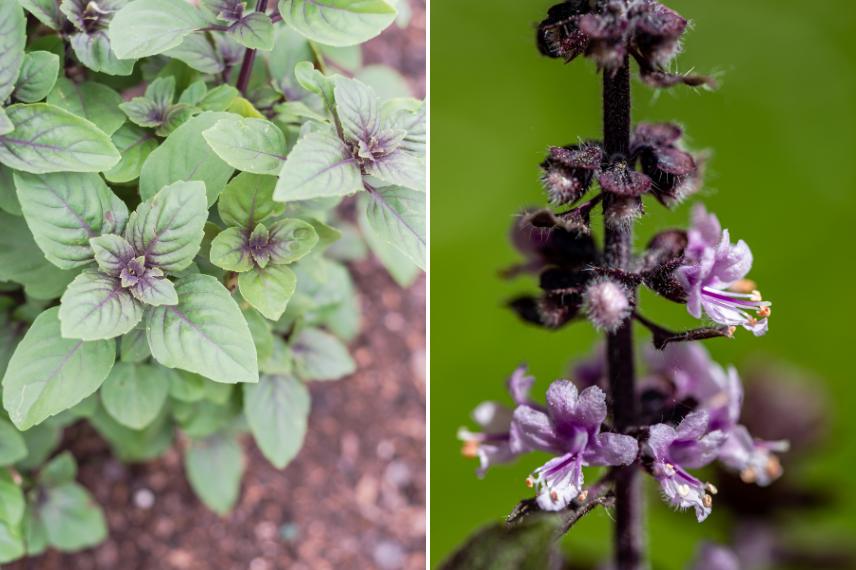
Leaves and flowers of perennial basil
These various species and varieties of perennial basil benefit from deciduous foliage that disappears in winter but re-emerges in spring. Hardy down to -5°C, they can be grown in the open ground in regions with a very mild climate. Elsewhere, they adapt perfectly well to pot planting to be brought indoors in winter.
Read also
Basil: sowing, planting, growingWhen to sow or plant perennial basil?
Perennial basil forms a fairly dense clump of foliage, in a bright green hue, often quite vivid, supported by upright stems. As it is relatively frost-prone, it is best to grow it in a pot to keep it for many years. Ground-planting can be considered around the Mediterranean rim, particularly along the Côte d’Azur, and even on the Atlantic coast at a well-sheltered site, as it is hardy down to about -5°C.
Basil is available as seed, plug plants and plants offered in pots.
When to sow perennial basil?
Perennial basil seeds are sown in warmth in April or May. A conservatory is ideal, but sowing can also take place near a window. An ambient temperature of 20°C is required for the seeds to germinate in around two weeks.
When to plant perennial basil?
It is necessary to wait until the risk of late spring frosts has completely passed before planting perennial basil, which is sold in pots or plug plants. Planting in April or May is ideal depending on the region, but planting can continue until June.
How to sow or plant perennial basil?
Sowing the seeds
Sowing basil seeds in warmth is done in seed pots, seed trays or sowing plates, or any other recycled container (cut plastic bottles, egg boxes…)
- Fill the container with a seed-starting compost
- Sow the seeds, spacing them a few centimetres apart
- Cover with a thin layer of seed compost about 3 mm thick
- Water with a fine spray using a spray bottle
- Optionally cover with a plastic bag or glass lid to maintain some humidity and warmth to encourage germination.
Seedlings must be kept consistently moist, not too damp or waterlogged. They should be kept at a minimum of 20°C, but must not be placed in direct sunlight. Regularly air them by lifting the lid or the plastic bag. Expect two to three weeks for the seeds to germinate.
When perennial basil plants have three true leaves (excluding cotyledons), they should be transplanted into individual pots filled with seed compost. It is essential to acclimatise them by placing them outdoors in daylight to partial shade.
When they reach at least 10 cm and have 4–6 leaves, they will be transplanted into the ground in regions with a very mild climate, or more likely into pots.
Planting the basil plants in pots
- Choose a terracotta pot at least 30 cm in diameter
- Place a layer of clay balls or pouzzolane at the bottom of the pot
- Fill the pot with a vegetable potting compost, mixed with a little compost, or a mix of one-third garden soil, one-third compost and one-third sand
- Transplant the perennial basil and firm in with the substrate
- Water gently with a spray bottle, taking care not to wet the foliage.
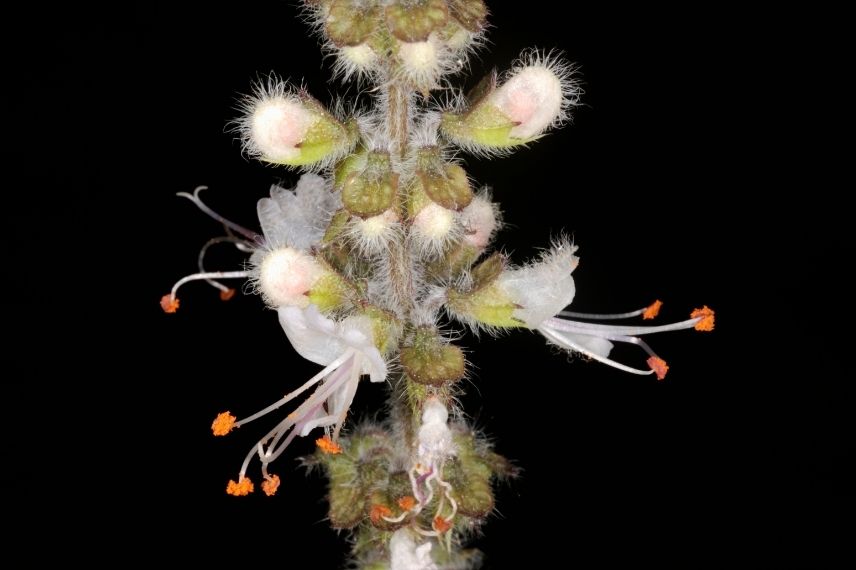
The pretty flower of perennial basil
Planting the perennial basil plants in the ground
Pour rappel, planting perennial basil in the ground is possible only in regions with a mild climate. In other regions with less forgiving weather, it is also feasible to plant your plant outdoors for the entire growing season, then transplant it into a pot before the first frosts to overwinter indoors. In the ground, perennial basil needs fertile, fairly cool and well-drained soil.
- Lightly work the soil to loosen it
- Carefully remove weeds and stones
- Add well-decomposed compost
- Dig a hole twice as large as the pot
- Place a little sand at the bottom of the hole to ensure drainage
- Set the root ball in place and fill the hole
- Water generously with rainwater at room temperature.
Read also
Choosing basil: our buyer's guideWhere to plant perennial basil?
To obtain a lush clump of foliage, perennial basil needs sun and warmth. That’s why, whether grown in a pot or in the ground, it should be in full sun.
However, where the sun can be scorching, or in very hot weather, it is preferable to place it in partial shade.
The perennial basil should also be situated in a spot reasonably sheltered from the cold.
With its pretty foliage and abundant flowering, perennial basil can be planted in a border of perennials where it will not be out of place.
A planting in the vegetable garden is well worth considering, as perennial basil is repellent and helps deter flies.
It can also be planted on the terrace to deter mosquitoes.
What care does vigorous perennial basil require?
Basil is relatively low-maintenance and requires little upkeep. That said, a few essential steps help it achieve excellent growth:
- Rainwater watering should be regular during the warm season, at a rate of two to three times per week, ensuring any residual water is removed. The substrate should be moist but not waterlogged. In the ground, watering will be somewhat more spaced out. From the first frosts, perennial basil should be over-wintered. However, watering should continue once a week throughout winter.
- To increase the vigour of the basil young plant and achieve compact growth, it is recommended to pinch a few stems. Flowers can be removed, but this is facultative. Indeed, unlike common basil, perennial basil continues to produce leaves even in flowering.
- In spring, a compost application is feasible to stimulate the recovery of the perennial basil young plant.
- From October onwards, over-winter the perennial basil grown in pots in a veranda or a cold greenhouse where it will receive sufficient light. In regions where frosts are non-existent or light, perennial basil can stay in the ground. It can still be protected by a winter fleece.
Harvesting basil leaves: when and how?
Perennial basil is harvested as needed, taking care never to cut more than a third of the plant to avoid weakening it.
- When to harvest? As soon as the plant reaches a sufficient size, generally a few weeks after planting. It is recommended to harvest the leaves in the morning, as they contain more aromatic compounds.
- How to harvest? Snip the leaves and the young stems with clean scissors, cutting just above a leaf node to encourage branching.
Leaves should be used promptly. But it is perfectly possible to freeze them, whole or chopped, in ice cube trays filled with water or oil. They can also be dried in the shade and in the open air. They will then be stored in an airtight jar.
- Subscribe!
- Contents
Comments