





























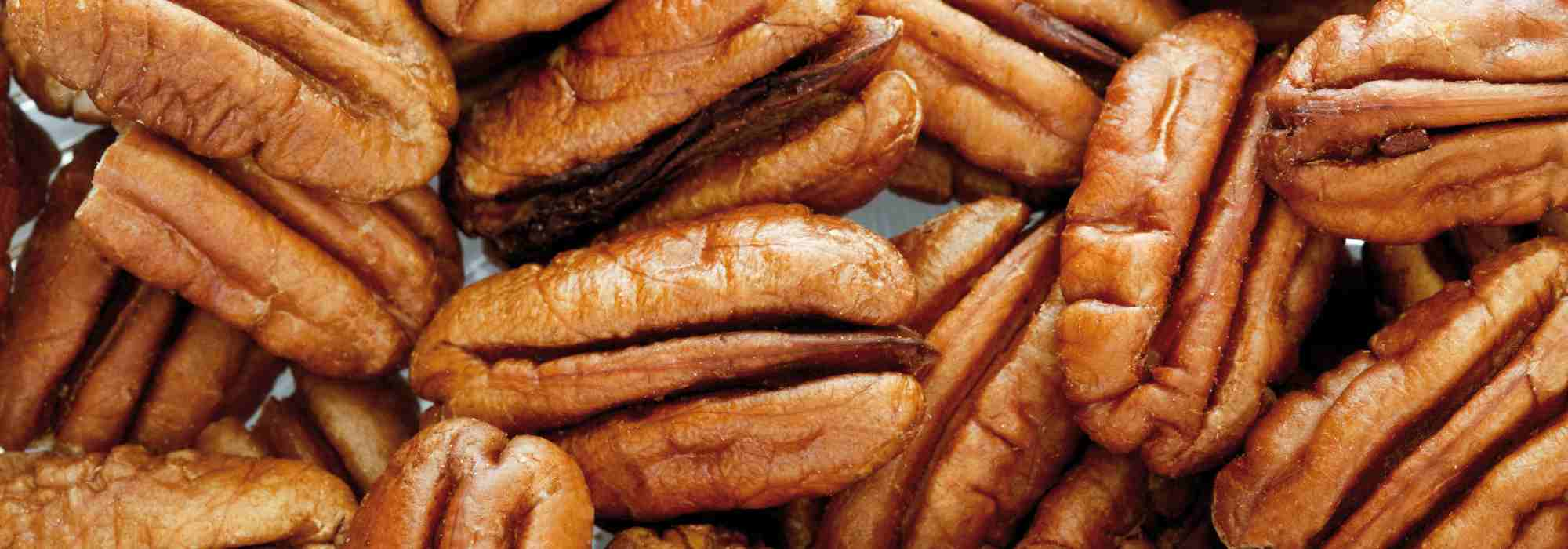
Pecan tree: the best varieties
The top 5 best pecan trees
Contents
The pecan tree (Carya illinoinensis) is the fruit tree that produces the subtle and delicious pecans, these nuts with a flavour close to walnut and almond, with less bitterness. It is a large tree that can reach 20 to 40 metres in height, but there are more compact varieties suited to small gardens. Although hardy to -15°C, the pecan tree requires warm and long summers and will only bear fruit in the south of France. It should be planted in full sun, in neutral to slightly acidic soil that is sufficiently moist. With attractive green foliage that turns golden in autumn and a spring flowering of long pendulous aments, yellow-green, it can be cultivated as well as an ornamental tree and a fruit tree. If the aim is to obtain fruit, we recommend planting two trees to achieve a better harvest, in which case a sufficiently large garden is advisable!
We present here five varieties among the finest, reliable for their foliage and spectacular flowering, their growth, productivity, the size of the nuts, early maturity and disease resistance.
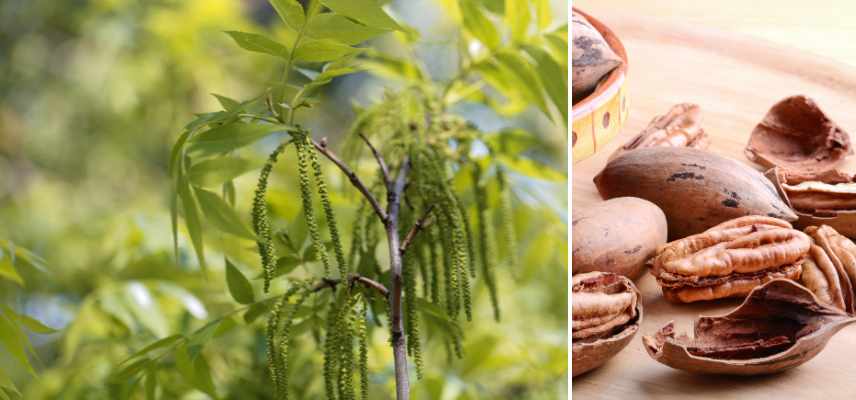
The flowers of the pecan tree will turn into irresistible nuts !

Carya illinoinensis 'Pawnee'
The pecan tree, or pecan walnut, is a large nut-bearing tree with deep-set roots, capable of reaching 20 to 40 m in height and 10 to 15 m in width, with a trunk up to 6 m in girth. As with ‘Pawnee’, some varieties are distinguished by smaller dimensions, better suited to more modest gardens. In time, it will form a moderately sized tree, around 10 m tall, perhaps 12 m, and 8 to 10 m wide, with a less imposing ramure than that of the type species. It bears fruit earlier in the season than the other pecan varieties, rewarding us, from October, with large, sweet walnuts. This is a partially self-fertile pecan that could self-pollinate to some extent; however, it will bear better with the presence of another pecan (such as the varieties ‘Shoshoni’, ‘Mohawk’, ‘Apache’, ‘Kiowa’, ‘Mahan’, ‘Sioux’, ‘Wichita’ or ‘Tejas’). You will plant it at a distance of 15 to 50 m from ‘Pawnee’. This variety is not overly prone to alternating bearing; harvests will therefore be regular year after year.
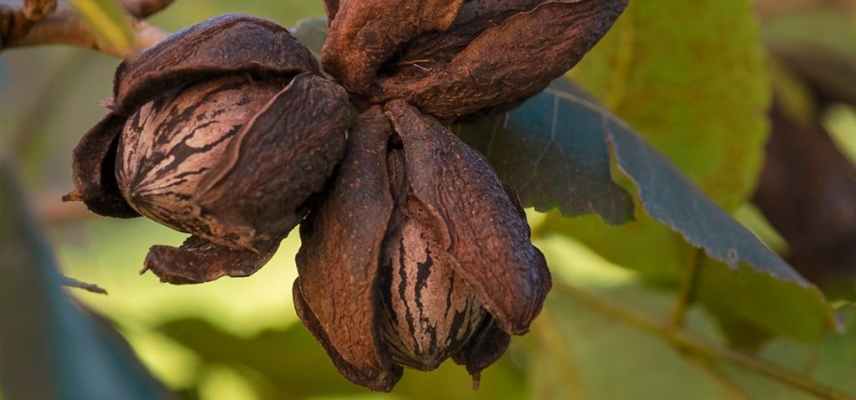
Carya illinoinensis ‘Pawnee’
Carya illinoinensis 'Mohawk'
Here is another early variety that provides from September large, thin-shelled pecans. Very productive, ‘Mohawk’ is an old variety that will yield abundant, beautiful nuts, though they are not as tasty as those of newer hybrids. Less imposing than the type species, it will nevertheless retain respectable dimensions, measuring about 15 m tall, up to 20 m, and 10–15 m wide at maturity. Like other pecan trees, it develops a handsome crown of branches with deciduous foliage, green in spring, turning golden in autumn just before the leaves drop. Partially self-fertile, this pecan tree will benefit from being paired with another variety such as ‘Cape Fear’, ‘Cherokee’, ‘Cheyenne’, ‘Desirable’, ‘Pawnee’ or ‘Western Schley’. It is prone to alternate bearing, which means production can be irregular from year to year.
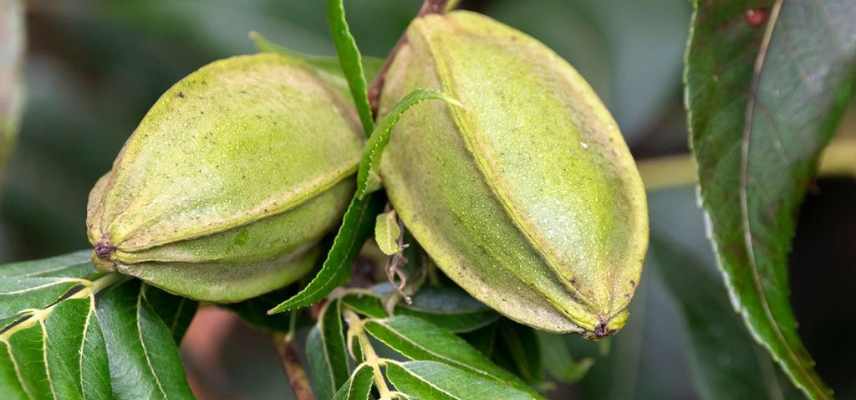
Carya illinoinensis 'Choctaw'
The Carya illinoinensis ‘Choctaw’ is a late variety that yields large pecan nuts in November. Its fruiting is also later than that of other varieties, as it only bears fruit after 5 to 7 years. This pecan tree is worth the wait and you’ll need to be patient! Nevertheless, it offers a good resistance to diseases and notably to the apple scab. It will form a tall, handsome tree of at least 20 m in height. This ‘Choctaw’ variety will benefit from being planted not far from another plant such as ‘Desirable’, ‘Jackson’ and ‘Oconee’, which will promote fruiting.
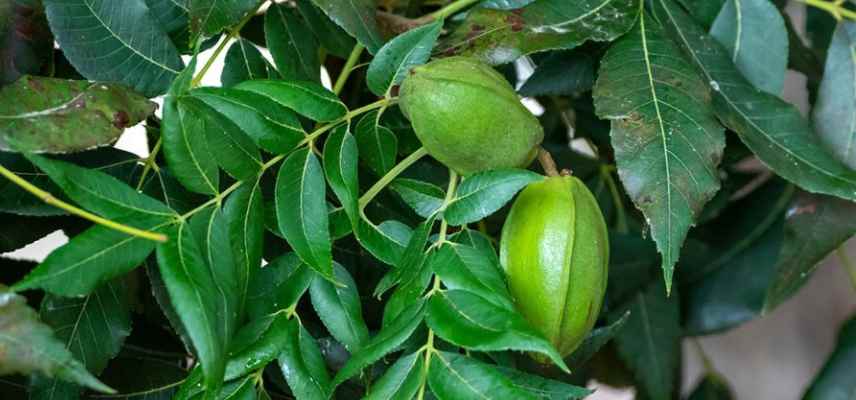
Carya illinoinensis 'Shoshoni'
This pecan tree variety packs all the advantages! ‘Shoshoni’ proves to be one of the most resistant to insects and diseases. Pecan trees are primarily affected by certain fungal diseases such as powdery mildew or bacterial leaf scorch that affect the foliage. This pecan tree variety reaches ripeness faster than the others, in around four years, and will reward you with pecan nuts from early October. It is nevertheless subject to some alternate bearing, with years of abundant harvests and others leaner.
This pecan tree that will grow to 15–20 m tall. Its handsome stature makes it well suited to larger gardens, especially if paired with a second specimen to achieve cross-pollination, as it is only partially self-fertile (we suggest planting another pecan tree such as ‘Cape Fear’, ‘Cherokee’, ‘Cheyenne’, ‘Desirable’, ‘Pawnee’ or ‘Western Schley’).
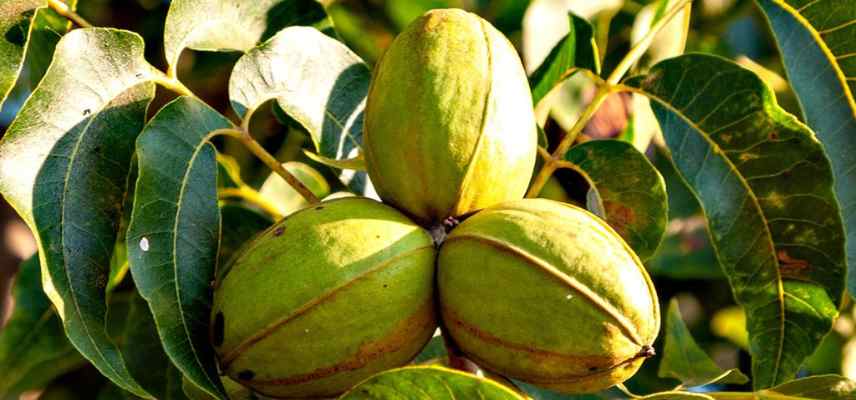
The Carya illinoinensis 'Delmas'
This pecan tree variety bears fruit early, as early as September, delivering its delicious pecans. Vigorous and productive, the Carya illinoinensis ‘Delmas’ planted in 1877 by a Mississippi farmer who gave it its name, is too susceptible to rust to be grown in the southeastern United States. It is, however, very popular in Israel where it proves quite resistant. It is a fruit tree that grows best in warm climates. Fruiting begins relatively quickly after about four to five years. ‘Delmas’ yields smaller nuts than Mohawk, but with superior flavour. A variety such as ‘Cape Fear’, ‘Cherokee’, ‘Cheyenne’, ‘Desirable’, ‘Pawnee’ or ‘Western Schley’ planted nearby will improve yields.
Also read
- Grow a pecan tree to harvest pecans
- To learn everything about this plant, browse our complete fact sheet on the Pecan tree: planting and growing.
- Why not go for a pecan tree.
- And, why not grow nut trees such as the almond tree (The almond tree: planting, pruning and harvesting), the hazel tree (Choosing the right hazel tree: buying guide) or the walnut (Walnut, Juglans regia: planting, pruning and care)?
- Subscribe!
- Contents

Comments