





























Pair Gardenia
6 ideas for successful plant pairings
Contents
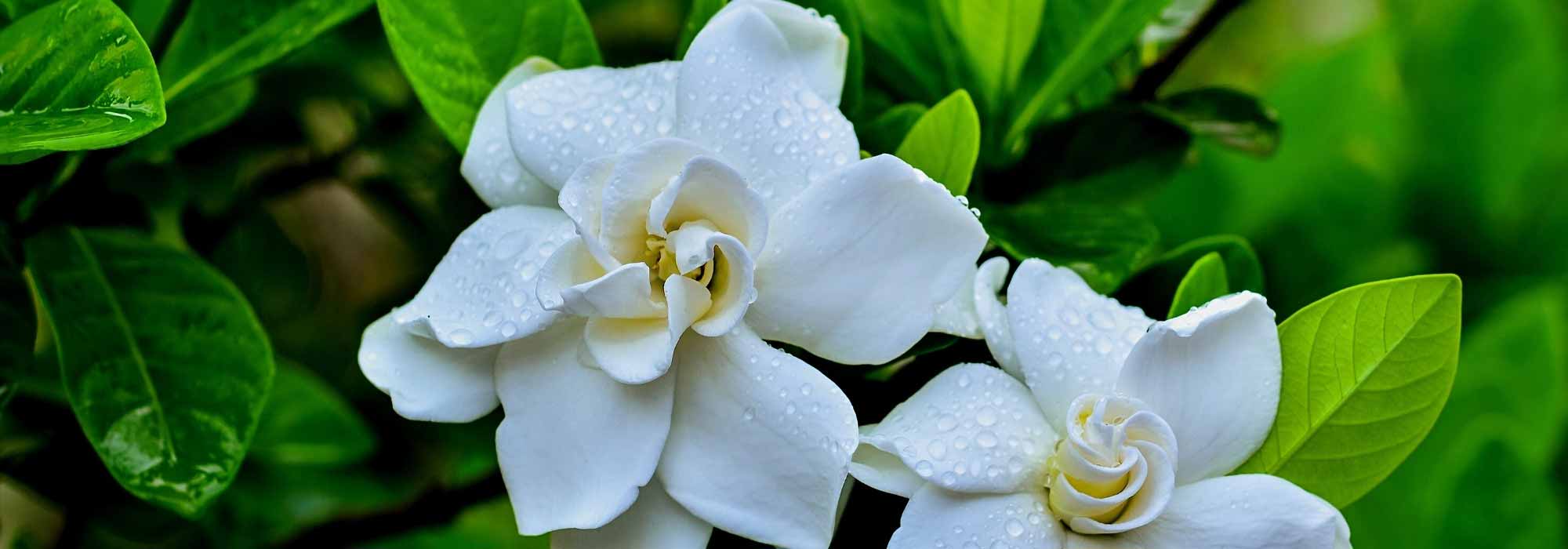
Gardenia, also known as Cape Jasmine, is a charming small bush with pleasantly fragrant flowering. It bears, from May to October depending on the variety, elegant pure white flowers, single or double, very romantic. It also bears generous dark-green, glossy evergreen foliage. Its white, fragrant flowers give off a sweet and lasting scent, lending your garden a calm and serene atmosphere. Gardenia prefers fertile, well-drained soil that remains cool in summer, and is rather acidic. It is quite frost-sensitive, but there are varieties that withstand temperatures around -10 to -12 °C, allowing them to be grown in the ground in mild-climate regions. In colder regions, it can be grown in a pot or tub, to be brought under cover for the winter. Discover our finest ideas for pairing Gardenia, whether you grow it in the ground or in a pot.
And to learn all about its cultivation, consult our comprehensive guide: Gardenia: planting, maintenance, pruning and watering

With acidic soil shrubs
As Gardenia thrives in cool, acidic soil, shaded from the scorching sun, it will be perfect to accompany ericaceous shrubs, which share similar cultivation conditions. Think of Rhododendrons and Azaleas: their vibrant flowers will add a splash of colour that contrasts with Gardenia’s immaculate white. For example, you could choose Azalea ‘Glowing Embers’, which stands out for its beautiful orange flowering, or an Azalea from the Encore series, which have the feature of flowering two to three times a year: ‘Empress’, ‘Sweetheart’, ‘Sangria’… Take advantage of the lush flowering of hydrangeas, for example Hydrangea macrophylla ‘Endless Summer Bloomstar’, which also offers prolonged flowering. Plant beside them Japanese pieris (Pieris japonica), kalmias and Japanese maples. Also discover Calycanthus ‘Venus’, which bears beautiful white and perfumed flowers, and Crinodendron hookerianum, nicknamed Lantern Tree, a very distinctive bush with its pendulous red bell-shaped flowers.
Browse our full range of ericaceous shrubs.
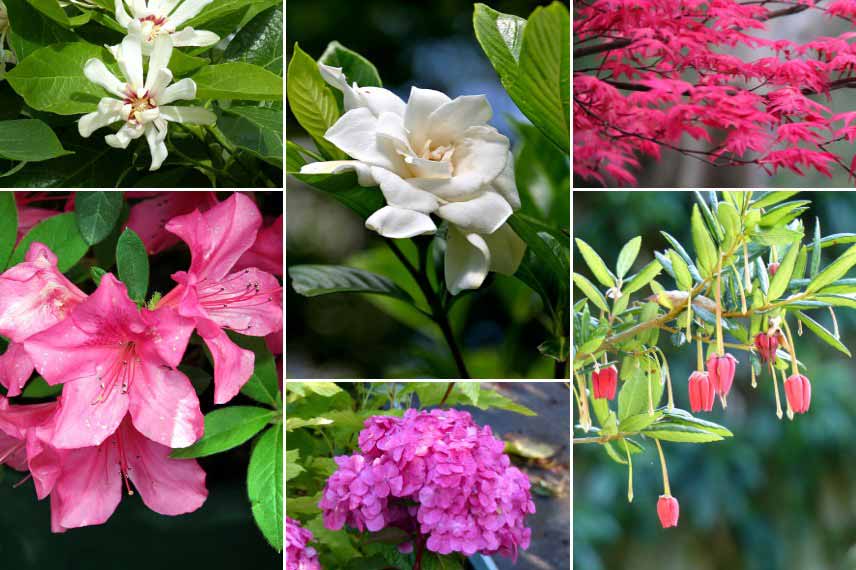
Calycanthus ‘Venus’, Gardenia, Acer palmatum ‘Shindeshôjô’, Azalea Encore ‘Sangria’, Hydrangea macrophylla ‘Endless Summer Bloomstar’ et Crinodendron hookerianum
With other fragrant flowering plants
Gardenia jasminoides is highly prized for its intense and voluptuous fragrance, which evokes jasmine! Why not intensify this aspect by pairing it with other fragrant plants? Pair it with Common Jasmine, which also bears very beautiful white flowers, to Osmanthus fragrans, which offers small pale-yellow flowers with a delicate fragrance, to lavenders, and to the old Gallica rose Rosa gallica ‘Officinalis’. Also consider Mock Orange seringat Philadelphus ‘Belle Etoile’, which from May to June unfurls delightful white flowers whose fragrance evokes strawberries, as well as Honeysuckle Lonicera ‘Scentsation’. Each of these plants adds its unique fragrance to the mix, creating an intoxicating atmosphere that will pair with the Gardenia’s sweet and lasting aroma. Thus, in addition to the beauty of their flowering, you will enjoy their intoxicating scents as soon as you pass by these plants. We also recommend planting them near high-traffic areas, a terrace or the house entrance to enjoy them more.
For more ideas, do not hesitate to consult our care sheet: A fragrant garden all year round
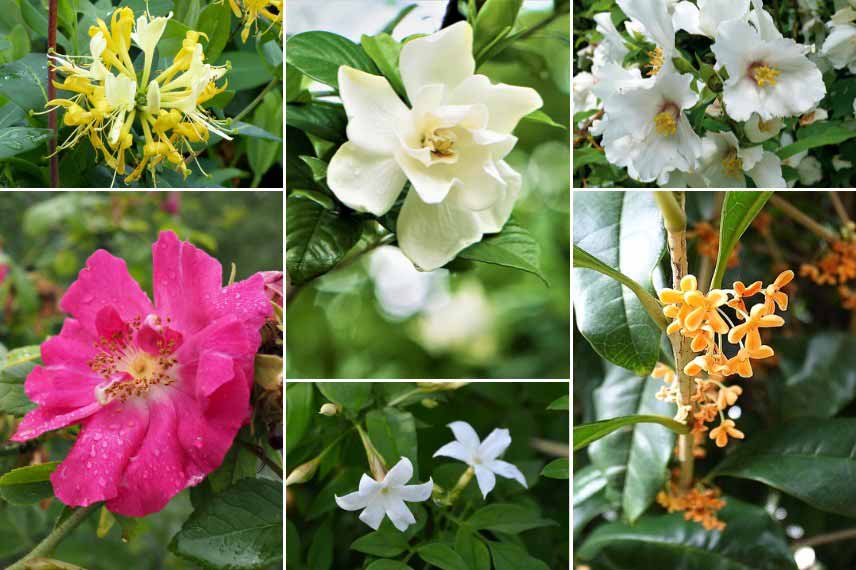 Honeysuckle Lonicera ‘Scentsation’, Gardenia, Mock Orange Philadelphus ‘Belle Etoile’, Rosa gallica ‘Officinalis’, Jasminum officinale and Osmanthus fragrans ‘Aurantiacus’
In a white garden
Take advantage of the beautiful flowering of the Gardenia to create a white monochrome bed! White gardens have the advantage of being very bright, elegant and soothing. They have a timeless, serene quality. The brightness of the flowers will be perfectly showcased in a partly shaded border, more so than if you plant them in full sun. Complete this palette with astrantias such as the Astrantia major ‘Alba’, as well as a Hydrangea Hydrangea arborescens ‘Annabelle’, Cosmos ‘Sensation Purity’, Epilobium angustifolium ‘Album’ and white campanulas. Also consider the superb Dahlia ‘Lady Liberty’, which offers large, very double flowers in immaculate white. You can also plant beside them silvery-leaved plants, such as Stachys byzantina and the Stachys byzantina : their silvery-grey leaves will reflect light and harmonise beautifully with the whiteness of the flowers. To accompany these plants, opt for the striking bark of the Himalayan birch, Betula utilis ‘Jacquemontii’.
Our tips sheet: “7 ideas for white garden beds”
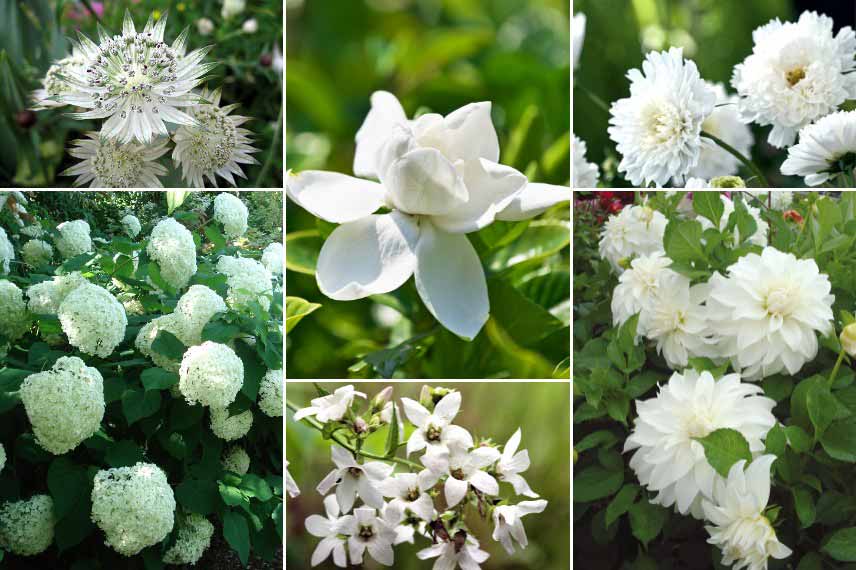
Astrantia major ‘Shaggy’, Gardenia, Cosmos ‘White Knight’, Hydrangea arborescens ‘Annabelle’, Campanula lactiflora ‘Alba’ and Dahlia ‘Lady Liberty’
Read also
Potted Gardenia: Planting and CareIn pots on the terrace
Gardenia adapts very well to pot culture, which allows you to enjoy its fragrance and the beauty of its flowering by placing it directly on a terrace or balcony. It can also be brought indoors under cover for the winter, in the coldest regions. You can pair it with fuchsias to create a pleasing colour contrast. Their bell-shaped, trailing flowers, often bi-coloured, in shades of pink, red or purple, will be perfect for brightening the terrace. Plant Carex beside them, for example Carex oshimensis ‘Everest’, and Hakonechloa, which are very decorative for their long, slender foliage. Think of Heucheras, whose foliage ranges across a very wide palette of colours depending on the varieties: red, orange, golden yellow, light green or dark green, purple… For shrubs, you can plant a Japanese maple, a Mexican orange blossom (Choisya ternata) and a Nandina domestica, for their light and very architectural foliage!
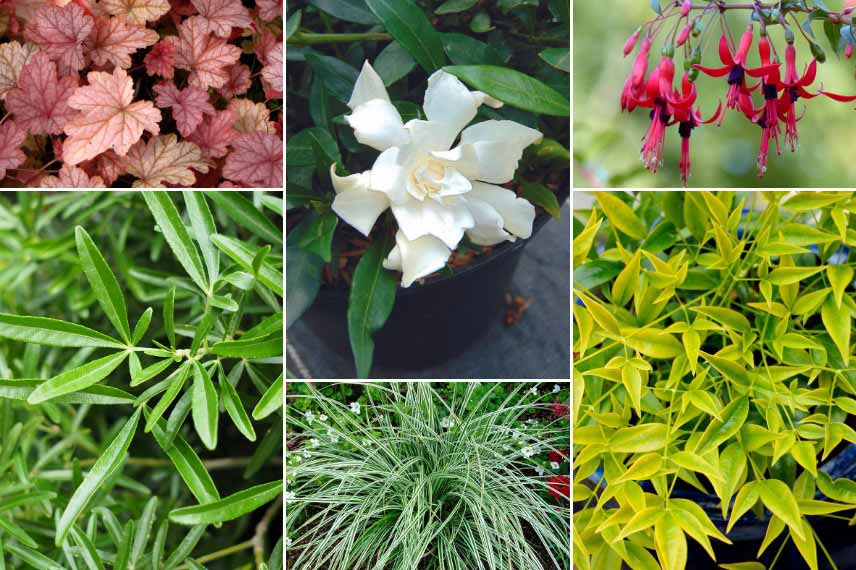
Heuchera ‘Vienna’, Gardenia jasminoides ‘Perfumed Petticoats’, Fuchsia regia ‘Reitzii’, Choisya ternata ‘Aztec Pearl’, Carex oshimensis ‘Everest’ and Nandina domestica ‘Brightlight’
To create a lush and exotic ambience
With its lush, dark-green foliage and its striking flowering, Gardenia has an undeniably exotic style. Use it to create a tropical atmosphere by pairing it with plants with lush foliage: for example, the Fatsia japonica, the ferns and the agapanthus. Discover Tetrapanax, with its enormous palmate leaves. Add climbing plants, which will evoke lianas and can be trained up a pergola: we particularly recommend the Akebia quinata, which bears lovely leaves divided into five oval leaflets, or the trumpet vine, notable for its lush foliage and its red or orange trumpet-shaped flowers. The delicate bell-shaped flowers of Fuchsias can also find a place here. You can also incorporate palms, such as the Chamaerops humilis, and bamboos. Bring colour with the flowering of Hemerocallis ‘George Cunningham’, which in midsummer offers large star-shaped flowers formed of six petals in a lovely orange hue.
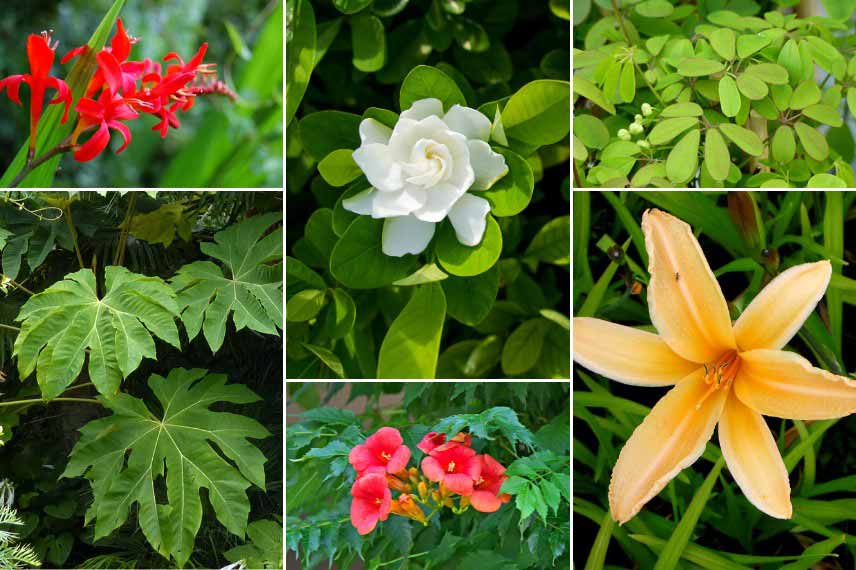
Crocosmia ‘Lucifer’ (photo: Vicky Brock), Gardenia, Akebia quinata, Tetrapanax papyrifer ‘Rex’, Campsis grandiflora and Hemerocallis ‘George Cunningham’
Playing with colour contrasts
One of the best ways to showcase Gardenia’s white flowering is to pair it with plants with dark foliage. This will create a garden with a graphic, sober and pared-back style. Surround it, for example, with a carpet of Ophiopogon planiscapus ‘Nigrescens’ and of Heucheras ‘Obsidian’ or ‘Black Pearl’. Place beside them Physocarpus ‘Midnight’ and Black Lace elder. Also discover the Astilbe ‘Chocolate Shogun’, with leaves chocolate-purple, almost black. To heighten the contrast, boost Gardenia’s pale colour by incorporating campanulates and white phlox, Cosmos ‘Purity’ and sages ‘Schneehügel’. This will give you a very original bed, which catches the eye and surprises with the intensity of the contrasts.
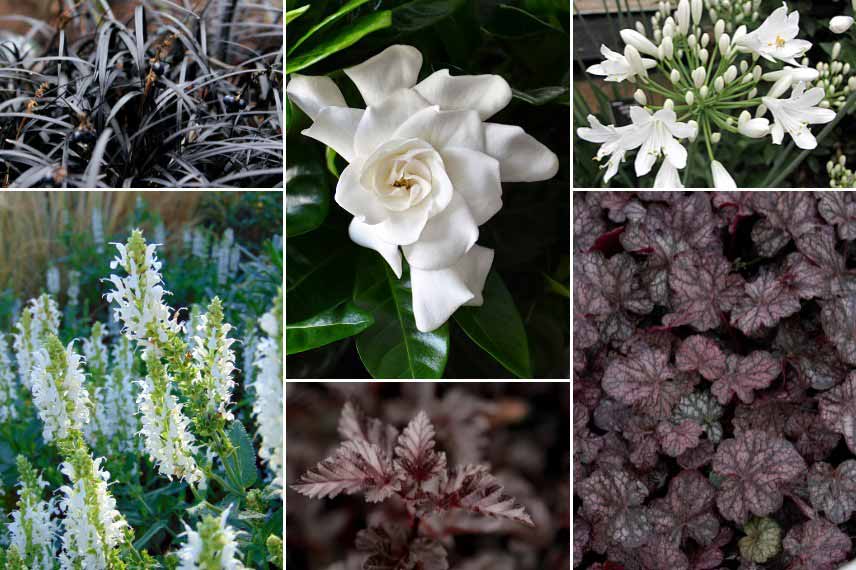
Ophiopogon planiscapus ‘Nigrescens’ (photo: Brewbooks), Gardenia jasminoides, Agapanthus africanus ‘Albus’, Salvia nemorosa ‘Schneehugel’, Physocarpus ‘Midnight’ and Heuchera ‘Velvet Night’
- Subscribe!
- Contents
Comments