





























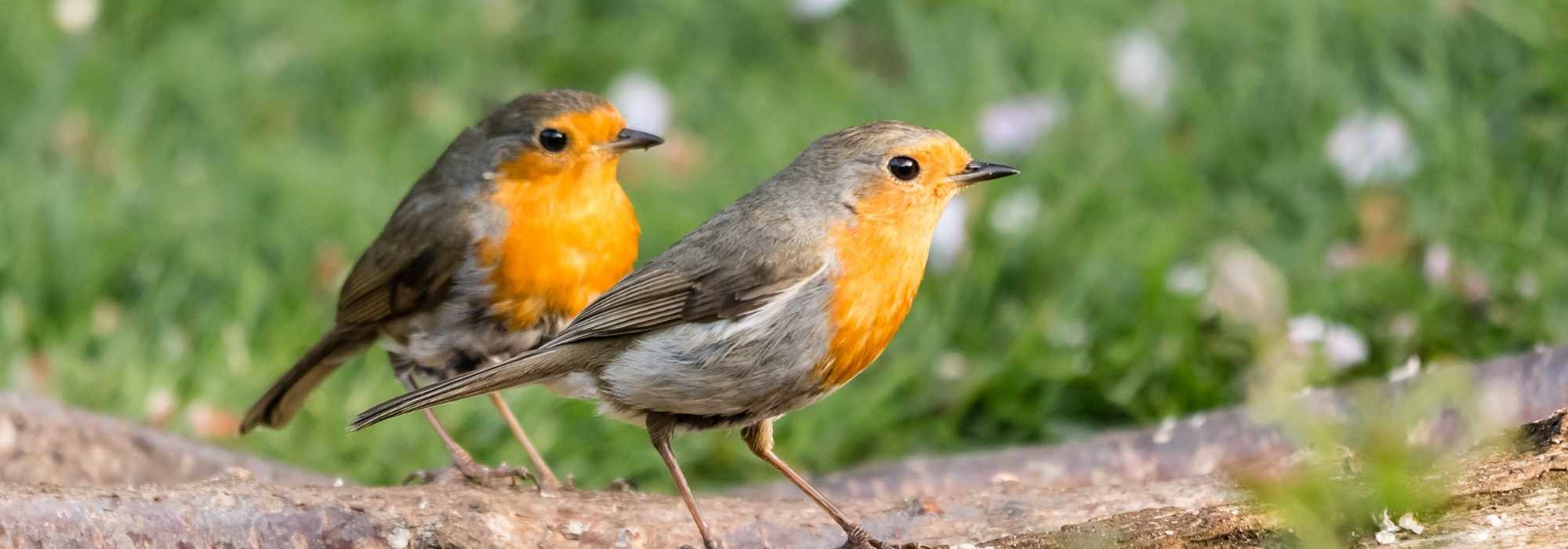
Making your garden welcoming for Robins
Create a paradise for birds
Contents
The European Robin (Erithacus rubecula) is a very common bird in our gardens. It is easily recognised by its large orange patch on the throat. This friendly little bird is not very shy and sometimes accompanies the gardener in their gardening tasks. Its appetite for insects, larvae, caterpillars, and a few slugs makes it an excellent ally in the garden. How can you make your garden welcoming for the Robin (and more!)?
We explain all this in our article.
The European Robin
The Robin, or European Robin (both spellings are now accepted), or Erithacus rubecula in Latin, is a passerine bird from the family Muscipadiae, which also includes chats and wheatears. This small bird (about 13 cm) is well-known and easily recognisable by its large orange patch on the throat. Its belly is dirty white, and the rest of the plumage is rather brown.
The European Robin can be found throughout France and Belgium. In fact, the bird is so common that it is encountered across a large part of the Eurasian continent, as well as in North Africa and even North America.
The Robin is present in our gardens, summer and winter. However, it is not always necessarily the same individual that is observed. Indeed, the European Robin is a partial migrant: this means that part of the population migrates while others stay put (this primarily depends on the availability of food). In winter, robins from the North arrive here, some of the robins present in summer head down to Spain or North Africa, while others do not move at all. All this means that on average, there are more robins in the garden in winter than during the “beautiful season”.
The European Robin nests here between April and August. It builds its nest from moss and dry herbs in hedges, in a dense climbing plant (such as ivy), but also in tree cavities, walls, and in sometimes incongruous places like a tin can, an old mailbox, or even an old shoe.
The Robin feeds on various insects, earthworms, slugs, caterpillars, larvae, and spiders. It also enjoys some berries and small fruits, and even seeds in case of winter scarcity. This bird is not very shy and sometimes seems to follow the gardener. It is mainly its belly that speaks: the gardener disturbs some insects or earthworms while working the soil, which the robin appreciates.
The lifespan of a Robin is about 5 years at most, if nothing happens to it, of course.
The song of the Robin is a pleasant, fluted, and melodious tune, but varied and quite complex (difficult to transcribe). Its call is a very brief and dry “tsic“, almost metallic. The bird does not sing in summer but can sing in autumn and winter, as the male and female live separately during this period, each continuing to protect their own territory. The male is indeed very energetic in this defence and does not hesitate to fight with another robin or… anything that might display an orange patch. Experiments have been conducted with a plush toy of this colour: it did not last long!
Nota bene: do not attempt to tame a European Robin or, even less, to confine it in a cage! It is a wild bird that must remain so.
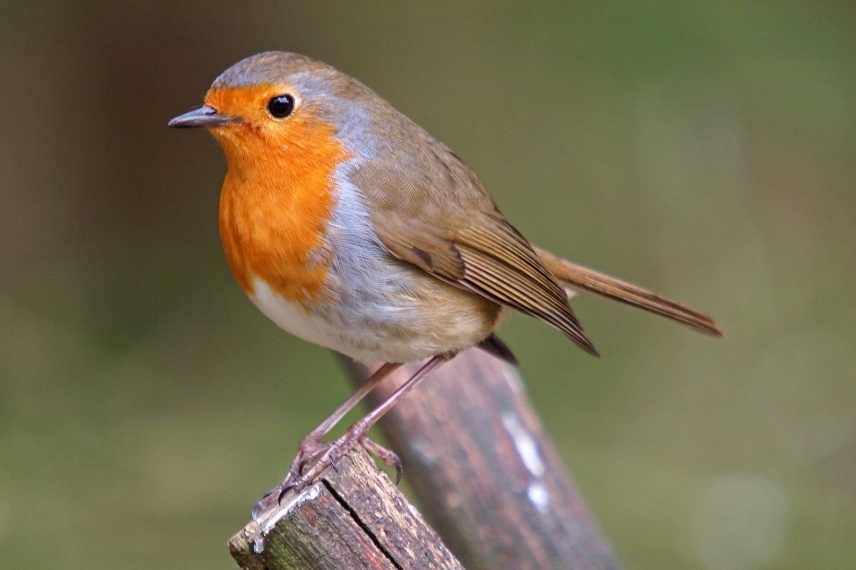 The robin is easily recognisable and well-known in our gardens
How to design your garden to attract it?
With its diet primarily consisting of insects, larvae, and slugs, the European Robin is a perfect and friendly ally for gardeners.
- To attract it to your garden, it is advisable to plant a wide variety of leafy trees and bushes. The presence of a beautiful, dense, protective hedgerow (with hawthorn, blackthorn, dogwood, guelder rose, for example) will be a bonus. Climbing ivy is also a fantastic habitat for much of the garden wildlife;
- Create the most natural and welcoming garden for biodiversity possible: with a small pond, flowering areas, piles of dead wood…;
- Ban insecticides, even those supposedly natural, to provide a wide range of insects for the birds to feed on;
- Respect the peace of your garden by limiting noisy machinery as much as possible;
- Finally, do not prune your hedges between 15 March and the end of July, or even mid-August, to avoid disrupting the nesting of the birds in your garden.
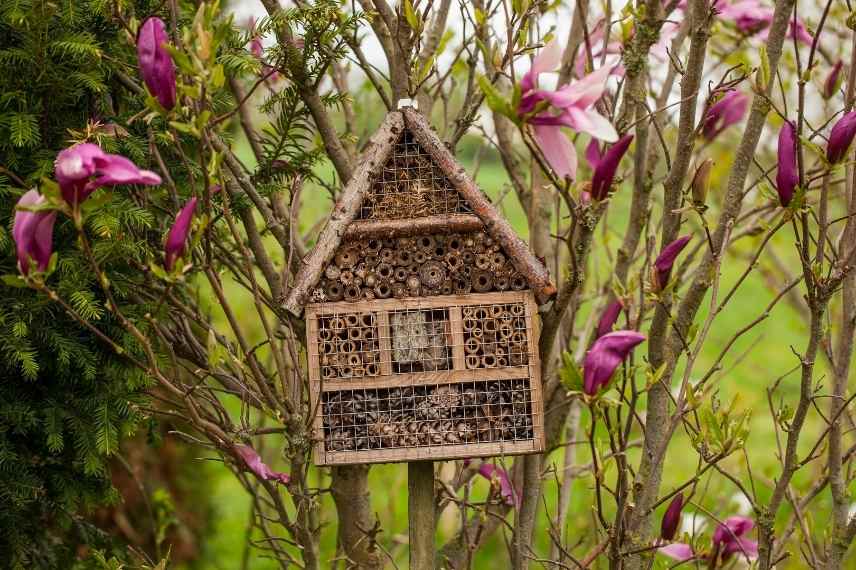 A garden promoting biodiversity will greatly help attract birds… and robins.
What more can be done?
A bird feeder
Placing a feeder filled with seeds is an excellent idea for observing the Robin in winter. It is not the only one visiting feeders; other granivorous and omnivorous birds also come daily: tits, sparrows, greenfinches, goldfinches, finches…
Although primarily insectivorous, the European Robin enjoys small seeds that help it get through the winter. Avoid fat balls as they do not provide a good source of energy for birds. Moreover, some commercial fats are of poor quality. Sunflower seeds and/or niger seeds remain the best solution. Don’t forget to clean the feeder every two or three days to prevent seed rot and the development of potential diseases.
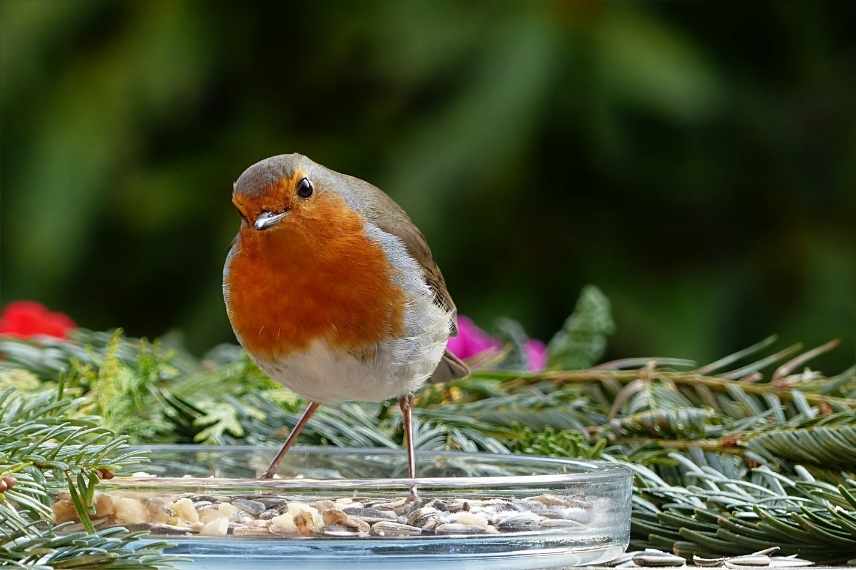 Offer seeds rather than fat balls to robins
Water points
Place shallow dishes filled with water at height, sheltered from predators, and in various spots around the garden throughout the season, even in winter. Indeed, during freezing periods, water is not always available for animals. Empty and change the water daily to prevent the development of bacteria!
Installing a specific nest box
Although birds have managed to build their nests on their own since time immemorial, it is still possible to install specific nest boxes for particular species. Installing this type of nest box for very common birds also has an educational value: it allows us to observe the life of the pair and their young during nesting from a reasonable distance. A basic semi-open nest box will be perfect for the European Robin. Here is an example plan for this type of DIY nest box: specific robin nest box. The nest box should be placed at height (at least 2-3 m), sheltered from wind and rain, and about 5 m away from any other nest box.
Please note: installing specific nest boxes is genuinely useful for species whose habitat is threatened or nearly disappeared. For example: the Little Owl, which appreciates cavities in old trees (willows, old apple trees…). Installing nest boxes for common species is less useful, but that doesn’t mean we shouldn’t place them. However, be careful not to favour one species over another. This could disrupt the natural balance, and some species might suffer. This is the whole issue of species conservation actions: we must act without creating other problems. And that is not easy!
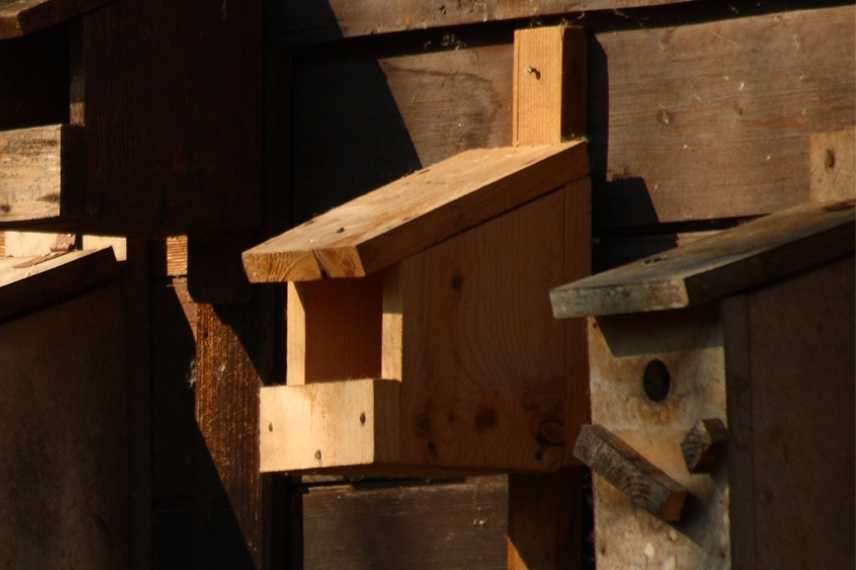 A semi-open nest box is ideal for our friend the robin
Read also
How to attract birds to your balcony?For further reading...
You love birds and nature in general. You can register your garden as a LPO Refuge (League for the Protection of Birds) in France or within the Nature Network at Natagora in Wallonia (Belgium). For more information, please follow the links below:
→ The Nature Network at Natagora
Feel free to also reach out to other nature protection organisations near you!
- Subscribe!
- Contents
Comments