





























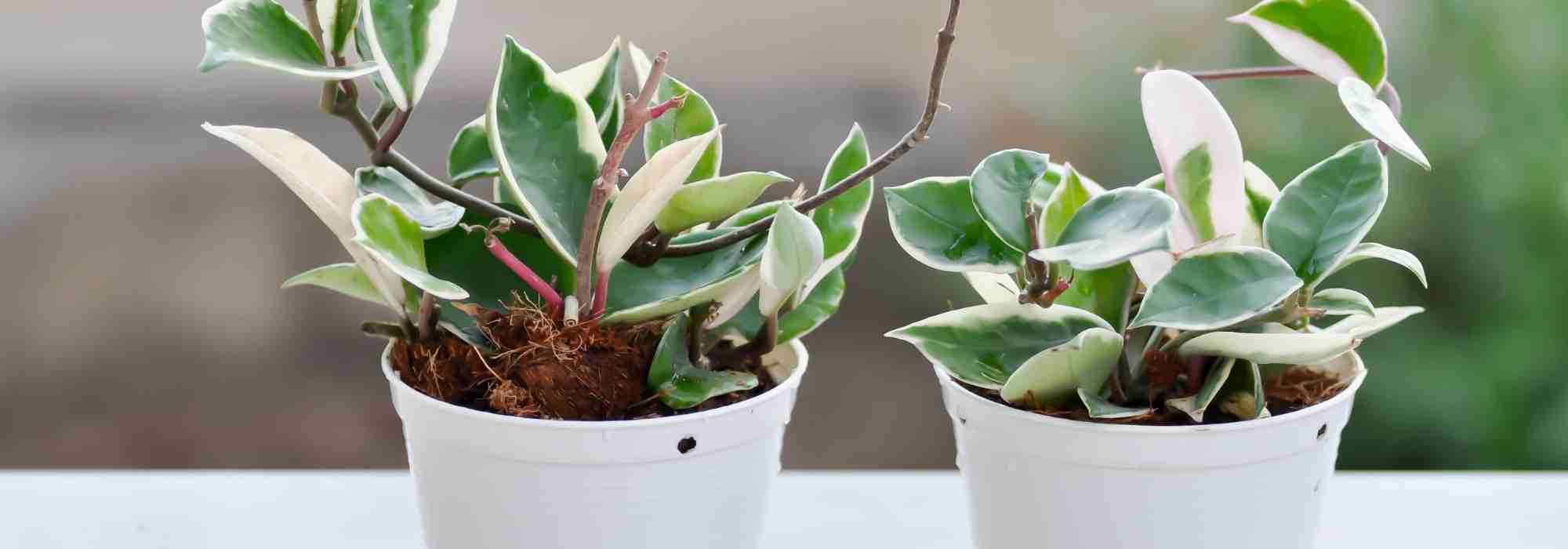
Hoya: what to do after purchasing it?
Our tips to help your Hoya acclimatise well indoors.
Contents
Hoyas, also known as “wax flowers” or “porcelain flowers” for the waxy appearance of their unique flowers, are wonders of the plant world. With their sometimes spectacular flowers and decorative, glossy, and thick foliage, Hoyas appeal to both beginners and plant enthusiasts. But after the thrill of buying this indoor plant, epiphytic in its native medium, comes an essential step: hardening. Indeed, even though the hoya is a fairly robust plant, it needs a bit of care and attention to adapt to its new environment.
Discover our comprehensive guide to help your hoya settle into its new environment and reward you with its magical flowering.

Hoya: an essential first phase of observation.
In their natural habitat, Hoyas are epiphytic plants that thrive in a tropical, warm and humid climate. They climb up the tree bark to reach the light they need. Along the way, they draw some organic matter from there to feed themselves. The Hoyas species sold in our latitudes, largely hybridised, have lost some of their characteristics. Nevertheless, they require particular conditions in their new environment, namely indoors.
Once your Hoya is home, don’t rush things. It has just undergone a period of stress related to transport, a change of environment, perhaps heat or cold exposure. In the first instance, place your Hoya in a bright room, not in direct sunlight, and let it “breathe” for a few days.
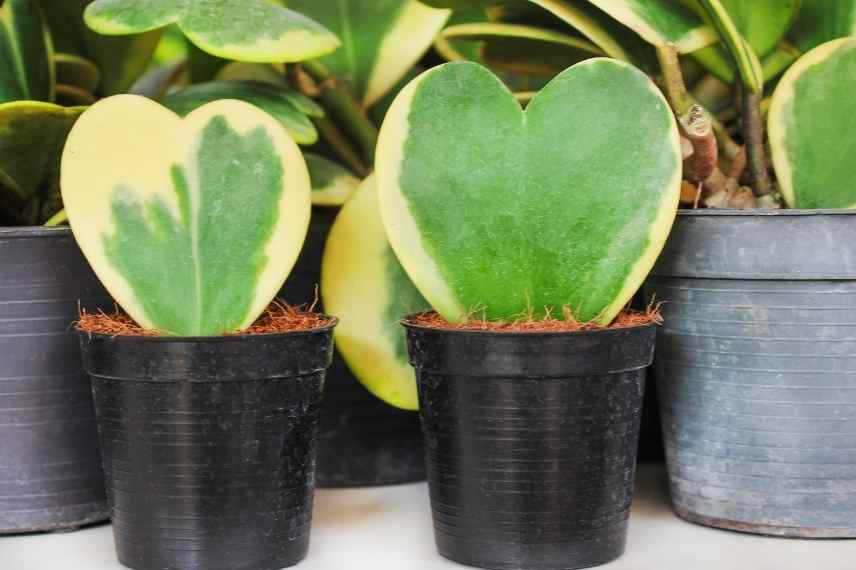 Between its place of sale and your home, the Hoya (here Hoya kerrii ‘Variegata) is undergoing a period of stress.Take advantage of this post-traumatic rest period to observe it and perform a quick check : Does it have any damaged or stained leaves? Is the potting medium not too waterlogged? Indeed, before sale or dispatch, plants are often watered to withstand transport. If so, allow the potting medium to dry gently. Finally, check carefully that there are no insects (scale insects, aphids, red spider mites…) on the undersides of the leaves and around the potting medium.
Choosing the right spot for your Hoya
Hoyas are plants that require bright light. They should be placed in a very bright room, near a south- or south-west-facing window. During the cooler periods, they can even tolerate direct sun. Except in summer, when the light source should be protected by a light sheer curtain. You can also simply shift your plant so that the foliage does not scorch.
That said, after purchase, it is best to acclimatise your hoya to its new lighting gradually. Initially place your plant near an east- or west-facing window, shielded by a curtain, then move it to its final position with optimal light. Thus, to bloom, a hoya needs 12 to 14, or even 16 hours of light per day. A grow light can therefore be useful during the darkest periods of the year.
In terms of temperature, a hoya thrives in a moderately warm environment, between 18 and 24 °C.
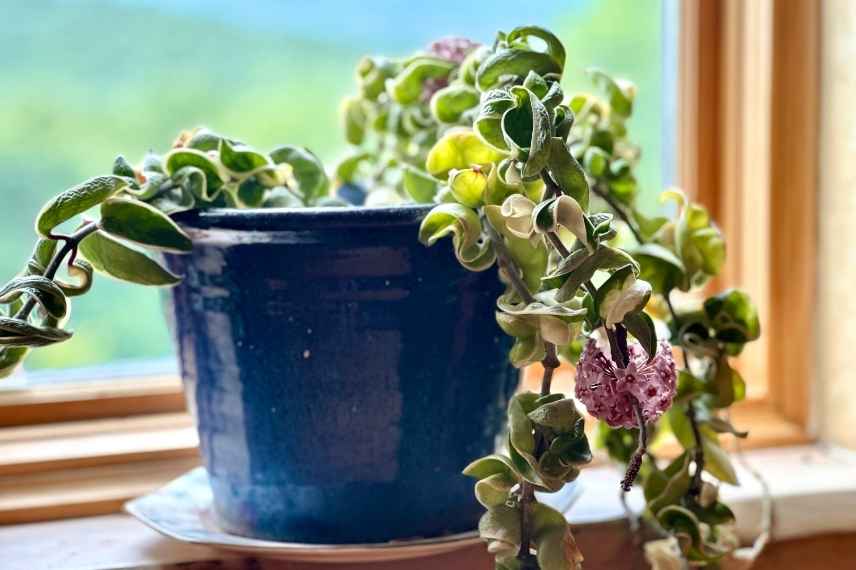
Hoyas require bright light
Moreover, avoid drafts and dark rooms at all costs, as the hoya will literally wither there! Keep it away from heat sources too, especially direct heating in winter.
Repotting the Hoya
Patience is required here as well. No need to stress your hoya more than it already is… Obviously, if the pot isn’t very attractive or if the hoya looks cramped, you’re tempted to repot as soon as possible. However, wait one to two weeks before doing so, giving your hoya time to settle into its new environment.
Only a few warning signs should prompt immediate repotting. For example, if the pot is really too small and the roots are spilling out everywhere. Hoyas don’t mind being cramped. If your hoya is planted in a poor-quality, very compact potting mix, you can also carry out a quick repot. Finally, if you detect signs of root rot, or a suspicious odour, act quickly to repot.
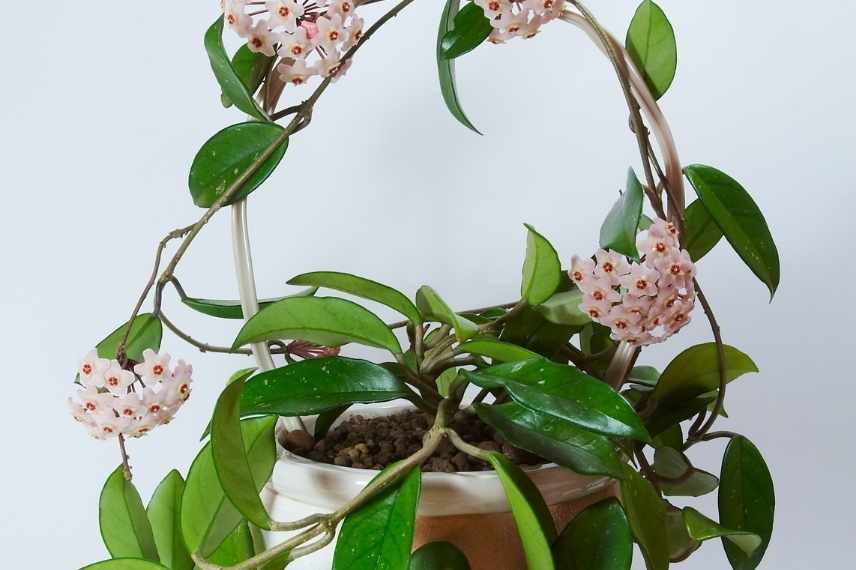
Don’t rush to repot a hoya after purchase
When repotting your hoya, pot and substrate choice is essential. Make sure you do not increase pot size by more than 2–3 cm in diameter, and instead choose a terracotta pot with drainage holes to ensure good drainage. Then the substrate… Hoyas have specific needs to achieve good growth. The substrate must be particularly light, airy and well-draining, retain only a minimal amount of moisture without holding onto it too much, and be rich. An orchid potting mix can work perfectly, unless you make your own blend with 1/3 of potting mix with high porosity, 1/3 of perlite and 1/3 of pine bark or of coconut chips.
Read also
Hoya: all our tips for year-round careWatering the Hoya
Once you have repotted, you will need to water your hoya. Water generously the first time, then a second time, ensuring you do not leave any water residue in the saucer or cache-pot. It is important to moisten the substrate well, as it does not retain water.
Next, you should adopt an appropriate watering frequency. But bear in mind that it is better to water generously and infrequently. Moreover, the watering frequency depends on the season and on the type of foliage of your hoya. Thus, during the growth period and, possibly, flowering, in spring and summer, we water more. Thus, hoyas with thin leaves need to be watered more often, variegated foliage such as Hoya australis ‘Tricolor’ or the pretty Hoya callistriphylla with marbled leaves are more sensitive to excess water. Hoyas with succulent leaves such as Hoya kerrii ‘Splash’ are more resistant to lack of water.
To sum up, in spring and summer, watering every 10 days may be enough, or even once a week if it is very hot. In autumn and winter, watering every three to four weeks is acceptable, depending on the temperature in your home. You should always wait until the top of the substrate is dry before watering. Soft water at room temperature is ideal.
Similarly, hoyas thrive in environments more or less humid. If the humidity in your home is too low, it is recommended to place your pot on a layer of clay balls covered with water to maintain constant humidity.
Hoya fertilisation
No need to fertilise a freshly purchased and repotted hoya, since the fresh substrate provides all it needs. Wait until the next spring or summer to start feeding your plant. When the time comes, use a liquid orchid fertiliser, dilute it to half the recommended dose, and feed once a month.
Staking Hoya to promote growth
Some hoyas take the form of a liana in the wild. This includes Hoya carnosa ‘Tricolor’ or the Hoya gracilis. They love to climb or cascade down, depending on the variety and how you grow them. That is why, if you want them to climb, you will need to install a small trellis or ring in the pot, and secure them with soft ties. Indeed, hoyas don’t cling on their own, but they adapt very well to the supports you provide.
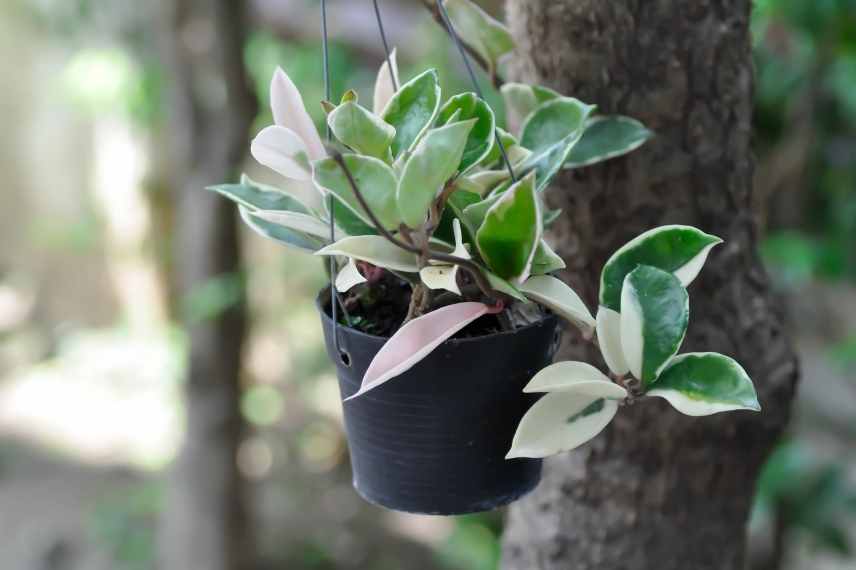
The Hoya gracilis loves to climb or cascade down
If you prefer them to trail, provide a hanging basket, or place them on the edge of a shelf.
A little patience for the Hoya’s flowering.
Many people buy a hoya for its famous star-shaped flowers, often fragrant, which bloom between spring and summer. The most floriferous is Hoya bella. But they don’t appear straight away. Sometimes, never, if the growing conditions aren’t perfect. To encourage flowering, you must therefore observe a few conditions:
- Optimal light
- Respect for the plant’s natural cycles, namely a winter rest period with less watering and a slight drop in temperatures to around 15–17 °C, and more light and warmth as spring returns
- Regular fertiliser applications during the growth period, from March to September–October
- A fixed position: avoid moving your hoya too much once it is well established.
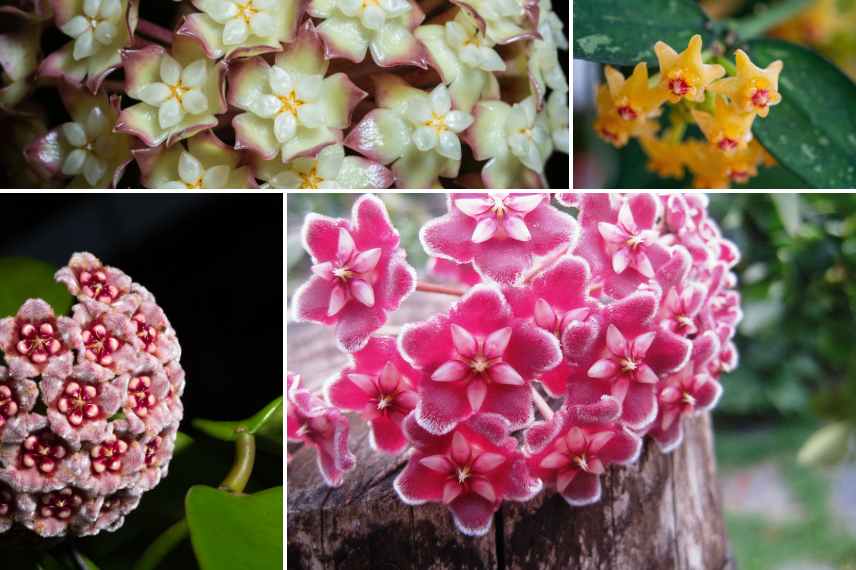
The flowering of Hoyas, a truly colourful enchantment
And above all, never cut the peduncles, that is, the small flowering stalks, even if they look dry, because new flowers often grow back in the same spot repeatedly.
- Subscribe!
- Contents
Comments