





























How to successfully grow mustard?
All our tips and tricks for growing mustard in your vegetable garden
Contents
Obviously, everyone has a jar of mustard in their fridge, essential for making a vinaigrette or mayonnaise, and a must-have for accompanying cold meats. But in the vegetable garden, have you ever considered growing mustard? This herbaceous plant from the Brassicaceae family grows very well in the garden, not only for its seeds with a spicy flavour, used in mustard production, but also for its leaves, which also have a peppery taste, making them interesting for enhancing a simple salad. Moreover, mustard can also be sown in the garden as a green manure. There are numerous benefits to growing mustard in the vegetable garden.
However, it is important to distinguish between white mustard, black mustard, and Chinese mustard, three different species that are sown and maintained according to the same rules.
Let’s discover together how to successfully cultivate mustard to add a bit of spice to your dishes, or simply to fertilise and aerate the soil.

What exactly is mustard?
Mustard is primarily an herbaceous plant belonging to the Brassicaceae family. Known since antiquity for both its culinary and medicinal qualities, it is very rich in vitamins A, C, B2, B6, and B9, as well as calcium and magnesium. Mustard was popularised by the Dukes of Burgundy and is now inseparable from the city of Dijon, always adding that little spicy kick to our dishes. This flavour is due to two molecules present in the leaves and seeds: sinigrin and myrosin.
But let’s return to our herbaceous plant. Or rather, our herbaceous plants, as there are various species of mustard from different genera: white mustard (Sinapis alba), commonly found in the wild in our countryside, black mustard (Brassica nigra), and Chinese mustard (Brassica juncea). The first two species are widely used for making mustard or as green manure, while the latter is primarily grown for the consumption of its leaves, which are quite similar to those of Chinese cabbage. By cultivating one of these plants, you can easily make your own homemade mustard!
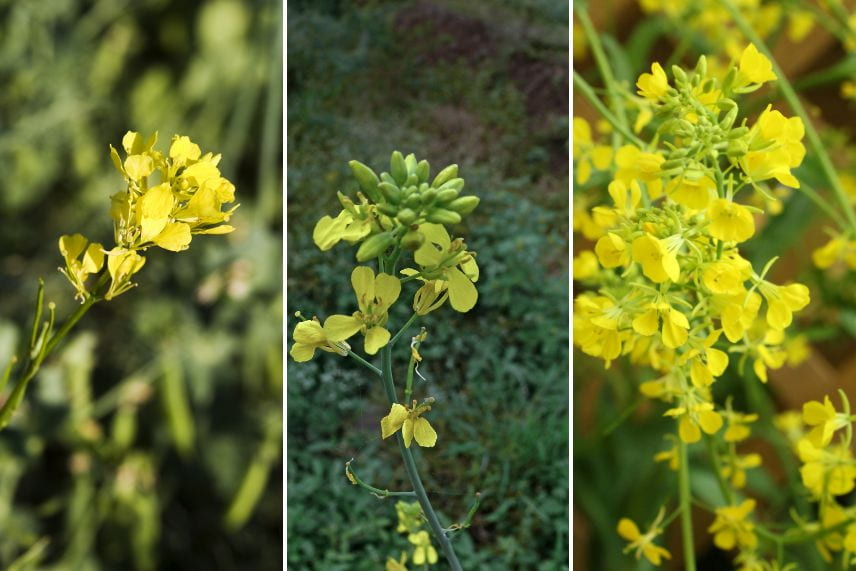
Flowers of white mustard (Sinapis nigra), black mustard (Brassica nigra), and Chinese mustard (Brassica juncea)
Mustard can also be grown as green manure, often sown by farmers between two cereal crops. As green manure, mustard has the ability to loosen and aerate the soil, prevent compaction and soil erosion, limit the proliferation of weeds, and enrich the soil through the decomposition of its foliage, which forms very rich organic matter. Finally, mustard also has the virtue of absorbing nitrates from the soil. To learn more about green manures: Green manures, why and how?
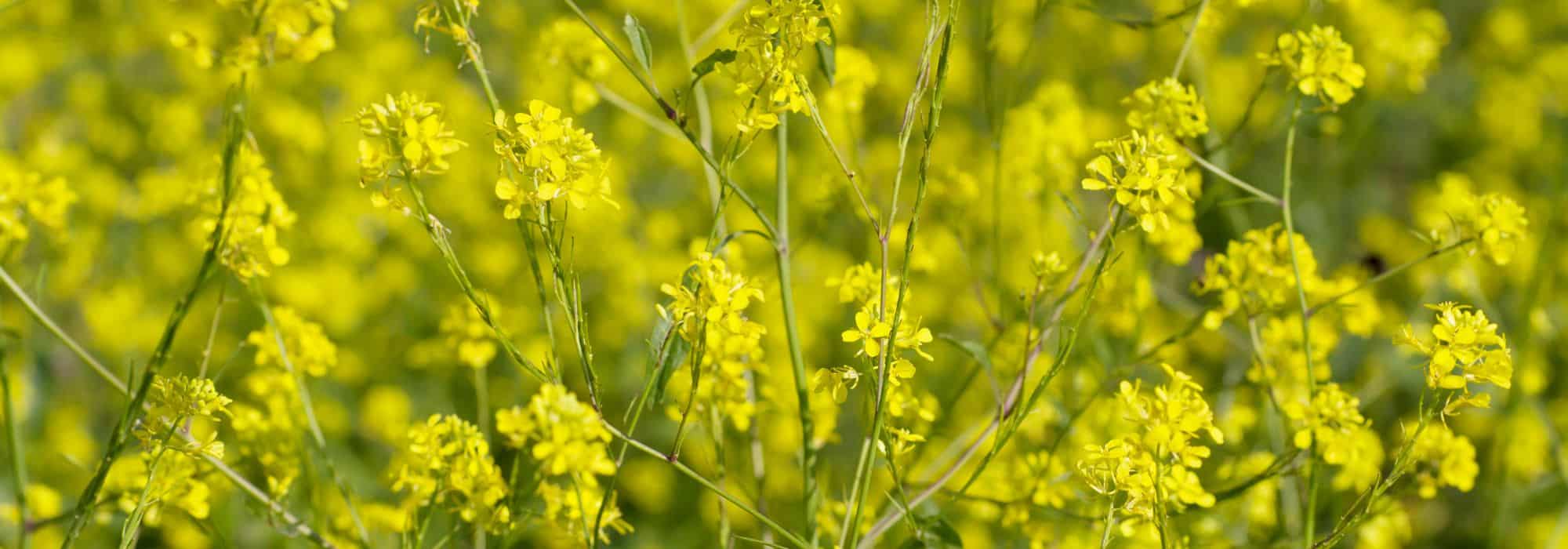
Recognisable by its yellow cruciate flowers, which bloom between June and October, mustard is very easy to cultivate in the garden.
Read also
White mustard: sowing, growingSowing mustard: where, when, and how?
White mustard and black mustard are hardy plants that are grown as annuals. In contrast, Chinese mustard is a biennial. Their sowing presents no particular difficulties.
Where to sow?
Mustard is not demanding in the slightest as it grows (almost) anywhere. Indeed, all types of soil can suit it, whether acidic, neutral, or calcareous, poor and ungrateful or fertile, heavy or light. However, mustard develops better in rich, cool, loose, and light soil, which must be perfectly drained. For therein lies its weakness: mustard does not like waterlogged and overly moist soils.
In terms of exposure, provide full sun for your mustard. It will flower more abundantly. However, it tolerates partial shade, and somewhat less so full shade.
When to sow?
The sowing period mainly depends on the use you want to make of your mustard.
- To produce seeds for making your homemade mustard, sow white and black mustard seeds between March and May. The seed harvest will occur approximately 60 to 80 days after sowing. Sowing can be staggered to have fresh leaves for salads.
- For using mustard as a green manure, sow either at the very beginning of spring, in March, or in August-September after summer crops.
- Chinese mustard, grown for its leaves, is sown either in spring from March to April or from August to October, depending on the varieties.
How to sow?
Sowing mustard is done by broadcasting at a rate of 2 g of seeds per m². In contrast, Chinese mustard is sown in rows.
Sowing white and black mustard
- Work the soil deeply to remove weeds.
- Rake and level the soil.
- Lightly moisten the soil before sowing.
- Sow by broadcasting.
- Lightly rake and water with a fine spray.
Sowing Chinese mustard
- Work the soil and remove weeds.
- Rake and level the soil to loosen it well.
- Draw furrows spaced 40 cm apart, 1 cm deep.
- Sow the seeds very sparsely.
- Cover with a very thin layer of soil or compost.
- Lightly firm with the back of the rake.
- Water with a fine spray.
Seed germination generally occurs within 8 days.
Caring for mustard in the vegetable garden
Here again, the maintenance of mustard largely depends on what you intend to do with it. If you are growing mustard as a green manure, maintenance is kept to a minimum. For a harvest of leaves or seeds, maintenance will be a bit more careful.
In any case, mustard does not like dryness. If it lacks water, it quickly bolts to seed. The soil must therefore be kept moist, which is why watering will be regular if the weather is dry. However, do not forget that mustard does not appreciate excess moisture. So, it needs watering, but not waterlogging.
The maintenance of white and black mustards is therefore limited to these waterings. On the other hand, Chinese mustard (which has been sown in rows) requires thinning as soon as the seedlings have 4 to 5 leaves. You should keep one plant every 25 cm. The young shoots that are removed can be added to your green salad of the day.
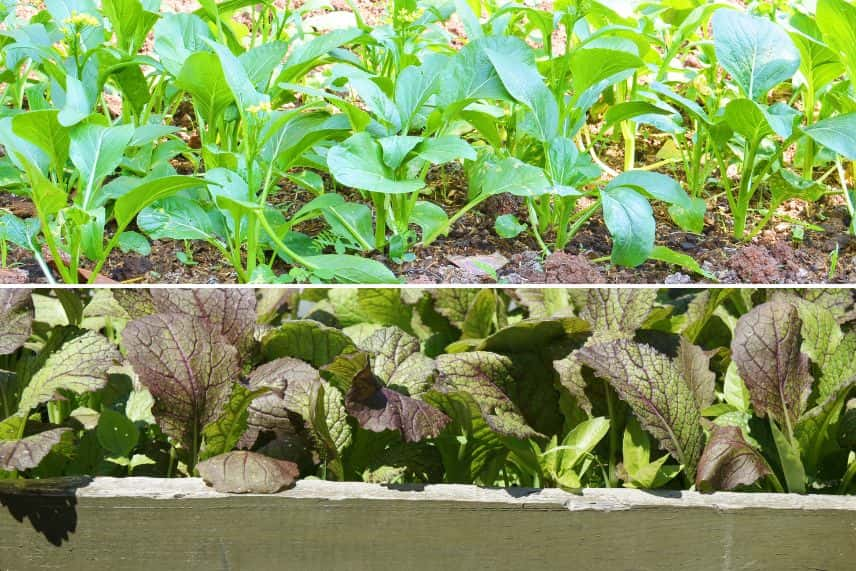
Cultivation of two varieties of Chinese mustard
Also, watch out for young mustard shoots that may be eaten by slugs. I invite you to discover the 7 ways to fight slugs effectively and naturally.
Similarly, flea beetles may attack mustard leaves. The most effective way to combat this little beetle is to water the mustard patch regularly to wet the foliage. Additionally, placing a insect-proof net can be effective on small plots. I also encourage you to read the article How to control flea beetles and protect cabbages?
Read also
Green manures: why, how?When and how to harvest and consume mustard?
If you have sown your white mustard or black mustard for seeds, the harvest occurs 60 to 80 days after sowing, from early to late summer. You should harvest when the siliquae (that is, the capsules containing the seeds) are dry, before they turn brown. To do this, cut the stems close to the ground and hang them upside down in a well-ventilated, dark place to dry. Don’t forget to place a white sheet underneath the stems to catch any seeds that may fall. When the stems and siliquae are perfectly dry, you should beat them on the sheet.
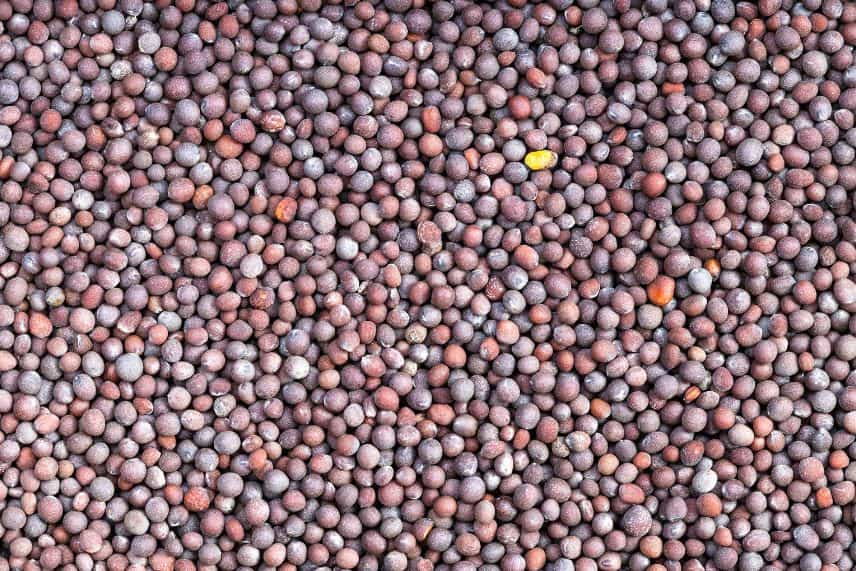 Black mustard seeds
If you have sown your mustard as a green manure, you should mow the stems just after flowering, before seed formation. To do this, you can cut the stems with a scythe or, more simply, use a mower. The stems will then be cut and shredded. Depending on the timing, you can choose to leave the stems to decompose on the soil as mulch, or bury them during digging.
If you have sown mustard to consume the leaves, harvest them as needed.
- Subscribe!
- Contents

Comments