





























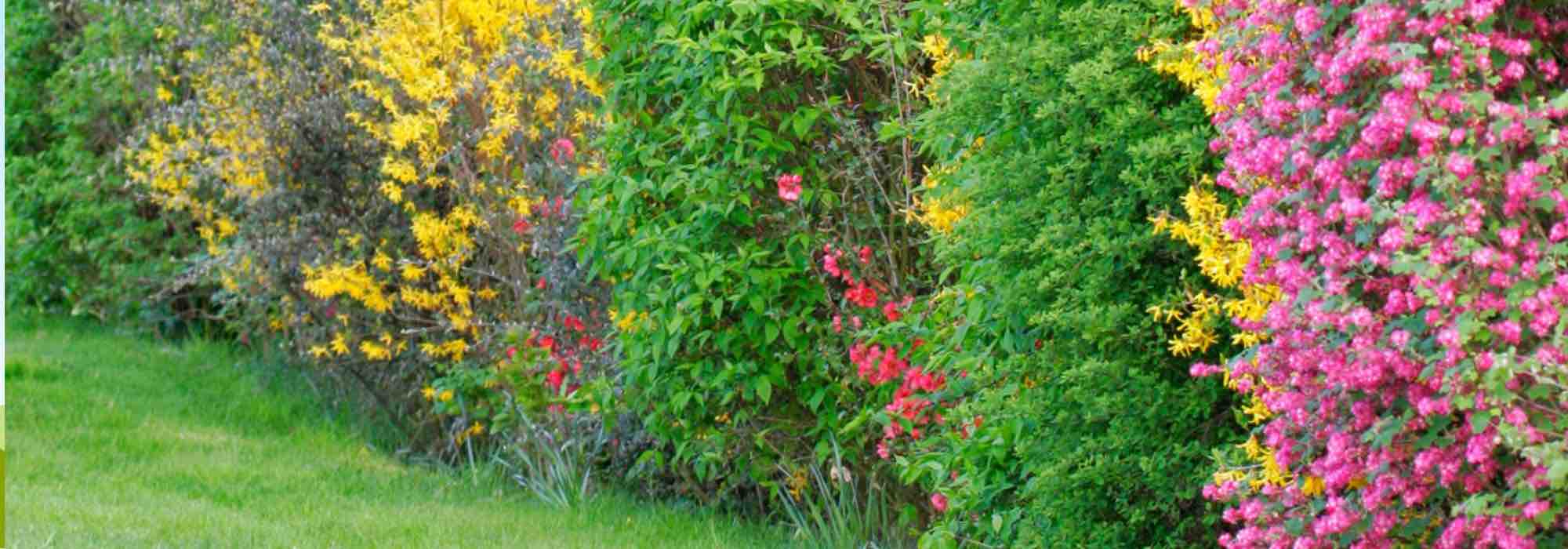
How to replace a conifer hedge?
Install other shrubs to create a new hedge in your garden
Contents
A hedge serves several functions in the garden: it can break the wind, protect you from prying eyes, dress up an unsightly structure, or delineate an area.
Cypress hedges, with Thuja at the forefront, were very popular at one time. However, they have certain limitations that may lead you to want to transform them today. Let’s explore how to remove a cypress hedge and what other hedging shrubs to replace it with.

Why replacing a conifer hedge?
Thuja hedges or Leyland cypress hedges are certainly among the most well-known conifer hedges. They offer several advantages.
- These plants grow quickly, reaching the desired height in just a few years.
- They withstand winds well and, thanks to their dense, evergreen foliage, provide good screening all year round.
- They respond well to regular pruning and offer a neat appearance.
- Finally, they are quite affordable to purchase.
However, there are many reasons that may lead you to replace them with other hedge shrubs.
- The conifer hedge requires a lot of pruning maintenance, at least 1 to 2 times a year. Some species can grow into true trees, such as thujas, which can reach nearly 30 metres at maturity. They must be heavily restricted to form a hedge, which also requires good equipment.
- Being a single species, it is more susceptible to pests and diseases and depletes the soil more easily.
- Its lack of diversity does not benefit wildlife (too dense for bird nesting, for example) or flora (the lack of light prevents the growth of other plants).
- Their aesthetics are a matter of debate: conifer hedges are sometimes seen as true monochrome plant concrete, dull and monotonous.
- It serves no other purpose than to create a screen, unlike other hedge shrubs (edible, melliferous, etc.).
- Their plant waste is difficult to compost.
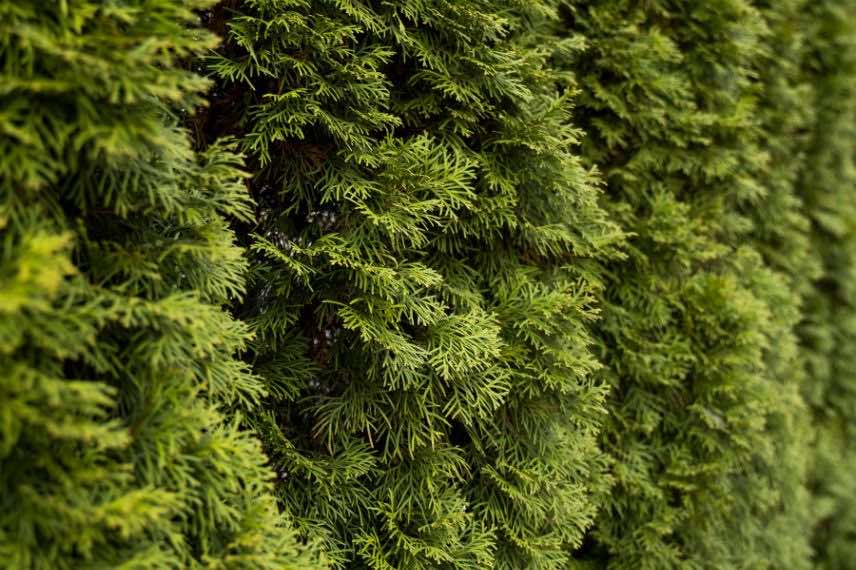
A thuja hedge
Read also
How to create a dead hedge?Removing the existing hedge
Let’s be honest, this is the most tedious step in replacing your hedge! Start by pruning the aerial parts of your conifers. Equip yourself with gloves and proceed using a branch cutter or a chainsaw.
Next, you will have two options.
- Leave the stumps in place, if they are not too large or too close to each other, allowing you to plant between them (removing only the surface roots at the time of replanting).
- Uproot and remove the area. This requires specific equipment, especially if the hedge is old: at least a good spade and a saw if the area is small, but generally rather a mechanical digger or a winch. Note that you can also seek help from a professional.
For waste disposal, choose:
- the drop-off at a waste facility;
- reuse as mulch for certain areas of the garden (for example, to create paths);
- composting, which will take time (more than a year) and will require first finely shredding the branches.
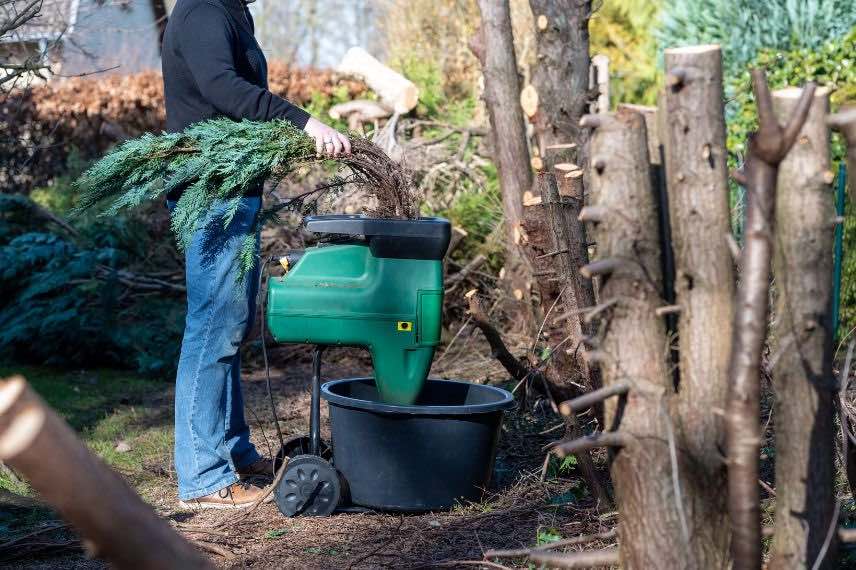
First, remove the aerial parts of the bushes before tackling the stumps
Choosing the shrub hedges to replace conifers
The choice of your future hedge shrubs will depend on:
- the nature of your soil (clay, sandy, limestone…);
- the weather conditions to which the garden is exposed (frost, rainfall, drought…);
- the exposure of the hedge (sunny, semi-shaded…);
- your needs (screening hedge all year round, hedge that lets in light in winter, low hedge…);
- the maintenance time you wish to dedicate;
- the aesthetics you are sensitive to and the style of your garden (trimmed or free hedge, single species, mixed…).
There are many types of diverse hedges that can replace conifer hedges.
- The bocage hedge consists of local trees and bushes that naturally adapt to the region’s climate and soil. They are planted in different strata. For example: black elder, hawthorn, blood dogwood, laurustinus, blackthorn…
- The fruit hedge is edible, consisting of small and large fruit trees. For example: raspberry, blueberry, redcurrant, goji, serviceberry…
- The melliferous hedge attracts and nourishes valuable pollinating insects. For example: Mexican orange blossom, Abelia grandiflora, Cotoneaster franchetii, ceanothus, strawberry tree…
- The defensive hedge consists of thorny plants. They create a true deterrent and impenetrable plant barrier. For example: Berberis, sea buckthorn, Mahonia, Pyracantha, common holly…
- The evergreen hedge has foliage that allows for privacy and wind protection in all seasons. For example: Photinia, Japanese aucuba, oleander, Eleagnus, Griselinia…
- The flowering hedge is lively and colourful all year round. For example: Witch hazel, autumn camellia, Deutzia, Hibiscus, weigela…
- The coastal hedge is resistant to winds and salt spray. For example: Cotinus coggygria, Callistemon, Escallonia, Vitex, Chinese orange…
There are also hedges with decorative fruits, hedges for birds, hedges to attract and nourish insects… So you have plenty of choices!
For packaging, you will find:
- pots (inexpensive, but require patience for the plants to reach a suitable size);
- bare roots (affordable and with good recovery, but not available all year round or for all species);
- clumps (with good recovery, but more expensive and increasingly less offered);
- containers (immediate effect, but more expensive to purchase).
To learn more: Hedge bushes: bare roots, clumps, pots, potted bushes… What to choose?
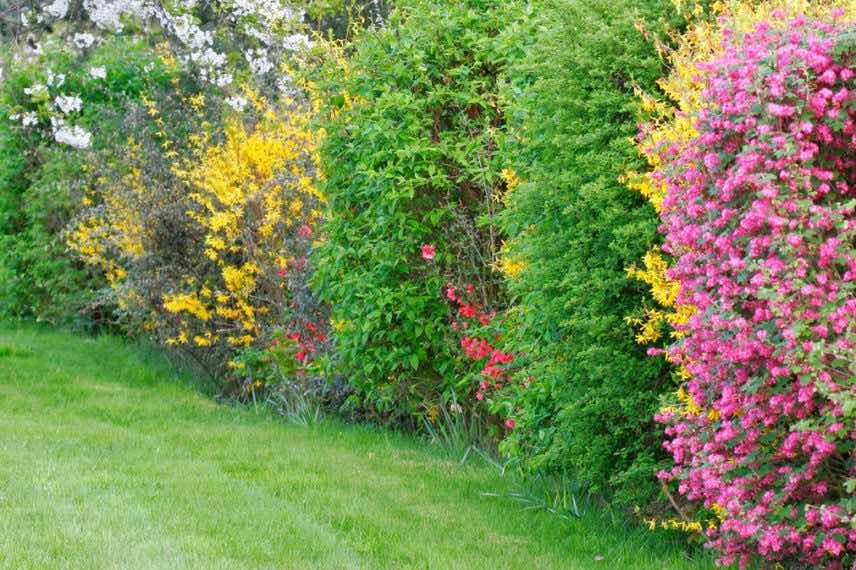
A diverse hedge, composed of different species, with various foliage and flowering, completely changes the perception of your garden’s boundaries compared to a single-species conifer hedge.
Read also
Pruning of HedgesInstall and plant the new hedge
Soil Preparation
The conifer hedge will have depleted many nutrients, leaving the soil impoverished. Start by loosening the soil with a spade, breaking up any clumps.
Next, to enhance soil fertility, add organic amendments, such as manure, household compost, or high-quality potting soil. Incorporate them into the soil.
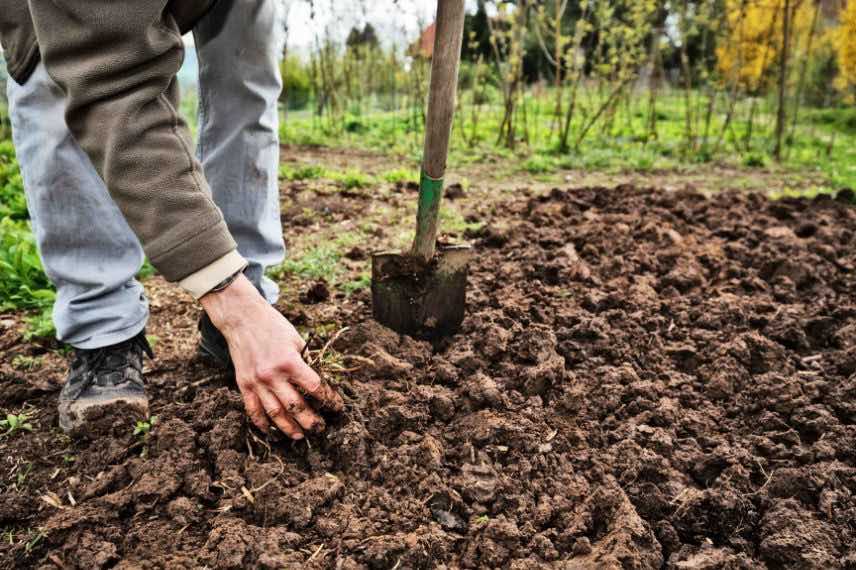
Work the soil that will host your new bushes and amend it
Planting
- Planting should take place in spring or autumn, outside of frost or drought periods. Dig planting holes that are about twice the size of the plant’s root system. Remove any roots or plant debris that may still be in the soil.
- Loosen the root ball of the bush if necessary (in pots or containers) or proceed with bare-rooting.
- Space your plants about 80 cm apart. You can choose to plant in a single line, double lines, or staggered rows.
- Then water generously. Install a organic mulch (wood chips, fallen leaves, plant husks…) at the base of your hedge bushes to limit evaporation and the growth of competing adventive plants.
- For certain bushes, such as fruit trees, provide staking. You can also set up two parallel lines of stakes in advance to facilitate training.
- If you need to maintain an opaque boundary while the hedge grows, you can install a temporary fence, such as reed screening.
Maintenance
In the first two years after planting, even if you have chosen drought-tolerant bushes, pay attention to watering until the root system develops. Provide water as soon as the soil is dry on the surface.
Pruning is only necessary a few times a year if you want a tidy hedge. Annual pruning will simply help balance the shapes or encourage some plants to branch out. Always use clean cutting tools to prevent the spread of diseases.
Finally, to replace the mulch at the base of the plants once it has naturally decomposed, you can grow groundcover perennials.
For more information: How to plant a hedge?
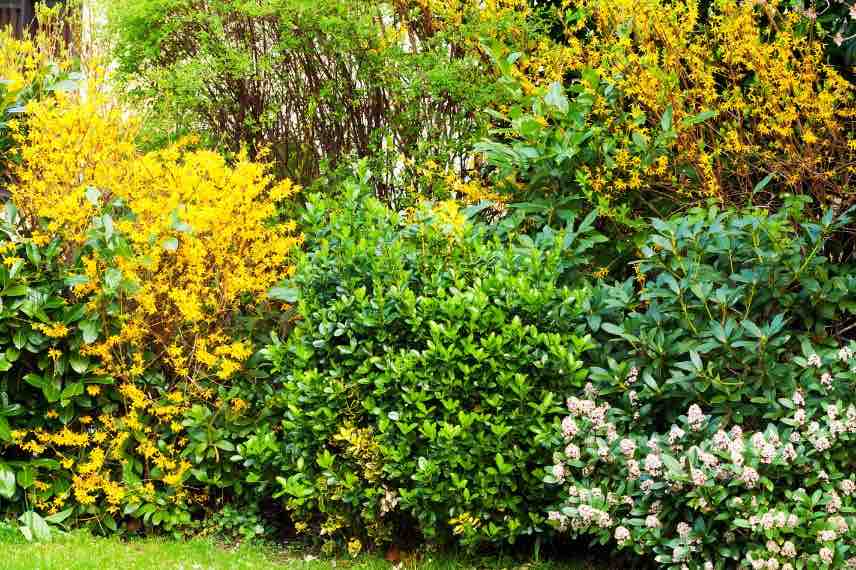
In the first years after planting, pay attention to watering, amendments, and the soil around to avoid leaving it bare: mulch and eventually plant perennials
- Subscribe!
- Contents

Comments