





























How to manage the cohabitation of chickens with domestic animals: our tips!
How to foster harmony between your hens and other pets at home?
Contents
For a few years now, keeping chickens in your garden has become a real trend. A trend, indeed encouraged by local communities, who do not hesitate to gift chickens or a chicken coop to their fellow residents. Having chickens in the garden is always a real joy: Beyond fresh eggs and reducing kitchen waste, they bring life to the garden. However, when other domestic animals already share the same space, an essential question arises: how to organise their cohabitation? Dogs, cats, rabbits… each has its own character and habits, which can clash with those of the chickens.
Discover how to foster cohabitation and create genuine harmony between your chickens and the other domestic animals that frequent the garden.

What are hens' specific needs?
Before considering cohabitation with other domestic animals, it is essential to understand clearly what underpins the welfare of the hens.
Chickens are gregarious birds that naturally live in flocks, with a well-defined hierarchy.
Keeping a single chicken is a complete utopia, as it needs company.
Moreover, their daily routine, governed by sunrise and sunset, relies on habits.
Deviating from this can harm their welfare.
By definition, a hen spends her day scratching the ground, pecking, eating, laying eggs and sleeping.
Chickens therefore need a chicken coop suited to their size and numbers, to sleep at night and lay eggs, sheltered from the cold and heat, the elements and predators.
This coop must be clean, well ventilated, and above all protected from foxes, weasels and stoats…
During the day, they should also have access to a grassy run to peck at grasses and a variety of insects at their leisure.
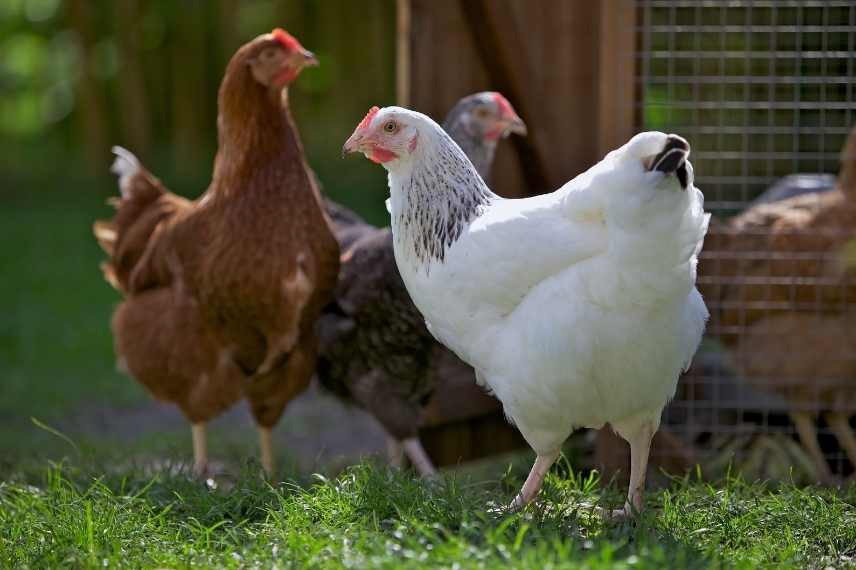
Chickens are gregarious animals and do not like solitude
Nutrition is also a key element of their welfare.
Granted, their meals may include some table and kitchen scraps, but that isn’t enough.
Their diet should consist of 70% cereals (wheat, barley, maize, oats…) and 30% protein, from animal or plant sources.
The insects they forage as they wander in the grass meet a large portion of these needs.
Thus, dog, cat or rabbit mixes are not suitable for them and may even harm their health.
They must also be provided with access to clean, fresh water.
Dogs and chickens: a possible coexistence but under supervision
The encounter between a dog and chickens largely depends on the dog’s instinct. Some dogs, especially those from hunting or herding breeds, may be tempted to chase the poultry, either for play or by predatory instinct. Others will completely ignore them. To avoid any accidents, gradually introduce the chickens into the dog’s environment and never leave them together unsupervised at first.
Training plays a key role. A dog that knows basic commands and has learned to channel its energy will adapt more easily to the presence of the chickens. The initial interactions should be calm and controlled: keep the dog on a lead, allow it to observe the poultry without being able to approach them, then gradually increase proximity. This habituation process requires patience and consistency.
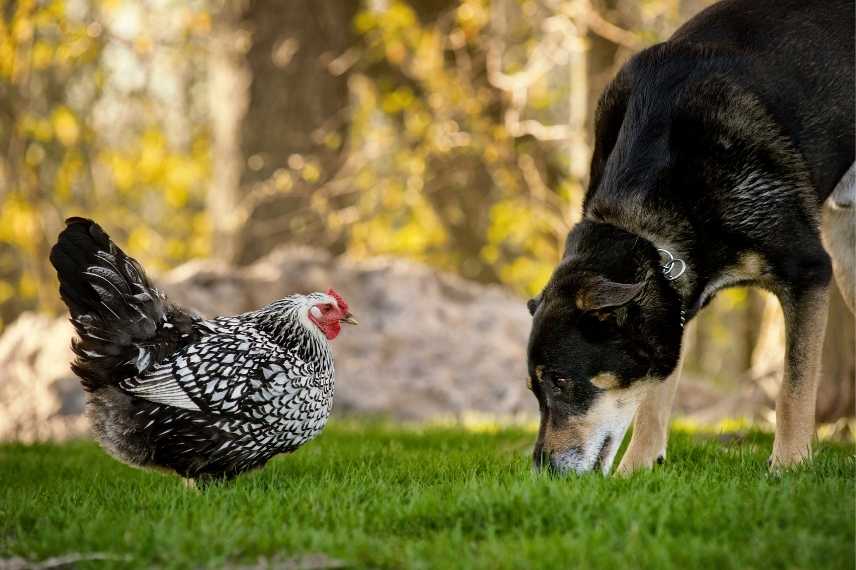
Some dogs may be tempted to chase poultry, either for play or by predatory instinct. Others will completely ignore them
A sturdy enclosure is essential, especially at the outset. It keeps the chickens safe and helps the dog understand that it does not have direct access to them. When trust is established, some dogs become true guardians, protecting the henhouse from intruders. But continued vigilance remains essential, as any situation can rekindle the chasing instinct.
If the chickens are introduced before the puppy arrives, it’s easier. All you need to do is introduce the chickens and the young dog as early as possible, under your supervision. Indeed, a puppy only wants to play and may make the occasional clumsy gesture. Regularly repeat these introductions. With time, your dog will become accustomed to its winged companions and may even become very protective.
Cats and hens: a fairly single coexistence
Unlike dogs, cats rarely pose a problem with adult hens. Their hunting instinct is expressed mainly on small prey such as rodents or birds, which makes poultry too large to arouse real interest. In most cases, cats simply watch poultry from a distance, sometimes with curiosity, and eventually ignore them completely.
However, vigilance is essential with chicks which, due to their small size and rapid movements, can awaken the predation instinct. During this sensitive period, it’s best to install a secure enclosure that prevents any direct contact. When hens reach adult size, the risk decreases considerably.
Cats, highly territorial, can also be unsettled by the arrival of new inhabitants in the garden. It is then advisable to proceed with gradual hardening, giving the cat time to explore the enclosed run, sniff and observe without constraint. This step reassures the animal and reduces rejection behaviours.
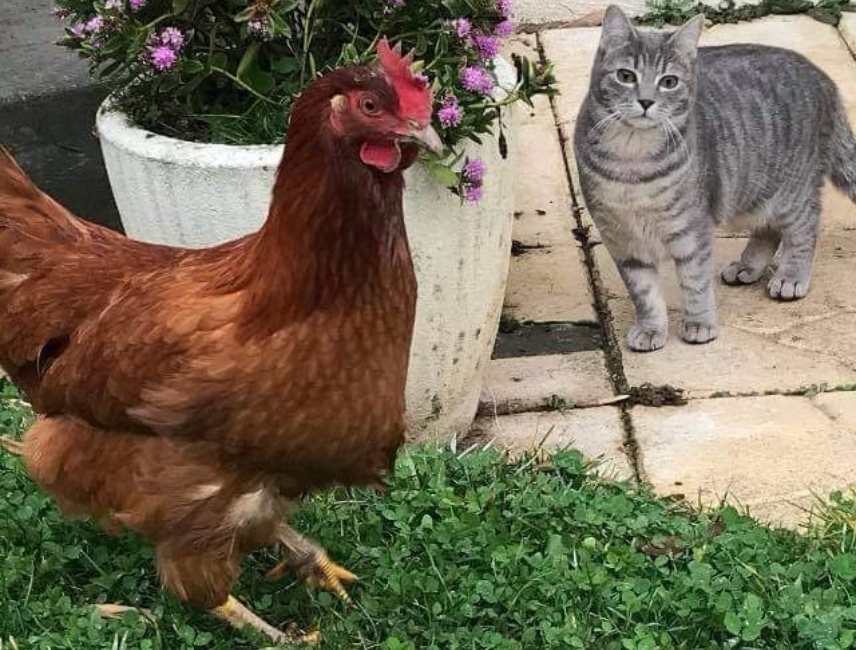
Generally, cohabitation between hens and cats is fairly smooth
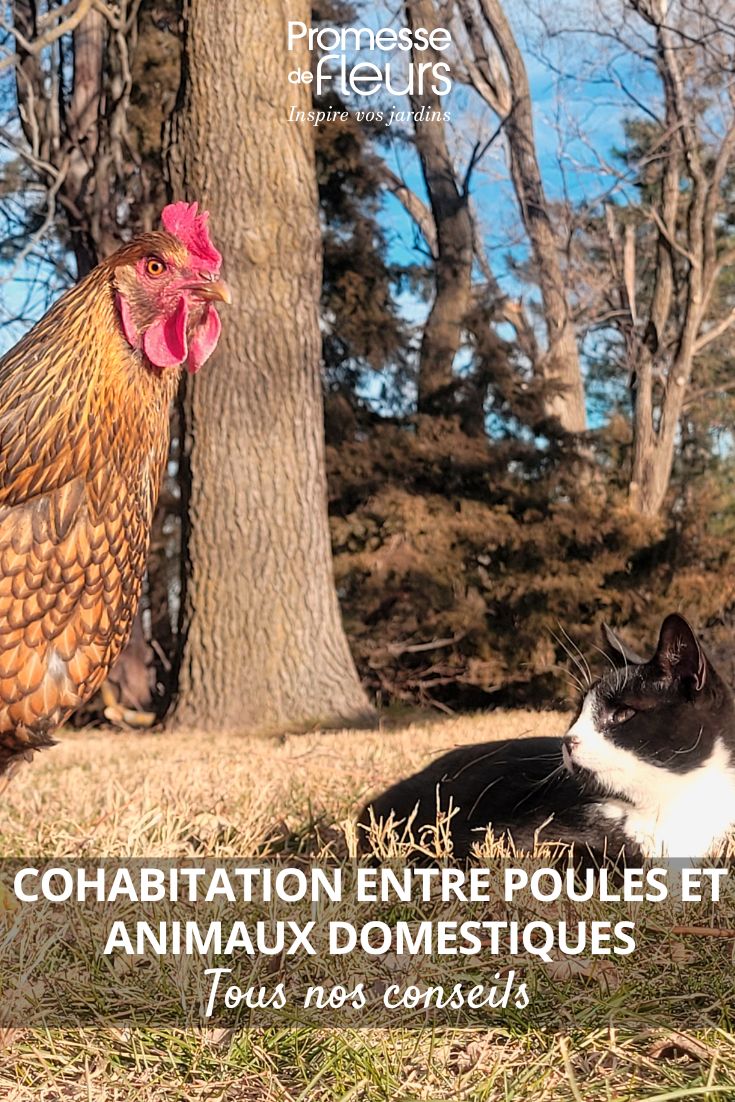
In most households, cats and hens live together without trouble. Once the initial moments of curiosity have passed, each returns to its usual habits. The hens peck around freely while the cat enjoys its own territory, often indifferent to the presence of the new arrivals. That’s the case with me: Romy, my five-year-old cat, adopted around the same time as my hens, has never shown the slightest sign of aggression. When young, Romy had playful urges, quickly checked by a wingbeat. Today, they ignore each other completely, going about their business on the lawn.
And with rabbits, is cohabitation possible?
At first glance, rabbits and hens could share the same space. Yet, their needs differ, especially in terms of feeding. Hens have a varied diet formed of cereals, insects and kitchen scraps, while rabbits require a fibre-rich ration with unlimited hay. If they access the other species’ food, digestive problems may occur.
Another aspect to consider is the health risk. Hens, through their droppings, can transmit certain parasites or bacteria to rabbits. And vice versa. Similarly, rabbits and hens need separate shelters. At night, most hens tend to perch, whereas a rabbit appreciates the comfort of a straw litter layer.
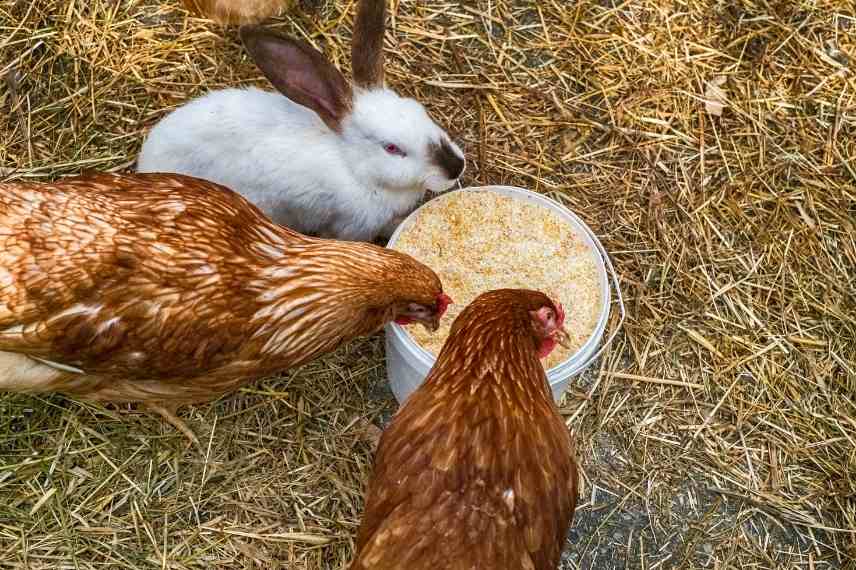
There may be a health risk in keeping chickens and rabbits together
That’s why it may not be advisable to let chickens and rabbits evolve in the same space. Unless you have very strict hygiene management, offer them separate rest spaces and provide well-separated feeding areas. Better to keep them in two separate spaces…
And what about the other poultry and smallholding animals?
Introducing other species of poultry such as ducks, geese, guinea fowl or turkeys to chickens is common practice, but it requires certain precautions. Each species has its character, its needs and the way it occupies space. The basic rule is to have ample space to accommodate all this poultry.
- Guineafowl, very gregarious and very noisy, have a vital need for space. If kept in too close proximity to hens, they can become aggressive.
- Ducks are more peaceful, but constantly seek water points to dabble, which can turn dry ground into a muddy area and disturb the hens.
- Geese, more territorial, will defend their space and can intimidate smaller birds.
- Turkeys, given their size and temperament, require heightened supervision to prevent conflicts.
Managing the pecking order is another key factor. Hens establish a social order among themselves, but this can be disrupted by introducing new species. Dominance behaviours, such as pecking or chasing, can then appear and require careful monitoring, especially during integration.
Health risks must also be considered. Mixing species facilitates the spread of parasites and diseases specific to poultry. Regular veterinary monitoring, rigorous hygiene and well-maintained spaces are essential to reduce transmissions.
Cohabitation between hens and other poultry is therefore feasible, but it must be based on appropriate organisation, impeccable hygiene and respect for each bird’s needs.
- Subscribe!
- Contents
Comments