





























How to have lilies in bloom all summer?
Take advantage of their extraordinary variety
Contents
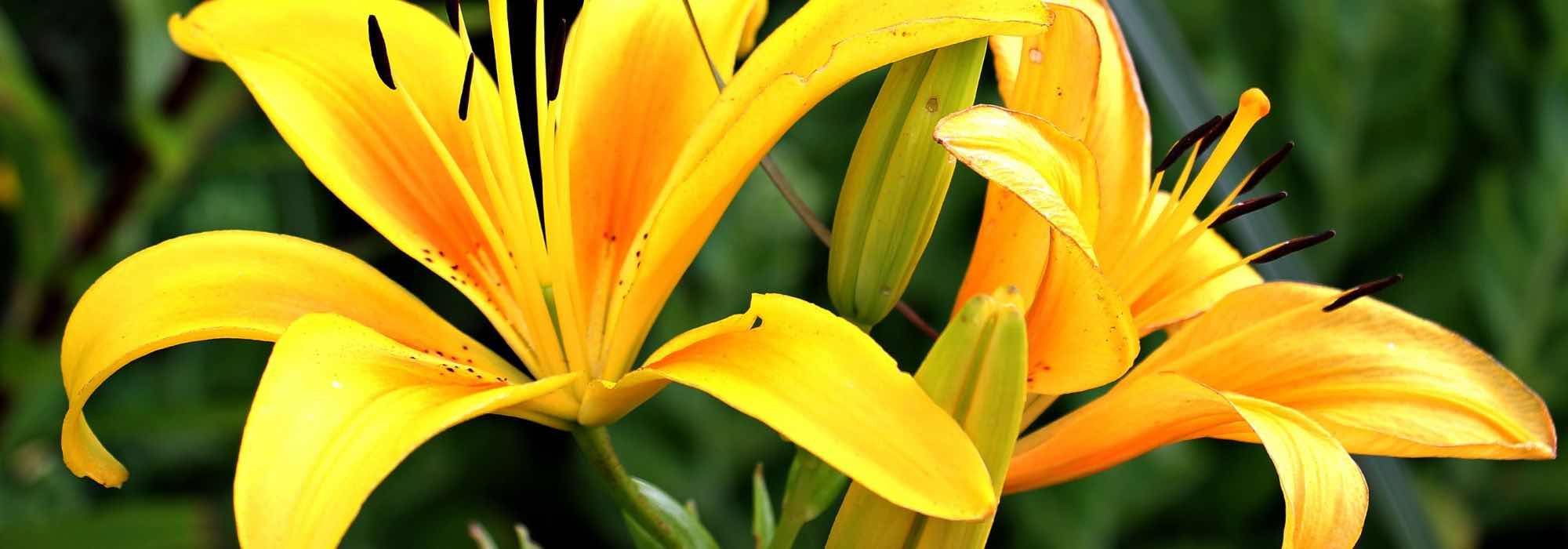
Lilies are elegant perennial plants that add a touch of grace and beauty to any summer garden. Their appeal lies in their delicate petals and vibrant colours, as well as their enchanting fragrance. There are many types of lilies with varying flowering periods. By choosing wisely, you can spread the flowering of your lilies from June to September. They also offer different flower styles, heights, and colours.
If you want to enjoy lily flowers throughout the summer, here are our tips for selecting them, along with some reminders on planting, maintenance, and care for lilies to ensure continuous flowering and optimal health.

Flowering period of lilies
Lilies are available in a beautiful variety of shapes and colours, although the white lily, Royal Lily or Lilium regale, is often highly valued for its purity and timeless elegance. The diversity of lilies means they are grouped into categories: hybrid or Asian lilies, trumpet lilies, botanical lilies, and martagon lilies, each with its own characteristics.
A clever way to extend the flowering period of lilies is to take advantage of their great variety by selecting them according to the timing of their flowering. By choosing varieties with staggered flowering periods, you can ensure continuous blooms throughout the summer season. When purchasing lily bulbs, be sure to check the information provided to know the specific flowering period of each variety and make your selection accordingly.
Here are the lilies classified by their order of flowering initiation according to their category; some categories are mentioned multiple times, as there are notable differences among cultivars within the same category.
Note that these periods are guidelines that vary according to your region and growing conditions.
The earliest (from June):
- The martagon lilies bloom as early as June, and depending on the varieties, until July or August. Their relatively small flowers are pendulous with curved petals. Most often, they are yellow, copper-red, or orange.
- Hybrid lilies, also known as Asian hybrid lilies or oriental lilies. They include many varieties, often in vibrant colours. Some double-flowered Asian lilies also bloom early. Within this large category of hybrid lilies, some are early, while others are not; flowering periods range from June to September depending on the varieties.
- The botanical lilies. These are the species that have existed in a natural state. Again, some bloom early while others do not, so check carefully.
Mid-season lilies (from July):
- The Easter lilies, also known as trumpet lilies or Lilium longiflorum. This category includes the Royal Lily or Lilium regale. They are highly fragrant.
- Hybrid lilies have many cultivars that bloom mid-season. Notable examples include: ‘Pearl Stacey’, ‘Lady Alice’, ‘Garden Party’, and ‘Purple Eye’.
- Some botanical lilies bloom from July. This includes Lilium leithclinii and Lilium pardalinum, for example.
Late lilies (August and September):
- Here we find oriental hybrid lilies and trumpet lilies, double oriental lilies, and botanical lilies. Notable mentions include the double oriental lily ‘Polar Star’, the botanical lily Lilium speciosum ‘Uchida’, or the trumpet lily ‘Muscadet’.
Note: the Coral Lily or Lilium pumilum is the earliest of all lilies, blooming from May to June. A botanical species, it is dwarf and features very pretty small flowers of a lovely coral colour.
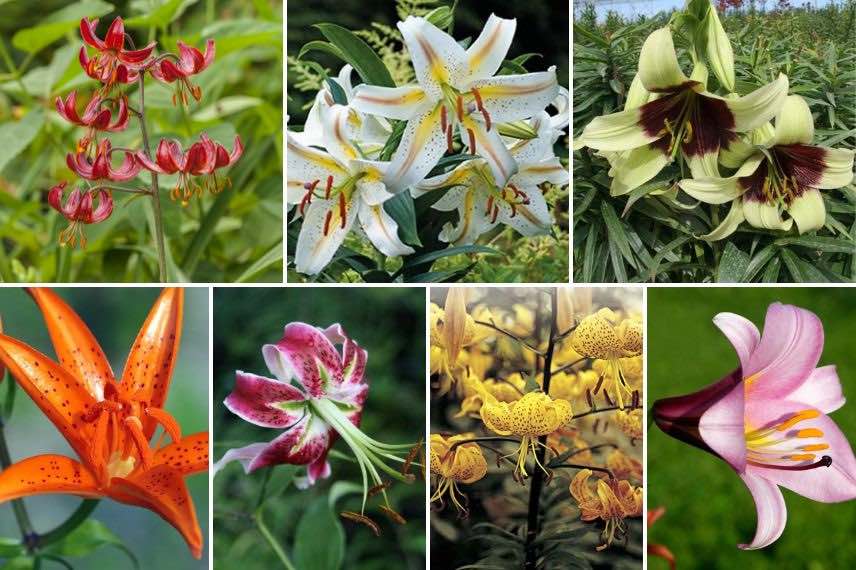
Clockwise: martagon lily ‘Claude Shride’ (June), oriental lily ‘Garden Party’ (July), botanical lily Lilium nepalense (June), trumpet lily ‘Pink Perfection’ (July), botanical lily Lilium leitchlinii (July), oriental lily ‘Black Beauty’ (August), botanical lily Lilium Tsingtauense NU (August)
Planting
Planting lilies is an important process to ensure their good growth and abundant flowering.
The ideal time to plant lily bulbs is generally in autumn, six to eight weeks before the first frosts, in September-October. This allows the bulbs to establish and develop before winter arrives. However, you can plant lilies until spring, avoiding frost periods. This is actually the best time for Asian lilies.
Choose a sunny or partially shaded location, with well-drained soil, sheltered from the wind.
Lilies prefer fertile, slightly acidic soil; add compost or organic matter to improve soil quality. Martagon lilies, on the other hand, tolerate limestone.
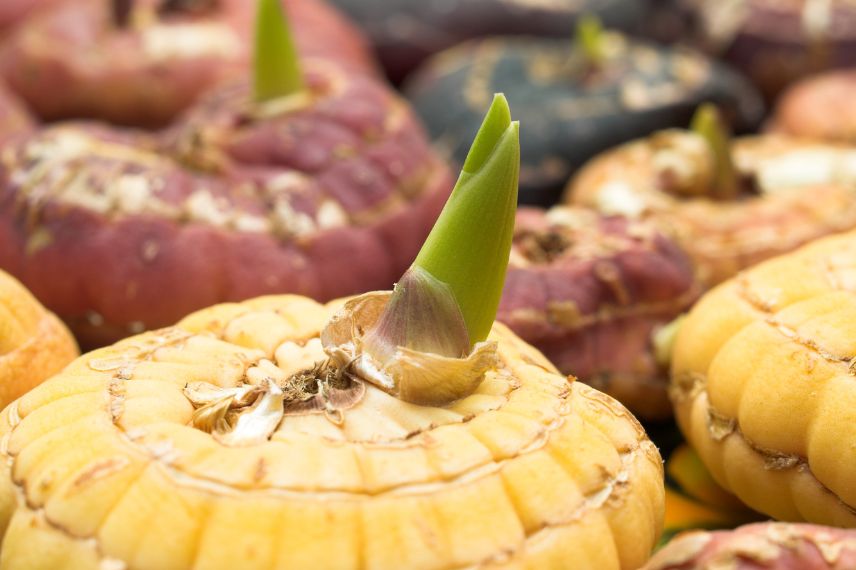
Plant the bulbs at a depth of about two to three times their height and space them approximately 15 to 20 centimetres apart to allow for good air circulation.
Maintenance and care
During summer, proper care of lilies is essential to encourage continuous flowering and maintain healthy plants. Regular watering is important to keep the soil slightly moist, but be careful not to overwater, as excess moisture can cause bulb rot. When watering, ensure that you do not wet the flowers and leaves to avoid fungal diseases.
Fertilising lilies is also important to promote vigorous growth and abundant flowering. Use a balanced fertiliser rich in nutrients, high in potash, such as a liquid flower fertiliser, and apply it according to the manufacturer’s instructions. It is best to fertilise lilies in spring, before the active growth period, and once again after flowering to nourish the bulbs for the next season.
Mulching around lilies can be beneficial for maintaining consistent soil moisture, reducing weed growth, and protecting bulbs from extreme temperatures. Use a layer of organic mulch and apply it around the plants.
Managing diseases and pests is also important for maintaining the health of lilies. Watch for signs of diseases such as bulb rot, leaf spots, or viral diseases, and take appropriate measures if necessary. Common pests of lilies include aphids, for which diluted black soap spraying is most effective, slugs and snails (consider using ferramol or slug traps), and lily beetles (which should be removed manually).
→ See our article on the lily beetle.
After Flowering
Once the flowering period is over, it is important to provide proper care for lilies to ensure their health and flowering next year. After flowering, do not cut the stems immediately. Allow them to wither naturally, as this allows nutrients to return to the bulbs to strengthen their future growth. You can cut the stems when the leaves are completely yellowed.
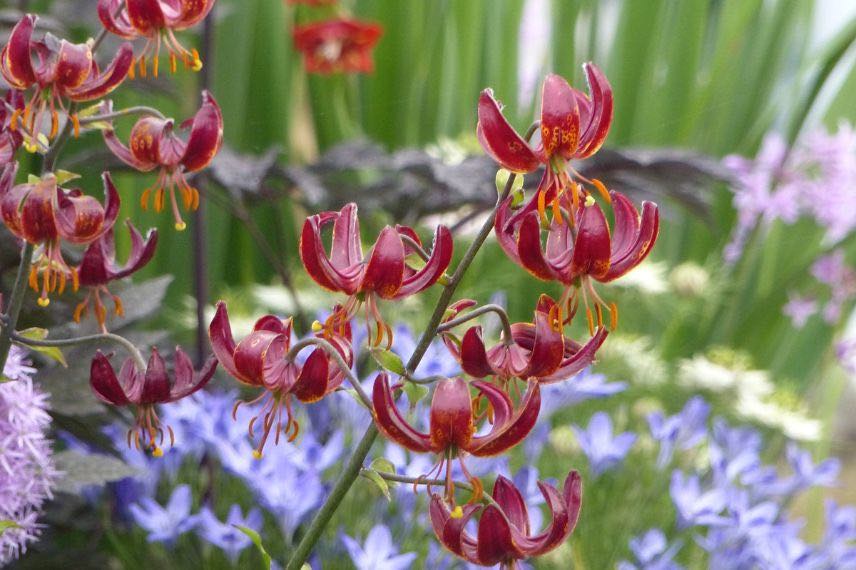
A beautiful Martagon lily in the garden
- Subscribe!
- Contents

Comments