






























How to grow florist's cyclamen?
Our tips for keeping your florist cyclamen and caring for them properly.
Contents
The Cyclamen persicum, also known as Persian cyclamen or florist’s cyclamen, is a small perennial plant that enchants our interiors from winter to spring. There are now several hybrid varieties, such as ‘Scentsation’ and ’Lazer Mixed’, offering fragrant white, pink, purple, or red flowers.
Being frost-sensitive, these small plants are generally grown in pots, except in the mildest regions of the Mediterranean where it rarely or never freezes.
Their cultivation will require some precautions to bloom well. Here are therefore our tips for planting and caring for your Cyclamen persicum, so you can easily keep them from one year to the next.
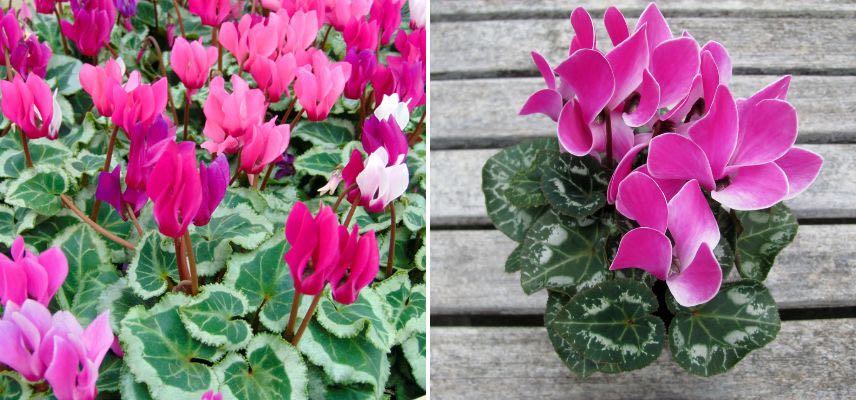
Cyclamen persicum

When to plant florist's cyclamen?
Planting takes place in summer when the plant is in dormancy, between July and September. Choose healthy tubercles that show no wounds or signs of mould. Plant them promptly after purchase.
You can also buy your Cyclamen persicum in pots. Planting can then be done practically all year round. If you wish to grow them outdoors in the rare regions of the Mediterranean that allow it, avoid planting during the winter period.
Finally, sowing from seeds is possible, but you will need to be patient to see the first flowers of your cyclamen. This bulbous plant only flowers after 2 to 3 years of cultivation.
Read also
Cyclamen: planting, growing and carePlanting Cyclamen persicum in pots
The Container
The Persian cyclamen can be grown in various containers: pots, window boxes, troughs… As small plants, they reach about 15 to 30 cm in height and the same in width. Therefore, it is unnecessary to choose a container that is too deep. Opt for a maximum depth of 40 cm (30 cm is sufficient even for mini hybrid cyclamens).
The width of the container will depend on the number of cyclamens you wish to grow, with a recommended distance of 10 to 15 cm between each.
Prefer terracotta containers, as the porous material will allow better aeration of the substrate and limit the risk of rotting the tubercle, which is very sensitive to moisture.
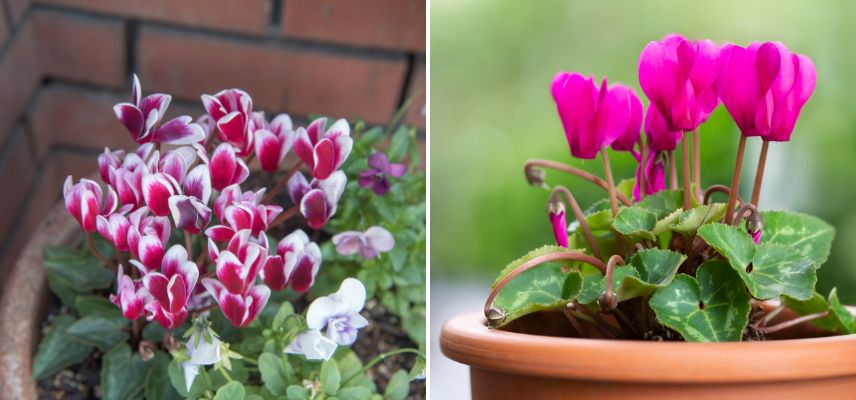
Plant your cyclamens in a terracotta pot
The Substrate
The Cyclamen persicum prefers soils that are rich in organic matter, but especially well-drained, to avoid retaining excess water.
For planting, mix:
- 2/3 of good quality horticultural compost, or potting compost for flowering plants or garden soil;
- 1/3 of river sand, garden sand or gravel to promote drainage;
- a handful of well-decomposed household compost or manure (optional).
Planting
If you have chosen to plant bulbs of Cyclamen persicum, do not hesitate to soak them in a bucket for about ten minutes before planting, to rehydrate them. Their particular flat shape may confuse some inexperienced gardeners: to plant the tubers correctly, place the slightly rounded part down and the flatter part up.
If you have chosen cyclamens in pots, soak them in a bucket or basin before planting to properly rehydrate the root ball.
We recommend growing several cyclamens together to create a more aesthetically pleasing mass effect.
- Install a drainage layer of about 3 to 5 cm at the bottom of your container (clay balls, gravel, terracotta shards, pouzzolane…).
- Fill with the substrate mix.
- Prepare planting holes to a depth of about 5 to 8 cm (you can use a bulb planter for this). The tubers will then be placed in the holes, ensuring they slightly protrude from the substrate when buried. Plant the other tubers about 10 to 15 cm apart. Choose either a staggered arrangement or a straight line.
If you have chosen plants in pots, place the root ball in the container, then fill with substrate.
- Lightly press down with your fingers.
- Water moderately.
Exposure
The Cyclamen persicum naturally prefers shaded or semi-shaded woodland areas.
To ensure good flowering, provide it with a bright location, but absolutely sheltered from direct sunlight. Avoid placing it behind a window that is exposed. Outside of frost periods, it is possible to place your potted cyclamens outside (in a sheltered position from cold winds and prevailing rains).
Indoors, also avoid nearby heat sources (radiators, fireplaces, cooking plates…) and areas exposed to drafts. Our cyclamen will thrive better in cooler rooms of the home than in overly heated ones. A temperature of 12 to 16°C will suffice, avoiding exceeding 20°C.
Once the dormancy period begins in summer, leave your potted cyclamens in a cool but dry place, shaded or semi-shaded.
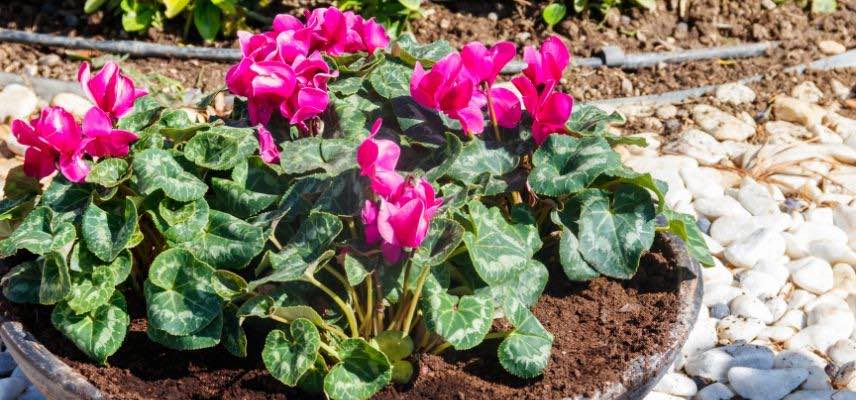
Only take your Persian cyclamens outside when there is no frost and in a sheltered position
Care for Cyclamen persicum in pots
Watering
Watering is one of the key points for successfully growing Persian cyclamen and keeping them for many years.
To keep it simple, the substrate should remain fairly cool (moist but not soggy) during the growth and flowering period. During the summer dormancy period, however, the substrate should be kept well dry. Persian cyclamen do not appreciate humidity at all during the summer.
Water moderately but regularly, as soon as the substrate becomes dryBe sure to avoid wetting the foliage or the tubercle to limit the appearance of fungal diseases to which our plant is sensitive.
Prefer watering either:
- gently around the edges of the container, carefully avoiding the base of the plant;
- by capillarity, filling the saucer and allowing the substrate to soak up the water;
- by immersion, submerging the container in a few centimetres of water until the substrate is moist.
Always empty the saucer after about twenty minutes if there is any remaining water, to limit the risk of tubercle rot.
When the foliage begins to yellow in late spring, stop watering. You can resume in autumn, as soon as the first shoots show the tips of their leaves.
If the flowers droop or lack vigour, this may be a sign of insufficient water.
Conversely, if the leaves yellow and become soft during the flowering period, it is possible that your Cyclamen persicum is overwatered.
Fertilisation
Potted Persian cyclamen will need fertilisation during the flowering period. The substrate depletes its nutrient reserves more quickly than in open ground.
Choose a fast-release liquid fertiliser or a slow-release solid fertiliser (sticks). Opt for suitable fertilisers, such as fertilisers for flowering plants or special fertilisers for containers and pots.
Always follow the usage precautions, which vary according to the products.
Pruning
Remove faded flowers along with their stems as they appear, using a pruning shear. This action helps to extend the flowering period.
Also gradually remove faded leaves.
Repotting and Division
Repotting occurs during the dormancy period of cyclamen in summer, if the plants become less floriferous and seem cramped.
Pests and Diseases
Cyclamen persicum are very sensitive to excess moisture, which can lead to the development of fungal diseases (mould). They are particularly prone to botrytis, also known as grey mould, and fusarium, which affects the tubercle and causes the foliage to yellow.
To limit risks:
- never water the foliage or tubercle of your plants;
- choose a well-ventilated growing area, not too warm (< 25°C);
- avoid excess nitrogen fertilisers;
- remove leaves at the first signs of yellowing or wilting.
Wintering
Florist cyclamen or hybrid Cyclamen persicum are significantly less hardy than some of their relatives, which is why they are often grown indoors. The typical species can withstand temperatures down to about -3 to -5°C, while other varieties can barely tolerate any negative temperatures.
From autumn, bring your potted cyclamen indoors to a room that is not too warm, or winter them in a conservatory or unheated greenhouse.
- Subscribe!
- Contents
Comments