





























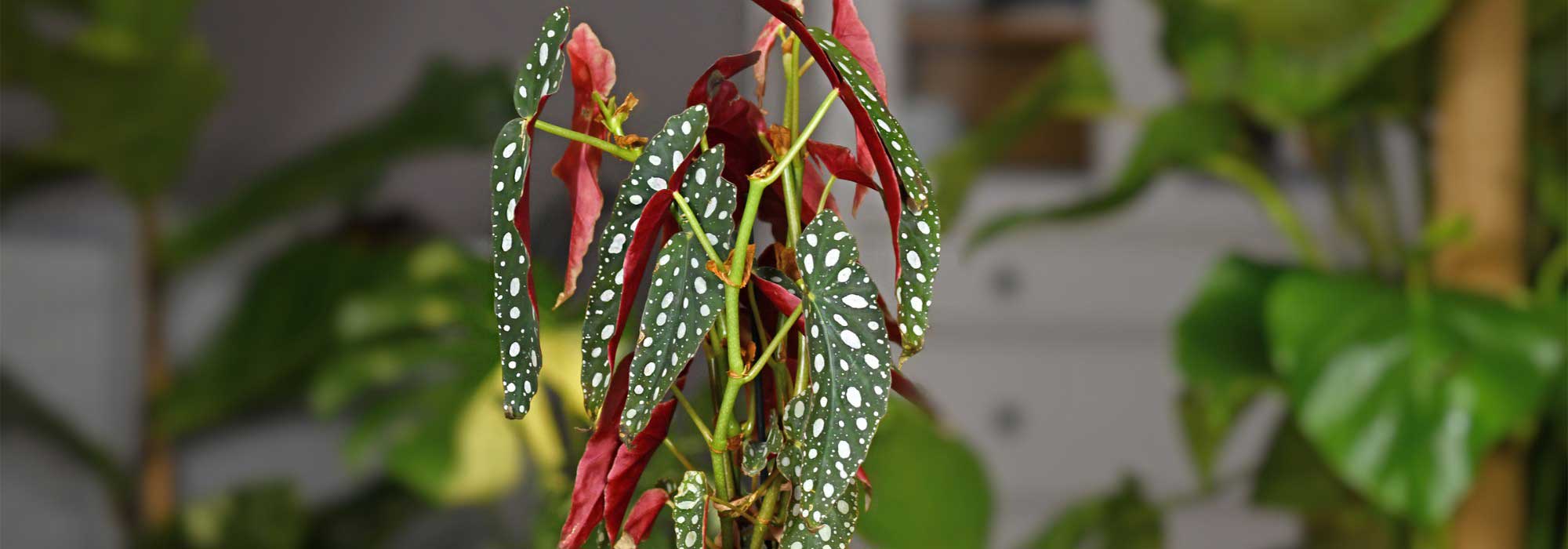
How to grow and care for your variegated or iridescent indoor begonias?
How to grow begonias with decorative foliage?
Contents
Long-forgotten, indoor begonias are making a spectacular comeback. Some begonias captivate with the exceptional beauty of their foliage. Unique, sometimes variegated or iridescent, they are now making waves in the trendiest interiors. Among the various indoor begonias with decorative foliage, Begonia maculata, with its silver spots on a deep green background and its red underside, has become an icon. The Begonia rex captivates with the hypnotic tones of its silvery foliage, tinged with pink or green. These plants command attention in the most stylish interiors — either gathered for a jungle vibe or showcased on their own.
However, these variegated and iridescent begonias require a little more vigilance regarding humidity and foliage care than standard indoor begonias (such as Begonia semperflorens or flowering hybrids). Let’s find out how to keep these indoor begonias going year after year!
What type of pot and what size to choose?
These indoor begonias need a well-drained pot, with a hole at the bottom to prevent waterlogging. Terracotta is ideal, as it allows the substrate to breathe, but ceramic or plastic pots are also suitable, provided they do not retain moisture. No need to go too big: a pot just a few centimetres wider than the root ball is enough. A pot that is too large increases the risk of overwatering.
For our begonias in mini-plants, a quick repot is recommended on arrival. These young plants, still fragile, will benefit from being placed in 7 to 9 cm in diameter pot. This leaves them just enough room to develop their roots without excess substrate, which limits the risk of rot. You can then repot them into a larger pot (about 12 cm) once well rooted.
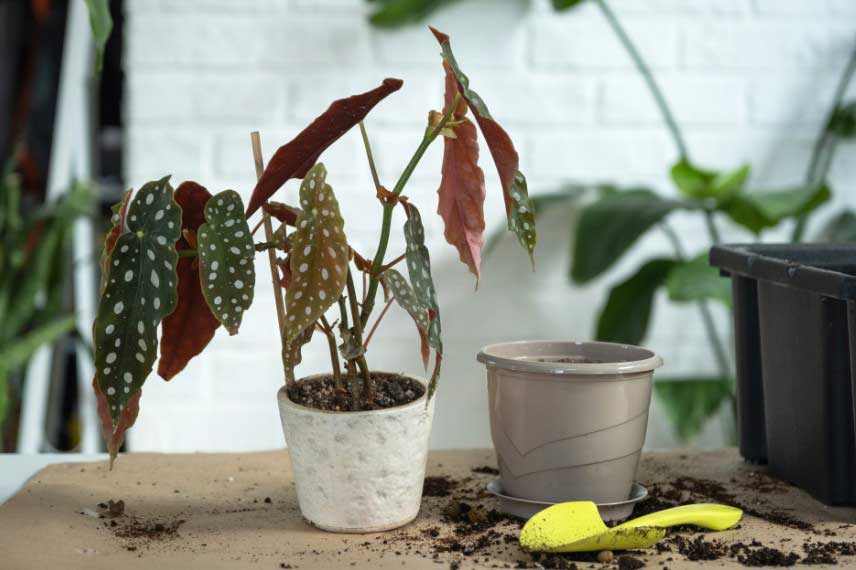
To repot your begonia, choose a pot slightly larger than the previous one, and with drainage holes.
What growing medium?
A soft, rich, yet well-drained substrate is essential for these tropical plants. Mix a potting compost for indoor plants with perlite, coconut fibre or a little coarse sand to ensure good aeration. Adding a layer of clay pebbles at the bottom of the pot is a good practice to prevent excess moisture.
When and how to repot?
When you acquire an indoor begonia, it’s advisable to quickly check the condition of its potting mix and roots. Plants sold in pots are often grown in a temporary potting mix, sometimes compacted or depleted. If the potting mix looks too dense, sticky, or the roots form a visible knot at the bottom of the pot or on the surface, repotting is necessary.
This is also a good opportunity to perform a quick health check: ensure the plant shows no signs of pests or signs of rot or stress.
The repotting of indoor begonia is preferably carried out in spring, at the time the plant enters its growth period. Once a year is a good rhythm for young plants; more established specimens may stay in their pot for two to three years, provided the substrate remains healthy.
How to repot an indoor begonia?
- Prepare the new pot: choose a container slightly larger than the previous one, with a drainage hole.
- Add a drainage layer to the bottom (clay balls, gravel…), about 2–3 cm thick.
- Pour in the potting mix until it fills roughly a third of the pot.
- Place the root ball in the centre, taking care not to bury the base of the stems.
- Top up with the potting mix, lightly firming as you go.
- Leave about 2 cm between the level of the potting mix and the rim of the pot to aid watering.
- Water thoroughly after repotting, then allow to drain well.
- Place a saucer or cachepot to protect surfaces while keeping the plant slightly humid.
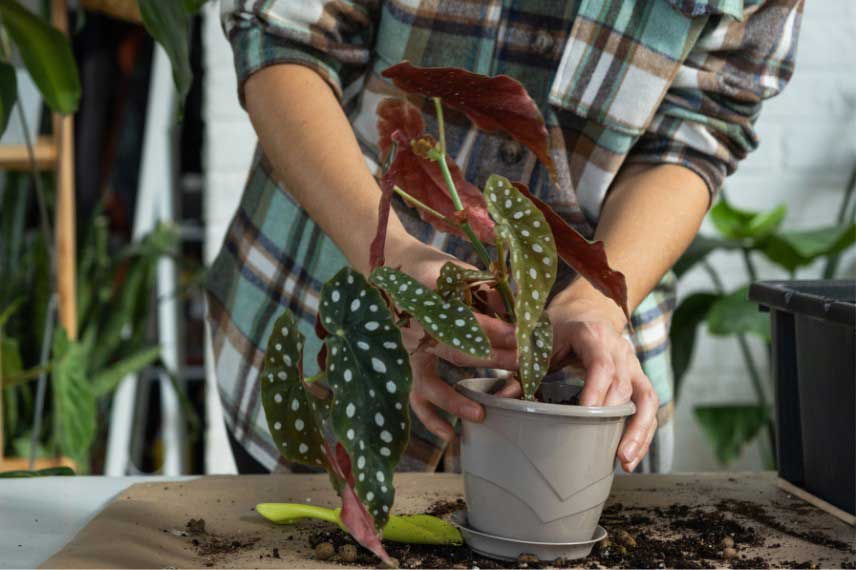
Gently position the begonia in the centre of the pot, fill with potting compost, then water.
What light conditions does an indoor begonia with decorative foliage need?
Indoor begonias prefer bright, but diffused light. For flowering varieties, such as the Begonia semperflorens or certain hybrids, a bright exposure is essential to encourage flowering, with a few hours of gentle sun in the morning or late afternoon.
Variegated and iridescent begonias, grown for their striking foliage, are more sensitive: they must be placed in indirect light, never in direct sun that burns and dulls their leaves. A bright room with a window facing north or east, veiled with a light curtain, is ideal for preserving their colours and reflections without damaging them.
The ideal temperature is between 18 and 25°C, not below 15°C. These indoor plants are sensitive to cold drafts and dry air. To maintain good humidity, place the pots on a bed of damp clay pebbles or group several plants together. An accumulation of begonias and other foliage plants creates a trendy jungle look, while helping to maintain a more stable humidity.
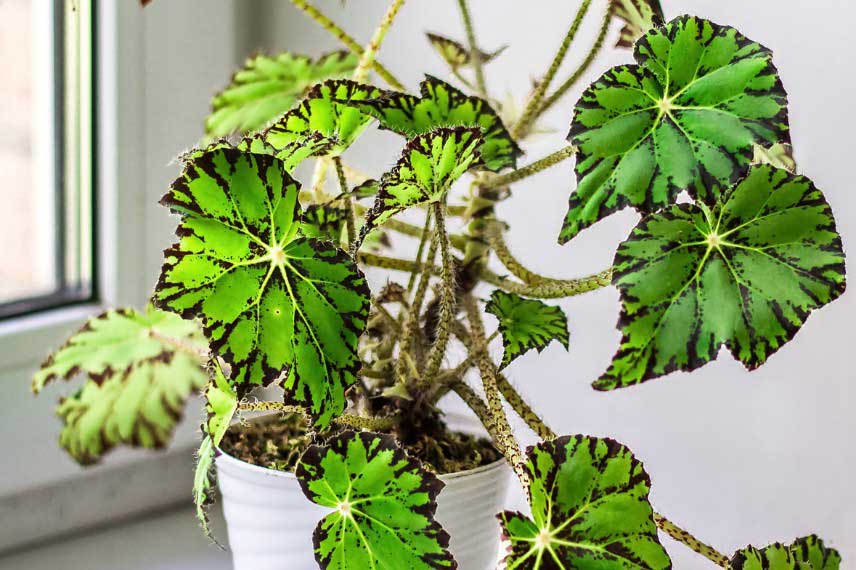
Place the Begonia in a bright spot, but not in direct sun, for example near a window facing north or east.
Watering and fertilising indoor Begonias
These decorative-foliage begonias prefer consistently moist conditions without excess. Here’s how to water an indoor begonia:
Unlike flowering begonias, which require slightly more generous watering during the flowering period and regular applications of potassium-rich fertiliser, variegated and iridescent begonias require more restraint. In summer, one to two waterings per week are sufficient depending on the heat, while in winter watering should be more spaced. Use room-temperature, soft water to avoid spots on the foliage.
During the growing period, from spring to autumn, applying a liquid fertiliser for flowering or foliage plants every two weeks promotes the vigour of the plants; favour a balanced fertiliser, or one slightly higher in nitrogen, to enhance the colours and the sheen of the leaves.
Indoor begonia care
A light cleaning of the leaves with a damp cloth helps remove dust and keeps them looking bright. Regularly remove damaged or yellowing leaves to keep the plant healthy, cutting their petioles cleanly at the base of the stem.
How to prune an indoor begonia :
- Pinch back the new shoots just above a node (where a leaf emerges) to stimulate branching and achieve a denser habit.
- Shorten the stems that are too long in early spring, by pruning just above a node, to restore the plant’s balanced shape.
Diseases and pests
Indoor-grown begonias can be susceptible to root rot if the substrate remains waterlogged. Good ventilation and moderate watering are the best preventive measures. They can also attract aphids, scale insects or mites (red spider mites), especially if the air is too dry. Regularly inspect the undersides of the leaves and act quickly if pests are present, using gentle treatments such as black soap or neem oil.
For more information, read: Aphids: identification and treatments, Scale insects: identification and natural treatments, Red spider mites: identification and treatment.
- Subscribe!
- Contents
Comments