





























How to grow Hoya?
And enjoy its beautiful, fragrant flowering
Contents
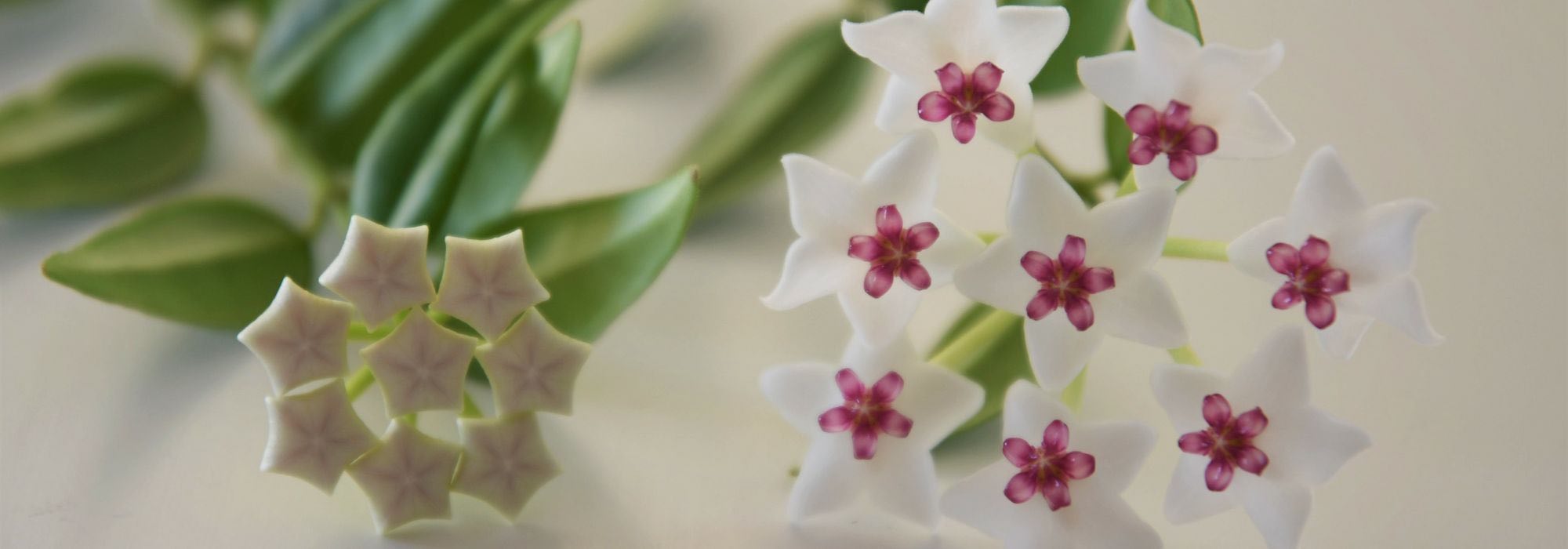
Hoya is a tropical epiphytic plant cultivated here as an indoor plant. There are many species and varieties, including the popular Hoya carnosa and Hoya bella. The Hoya is highly regarded for its stunning, fragrant porcelain flowers, but there are varieties with very interesting foliage. In this article, let’s explore the various steps of growing Hoya indoors: pot, substrate, repotting, exposure, watering, maintenance.
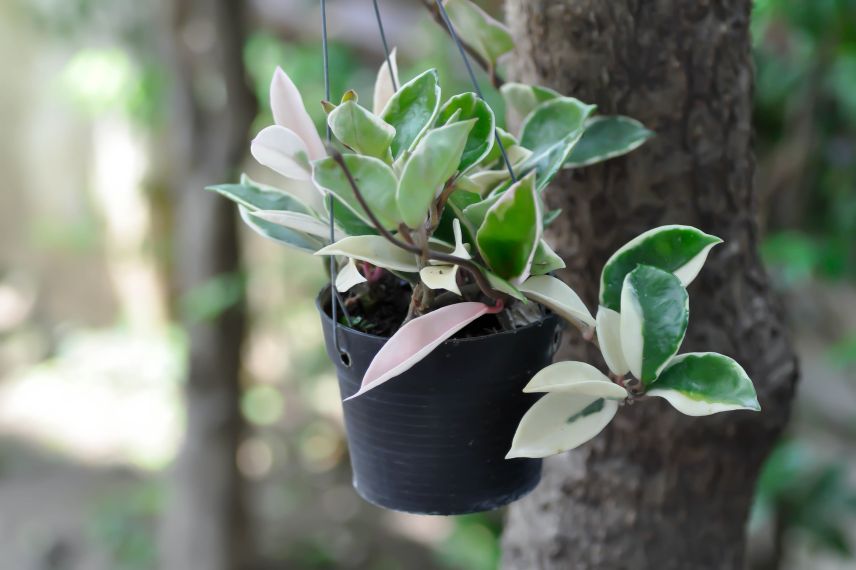
The beautiful variegated foliage of Hoya carnosa tricolor

What type of pot? What size?
The ideal pot for a Hoya is a terracotta pot with drainage holes. As this material is porous, it allows the substrate to dry out more quickly after watering, and thus avoids any moisture stagnation around the roots, for this plant that needs good drainage and a substrate that dries quickly.
That said, if you are using an appropriate substrate (see the following paragraph), and your indoor environment is dry and/or rather warm, you may choose a pot made from any material, and if you use a cachepot, make sure there is no standing water at the bottom of it.
All houseplants enjoy being a little pot-bound, but it’s even truer for Hoyas. Their root system is not expansive; choose a pot that seems too small and the Hoya will be happy in it! Repot it progressively into pots only a few centimetres larger, just one size larger than the previous pot.
Read also
How to take cuttings from indoor plants?Which substrate?
Hoyas are epiphytic plants that, in their native habitat, do not grow in soil, but on bark, which provides maximum aeration and does not coat the roots in a sticky substance that could suffocate them.
Inside, the aim is to replicate this environment by selecting an epiphytic plant potting mix, such as orchid potting mix. You can also mix your own blend, by adding coconut husks, coconut fibre, perlite and blonde peat in equal parts. Moreover, this mix ensures a slightly acidic pH, ideal for this plant.
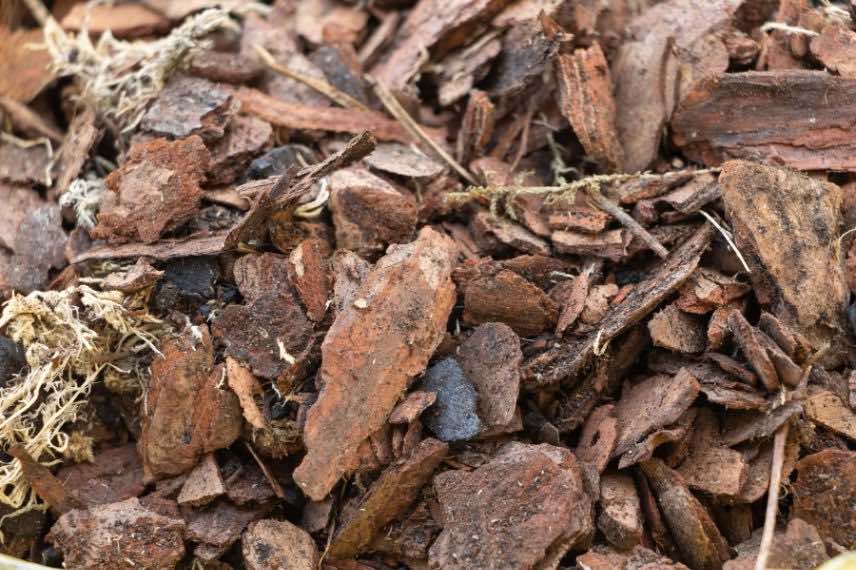
A typical orchid substrate made from bark
When and how to repot?
Hoyas are often sold in potting soil. It is therefore preferable to repot them into a more suitable mix after purchase. In general, there is no need to increase the pot size, but still check that the roots do not protrude from the pot. Take the opportunity to examine the plant carefully, in case it has any parasitic pests.
Next, repotting of the Hoya is necessary when its roots completely fill the current pot, usually every two to three years. Hoyas do not need to be repotted every year, which does not prevent them from sometimes growing quite vigorously. The best time to do it is in spring, when the plant enters its active growth period. However, houseplants can be repotted at pretty much any time of year.
How to proceed?
- Fill the pot to one third to one half full with the chosen mix.
- Place your plant in the pot.
- Pour in the rest of the substrate and gently tamp it down, just enough to stabilise the Hoya.
- Leave about 2 cm below the rim of the pot.
- Water thoroughly the first time, over a sink.
- Repeat the operation to thoroughly moisten the substrate, which holds little water.
- Place a saucer under the terracotta pot and choose a spot that showcases your plant.
Where to place your Hoya?
Hoyas need good light, but not direct sunlight, which could cause burns. They do, however, appreciate a little sun to encourage their flowering. Place them fairly close to a window. If it’s south-facing, shade the sun’s rays with a blind or a sheer. Morning or late-afternoon sun does not need to be shaded, as the sun is weaker. A bright north-facing spot also works, near a large window or under a Velux skylight, for example.
But to benefit from a little sun, a west-facing orientation is ideal.
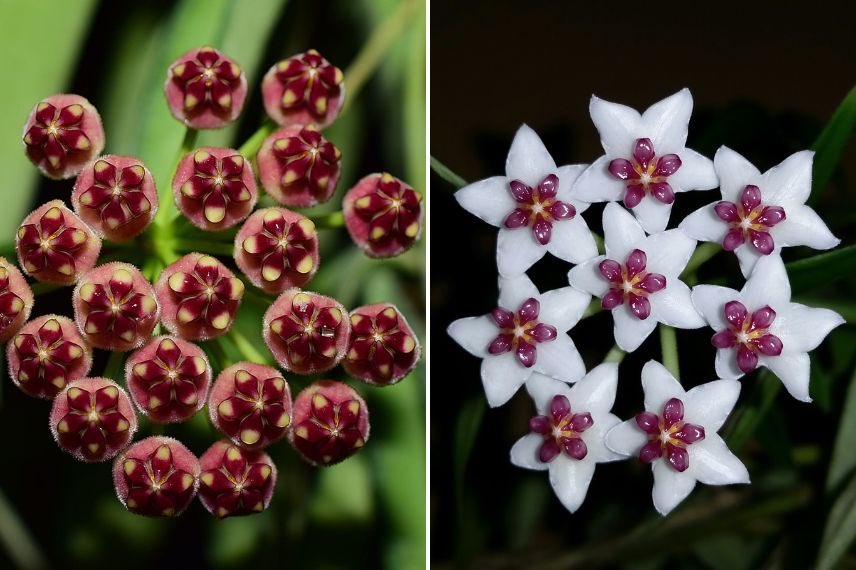
Two flowering Hoyas
Watering and fertilisers
Water your Hoya generously and infrequently.
The ideal is to water over a sink so you can pour water freely to thoroughly moisten the very well-draining substrate. Wait a few minutes and repeat the process.
Adjust the watering frequency to the humidity level of your environment, but in general Hoyas need watering somewhat less often than your other houseplants.
During the growing season, from spring to autumn, start with a watering schedule of once a week to every 10 days, and adjust according to your environment and observations. If it’s hot, increase watering. In winter, reduce the watering frequency.
Fertilise every 4 to 6 weeks with a balanced liquid fertiliser, diluted to half the recommended dose.
You can also use a slow-release fertiliser at the start of spring. Or use vermicompost amendments as a replacement or in addition.
Care
To encourage the flowering of your Hoya, the ideal is to provide it with a little sun and a significant winter–summer temperature difference. If you have a room that is not well heated in winter, this helps create those conditions.
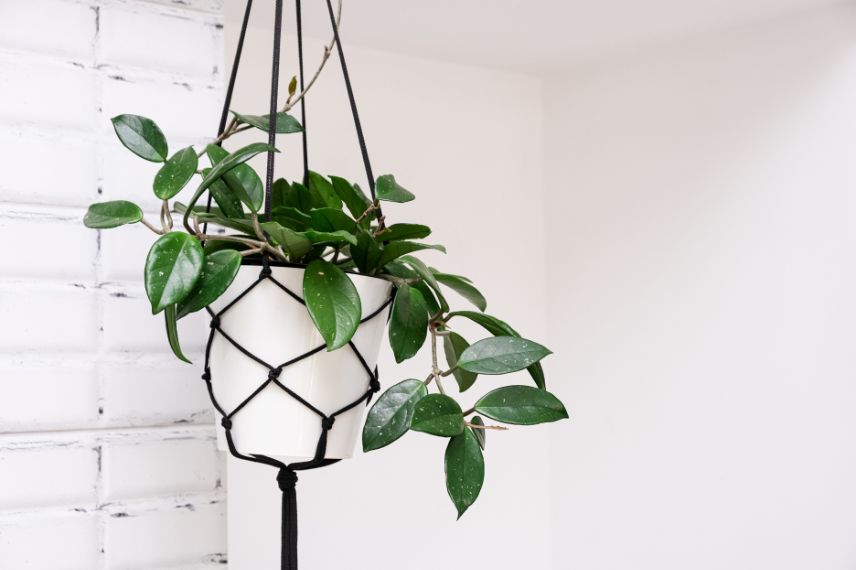
With the right substrate and appropriate watering, Hoyas are indoor plants that are easy to care for and thrive.
Multiplication
The propagation depends on the types of Hoya, but it is often done by stem cuttings in water or by stem cuttings in a sealed bag. It takes several weeks to see the rootlets appear. Then repot into an appropriate substrate in a tiny pot. The young plant then takes quite a long time to develop into an interesting specimen.
Learn more at: Porcelain flowers, Hoya: how to propagate easily?
Diseases and parasites
Hoya is generally resistant to diseases, but it can be susceptible to parasitic attacks such as aphids, thrips or scale insects. Regularly monitor your plant for any signs of trouble. If you notice pests, treat them using organic methods such as insecticidal soap or neem oil.
Learn more about Hoya, the Porcelain Flower.
Read our guide: “Hoya, Porcelain flower: growing and care“.
- Subscribe!
- Contents

Comments