





























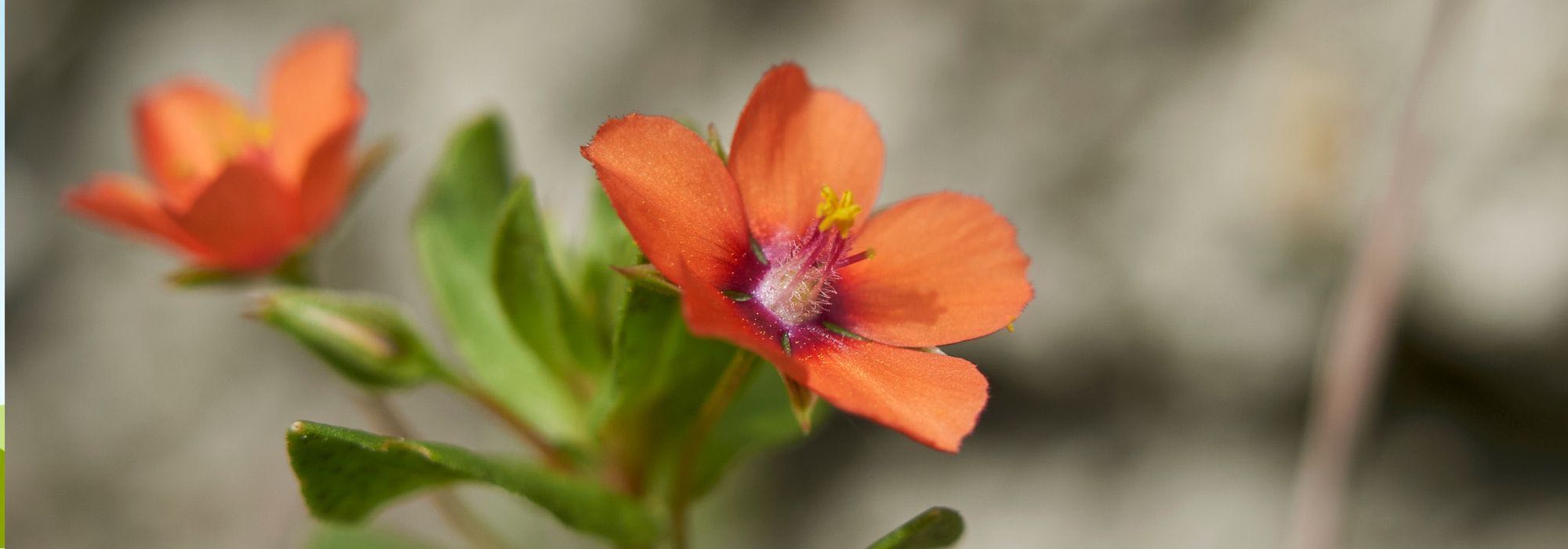
How to get rid of red chickweed?
Identify it, limit its spread in the garden, or eliminate it naturally.
Contents
The red pimpernel (Anagallis arvensis) is a small annual creeping plant that unfortunately spreads quickly, is toxic, and competes with other plants. Due to these characteristics, it is considered an adventive (“weed”), similar to bindweed, couch grass, and creeping buttercup.
However, it is possible to limit its spread or even eliminate it from the garden. Our natural methods will allow you to act without chemicals, but will require a bit of patience and diligence. Let’s explore how to effectively control or get rid of red pimpernel, this invasive plant.

How to Identify Red Chickweed
Identifying the Plant
There are different types of chickweed, which come in various colours. The red chickweed or field chickweed is Anagallis arvensis or Lysimachia arvensis. It belongs to the primrose family (Primulaceae). This is a small annual groundcover plant with a compact habit, measuring between 10 and 30 cm in height. It has small green leaves that are oval or slightly lanceolate in shape, marked with black spots on their inner surface. From spring and for many weeks, this chickweed produces small red flowers with 5 petals, revealing as many yellow stamens in their centre.
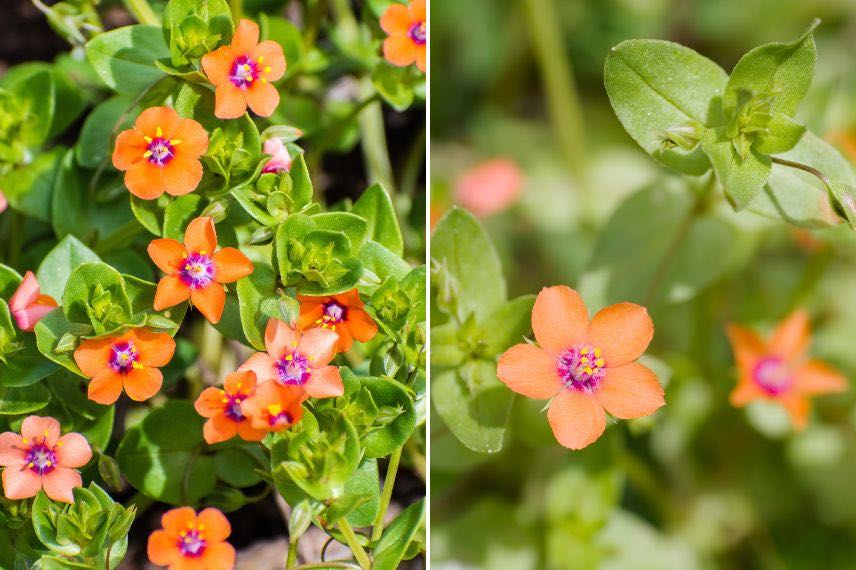
Anagallis arvensis or Red Chickweed
The aerial parts of the plant are sometimes used in herbal medicine. However, red chickweed is considered toxic, as it contains saponin in its seeds. This molecule is harmful to certain pets, such as rabbits, and livestock (although animals tend to avoid consuming it naturally).
The plant known as “bird’s chickweed” or “white chickweed” is actually another species of plants (Stellaria media). For its part, it is edible, often appreciated in foraging for its young shoots that can be used in salads. Its seeds also delight birds, hence its other common name.
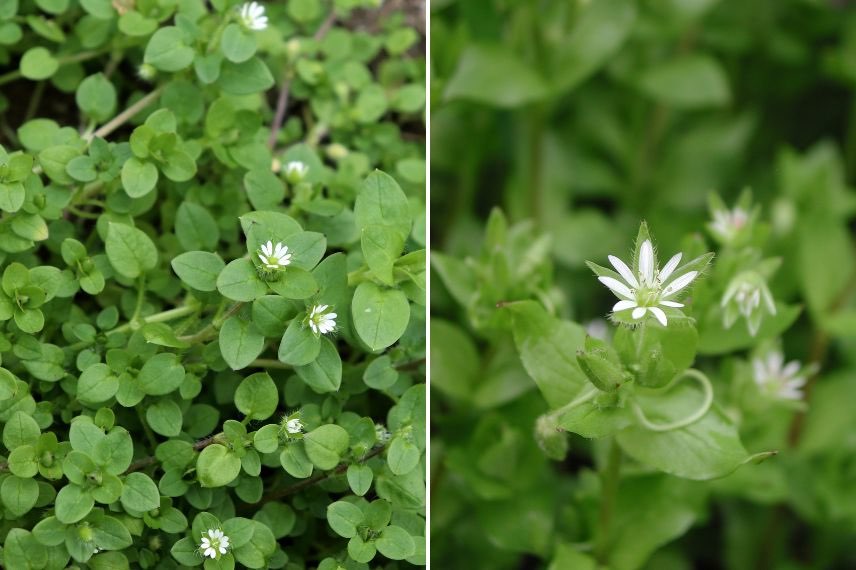
Stellaria media or Bird’s Chickweed. When the plant is not in flower, the foliage resembles that of Red Chickweed
There are also other varieties of chickweeds, valued for their ornamental qualities. This includes the large-flowered chickweed ‘Blue Noon’ (Anagallis monelli) or Monel blue chickweed (Anagallis monelli ‘Skylover’). Both are small Mediterranean annual plants that form lovely flowering carpets in summer. In well-drained soil and in a warm, sunny position, they can also become invasive.
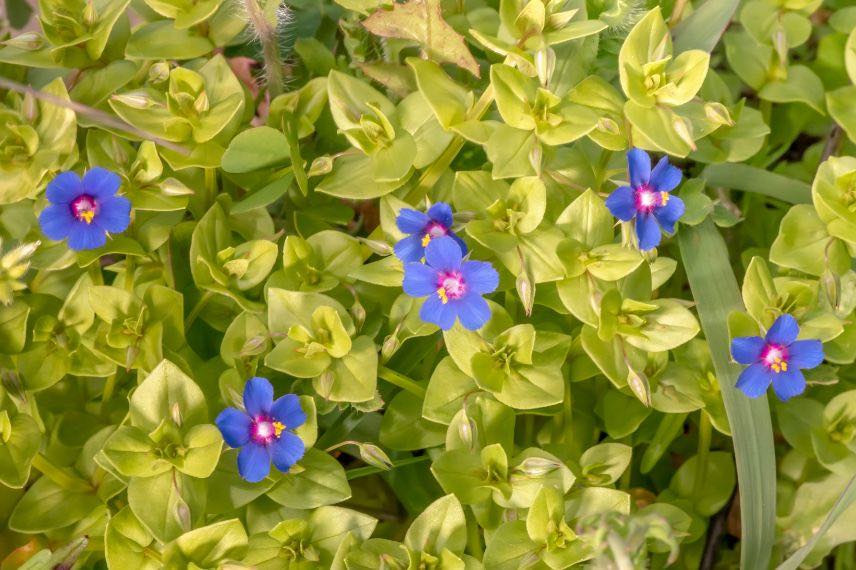
Anagallis monelli, cultivated as an ornamental plant
How Does It Spread?
Red chickweed grows spontaneously almost everywhere. It can be found in uncultivated areas, cultivated fields, on slopes, or along paths. However, it also has a troublesome tendency to colonise gardens, vegetable patches, orchards, and lawns.
Thanks to its fine, creeping stems, red chickweed quickly occupies space, forming a true vegetative cushion. Each stem also has the ability to root easily.
But the plant also uses another method of multiplication, which earns it a reputation as an invasive wildling. After flowering, it produces indeed capsules containing numerous seeds (between 500 and 1,000 per plant), which self-seed spontaneously and facilitate its proliferation. They also benefit from hermaphroditic and self-fertilising reproductive organs, meaning they do not require pollinating insects or wind for fertilisation. This is a case of self-fertilization. Finally, its seeds have good seed viability and can withstand a long period of dormancy before reactivating.
Red chickweed thus competes with other plants, particularly regarding resources such as nitrogen and water.
Read also
How to get rid of goutweed?Limit the spread of red deadnettle in the garden.
To control the spread of red deadnettle and prevent it from multiplying too quickly, you can:
- scratch the soil in spring to weaken the aerial parts;
- remove the flowers before they produce seeds, by scratching the soil or using a mower set to a low height;
- rebalance the soil by reducing organic (manure, compost) or mineral fertiliser inputs, as red deadnettle is a plant that thrives in rich soils.
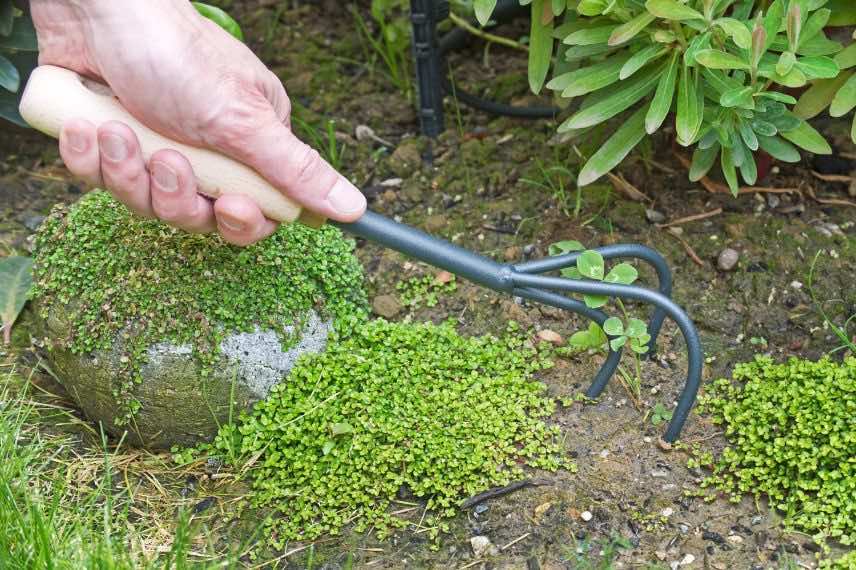
The claw
Eliminate red dead-nettle naturally
While it has the ability to grow quickly, red deadnettle does not have a deep and tough root system, unlike other “weeds.” Its removal, although time-consuming and tedious, is therefore not overly complicated.
We always advise against the use of weedkillers and herbicides, which disrupt soils and are harmful to biodiversity.
Removing the Unwanted
As the roots of red deadnettle are superficial, there is no need to dig too deeply to eliminate it. However, it is essential to remove all creeping stems and roots to avoid any risk of regrowth. Obviously, do not throw them on the compost!
Carry out the removal in spring, when the soil is dry (moist but not overly wet, for example, the day after a rain shower). You can weed directly by hand, or by using a hoe, a weeder or a cultivator.
Repeat the operation throughout the year as soon as new shoots appear.
False Sowing Technique
The false sowing technique is often used in vegetable gardens to prepare the soil by eliminating competition from other plants. It involves preparing the soil as if it were going to receive a sowing of a vegetable or ornamental plant. To do this:
- work the soil on the surface to eliminate all existing weeds;
- rake to achieve a fine and level surface;
- wait for about 10 to 15 days.
As soon as the first shoots of red deadnettle appear, remove them manually.
Mulching
Once the plant has been eliminated, install an organic mulch to avoid leaving the soil bare and to limit the chances of the unwanted plant returning. You may also choose to sow green manure.
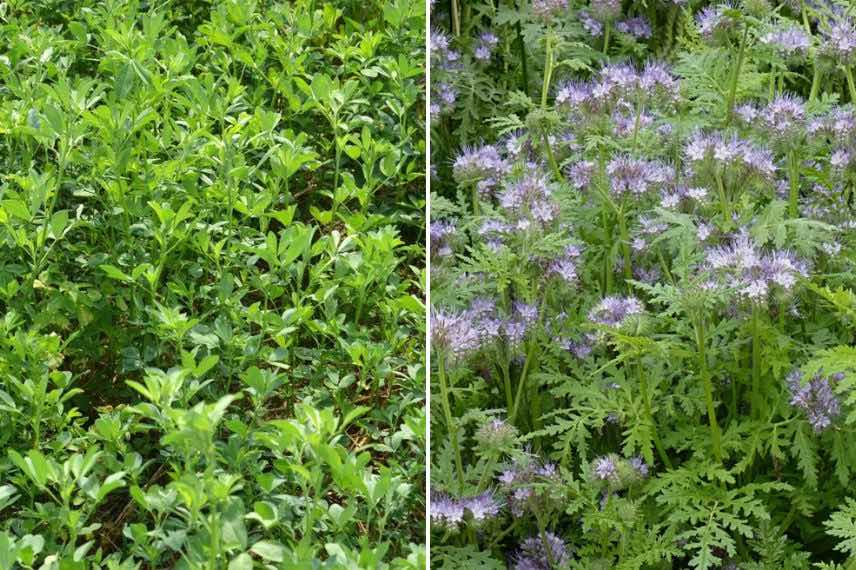
Lucerne and Phacelia are two types of green manure
Grandmother’s Tips
There are several natural solutions known as “grandmother’s remedies” for weeding in the garden: boiling water or water from cooking starchy foods, coarse salt, vinegar, baking soda…
While these techniques are more natural than using herbicides, they are not selective and can, in large quantities and with regular use, ultimately cause imbalances.
Read also
How to get rid of creeping buttercup?Red chickweed, an organic indicator plant
Like most adventive plants or “weeds”, red chickweed is an organic indicator plant, meaning it informs us about the quality of the soil or an ecosystem. These plants reflect an imbalance, often caused by excess (trampling, nitrogen, disturbed soil, etc.). In its case, red chickweed can indicate soil that is too rich in organic animal (manure) or mineral matter, which can even lead to nitrate pollution. In terms of pH, it provides information about soil acidity.
Another piece of information provided by the plant concerns the weather. Acting as a natural barometer, it could help anticipate rain a few hours before the first drops. Its flowers tend to close in response to increased humidity.
- Subscribe!
- Contents
Comments