





























How to fill your garden with flowers on a tight budget using perennial plants?
The best tips for cheap flowers
Contents
Dreaming of a flowering garden but your budget is holding you back? Don’t panic! Adding flowers and bulk to your garden on a small budget is entirely possible thanks to the perennial plants. They are an essential component in flower beds, as important as bushes and trees. But while buying the latter can quickly hurt your wallet, perennials are an inexpensive option for the effect they produce, and often quickly. They are economical, as they come back to flower in the garden year after year with little care. Just be a little patient, as they often take three years to reach their full potential.
It’s worth opting for the easiest perennials, those that will self-seed readily, and those that are inexpensive to buy. We give you all the tips to choose these perennials that will provide lasting colour to your outdoor space without breaking the bank!

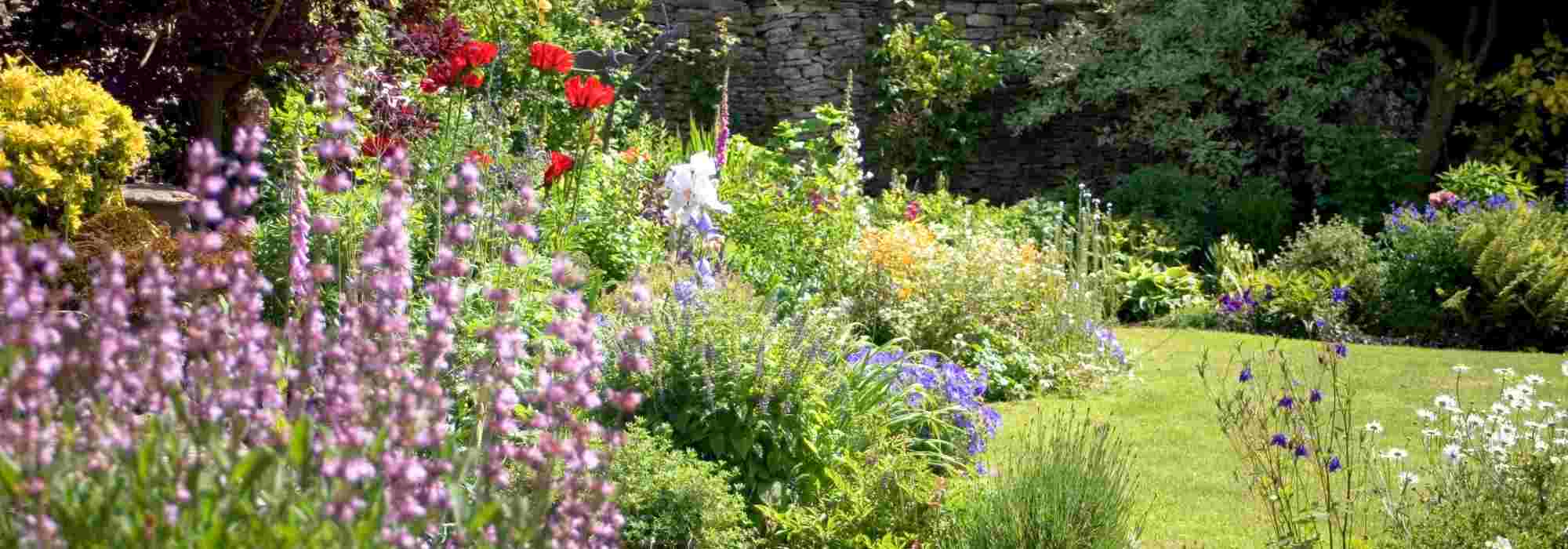
The effect of beds of perennials is spectacular after a few years: a flowering garden at little cost !

The advantages of perennial plants
Perennial plants, as opposed to annual plants that die after their flowering cycle, have a long lifespan, from at least three years to over 20 years… They are economical in many ways:
1/ Long-term savings: perennial plants, unlike annuals, are planted once and for all. You buy them and, for many of them, watch them live and grow year after year, becoming increasingly developed and generous. Which means fewer recurring expenses to replace dead plants!
2/ Savings at purchase: perennial plants are sometimes offered in larger volumes (2–3 L), but generally they are sold in small pot (8 or 9 cm), or even in bare roots. This production method in small containers makes it possible to buy at a lower cost, since the plants are young. And as perennials gradually develop their root system, you only need to wait a few months to obtain often spectacular results. As for bulbous plants, they are generally sold in packs of 3, 5 or 10, which makes the purchase more attractive!
3/ An ideal propagation method: perennials can often be multiplied by division or by sowing, allowing you to propagate them in the garden from a few starter plants without having to spend more!
4/ Ease of maintenance: this is a major asset of perennial plants since, by definition, they enter dormancy in winter, losing all or part of their foliage. They are therefore usually hardy, and only require a light tidy-up in spring, or specific pruning for some. There is also no need to spend fortunes on fertiliser!
5/ Their diversity: countless, there are innumerable perennials worldwide, especially as they undergo hybridization to produce many horticultural varieties. The result? Thousands of plants are available to gardeners around the world, with a selection sure to match our tastes!
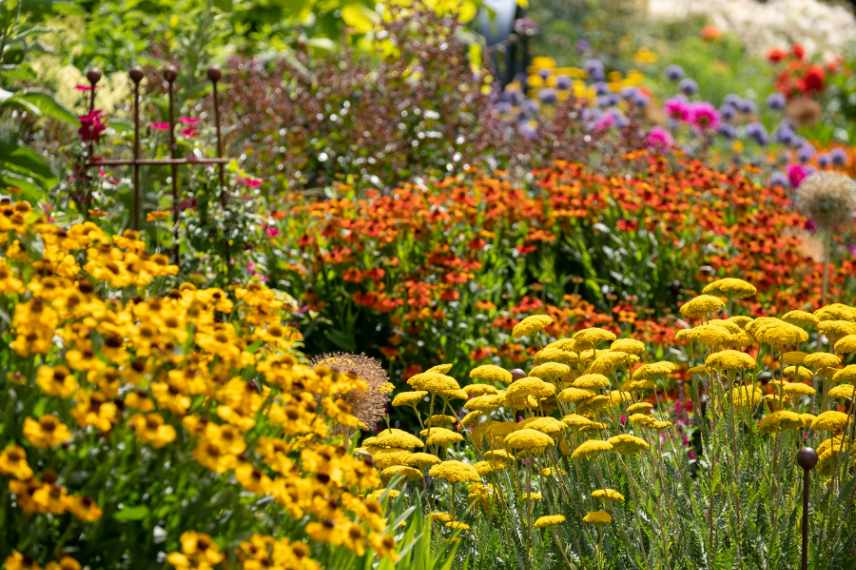
A garden radiant with colour using inexpensive perennials that make a big impact — it’s possible!
Read also
Perennial plants: how to choose?How to choose perennials for a generously flowering garden on a small budget?
Opting for the most opulent perennials, and those that are inexpensive to buy, is a great idea to visually bulk out the garden without spending too much. We will also identify those that are hardy in the cold, so as not to lose them in winter, while favouring those that are easy to multiply.
Hardiness
This is one of the major criteria, because depending on their origin, perennial plants do not all offer the same endurance against the cold, and in an unsuitable climate some may be lost. For example, among bulbs, some that flower in spring are generally hardy, but beware of Agapanthus or Fuchsia that can perish in winter in an unsuitable region. Above all, select your plants according to their hardiness zone (knowing that perennial plants, by the way they operate, are for the most part adaptable across metropolitan France).
Opulent perennials
Some perennial plants are ultra-generous and sometimes develop beyond our expectations. We will of course choose those that fill spaces most quickly in spread, even in height, for an enhancing, volumising effect in the garden. This allows you to plant fewer of them!
Perennials that multiply readily
Among the perennials that will enchant us with their blooms, many are very easy to multiply. By division of the stump, propagation by cuttings of stems or roots, layering, and of course by sowing by collecting their seeds at the end of flowering. These are therefore perfect for producing new clones in beds or pots. There are even perennials that self-seed spontaneously, and bulbs that naturalise brilliantly! Not to mention the spreading perennials, with a running root system, which will quickly colonise a larger area…
Read also: How to divide a perennial? , and our sections Dividing and propagate
Low-cost perennials
These are, as you might expect, those sold in small containers, those available as seed packets, those popular and easy to grow at nurseries, and the indestructible ones! We detail them just below…
→ Learn more with our article: Perennial plants: how to choose? , 8 tough climbing plants for beginners and 20 durable, very long-lived perennial plants.
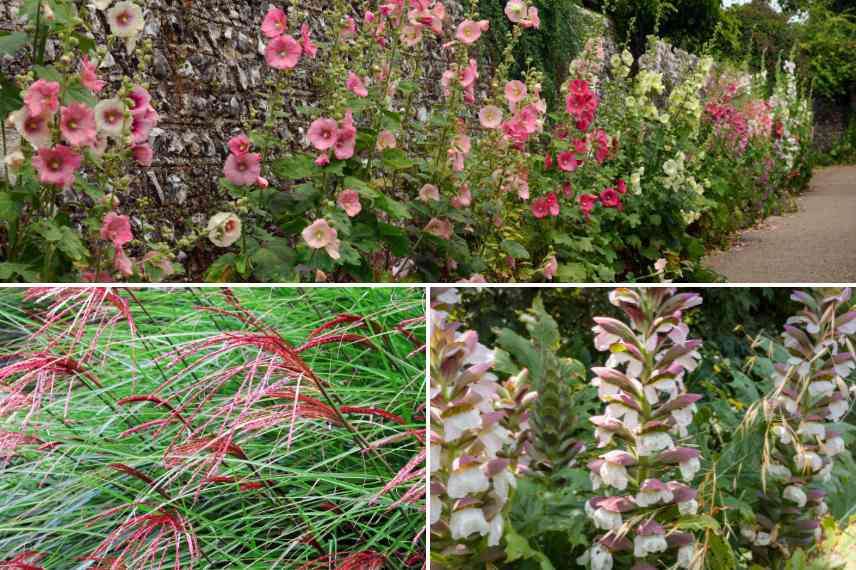
Flowers that self-seed, that add volume and that are cold-resistant: these perennials, inexpensive to buy, we want more of them! (here hollyhocks, Misanthus sinensis and Acanthus mollis)
The cheapest perennial plants
Most affordable to buy
There are many, flowering in all seasons and in a wide variety of colours. Look for the species types (non-hybrid) that are often much cheaper than recent cultivars. Among them:
Alchemilla mollis, achilleas, Coreopsis, campanulas, dianthus, aubrietas, Iberis sempervirens (candytuft), Echinacea purpurea (purple coneflower), lavenders, Phlox and Hesperis matronalis (dame’s rocket), some perennial foxgloves, periwinkles, glechoma, centaureas, and many bulbs including simple tulips and single daffodils…
→ Also see our selection of low-cost perennials and Deliciously vintage: grandmother’s garden plants, simple and inexpensive plants.
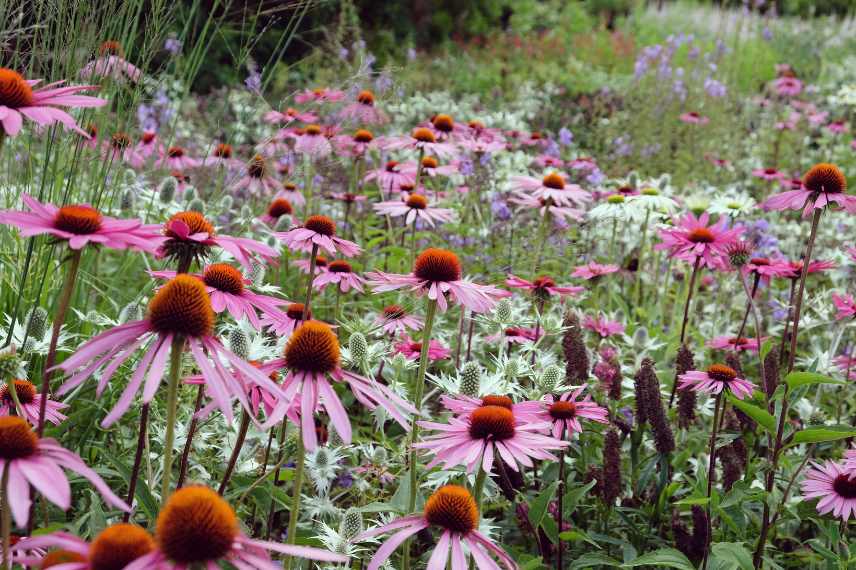
Echinacea purpurea ‘Pink Parasol’ and thistles
Lush perennials
They establish quickly, forming from the first year large colourful clumps (… when planted in ideal soil and exposure, needless to say!). Here are some of the most spectacular within one year of planting, allowing you to buy fewer plants:
Gaura, persicarias, Geranium ‘Rozanne’, Asters and autumn sedums (Sedum spectabile), Nepeta, Rudbeckia, Euphorbias, herbaceous and shrubby sages, Hemerocallis (daylilies), valerians, periwinkles and helianthemums, and among the grasses, for late-season flowering: Miscanthus.
→ Also read: 10 perennials that grow quickly for immediate impact.
Perennials often available from seed or that self-seed easily
Eschscholzia californica (California poppy), Gaillardia, the Dianthus (pinks), aquilegias and oriental poppies, Campanula glomerata, Cerastium tomentosum (snow-in-summer), honesty, etc.
→ Also read: Plants that self-seed and our selection of perennial flower seeds.
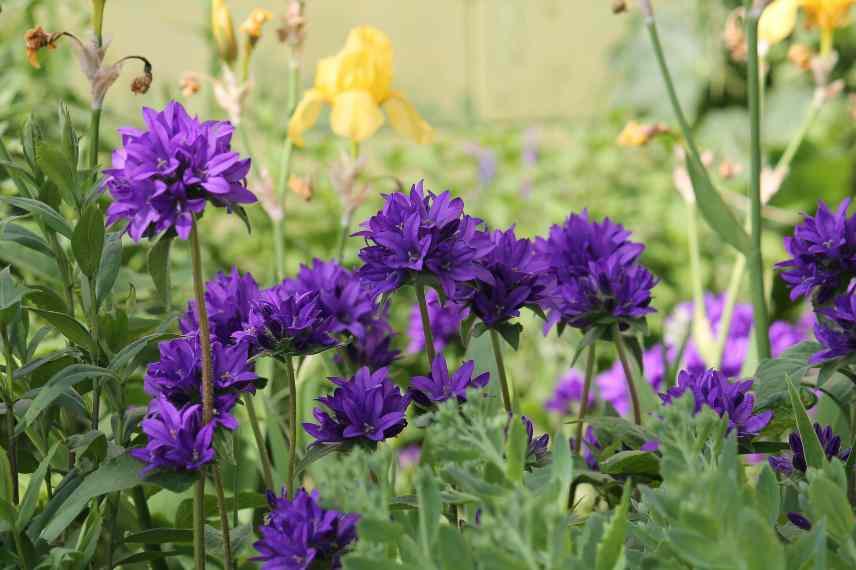
Campanula glomerata
Read also
Self-seeding plantsTips for planting and caring for perennials
With some targeted care, perennials will last a long time in a garden. In terms of maintenance, most require little care:
- Soil preparation: enrich it if necessary with compost or well-rotted manure. Add sand or gravel for any perennials growing in well-draining soil.
- Planting: for perennials in pots, always water by forming a small basin around the plant. Dig a hole twice as wide as the plant’s root ball and equally deep. Untangle the root hair system if necessary. Place the plant in the hole and cover with soil, firming gently. Mulch to keep the soil cool.
- Watering: after planting, water generously. Afterwards, adjust watering according to the specific needs of each plant.
- Pruning: a pruning in May benefits some perennials, making them bushier and denser (this is known as the “Chelsea chop”). Deadheading (pinching perennials after flowering) encourages a fresh wave of flowers.
- Division: often necessary after about 4 years when the clumps become very large.
→ See also: Chelsea chop : 13 perennial plants to pinch, Caring for perennial plants through the seasons.
- Subscribe!
- Contents
Comments