





























How to create a lavender garden?
An aesthetic, sensory garden that is favourable to biodiversity!
Contents
Lavender is one of the iconic plants of the Mediterranean. Its mere mention is enough to transport us to Provence, to the song of cicadas!
This sun-loving bush is particularly undemanding, ideal for creating a dry garden, a gravel bed, or a rockery with spectacular summer flowering.
But lavender also allows to create a garden with a thousand virtues, both aesthetically pleasing, sensory and practical. So let’s see how to plan, maintain and enjoy your lavender garden.
Why creating a lavender garden?
Few can deny that lavender is a plant with plenty of qualities. It offers indeed:
- a distinctive aromatic fragrance, which perfumes the garden;
- an abundant flowering on colourful spikes;
- pretty evergreen foliage with silvery reflections, decorative all year round;
- melliferous flowers, which attract a wide range of pollinating insects;
- versatile flowers, suitable for use both in the home and in herbal medicine;
- an undemanding habit, allowing it to go without watering once established and to cope with heat well;
- good hardiness, allowing it to be grown in most of our regions.
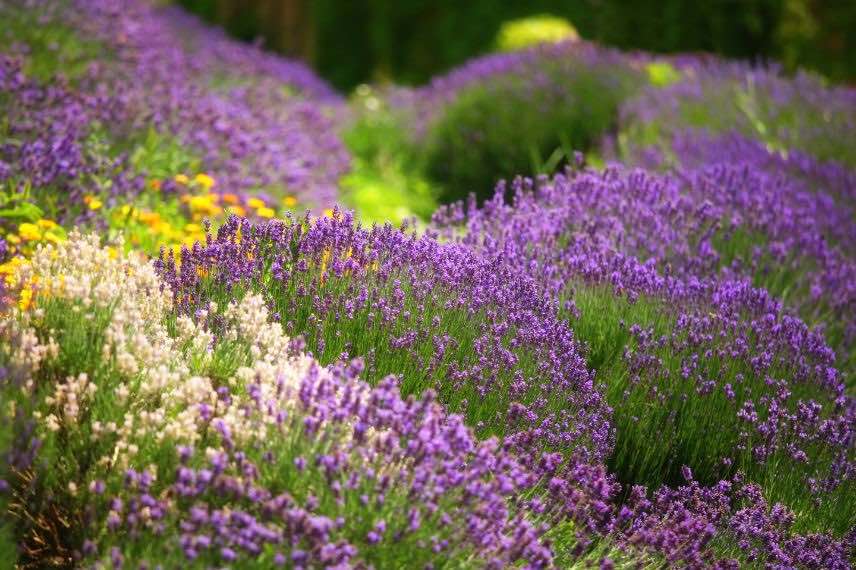
The soothing beauty of a lavender garden
Read also
Lavender: planting, growing, pruningWhich varieties to choose?
If true lavender is best known for its blue-violet flowering spikes, it comes in several shades and there are other colours to incorporate into the garden. You can thus choose to create a monochrome lavender garden, in the Provençal style. But you can also mix two to three colours. Planting can be done in alternating blocks, but also in a tonal range or gradient: first the lavenders with the lightest flowering, then those with the darkest flowering.
Opt for example:
- the Lavandula angustifolia ‘Arctic Snow’ with delicate white-flowering spikes;
- ‘Munstead’, with blue-violet flowers;
- ‘Rosea’, with pink-lilac flowering spikes;
- ‘Dwarf Blue’, with violet-purple flowering;
- ‘Ellagance Sky’, with soft sky-blue flowers;
- ‘Siesta’, with an intense and deep blue-violet colour.
You can also play with the flowering periods, to enjoy the scented spikes for even longer. To do this, pair the early varieties (which flower from May, such as butterfly lavenders butterfly lavender or dentate lavender) with later varieties (which will bloom until autumn, such as the Lavandula (x) intermedia).
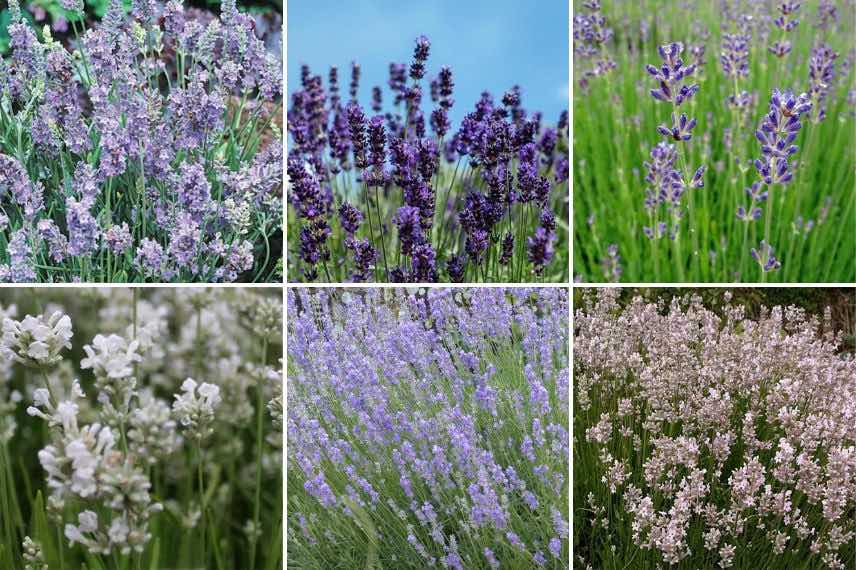
Clockwise: Lavender ‘Ellagance Sky’, ‘Siesta’, ‘Dwarf Blue’, ‘Arctic Snow’, ‘Munstead’ and ‘Rosea’
How to plant lavender?
Before planting
For creating a lavender garden, clearly define in advance the area that will receive your plantings. It can be of any shape: in a circle, in a square, in a rectangle, for row or block planting. You can imagine a bed, a rockery or a bank. A low hedge will, for example, dress the base of a stone wall, while a border will delineate a path with grace. The only imperatives: ensure a sunny exposure, in well-drained soil (no stagnant moisture), even if poor, stony or calcareous.
Note: Butterfly lavender prefers acidic soils and is considerably less hardy than its relatives (around -6°C).
Next, calculate the number of lavender plants you will need, bearing in mind that a spacing of 40 to 60 cm is usually necessary, depending on the mature width of the chosen variety. Allow about 4 to 5 plants per m2. This helps create an ornamental mass effect, while promoting good air circulation to prevent moisture from stagnating.
Step-by-step planting
Lavender is ideally planted in spring, once the last risks of frosts have passed (i.e., between March and May depending on the region). In regions with mild winters (light and rare frosts), autumn planting is also possible.
- Prepare the soil that will receive your lavender plantings. Weed and work it with a spade to loosen it well. Heavy, clay soils must be lightened with river sand, clay balls or gravel.
- Soak the root ball of your lavender in a bucket of water for about ten minutes.
- Dig a hole 3 to 4 times larger than the root ball.
- Place a drainage layer at the bottom of the hole (terracotta shards, clay balls, gravel…).
- Remove the plant from its container and gently tease the roots apart with your fingers.
- Place the root ball in the hole, cover with soil, then firm the soil with your fingers.
- Water at the base of the plant.
- Add a mineral mulch to limit the development of adventive weeds (facultative).
Read also
Lavenders: the most beautiful varietiesMaintaining a lavender garden
Lavender plants are low-maintenance. Water only during the first year after planting. Thereafter, they will be self-sufficient in water. There is no need to apply fertiliser.
Lavender is not susceptible to pests and diseases. Under suitable growing conditions, it can live for up to around ten years.
Just remember to perform annual pruning to help your plants maintain a neat growth habit. To do this, cut back the branches by half to achieve a compact growth habit. Intervene once flowering has finished. For more information: Pruning lavender: when and how?
Use and harvest lavender from the garden
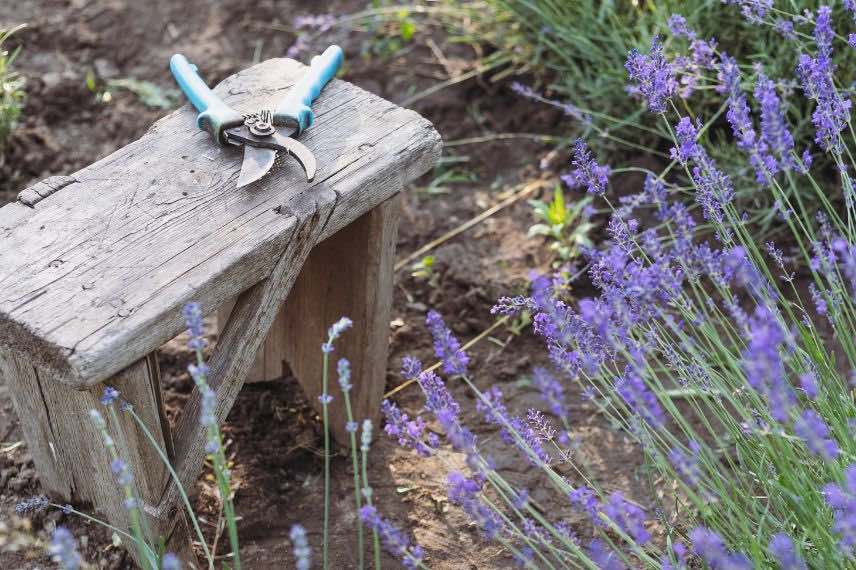
Lavender harvest takes place at the start of flowering, just before the flowers are fully opened. This allows for a more intense fragrance. Proceed before noon, on a dry day. Use a pruning shear that is clean and well sharpened (and don’t forget to leave a few spikes for the precious pollinators!)
Lavender offers a multitude of uses around the home and in skincare.
- Use the dried sprigs to create pretty bouquets or scented sachets (How to dry lavender?).
- Turn lavender into vinegar or syrup, to flavour your dishes and drinks (How to make lavender vinegar? and How to make lavender syrup?).
- Enjoy the natural benefits of lavender in a soothing herbal tea (How to make lavender tea?).
- The making of essential oil or hydrosol requires specific equipment. You can, however, make at home an oil macerate to enjoy lavender’s cosmetic properties. Simply leave the flowers to infuse for several weeks in vegetable oil, away from direct sunlight, before filtering.
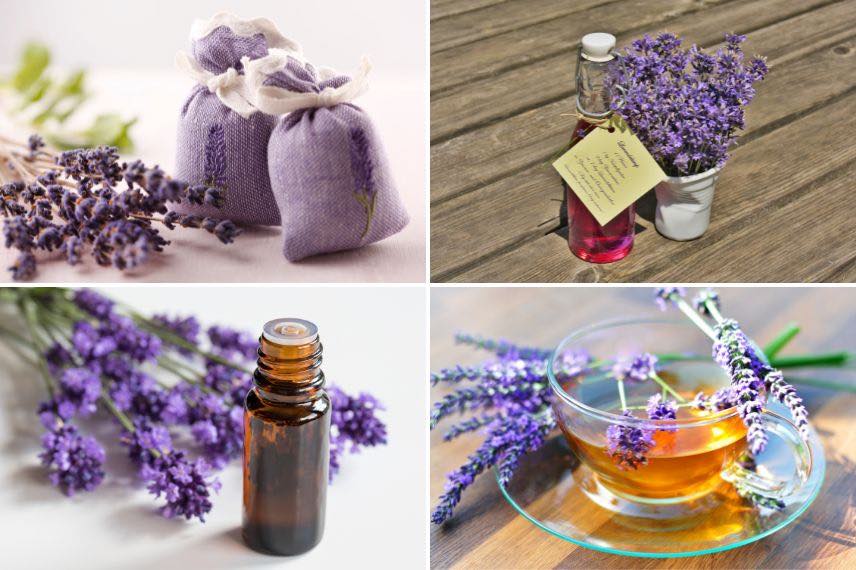
Dried lavender sachets, lavender syrup, essential oil and herbal tea
- Subscribe!
- Contents

Comments