





























How can you protect your chicken coop from stone martens?
Our tips to prevent ferrets from preying on your chickens and their eggs.
Contents
As cute as it is, a weasel can truly sow terror (and death) in your peaceful henhouse. This small mustelid can indeed decimate your small flock of pullets in a single night. And in the morning, discovering your poultry bloodied is a horrific sight. Nevertheless, a weasel, easily recognisable by its slender, streamlined body, is an effective predator of rats, voles and other rodents that swarm around your henhouse.
Discover all our tips and tricks to protect your hens from fearsome weasel attacks.

The stone marten, a small, agile and cunning animal.
Often, the stone marten is associated with the damage and nuisance it inevitably causes in henhouses, lofts and garages… And cohabitation isn’t always easy! Even though you hear the stone marten more often (and smell it more) than you see it. Indeed, it knows how to stay discreet by day, but at night it is not uncommon to hear it trotting overhead as it roams the attic. So who hides behind this adorable little animal with rather sharp fangs?
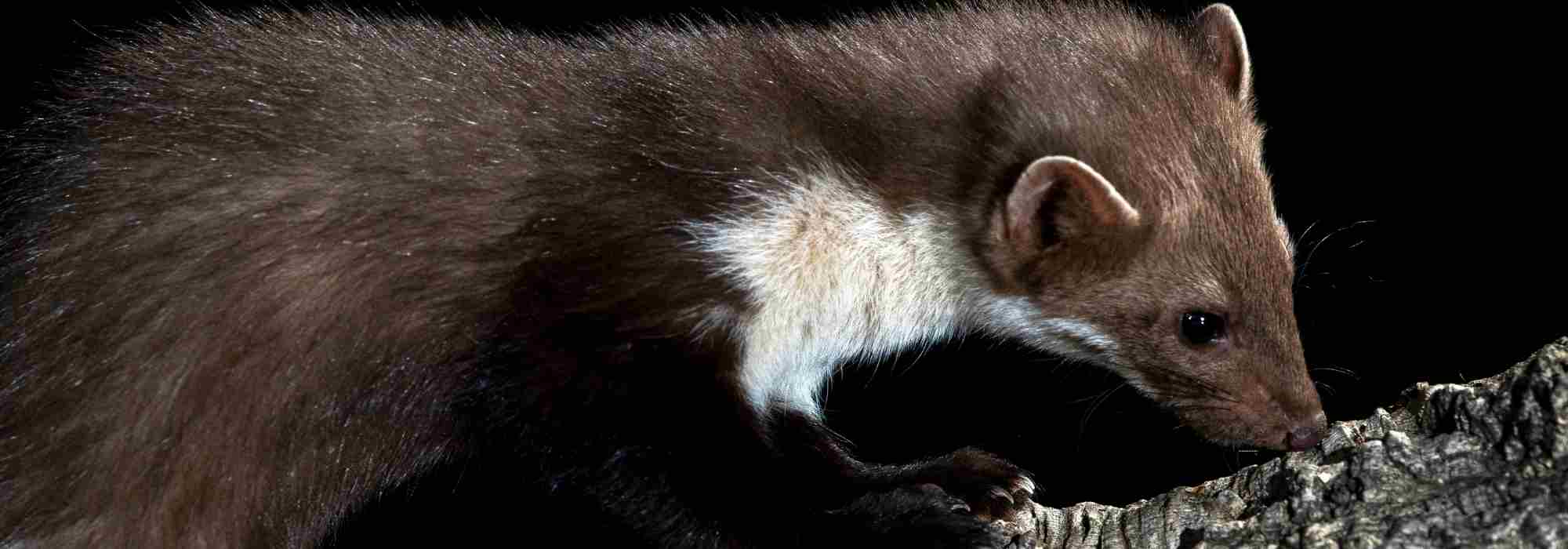
The stone marten (Martes foina) is a small mammal, in the mustelid family, a cousin of the marten and the weasel, with a slender and flexible silhouette. Including its long, bushy tail, it can reach up to 80 cm in length. However, it hardly exceeds 2 kg. It has short legs, a slightly pinkish snout, and a handsome brown coat on its back. But it is above all the broad white patch that covers its venter from the throat that allows us to distinguish it without error.
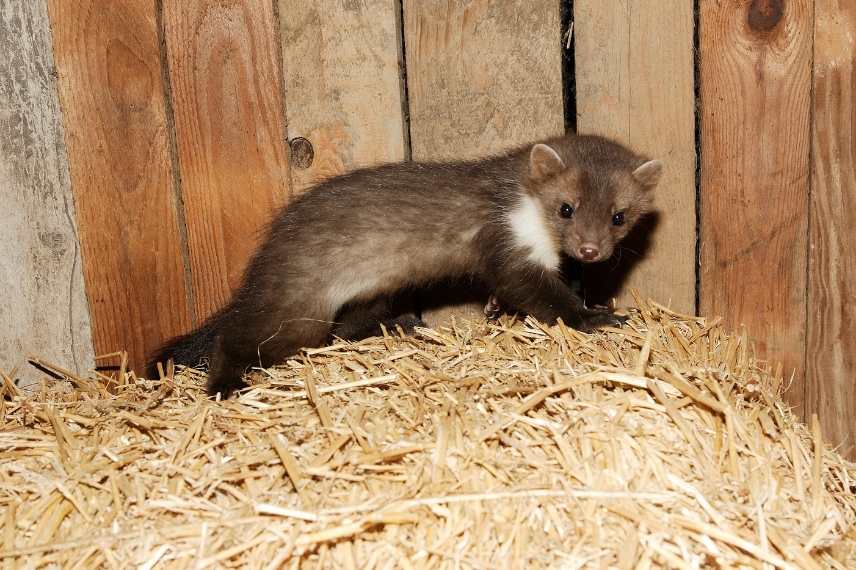
The stone marten is a rupestral animal that lives in woods and hedgerows, near agricultural areas, or close to dwellings where it can find shelter and sustenance. D’ailleurs, the stone marten is certainly the mustelid closest to humans. Simply because human activities destroy its habitat or the natural sites where it used to roam. Similarly, as a major predator of rats, voles, field mice and mice, it has taken to feeding in barns, in henhouses and in stables…
Nevertheless, stone martens also include on their menu garden birds (blackbirds, wood pigeons), nestlings, insects or earthworms, reptiles and amphibians, berries and fruits, or even eggs. One more reason that explains why they are attracted to the henhouse!
Stone martens, formidable predators of hens
The weasel is an animal that is active at dusk or night, in all seasons of the year, since it does not hibernate. And chicken coops are a prime larder for our slender-bodied little mustelid. When you sleep soundly under your duvet, she strikes! That said, she can also attack during the day in an enclosure.
In fact, it’s not so much the hens that attract her (unless she’s in a period of scarcity), but rather the eggs, her guilty pleasure. When the weasel slips into the chicken coop to nibble at a few eggs, she will provoke real panic among the hens asleep, calmly perched on their roosts. For a reminder, it is during the night that the egg she will lay the following day forms.

The weasel particularly enjoys eggs
And these hens that panic, fidget, and cluck all over the place will heighten the weasel’s anxiety, which uses the means at its disposal to defend itself, namely its teeth. Sharp carnivorous teeth that she will sink into the necks of the utterly frightened hens.
The next day, you discover, aghast, the carnage. The hens are bleeding, their heads often severed. Some are decapitated, others die of haemorrhage, with the traces of fangs in the neck, beneath the feathers. The weasel very rarely carries off its prey, especially hens, too heavy for it. However, if she has time, she can eat them on the spot, favouring the head and the entrails.
How to protect your chicken coop from stone martens?
To avoid this nightmare, it’s best to act in advance. It is indeed essential to protect the hen house and the run from the stone marten entering. Given its size and agility, it can squeeze through a hole the size of a tennis ball, or even a ping-pong ball. I’ve read here and there that the stone marten can slip through an interstice with a diameter equivalent to a 2-euro coin. I do have some doubts… By contrast, the stone marten can climb and jump.
To protect yourself against the stone marten, you must secure your hen house and run:
- It is advisable to store your hens’ feed (seeds, a cereal mix, dehydrated insects…) in airtight containers, such as buckets with lids, outdoor black plastic bins, metal tins… This way, rats, mice and other rodents won’t be attracted to this food. A way to limit rodent incursions, but also to avoid attracting stone martens, which particularly relish these prey.
- You should also collect your hens’ eggs daily.
- The run should be enclosed with poultry mesh with very tight holes, around 2–3 cm in size. Beyond this precaution regarding the mesh choice, the mesh should be buried to a depth of at least 10 cm, or anchored to the ground with concrete blocks (leaving no gaps). Stone martens do not dig burrows, but they can easily squeeze under fencing.
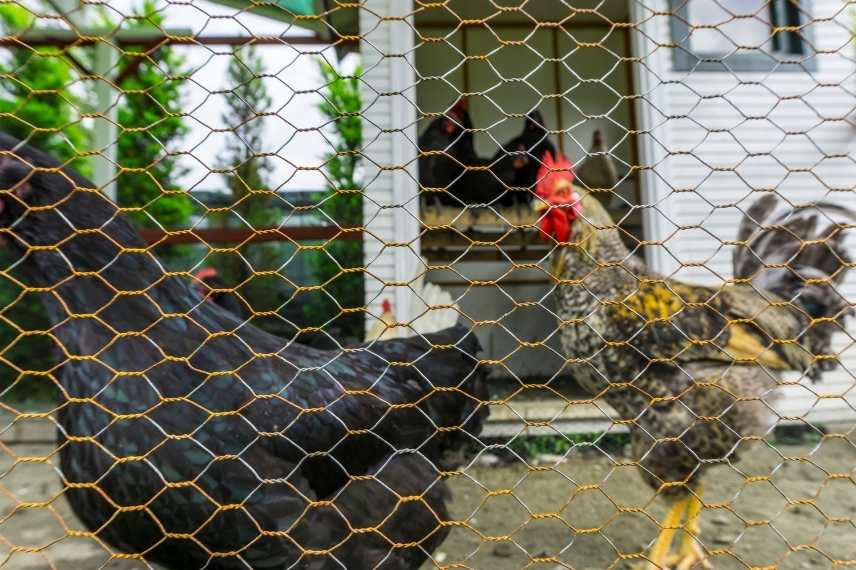 The chicken run should be surrounded by buried fencing, and the hen house securely closed at night
- The chicken run should be surrounded by buried fencing and the hen house should be hermetically closed at night.
- It is also recommended to choose a run at least 2 m high or cover the top with mesh
- It is essential to seal any tiny hole in your hen house, or to seal vents in summer with mesh. Indeed, the stone marten can slip into a minuscule interstice barely visible
- Installing a watering system with a motion detector, recommended by some specialists, is worth trying…
And above all, it is absolutely essential to lock your hens in their hen house at night. Either you shut the door every evening and reopen it in the morning, or you install an automatic door, very handy if you’re away. It can be programmed according to the seasons and your hens’ usual bedtimes and wake times.
Read also
Properly cleaning your chicken coopHow to deter a weasel?
To strengthen protection of the chicken coop and the run, we can also use repellents:
- Human hair or dog hair around the chicken coop.
- Garlic manure sprayed around the chicken coop.
- Peppermint essential oil, lavender or eucalyptus oil, soaked into cloths scattered around the chicken coop.
- White vinegar.
There are also ferret repellents available as sprays or granules on the market, as well as ultrasonic repellents.
These solutions are not foolproof, and it is wiser to thoroughly insulate the chicken coop and the adjoining run.
- Subscribe!
- Contents
Comments