





























Growing sweet peas: from sowing to care
Our tips for achieving a long, beautiful flowering
Contents
How charming scented sweet peas are, timeless in the garden, in the allotment, and even in a pot on a small balcony to conceal an unattractive view and enjoy their divine scents at little cost! They remind us of the plants in our grandmothers’ garden, and are among the easiest climbing plants to grow from sowing. We love the natural flowering of their white, pink and purple shades, perfect in a romantic, English or country garden.
Follow our tips to ensure you succeed with this annual plant of exquisite charm.
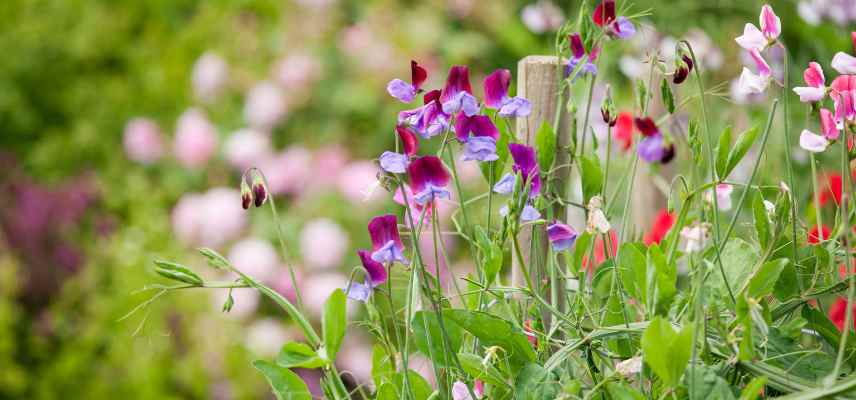
A timeless charm!
→ Learn more about the Lathyrus odoratus in our comprehensive guide: Sweet peas: planting, growing, care and use

Sow them well... and at the right time
Sweet pea seeds are large and, like all seeds of this kind, to ensure a successful sowing remember to soak them the day before in a little water for at least 12 hours.
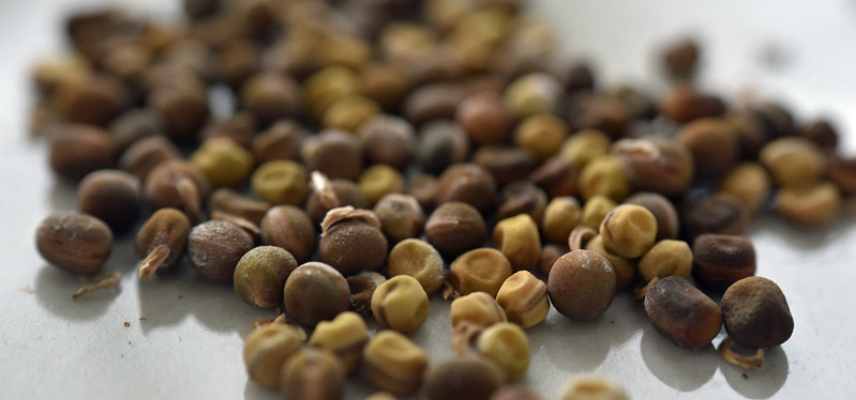
Sweet pea seeds have a thick integument, which should be softened before sowing to ensure good germination (© Conal)
If sowing itself poses no particular problems and is often recommended to beginner gardeners, especially because of these large, easy-to-sow seeds, it is the timing of your sowing that will be decisive for the desired flowering period.
Annual sweet peas are generally sown early in the year, in a seed tray or large pots in late winter (around March), or later directly into the ground, around April or May, after the last frosts. If you sow your seed well in advance in autumn, from September or in late summer, under an unheated shelter, they will flower in May, or even April. You will have pricked out the seedlings from the sowing directly into the open ground from October. This method is recommended for regions with mild winters (Atlantic coast, southern parts of the country).
If you sow your spring sowings on warmed soil, they will flower in summer. In place, in May, you can sow either in pockets of 3–4 seeds, or in rows if you want to dress a long linear boundary, for example. If you transplant your seedlings from indoor sowing (usually done in March), wait 4 to 8 weeks to avoid any risk of frost. In this case, your sweet peas will be a little earlier and will flower around June.
To increase your chances of success and stagger the flowering periods, perform several sowings: some under cover in winter and the other at the start of spring, directly in place.
→ Learn more with our tutorial How to succeed in sowing sweet peas?
Pinch them early to encourage a bushy growth
When your young plants have reached a height of about 10 cm, pinch them to encourage the development of side shoots. This will result in denser, bushier plants, with sturdier and more floriferous side shoots. At that stage, you can move your plants outdoors to begin hardening off (for spring sowing).
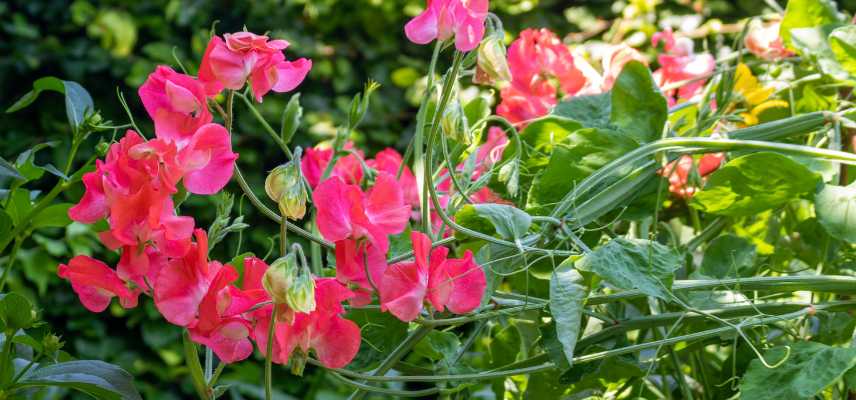
Pinching your sweet peas early helps to produce more prolific plants
Give them some freshness
Sweet peas love soil that stays cool! It is worth bearing this in mind before you start growing them. They thrive particularly well in English gardens or in the north of France. If they need sun, partial shade is possible, but always in humus-bearing soil, rich, deep and well-drained. They perform best in clay soils that are slightly calcareous.
At planting, prepare the soil well by loosening it and adding organic matter: incorporate into the soil a well-decomposed manure or compost, which will feed them and help keep the soil cooler.
When they are in full flowering, it is essential to keep the soil consistently cool. A drought, even momentary, slows the formation of flower buds and halts flowering. Note that they do not tolerate prolonged heat; this reduces their growth and development. So in southern regions, you will plant them in partial shade. As for watering, do it ideally in the morning, at the base of the plants, to avoid exposing your sweet peas to cryptogamic diseases such as downy mildew or grey mould. This will also help deter gastropods that come out at night and, unfortunately, love them and often attack young plants.
Finally, think to mulch the soil to keep the base of your sweet peas cool, and do not hesitate to surround them with numerous perennial plants to create a sufficiently cool spot.
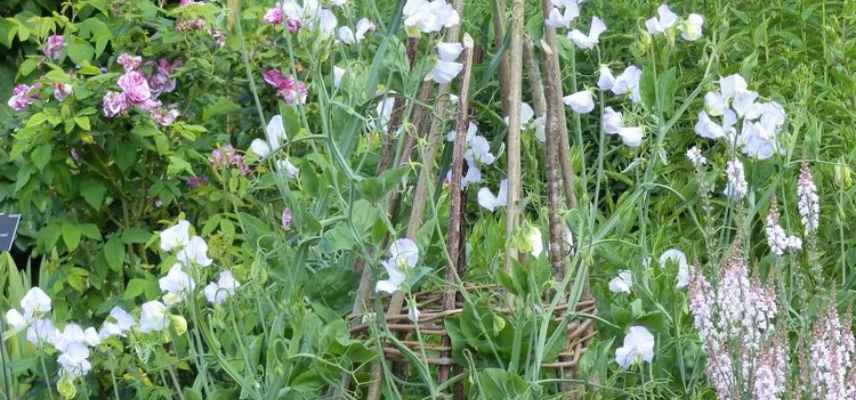
Sweet peas need coolness at their base: a few perennial plants around them will help too
Read also
Sweet peas: the most beautiful varietiesProvide staking
Lathyrus odoratus have voluble tendrils enabling rapid growth of the plant. A climbing plant that can reach up to 3 m in height, the annual sweet pea merits good staking to showcase its flowering that spreads along the length of the stems. However, you may also prefer to keep it creeping, running along the ground to dress a somewhat wild-looking area.
Bush-grown plants require support in the form of pea trellises (three bamboo canes arranged in a tipi) or a supporting mesh that will blend into the greenery (such as chicken wire). It is useful to guide them at the start of their growth, when they reach about 15 cm in height. Help them with a bit of raffia. After which, they will manage on their own.
If you decide to train your sweet peas more as a climbing plant, to dress fences, country-style barriers and boundaries, use a fine mesh along a wall or strings stretched between bamboo canes to make a single sturdy stem climb per plant. A handsome obelisk is a lovely way to showcase tall-growing sweet peas.
→ All ideas for support can be found in our article: How to train sweet peas to climb?
Some varieties such as Lathyrus odoratus ‘Bijou Varié’ are weak climbers and rather compact. Be sure to check the dimensions and heights of the horticultural cultivars, as not all are equally tall. And for the shorter ones that do not require staking you can even grow them in hanging baskets on a balcony, for example.
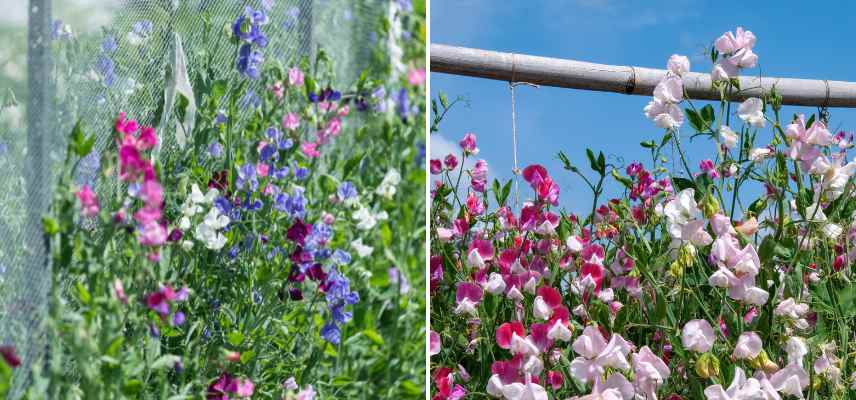
Remove wilted flowers to prolong flowering
As with many annual and perennial plants, sweet peas extend their flowering for weeks into October when faded flowers are removed by pruning (this is known as ‘pinching’ or ‘tip pruning’). If you forget to do this (you should also pick up pods already formed that may have escaped you), flowering is simply halted in its tracks, seed set stopping the return of flowers during the summer. Prune the flowers as soon as they begin to wilt, taking care to do so with a pair of clean scissors or a clean pruning shear, or simply with your fingernail. Get into the habit of regularly inspecting your sweet peas to carry out this pleasant little task, all the more so as you’ll enjoy using these prunings to make lovely summer cut flower arrangements that will scent the home.
To collect seeds, do so in late summer, keeping a few dry pods, more than enough to ensure next year’s sowing.
Alexandra also explains it in How to prolong the flowering of sweet peas all summer?
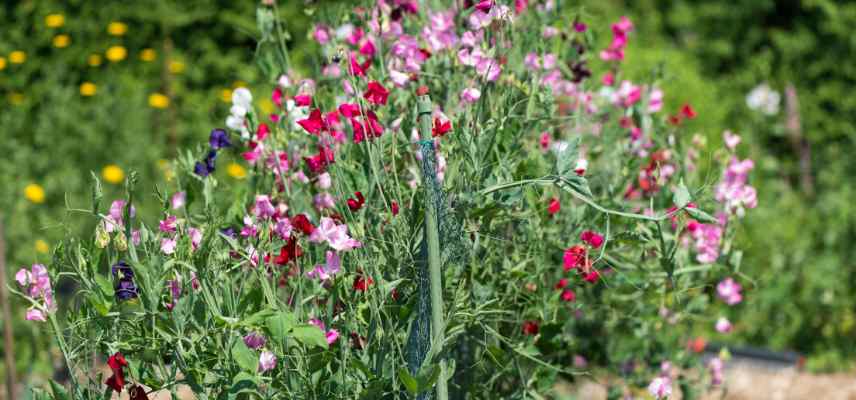
Feed potted plants
A regular application of liquid fertiliser is recommended to ensure the quality of shoots and flowering, especially for pots. Apply a liquid fertiliser for flowering plants, such as geranium fertiliser, every 15 days to your pots and window boxes or hanging baskets.
Don't be disappointed with the fragrance!
Finally, when people say sweet peas, do you mean fragrance? Well, no… not always. The perennial sweet pea (Lathyrus latifolius), on the other hand, is not scented.
To avoid disappointment with the fragrance of your sweet pea, if fragrance is the primary quality you are seeking, learn to tell apart the scented species from the others, just as pretty, but without fragrance. The different cultivars will also be more or less fragrant. The most fragrant sweet peas often have smaller flowers. For example, choose ‘Matucana’ with beautiful purple flowers, the Lathyrus odoratus from the ‘Spencer’ series, the sweet peas Fragrantissma, or ‘Mammoth’ and ‘Painted Lady’.
Learn more at: Fragrant sweet peas: the most fragrant varieties.
- Subscribe!
- Contents
Comments