





























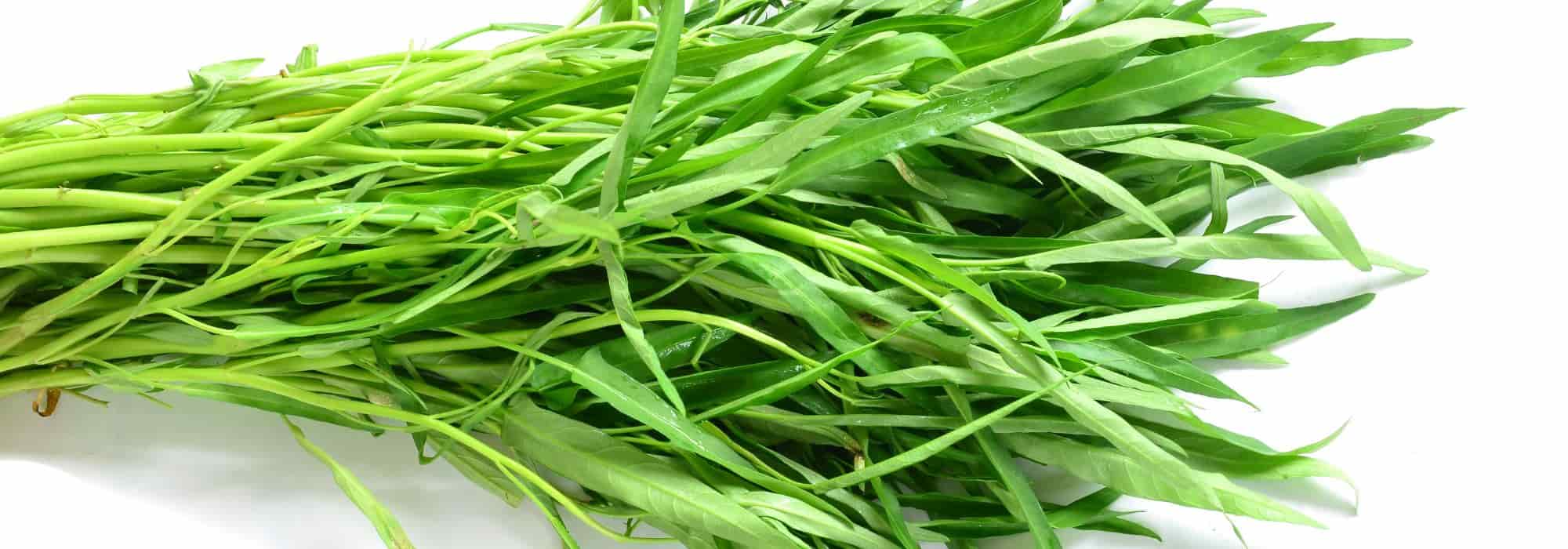
Growing water spinach
Also known as Kang Kong or water convolvulus, this herbaceous plant is highly valued in Asia, and grows in a basin or in a pot
Contents
Kang Kong, spinach or water convolvulus, aquatic or water spinach… There are many terms to describe this tropical herbaceous perennial whose stems and leaves are highly valued in Asian cuisine. Ipomoea aquatica, a semi-aquatic plant from the Convolvulaceae family (like bindweed and morning glories), is widely cultivated in Malaysia, Vietnam, and China. It is actually considered invasive there due to its tendency to spread in rice paddies. This is because this herbaceous plant produces hollow stems that can spread up to 3 to 4 m across the water’s surface. As it develops roots at each node, it propagates very quickly.
As a tropical plant, the water spinach requires warmth to germinate and grow. It also needs good humidity. In our latitudes, it can be grown in ponds in regions where it can receive enough heat. Elsewhere, pot cultivation is entirely feasible.
Let’s discover how to sow, grow, and care for this water spinach that can be enjoyed raw or cooked.

What exactly is aquatic spinach?
Water spinach (Ipomoea aquatica) is a semi-aquatic freshwater plant from the Convolvulaceae family. It is therefore a close relative of bindweed, the beautiful morning glories, and sweet potatoes! Water spinach is a creeping, voluble herbaceous plant with hollow cylindrical stems that can spread up to 3 to 4 m in its natural medium. It is often considered invasive. It easily grows in marshes, wet lands, rice paddies, sugarcane plantations, and irrigation and navigation canals.

The water spinach can be invasive when grown in its natural habitat
A tropical plant, water spinach thrives with its roots in water and foliage in the sun. It also requires a good ambient warmth. Under these conditions, it develops abundant foliage, consisting of narrow leaves that can reach 15 cm in length. These leaves, with long petioles, are alternate, sagittate to lanceolate, and range in colour from dark green to light purple. The stems, sometimes hairy at the nodes, produce roots that facilitate anchoring.
Between June and September, funnel-shaped flowers appear, generally mauve lilac, and more rarely cream white. These inflorescences are characteristic of the Convolvulaceae and very similar to those of bindweeds and ipomoeas (volubilis). These flowers produce fruits in the form of ovoid or spherical capsules containing 2 to 4 greyish seeds, often pubescent.
Read also
10 aquatic plants, submerged or floatingWhy growing Kang Kong?
Aquatic spinach requires little maintenance and benefits from rapid growth, provided it is grown in sufficiently moist soil. It is therefore perfect for growing in a pond, as long as its growth is limited. Furthermore, it is an edible plant, albeit little known in Europe, but very common in Asian cuisine. All parts of the plant can be consumed, including stems, young shoots, and leaves, either raw or cooked.
It should be noted that this plant, which has a spinach-like flavour but is much more subtle, also has notable nutritional benefits: Ipomoea aquatica is low in calories and rich in antioxidants, vitamins A, B, C, and minerals (iron, calcium, potassium, magnesium, manganese, and phosphorus). Traditional Chinese medicine also attributes medicinal properties to it for treating various ailments.
It is also a very interesting ornamental plant for wet areas: its arrow-shaped leaves and flowers are highly decorative.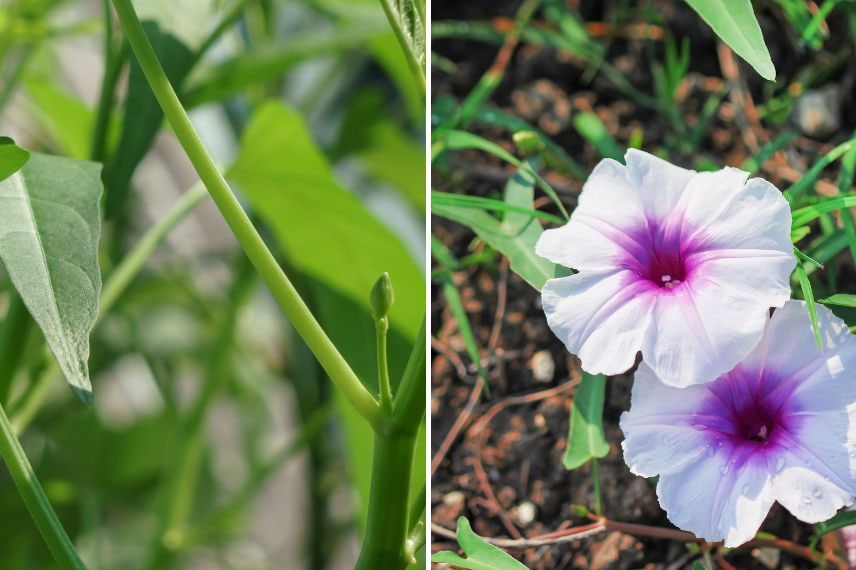
Where, when, and how to sow it?
As a semi-aquatic tropical plant, water spinach has two essential requirements for thriving: warmth and constant humidity. If these two conditions are met, it can be grown anywhere in open ground with its roots in water or in pots.
Where to sow it?
Water spinach needs a soil rich in organic matter, constantly moist, and a location that is largely sunny. Heavy, clay soils are perfectly suitable for it. In regions with a mild climate, it can be grown in a pond, possibly planted in submerged pots. However, its growth should be limited as the voluble stems can smother other submerged plants or those growing on the surface.
Elsewhere, it is best cultivated in pots under cover as it requires a constant temperature of around 23 to 25 °C.
When to sow it?
Sowing is done under warm cover, in seed trays or boxes, from February to May. A minimum temperature of 25 °C is needed for water spinach seeds to germinate.
How to sow it?
- Soak the seeds in a glass of lukewarm water for 24 to 48 hours
- Fill your containers with a special seed compost, possibly mixed with a bit of sand
- Place the seeds and cover with a very thin layer of compost
- Water gently
- Place the containers in a bright room at a minimum of 25 °C
Regular gentle watering is necessary to keep the substrate moist. The seeds will germinate within 7 to 30 days after sowing.
Once the seedlings are strong enough, they can be transplanted into pots or into open ground near a water source. This transplanting should occur as soon as the risk of frost has passed, from May to July.
What care does water spinach require?
If aquatic spinach has been planted with its feet in water in full sun, it has everything it needs and requires little care. However, if it is grown in a pot, it must receive substantial watering to keep the substrate continuously moist. Similarly, it is essential that the temperature remains constant, around 24 °C. This is why greenhouse cultivation may be recommended. 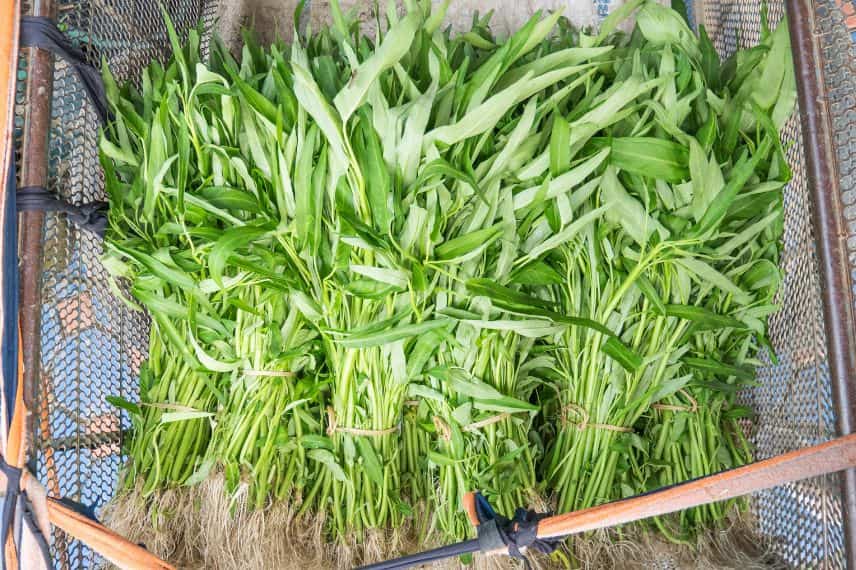
Also, be sure to limit encroachment by cutting back overly expansive stems.
Water convolvulus, from garden to plate
The first harvest of young shoots, leaves, and stems of aquatic spinach occurs about one to one and a half months after planting. After that, harvesting takes place as needed. Moreover, the leaves do not keep for more than two or three days in the refrigerator. 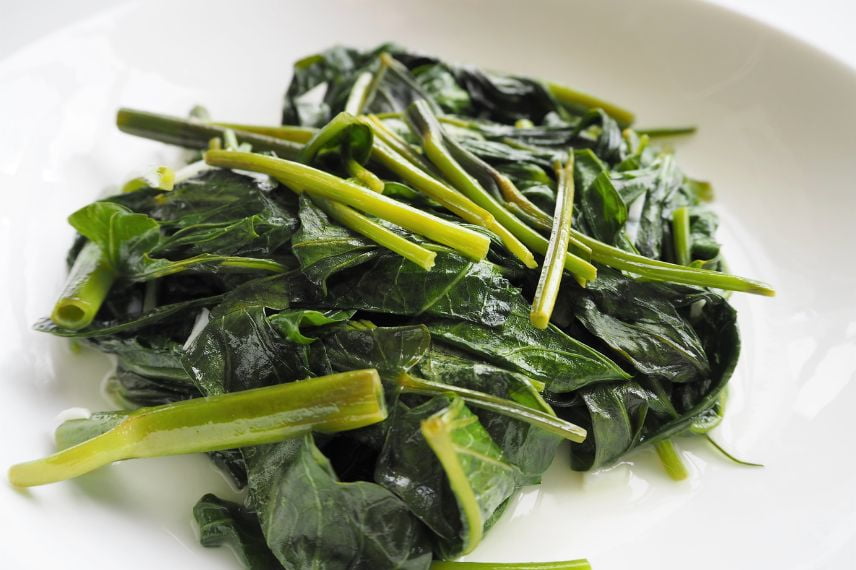
The leaves and stems can be consumed raw in a salad. However, traditionally, Asians prefer to enjoy them cooked, stir-fried in a wok with garlic, chilli, spices, and soy sauce. They can also be steamed, boiled, or blanched, and eaten like spinach to accompany fish or prawns.
- Subscribe!
- Contents

Comments