




























Growing a vegetable garden near farmland: what are the impacts? What solutions?
What are the risks of gardening near farmland?
Contents
Having a small vegetable plot in the countryside is often a dream—a place to grow your own vegetables and fruit. But when this vegetable plot borders an agricultural field cultivated using intensive farming practices, the reality can be somewhat more complicated. Aside from odour and noise nuisances, which are perfectly harmless, it is the pesticidal products that raise concerns. Between pesticidal drift, soil pollution and impacts on health and biodiversity, the consequences can be serious, though invisible on a day-to-day basis. So, what are the real impacts of a vegetable plot on the boundary of an agricultural field? What does the law say? And how can you protect yourself?
Discover everything you need to know about the risks and solutions related to having a vegetable plot close to an agricultural plot.
There are very real pesticidal contamination risks
If your vegetable garden adjoins a field farmed organically, no problem. However, in an intensive farming setup, the situation changes.
Pesticide drift
One of the first risks your vegetable garden is exposed to is the drift of plant protection products used in fields. When a farmer sprays a weedkiller, a fungicidal product or an insecticidal product, part of the droplets can be carried by the wind, sometimes over several tens of metres. This depends on the type of equipment used, on wind speed (treatment is prohibited if it exceeds 20 km/h), on the air humidity and on the time of spraying, but also on the type of nozzle used. Your vegetable garden, if located in close proximity, can therefore receive residues without you realising.
Moreover, in recent years, lawsuits have been brought to highlight the risks of passive exposure to plant protection products. And it is clearly established that these products can affect the health of local residents, beyond that of farmers who use them.
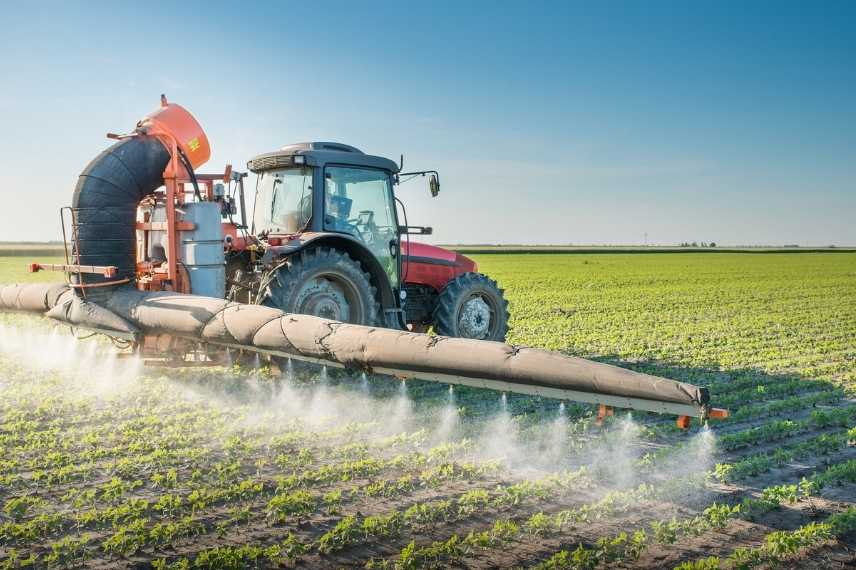
One of the first risks faced by your vegetable garden is the drift of plant protection products used in fields
Runoff and infiltration
In case of rain after a treatment, pesticidal products can also runoff to lower-lying areas, including your vegetable garden, especially if there is a slope, even a gentle one. They can also infiltrate the soil and reach the roots of your plants, and may even reach the groundwater. Analyses have shown that residues of pesticides can persist in soils for a long time and contaminate neighbouring crops. Public Health France studies have even demonstrated the presence of these substances in the hair of children living near agricultural fields.
Contamination of your vegetables
If you grow organic vegetables in your vegetable garden, these residues can compromise the quality of your harvests. It becomes difficult to guarantee the absence of chemical residues, even if you scrupulously follow the principles of organic cultivation.
Effects on health and biodiversity
The proximity of a cultivated agricultural field near your home and garden can have particularly harmful effects on both your health and the environment.
Human exposure to pesticidal products
The proximity of a treated field can lead to chronic exposure to pesticidal products, through the air, water or food. Research has linked this exposure to increased risks of certain cancers such as leukaemias, hormonal disorders, neurodegenerative diseases and asthma. Children, pregnant women and people with weakened immune systems are particularly vulnerable.
What impact does it have on biodiversity?
Your vegetable garden is also an ecosystem, often rich in pollinating insects, earthworms, birds and small mammals such as hedgehogs, shrews… But the products used in conventional agriculture can kill or weaken these organisms, yet essential for soil health and for the pollination of your plants. We know very well the impact that pesticidal products can have on bees, both domesticated and solitary, the main pollinators of vegetables, fruits and flowers.
What does the French law says?
The law now regulates the use of pesticidal products more strictly, particularly near inhabited areas.
Non-treatment zones (ZNT)
Since 2019, the decree of 27 December 2019 from the Ministry of Agriculture, relating to measures to protect people when using phytopharmaceutical products, supplemented by the decree of 25 January 2022, imposes non-treatment zones (ZNT) around dwellings, gardens and places where vulnerable people are present:
- 5 metres for low-growing crops (wheat, maize, vegetables)
- 10 metres for tall crops (fruit trees and soft fruits, vines, hop cultivation…)
- 20 metres non-negotiable for the most toxic products listed in the 4 May 2017 decree on the placing on the market and use of phytopharmaceutical products and their adjuvants.
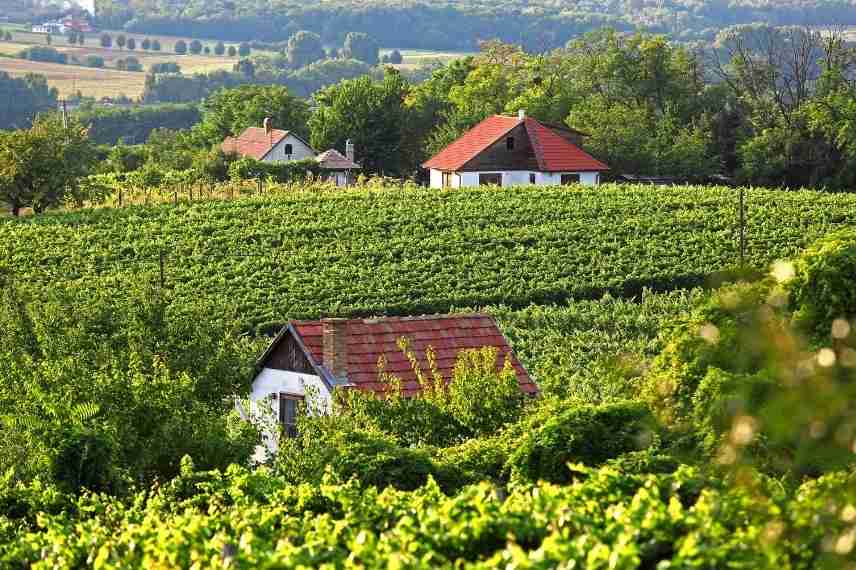
Non-treatment zones (ZNT) are now required
These distances can be reduced to as little as 5 metres for arboriculture, and 3 metres for other crops, if the farmer uses sprayers fitted with anti-drift nozzles to limit drift. The farmer may also undertake, by departmental charter, to warn neighbours or to observe certain timings.
Finally, spraying is prohibited when wind speeds exceed 19 km/h.
Duty to inform
Farmers also have the obligation to keep a record of their phytosanitary treatments and to inform neighbours if treatments are carried out near dwellings.
How to effectively protect your vegetable garden?
Even if you can’t stop your neighbour who farms from treating their crops, you can limit the risks to your vegetable garden and your health.
Keep your distance
Place your vegetable garden as far away from the field as possible, or even on the opposite side. And if you are surrounded by farmland, maintain a distance of at least 5 to 10 metres from the field boundary, or more if possible. If the farmer uses pesticidal substances, the no-spray zone can extend up to 20 metres, and your vegetable garden should not be located within this zone.
Create a dense, tall hedge
A dense and tall hedge can act as a natural filter and screen, reducing the drift of chemicals. Hedge heights of at least 2 metres are needed for it to be effective. The root system of the chosen shrubs and trees will also impact water runoff. These hedges also shelter wildlife useful to the garden, such as birds or pollinators. For example, you can plant some of the following shrubs or trees:
- Leyland cypress (Cupressocyparis leylandii): growth of more than 1 m per year, very dense foliage, exceptional as a windbreak
- Thuja (Thuja spp.): growth of about 50 to 60 cm/year, suitable for compact hedges
- Photinia ‘Red Robin’ (Photinia × fraseri): young bright red foliage, fast growth and attractive
- Privet (Ligustrum): evergreen, very dense, hardy, fast-growing hedge
- Cherry laurel (Prunus laurocerasus): large evergreen leaves, vigorous growth, ideal in a thick hedge
- Chalef (Elaeagnus ebbingei): silvery foliage, very tolerant (drought, wind, salt), rapid growth
- Pittosporum (Pittosporum tobira et autres espèces): evergreens, beautiful flowering, steady growth
- Aronia (Aronia): fast growth, berries enjoyed by birds
- Sea buckthorn (Hippophae rhamnoides): steady growth, vitamin-rich fruits, tolerates poor soil
- Medlar, elder, dogwood : varied hedgerow, fruits useful for birds
- Hazel (Corylus): fast growth, nuts enjoyed by wildlife
- Non-running bamboos (Fargesia): evergreen hedge 2–3 m tall, fast-growing, low maintenance
- Miscanthus: evergreen hedge 2–3 m tall, grows quickly and requires little maintenance
- Paulownia tomentosa (Empress tree): rapid growth (up to 2 m/year), very large leaves, excellent for shade. Purple flowering in spring, attracts bees and butterflies.
- Weeping white willow (Salix alba): hardy tree with vigorous growth, grows in damp or moist soils. Rapid growth, good windbreak, attracts birds.
- Black poplar (Populus nigra): grows up to 1.5 m/year. Widely used for agricultural rows. Caution: strong roots, keep away from any structure.
- Common ash (Fraxinus excelsior): hedgerow tree, fast growth, light wood, airy foliage. Shelter for birds and insects.
- Eucalyptus gunnii: Very ornamental, growth of more than 1 m per year, aromatic foliage. To be planted in well-drained soil.
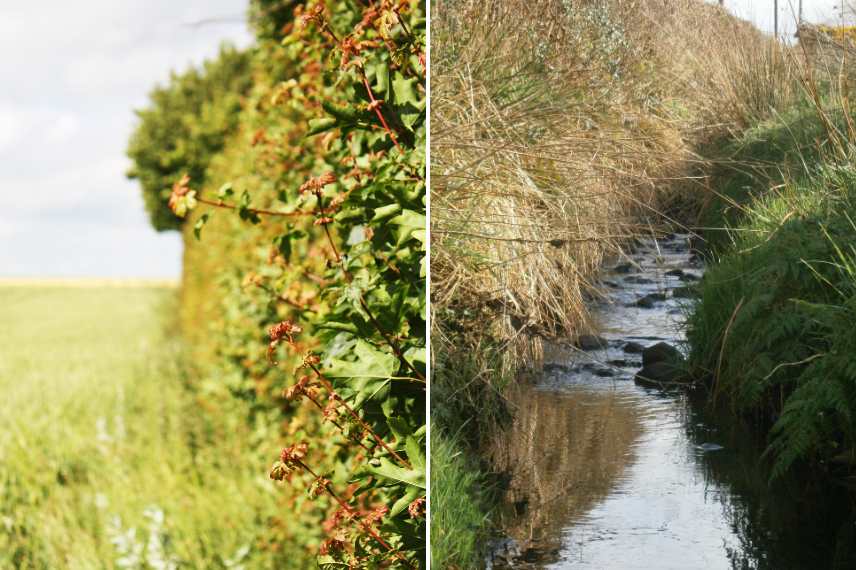
Tall hedge and ditch protect against drift and runoff of pesticides
Install drainage systems
If your land is sloping or prone to runoff, it can be useful to install a ditch or a vegetated swale to slow the water and trap chemical particles before they reach your vegetable garden.
Talk to the farmer
Good communication can make all the difference. Talk to the farmer about your concerns, ask to be informed before treatments. Some farmers agree to treat at times with less exposure or to use nozzles that reduce drift of pesticides.
At treatment times, it is advised to close doors and windows and stay indoors to limit exposure to pesticides.
- Subscribe!
- Contents
Comments