






























Growing Canna in pots
They will be the kings of the terrace or balcony in summer!
Contents
Cannas have an undeniable flair in summer. With their often warm, exotic-looking flowers and lush foliage, they provide an escape! In the garden, as well as in pots, these summer bulbs demonstrate that they no longer possess the outdated character they were once attributed. The only small constraint is that they are tender, so they should be grown somewhat like Dahlias, by lifting them for the winter.
Want to add personality and exoticism to your terrace or balcony this summer? Adopt cannas by planting them in pots. We’ll give you the tips to ensure your success.

Which varieties?
Imperial cannas in large clusters are perfectly adaptable for planting in attractive summer pots. As you will be bringing them indoors for the winter, you have plenty of options without worrying about their hardiness: one rule, enjoy yourself! Just select the shortest varieties, as cannas can grow to over 2 m (this height always refers to the flower spikes). We recommend the small dwarf cannas (60-80 cm) for balconies, such as ‘Yellow King Humbert’, ‘Taroudant’, ‘Lucifer’ or ‘Gnom’, and the intermediate, or even quite tall ones (up to 1.60 m) for terraces, because what we love about cannas is their appearance and height that ensure a spectacle, like ‘Semaphore’, ‘Pretoria’ or ‘Angèle Martin’.
Choose also based on their colour: yellow like Canna ‘En Avant’, orange, red in a tropical spirit, or Indian pink, even salmon pink like ‘Angèle Martin’ and bright pink like ‘Pink President’: it is ultimately quite interesting to pair it with the same colours as the rest of your pots. You can also combine yellow and orange cannas with other pots featuring blue or purple flowers!
Don’t overlook the varieties with purple or variegated foliage, which are almost as ornamental with the display of greenery they provide: ‘Andaloucia’ striated and variegated, ‘Pretoria’ striped with gold, ‘Angélique’, violet-purple, ‘Stuttgart’ striated with white, or the large Canna ‘Wyoming’, purple, and ‘Tropicanna Black’, nearly black.
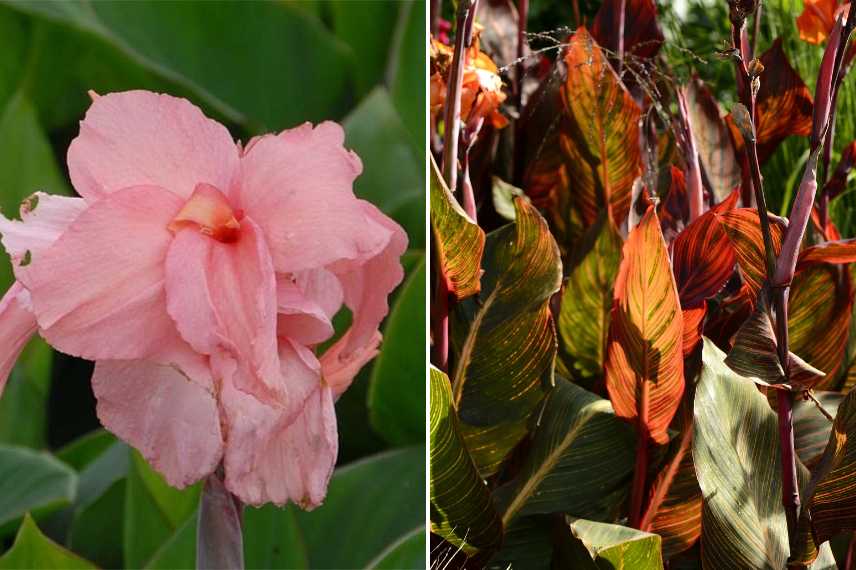
Choose the variety based on the flower colour, here ‘Pink President’, but also the foliage
Read also
Canna: planting, growing and careWhere to place your potted canna?
Cannas, with their tropical origin (Central and South America), require plenty of sun and warmth. They need a sunny spot, facing south or west, to develop a generous flowering. In partial shade, they will still look beautiful, just a little less floriferous.
With their large leaves resembling those of a banana plant, they will stand out on an exotic terrace, where even before flowering, the foliage will make a statement alongside equally exuberant pots. However, you can also invite them into a less themed space; they will add lovely density and an interesting vertical element.
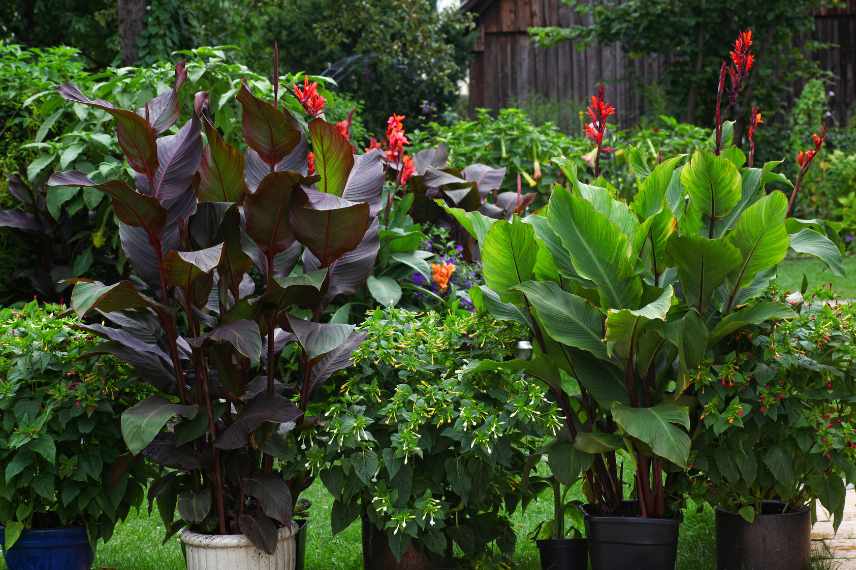 Provide cannas with a bright, sunny, and warm exposure</caption]
What type and size of pot?
It all depends on the size of the canna. For dwarf cannas not exceeding 80 cm (and with less voluminous foliage), a 30 cm pot is sufficient. However, it should be deep enough. As soon as you choose taller varieties, the spread will be around 80 cm, so it is advisable to use pots or containers of at least 40 cm in diameter. Generally, remember that the larger the pot, the more the foliage can fully express itself!
Canna particularly loves water, you can even place it in pots without drainage holes at the bottom – if they are large enough or with an integrated saucer. This pot or container (for example, earthenware jars or pottery) will be the ideal companion, perfectly watertight, keeping the moisture it needs in summer.
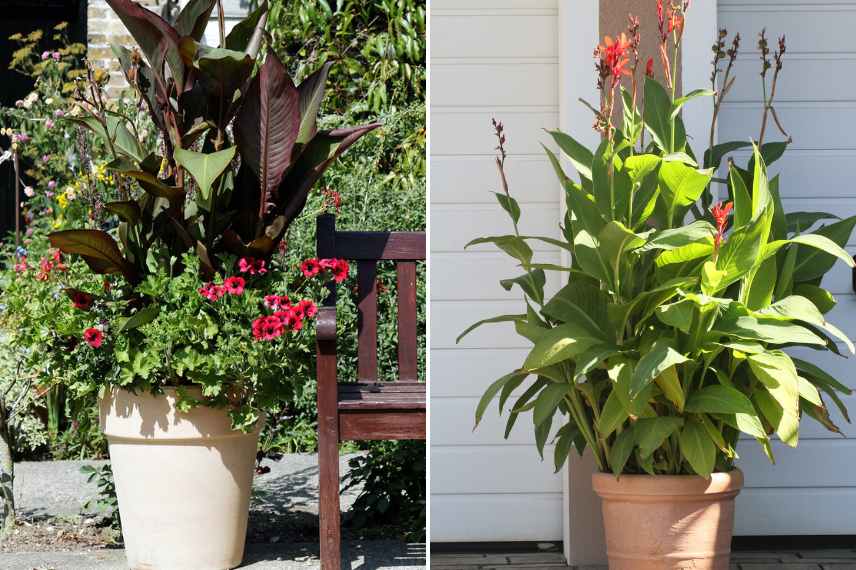
The pot must be large and deep enough to allow for generous development
Read also
Canna: the most beautiful varietiesWhat substrate?
Canna needs rich soil that remains both cool and well-drained, thus light. It is therefore preferable to create your own mix of equal parts good potting soil and homemade compost, or even manure if you can obtain it, to ensure good water retention. If not, use a potting soil with water retention.
When to plant?
For these frost-sensitive South American plants, proceed as with Dahlias, that is to say, plant from the end of April, not before. This obviously depends on the regions, but you must ensure that frosts are no longer a concern.
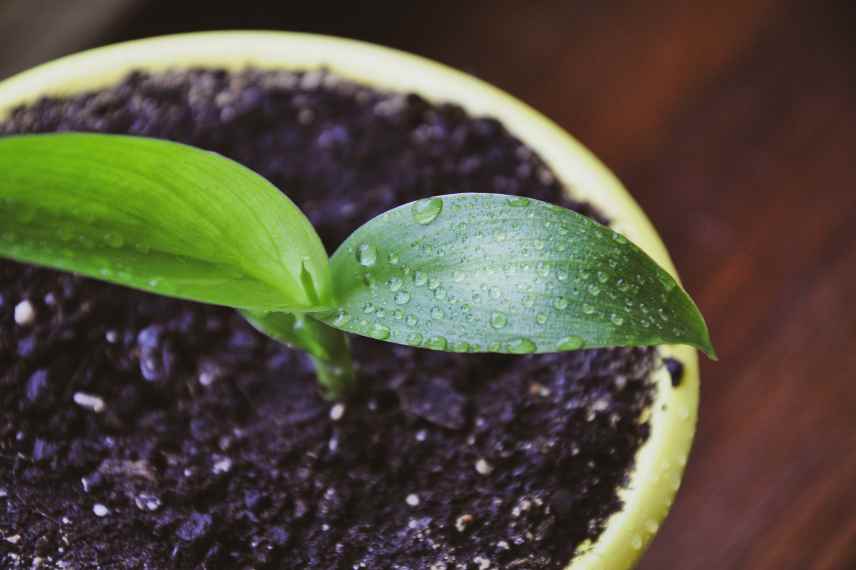
You can force cannas like dahlias by placing the rootstocks in trays from February or March: covered with compost or turf, they will produce shoots that accelerate the growth process. They should be placed in a bright location at a temperature of around 13°C to 16°C. You will transplant them at the end of April or mid-May into the pot or pots reserved for their use.
How to plant?
- Soak the rootball of the young plant or pot of Canna, if they come in this form, for a few minutes in a basin of water, or take your rootstocks out of the packet
- Fill the pot with your substrate, well prepared for these hungry plants (see above), enriched with a small handful of crushed horn, an excellent slow-release organic fertiliser
- Place the rootstocks in the middle of the pot, pushing them down about 5-8 cm, spacing them 10 cm apart if you are planting two or three
- Firm the soil
- Water generously
- Top with mulch to retain the moisture that Canna needs to thrive
- You can add a few annuals around the edge of the container, but Cannas really show their best when alone in their pot.
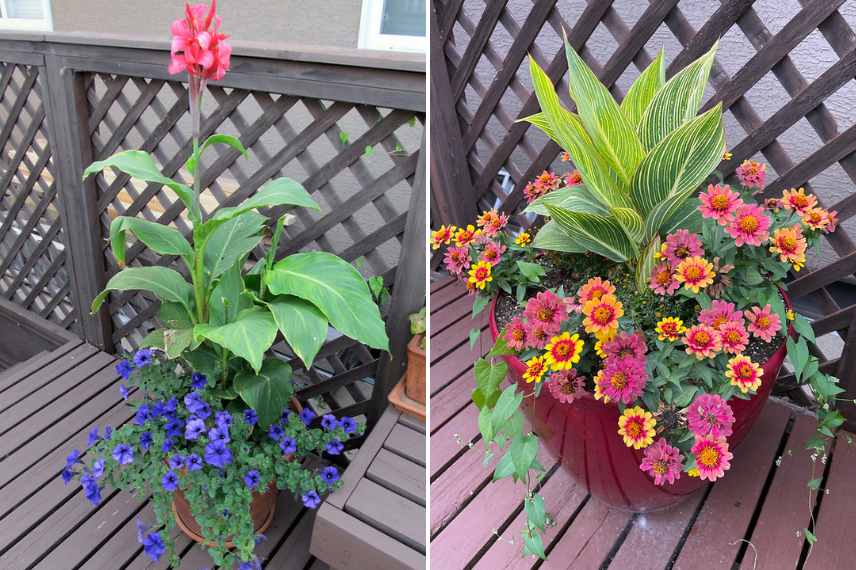
Cannas in colourful pots (© daryl_mitchell)
Care and Maintenance of Potted Canna
Watering
Cool-loving plants require careful attention to watering, especially during the summer months. Generally, two waterings per week are recommended, but this varies depending on your region and the location, whether in full sun or partial shade.
Fertilising
Greedy, potted cannas need fertiliser to support their flowering and ensure beautiful growth of their foliage: either slow-release fertiliser at planting, which will benefit the canna throughout the summer, or in the form of liquid fertiliser, applied twice during the summer, for green and flowering plants.
Maintening
You should remove faded flowers to keep the plant looking its best and to ensure the renewal of flowers; this is particularly important on a terrace or balcony where everything is more visible than in the garden! When the entire bouquet of flowers has faded, you can then cut the stem at its base.
Wintering
The bulbs should be dug up in autumn, around October, when the foliage begins to dry, certainly before the first frosts, to store them in a frost-free place. Cut the stems to 5-10 cm, remove the last leaves, shake off excess soil, and let the rootstocks dry for a few days. Store them in a large box or market crate filled with turf, in a garage, cellar, or frost-free greenhouse. The division of the rootstocks is best done in spring.
- Subscribe!
- Contents
Comments