



























Firs: Discover the benefits of various varieties
Conifer varieties for a range of uses in the garden or in pots
Contents
If the popularity of firs reaches its peak during the festive season, especially at Christmas, they are also very common trees in our gardens.
Also called Abies, these resinous conifers have the advantage of being evergreen, remaining beautiful all year round. They are easy to grow and hardly require any maintenance.
There are different varieties, distinguished by their aesthetics, their silhouette or their cultivation requirements. Let’s discover them in this article to integrate them well into the garden or in pots.
For more on growing firs, discover our guide Fir, Abies: planting, pruning and care.

Benefits of fir trees
In the garden, fir trees are first and foremost interesting for their evergreen foliage. They therefore remain decorative year-round, letting us observe, without pause, their soft, touchable needles. They can be used in a variety of ways.
First of all, fir trees can be grown as solitary specimens, to catch the eye by creating a focal point, especially for the more imposing specimens. They will thus be shown to best effect.
They are also useful for structuring space, as part of the creation of a privacy hedge, which helps to protect from prying eyes but also to break the wind.
They are also interesting for delimiting a bed, a path or a border. They therefore provide an alternative to boxwood. The smaller varieties can, in turn, find their place in a rock garden or even in a pot.
The sobriety of firs allows the flowering of other plants to be highlighted and to add volume. If they have been somewhat neglected, firs and their distinctive form are now making a comeback in gardens, particularly in contemporary-style ones, which give pride of place to shapes and textures.
Above all, these trees or bushes require virtually no maintenance and will grow without care. With their growth generally very slow, there is no need for pruning: you can let them develop naturally for many years.
Read also
Major diseases and pests of conifersDwarf conifers for pots and small spaces
Even though the imposing pyramidal fir often comes to mind, there are also compact-silhouette varieties that will look wonderful in a container planting. They will also make excellent candidates for greening a terrace or balcony, to structure the space more easily. Don’t hesitate to place them in rockeries that aren’t too dry, planted in small groups of three.
Among these dwarf firs, which do not exceed 1.5 metres in height, let us first mention the Abies balsamea ‘Nana’, whose squat silhouette and globose habit reach only 60 cm in all directions.
Another low-maintenance fir, ideal for small spaces: Korean fir (Abies koreana) ‘Tundra’. It forms an adorable flat, dense and glossy cushion, not exceeding around 40 centimetres in all directions. Encore plus petite, la variété ‘Cis’ atteint tout juste 30 cm de largeur comme de hauteur.
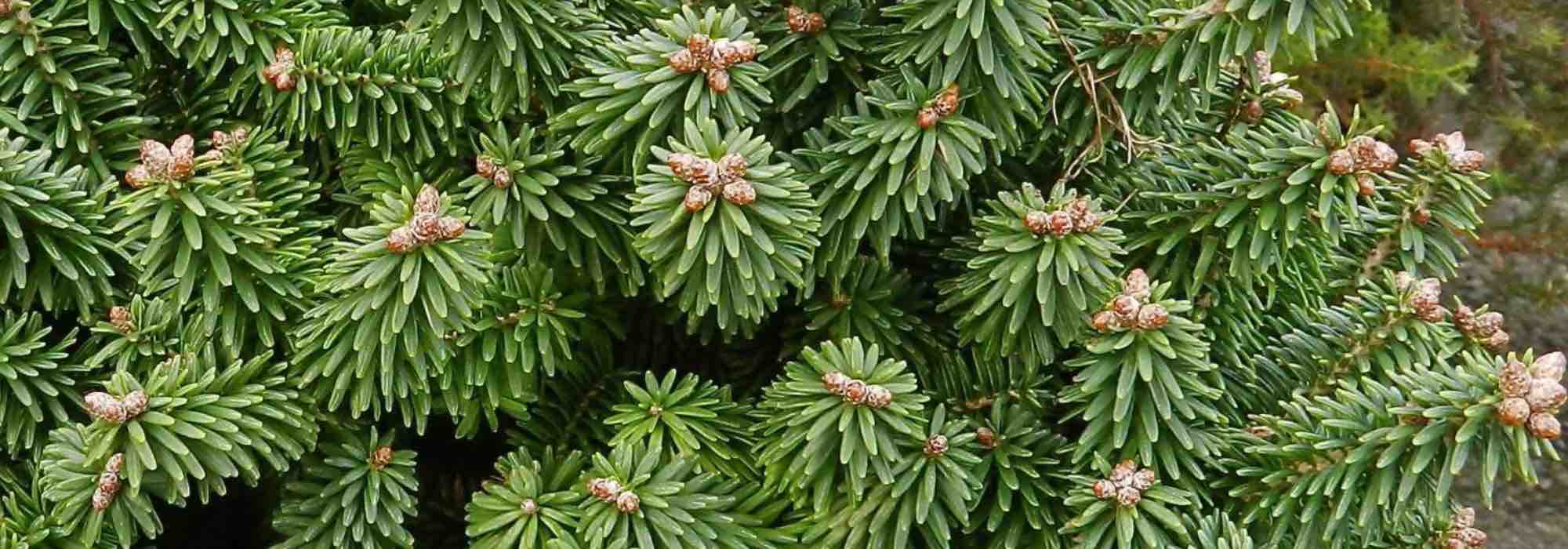
The Abies balsamea ‘Piccolo’ is an interesting dwarf fir for its stout and compact habit, but also for its prominent brown buds in spring, which provide contrast.
The Nordmann fir, one of the most popular at Christmas, is also available in a very small form, with the adorable ‘Münsterland’. Its prostrate silhouette will not exceed 30 cm in height and 50 cm in spread after several years of growth.
For its part, Abies amabilis Abies amabilis ‘Spreading Star’ constitutes an excellent groundcover, with its measurements reaching 30 cm in height and 1 metre across.
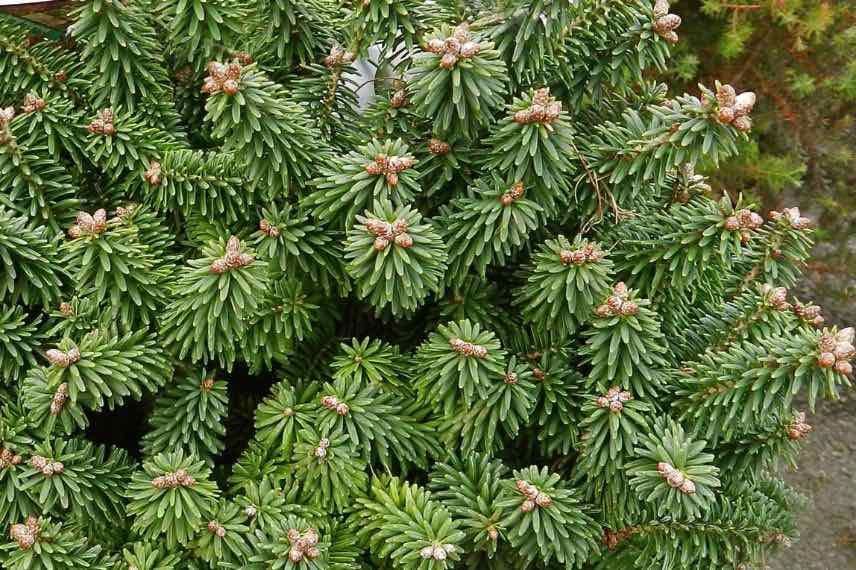
Abies balsamea ‘Piccolo’
Tallest and most imposing fir trees
If you’re after a showpiece, a majestic fir to grow as a specimen, that will command attention with its charisma, go for the tallest firs. They can reach several tens of metres in height.
Fall in love, for example, with the golden Spanish fir, a large conifer with a pyramidal habit, which will reach 20 metres in height and 6 metres in spread. Its stiff needles are arranged in a brush all around the branches, of a lovely golden-green.
Obviously, the Nordmann fir Christmas tree. When it doesn’t adorn our interiors, it can reach 30 metres in height and 6 metres in spread. We love it for its pyramidal silhouette, as well as its soft and fragrant needles.
Be patient: these conifers have very slow growth. For faster growth in a large garden, opt for the Vosges fir (Abies alba), whose growth accelerates from its sixth year, reaching nearly 1 metre per year. At maturity, this giant will reach 45 metres in height.
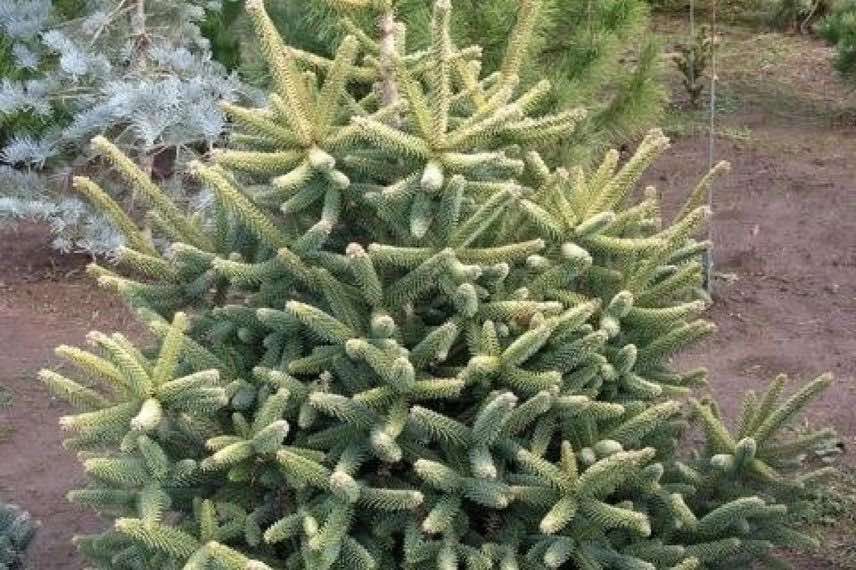
Abies pinsapo ‘Aurea’
Firs with colourful foliage
It is true that fir trees do not display the widest range of foliage colours in the plant world, but some of them still play with shades to stand out. This is particularly the case for Korean firs. Among the compact ones, ‘Green Carpet’ or ‘Nadelkissen’, the needles are a pale, vivid green, bringing a lovely touch of light.
A little more imposing at 5 metres tall and 3 metres wide at maturity, the variety ‘Samling’ delights us with needles of a glossy green, but lighter on new growth.
At ‘Silberlocke’, the needles, very curved, have a silvery reverse that catches the light and the eye. This is also the case with ‘Luminetta’.
At the dwarf graceful fir ‘Spreading Star’, we are also treated to a fairly strong green-blue colour, with silver reflections.
The noble fir (Abies procera) ‘Bizarro’, foliage also bears this grey-blue colour.
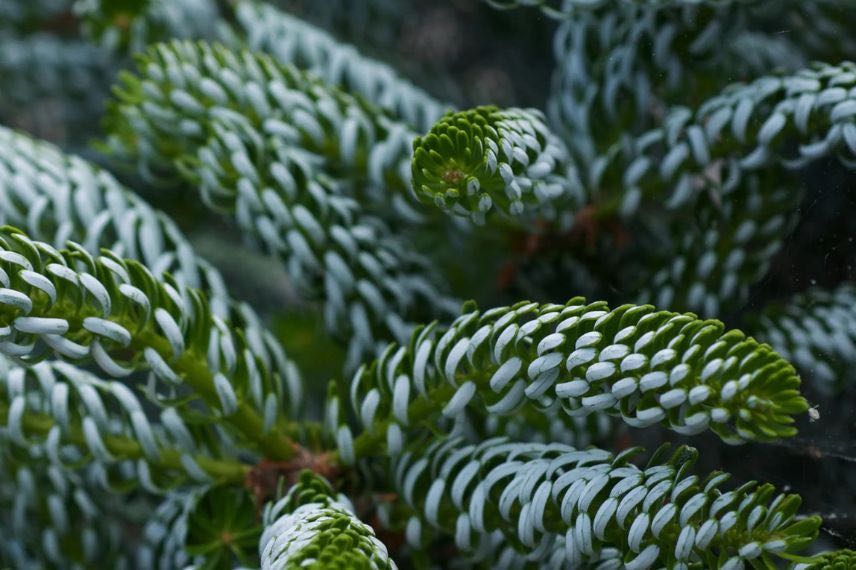
Abies koreana ‘Silberlocke’
Decorative-cone varieties
Some firs produce cones that add an extra aesthetic touch. The Korean fir is another example, delighting us from a young age with cones of a beautiful blue-violet colour.
For its part, the Abies alba ‘Pyramidalis’ produces in summer small upright green cones, which later take on a pretty purplish or reddish-brown hue.
Fir varieties for dry soils
Firs are mainly found in cold, damp alpine forests or along the coast, but there are a few exceptions. This is the case with the Spanish fir, one of the few to tolerate drought, calcareous soils and poor soils, even stony, as long as they are deep. It is indeed native to the southern mountains of the Iberian Peninsula and Morocco. A boon for more exposed gardens, which can rarely accommodate firs. Its cylindrical needles are arranged in a brush and it boasts a very beautiful blue-grey foliage. It is a fir that can reach 20 metres in height with a 6-metre spread.
Also note the subalpine fir (Abies lasiocarpa) ‘Compacta’, a variety with moderate growth, which reaches 4 metres in height and 2.5 metres in spread. In addition to its beautiful blue-grey foliage, it has the advantage of tolerating poor soils, as well as drought once established.
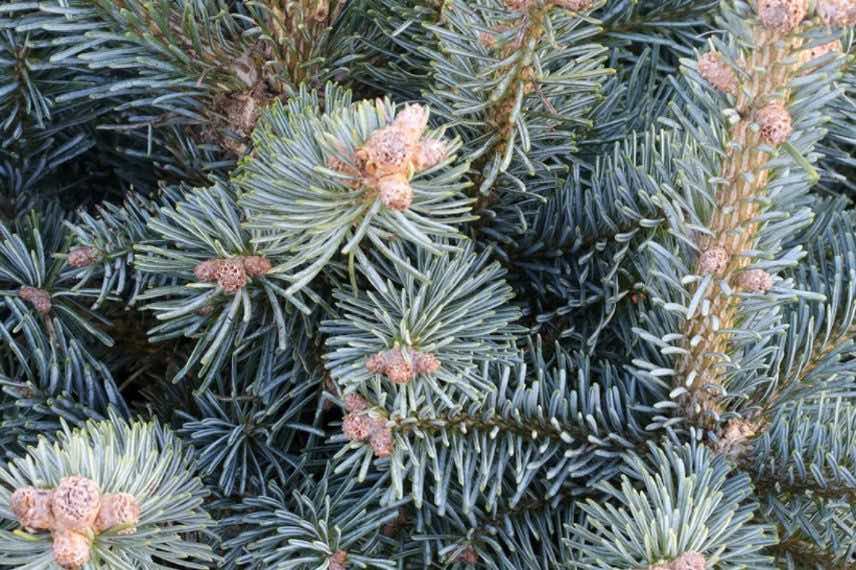
Abies lasiocarpa ‘Compacta’
- Subscribe!
- Contents
Comments