





























F1 Tomatoes: what are they exactly?
Highly productive and resilient hybrids
Contents
The term F1, far from evoking any affinity with car racing, is a botanical designation associated with certain varieties of tomatoes. The F1 tomatoes, often mentioned in seed catalogs and gardening websites, are hybrid varieties known for their exceptional hardiness and productivity. But what does this designation really mean, and what truly distinguishes them from other tomatoes?

What is an F1 tomato or F1 hybrid variety?
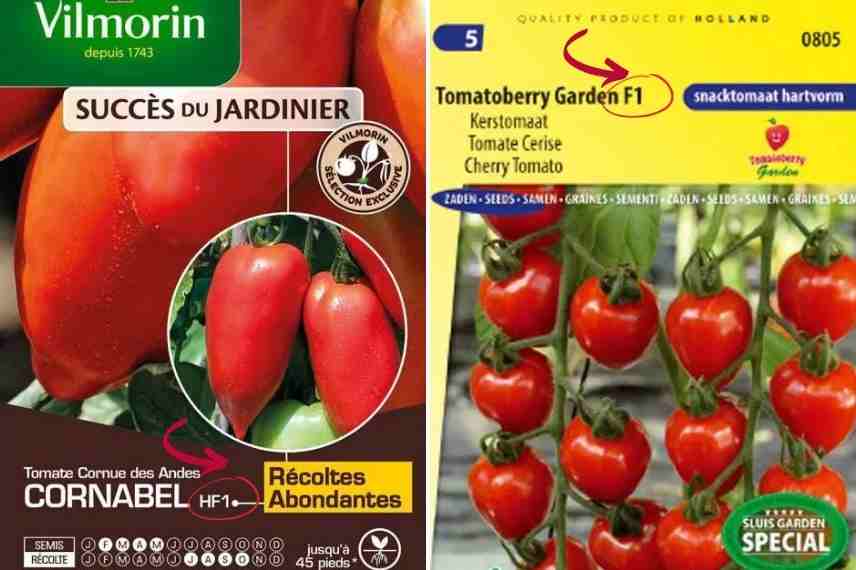
F1 tomatoes are specific hybrid varieties designed to offer valuable benefits to gardeners. They are not GMOs, as some believe, but rather a process of hybridization between two individuals of pure varieties. The first F1 tomato varieties were marketed as early as 1956. The term F1, for “F1 hybrid,” means “Filial 1” or “fertilization 1.” It refers to the first generation resulting from a cross between two parent tomato varieties. These modern varieties are meticulously selected for their distinct characteristics, aiming to combine their strengths (taste, shape, colour, yield…). Their seeds constitute the first generation of the hybrid, hence the term “F1.” The result of this cross is the F1 tomato: a hybrid variety that combines the best of its two parents. Thus, F1 tomatoes, such as the famous Montfavet tomato, are designed to be more resistant to diseases and more productive than traditional varieties.
Among the most popular F1 tomatoes:
- The Montfavet 63/5 F1 Tomato, a early variety developed by INRA Montfavet. It produces beautiful red fruits with a green collar, weighing between 150 and 300 g, resistant to splitting.
- The Fandango Tomato, a lovely hybrid that yields beautiful round red fruits averaging 150 g and is very resistant to splitting.
- The Paola F1 Tomato, a semi-early cluster tomato with excellent sweet flavour and good resistance to diseases.
- The Maestria Tomato, a vigorous variety, resistant to downy mildew. It produces large ribbed fruits weighing around 170 g with a true tomato flavour!
- The Honey Moon F1 Tomato, has the rare characteristic of being resistant to downy mildew and is particularly productive. It is the ideal variety when one does not want to use Bordeaux mixture.
- Discover our entire collection of F1 Tomatoes
READ ALSO
→ The Honey Moon Tomato: finally a real solution against Downy Mildew
The advantages and disadvantages of F1 tomatoes
Advantages
Valued by gardeners for their robustness and yield, the seeds and plants marketed under the name F1 tomatoes or “F1 hybrid varieties” have specific characteristics and interesting advantages. They produce vigorous and highly productive plants, generally earlier (as they are less sensitive to weather fluctuations such as cold or rain), easy to grow in the garden, with high resistance to common tomato diseases (such as blight, mosaic virus, Fusarium…) and to pests and parasites like nematodes. Their vigour and resistance allow for natural cultivation without synthetic products. They also have good resistance to splitting. They exhibit faster growth rates than traditional varieties and can tolerate sometimes more challenging growing conditions. F1 tomatoes offer predictability and homogeneity (they share exactly the same genetic makeup), which can significantly simplify garden management.
Disadvantages
F1 tomato seeds are usually more expensive to purchase than seeds of traditional varieties. The process of creating these hybrids requires time, skills, and resources, hence the higher price. Furthermore, the reproducibility of F1 seeds is a topic of debate among gardeners. F1 varieties are not stable and therefore non-reproducible. To maintain the desired characteristics, it is recommended to buy new F1 seeds each year.
F1 hybrids are so vigorous that they tend to deplete the soil of nutrients and water more quickly than other tomato varieties.
Some may say that these hybrid tomatoes have a reputation for being watery and lacking in flavour.
How to grow F1 tomatoes?
Growing F1 tomatoes is not very different from cultivating traditional tomato varieties. Like other tomatoes, F1s enjoy a sunny location and well-drained soil. However, due to their productivity, it is advisable to provide adequate support, such as a stake or tomato cage, to prevent the plants from toppling under the weight of the fruit. For example, the Paola tomato, a popular F1 variety, is known for producing a large quantity of fruit that can weigh down the plant. Plants can reach 1.5 metres and require staking as soon as they are planted.
READ ALSO

Read also
20 tomatoes put to the test: our top 5!Can I collect and reseed F1 tomato seeds?
A common topic of discussion among gardeners is the possibility of reusing F1 tomato seeds. Technically, you can harvest their seeds for later sowing, but the results may not meet your expectations!
Indeed, as F1 tomatoes are hybrids, the seeds they produce are not genetically stable. This means that the resulting young plants may not have the same characteristics as the parent plants. They could produce lower quality fruits or be more susceptible to diseases. Their qualities do not pass on to subsequent generations. If you want to benefit from the advantages and characteristics of F1 tomatoes, it is generally best to buy new F1 seeds each year. Instead, opt for heirloom varieties if you wish to save your seeds from one year to the next.
- Subscribe!
- Contents
Comments