





























Diseases and pests of palms
Identify, treat, prevent
Contents
Palms, symbols of exotic imagination, are unfortunately also carriers of exotic pests. The two main enemies of certain common species of palm are the Red Weevil and the Palm Moth, which can lead to their death. Present in the south of France, they should be taken very seriously. Other pests or diseases can affect palms without causing the same consequences. Discover who these enemies of palms are, how to recognise them, prevention measures, and possible control methods.

Palm weevil
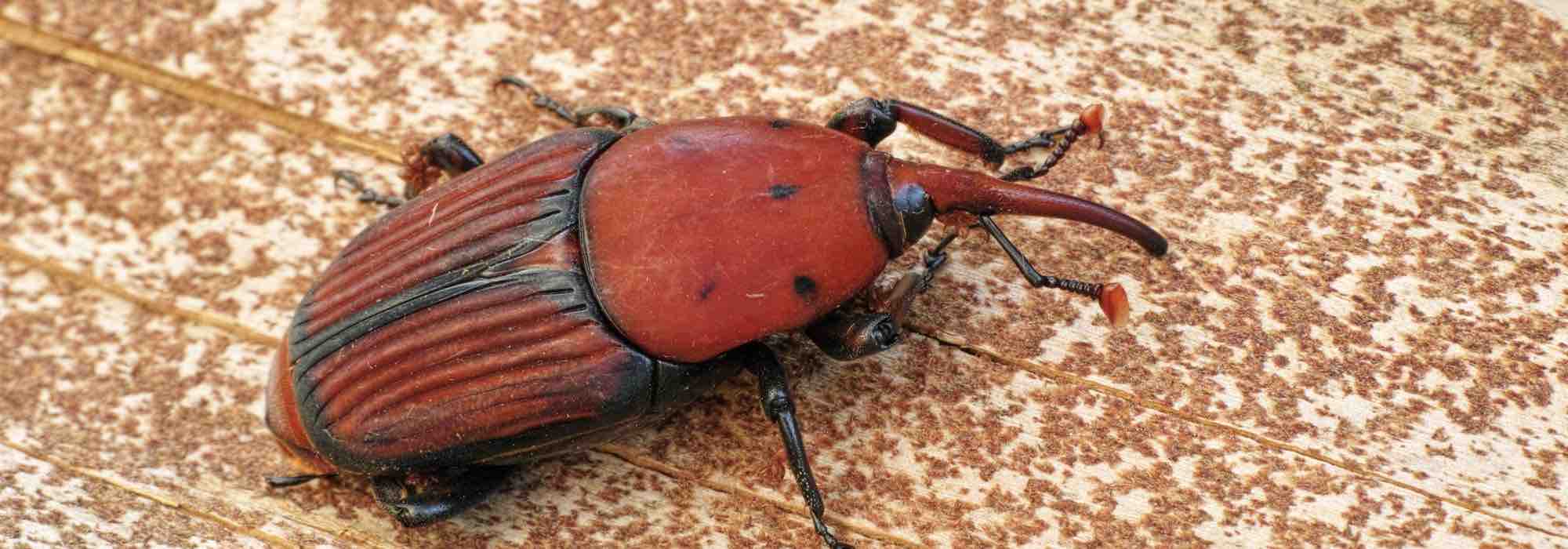
The palm moth or Paysandisia archon is a harmful insect that attacks palms, causing considerable damage. It is native to South America, but has spread to other regions of the world, particularly Europe. In France, it was accidentally introduced in 1997 in the south and wreaks havoc along the Mediterranean coast and in the South-West region. It leads to the death of the tree within a few years. Its presence should be reported to the mayor of your municipality or to the DRAAF.
The moth Paysandisia archon has a wingspan of about 10 to 12 centimetres. Its hindwings, visible in flight, are brightly coloured. It is active during the day, especially in mid-July, and more generally between April and September.
The first signs of damage are only visible a few months after the larvae penetrate the upper trunk. The leaves of palms infested by Paysandisia archon show holes or linear perforations across the width of the frond, but sometimes only chewed or dried areas are visible. The larvae burrow galleries inside the trunks of the palms, thereby weakening the structure of the tree. These galleries may be visible externally as small holes or cracks. Debris such as droppings, wood shavings, and fragments of leaves can be observed at the base of the tree or around the infestation areas. Infested palms often show signs of general weakening, such as slowed growth, drooping fronds, and a decrease in the overall vitality of the tree. When several caterpillars have entered the palm, the tree dies within 3 to 4 years. Some palms may only show foliar symptoms without further consequences if the larva has disappeared.
Some local authorities offer assistance to private owners of palms. Amateur gardeners can attempt treatment using entomopathogenic nematodes: The nematodes Steinernema carpocapsae parasitise the larvae and kill them.
Read Eva’s article on the palm moth to find out which species are affected and if you think you are experiencing an infestation to find very precise information.
However, as a preventive measure, carry out regular inspections of palms to detect any infestation at the first signs. This will allow for a quick intervention before the damage becomes too significant.
Red weevil
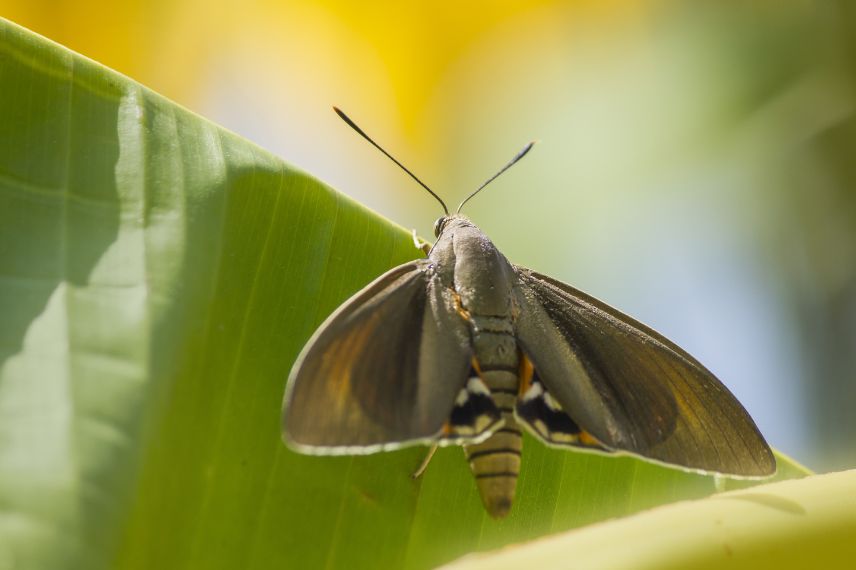
The red weevil, Rhynchophorus ferrugineus, is a pest that attacks palms and can lead to their death in just 2 years. It is native to Oceania but has spread to many regions worldwide, including Europe, North Africa, and the Middle East. It is responsible for the death of tens of thousands of palms in Europe. In France, it was accidentally introduced in 2006. It is present in a large part of southern France.
Adults typically measure between 3 and 4 cm. Their bodies are dark red to reddish-brown. The larvae are cream-white. Red weevils have a long incurved proboscis, used to pierce the tissues of palms and feed on their sap. They have long club-shaped antennae, which are characteristic of weevils. You are legally obliged to report the presence of the pest to the relevant authorities (such as the local council) and to contact an accredited company that will take the necessary steps to eradicate this species from your property.
Infestation by the red weevil begins with laying eggs on a weakened part of the palm, such as a broken branch, a crack in the trunk, or simply the base of a leaf. An adult red weevil can fly several kilometres to infest another distant tree. When symptoms are visible, several months after the emergence of the larvae, it is already too late to save the palm.
If the infestation has gone unnoticed, the visible signs are as follows:
- The leaves of infested palms begin to wilt, dry out, and yellow. They lose their vitality and detach easily from the tree.
- Debris such as wood shavings may be visible at the base of the fronds.
- Infested palms show general weakening, reduced growth, fronds that dry out, and a deterioration in the overall appearance of the tree.
Prevention is essential to avoid infestation by the red weevil. Here are some recommended measures:
- Protect pruning wounds by applying a sealant.
- Conduct regular inspections of palms starting in April to detect the first signs of infestation.
- Avoid pruning between March and October, the insect’s active period.
- If you are aware of infestations in your area, look for other signs, such as frass at the base of the fronds and the trunk.
- Pheromone trapping: they provide 3 months of protection.
- Inform local authorities and horticultural professionals of any red weevil infestation. Cooperation between residents, palm owners, and experts can help contain the spread of the insect.
In case of infestation:
- The nematodes Steinernema carpocapsae are natural parasites of the red weevil and can be sprayed.
- Notify the relevant authorities.
→ For more details, read François’s article on the red palm weevil.
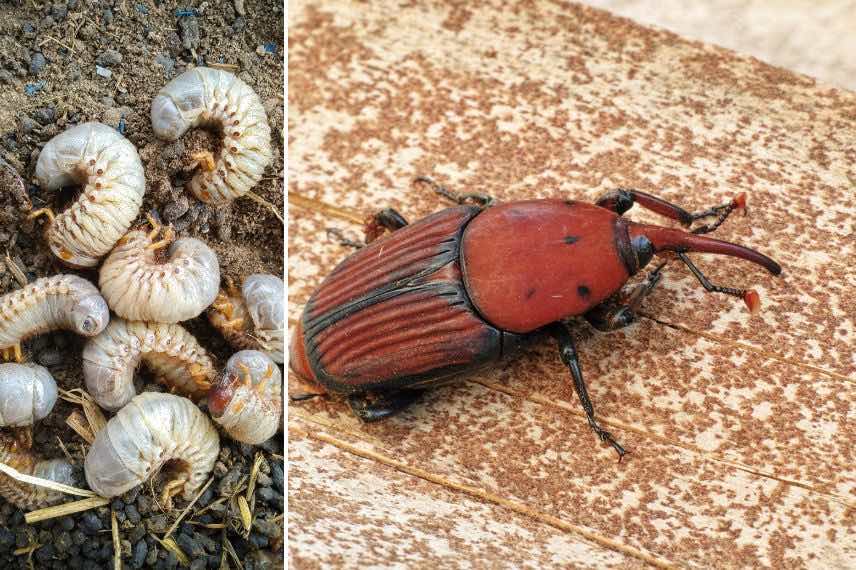
Larvae and red weevil
Other pests: scale insects, red spider mites
Mealybugs and red spider mites are well-known parasitic pests in our gardens. I refer you to our respective articles that address these topics.
→ Our tips on mealybugs.
→ Our article on red spider mites.
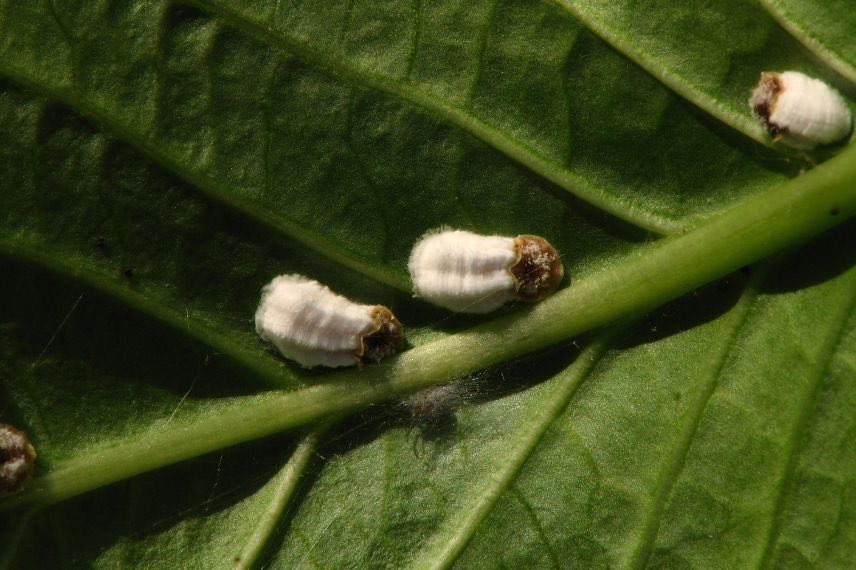
Mealybugs
Chalara paradoxa
The palm disease caused by the fungus Chalara paradoxa, also known as palm dry rot, is a serious condition that affects palms.
This disease manifests as dry rot of the palm tissues. The infected tissues can turn brown, become brittle, and detach easily, appearing shredded. The fungus attacks the meristem and causes bud rot. Ultimately, it leads to the death of the palm. Chalara paradoxa tends to attack the heart and interior of the stipe, which can result in degradation and weakening of the structure, causing the palm to bend over time.
The disease caused by Chalara paradoxa primarily spreads through fungal spores. Palms that have suffered injuries, such as poorly executed pruning cuts or damage from insects, are more susceptible to infection by the fungus. It often occurs after a cold, wet winter.
Fungal spores can persist in the soil and spread to other palms. Contaminated soil is a source of disease propagation. Carefully remove and destroy the infected parts of the palm. This can help slow the spread of the fungus and limit damage. If the damage is too advanced, burn the palm. Only replant a species that is not susceptible to this disease in the same location, as not all palms are affected.
There is no natural curative treatment for the disease caused by Chalara paradoxa.
- Use clean pruning tools and disinfect them between each use to prevent the spread of the fungus. Appropriately remove and destroy the infected parts of the palms.
- Reduce injuries to palms by making correct pruning cuts and avoiding mechanical damage. Healthy palms without injuries are less likely to be infected.
- Ensure adequate fertilisation and avoid excessive watering on the stipe.
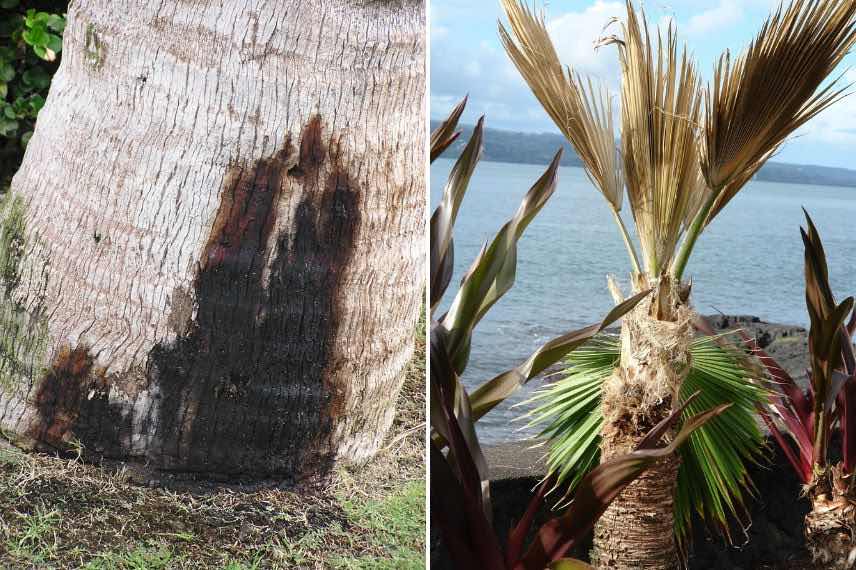
Manifestation of Chalara paradoxa on the stipe and leaves
Phytophthora palmivora
The palm disease caused by Phytophthora palmivora is a serious fungal condition that can affect palms as well as other species.
The leaves of palms infected by Phytophthora palmivora wilt and dry out, becoming brittle. The central bud dies. In humid conditions, spores of the fungus can be observed on the infected tissues. They are generally brownish and may appear as filaments or mycelium.
Humid conditions promote the spread of the fungus. Waterlogged soil or excessive irrigation can increase the risk of infection. Poorly drained soil retains moisture and creates an environment conducive to fungal growth, making palms more vulnerable to infection.
Once again, prevention is essential, as there is no curative treatment for the disease caused by Phytophthora palmivora.
- Ensure that the soil around the palms is well-drained. If necessary, carry out landscaping work to improve the drainage of the growing area.
- Avoid over-irrigation, as this can create conditions favourable to the spread of the fungus. Water the palms appropriately, taking into account the specific needs of each species.
- Disinfect pruning tools and prune sparingly.
- Strengthen the health of the palms: Provide appropriate care to enhance their overall health. This includes adequate watering, balanced fertilisation, and careful pruning.
- Consider applying Bordeaux mixture sprays in autumn every two weeks.
Fusarium wilt, another cryptogamic disease, requires the same care for the same causes, as does the condition known as “pink rot”.
Finally, the palm weevil (Pistosia dactyliferae) is a pest that also attacks palms.
- Subscribe!
- Contents
Comments