





























Diseases and pests of broad beans
Identify, manage, and prevent pests of broad beans
Contents
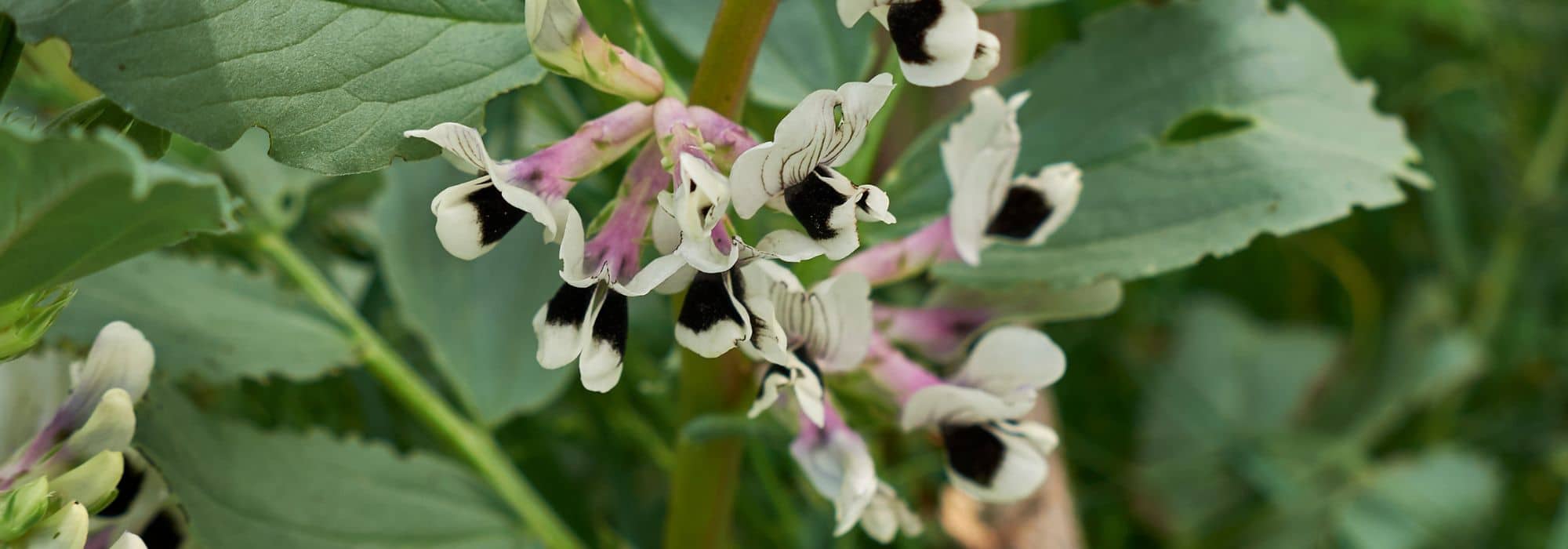
There are many advantages to growing broad beans (Vicia faba var. faba) in your vegetable garden: it is a legume from the Fabaceae family, very rich in proteins and energy nutrients, making it ideal for a vegetarian diet. From April onwards, in regions with a favourable climate, its seeds can be enjoyed fresh. Fairly easy to grow in deep, moist, humus-bearing soil, broad beans are also beneficial for your garden soil: the nodosities on their roots have the ability to capture atmospheric nitrogen and return it to the soil. Growing broad beans thus enriches the soil with nitrogen.
However, it is a vegetable plant that can be susceptible to a few diseases and pests, among which aphids are the most well-known. So much so that sometimes broad beans are considered a martyr plant, a true magnet for aphids. Let’s discover together the main pests and diseases of broad beans, and especially how to identify, treat, and prevent them.
To learn more: Broad bean: sowing, growing, harvesting.

Ascochyta blight of broad bean
Formerly known as anthracnose, the ascochyta blight of broad beans is a fungal disease caused by the fungus Ascochyta fabae. The disease primarily develops in cool temperatures, around 10 to 15 °C, and with some humidity. This disease is more prevalent in the south of the territory.
The responsible fungi survive over winter on contaminated plant debris. Seed can also be contaminated.
Symptoms
Two to three light grey to ash-brown spots appear on the leaves in a rather diffuse manner. The spots then develop into streaks and become punctate with small black dots. The centre of the spot undergoes necrosis. This disease can also affect the collar and roots of the broad bean, significantly weakening the plant, which may eventually die.
Treatment
A spray of Bordeaux mixture can be applied at the first appearance of symptoms
Prevention
- Carefully collect and destroy end-of-crop debris
- Use healthy, disease-free seeds or new seeds
- Do not keep seeds from diseased plants
- Water at the base of crops rather than by spraying
For further reading: Anthracnose
Read also
Broad bean: to sow, to grow, to harvestBean rust
Bean rust is caused by the fungus Uromyces viciae-fabae. It overwinters on the culms and on spontaneous regrowth of beans before being dispersed by the wind. This fungus generally attacks legumes, including faba beans, lentils, and vetch.
Symptoms
Small circular spots resembling pustules appear on the upper and lower surfaces of the leaves. The stem may also be affected. The disease causes stunted growth, and the leaves often turn yellow. Humidity is a factor in the development of the disease.
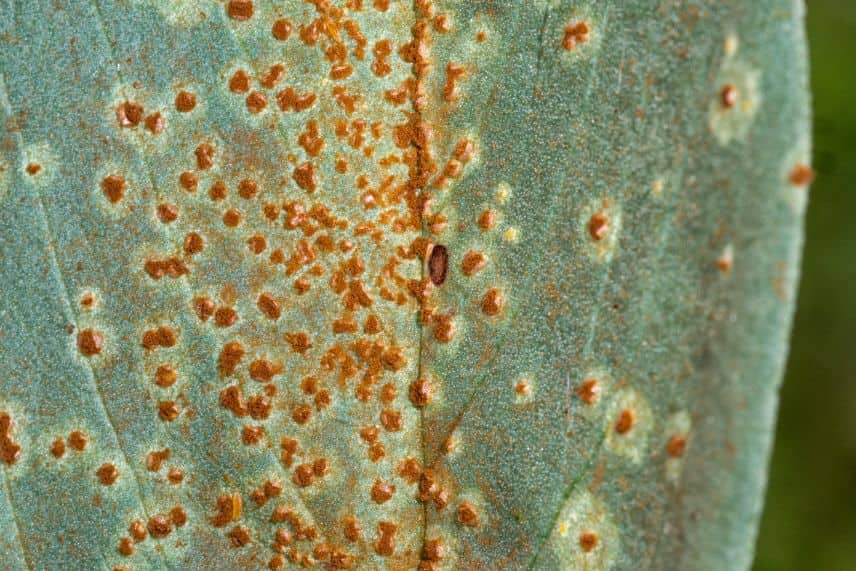
Symptoms of rust on a bean leaf
Treatment
Bordeaux mixture is used as a curative treatment at the first signs of the disease. It is also necessary to remove affected leaves, whether they are still on the plant or on the ground.
Prevention
- Spray nettle manure on the soil before planting bean seeds
- Plant sufficiently spaced to ensure air circulation between plants
- Clean and disinfect gardening tools after each use
For further reading: Getting rid of rust disease
The bean downy mildew
Downy mildew is a cryptogamic disease caused by the fungus Peronosporea viciae, present in the soil and on seeds. Downy mildew develops in cool (between 10 and 15 °C), humid, and overcast conditions.
Symptoms
On the upper side of the leaves, discoloured areas appear, tinged with a slightly reddish-grey to almost black. A grey felt develops on the underside of the leaves. The leaves blacken, dry out, and sometimes curl. They eventually perish.
Treatment
The treatment will be the same as for rust: simply spray Bordeaux mixture at the first signs of symptoms. Destroying the affected parts is also important.
Prevention
- Spray nettle manure on the soil before planting
- Keep the soil well-tilled
- Avoid growing broad beans in overly damp areas
- Make preventive sprays of horsetail manure
Read also
Succeeding in Growing Broad BeansGrey mould or botrytis of broad bean
The fungus Botrytis fabae is responsible for this disease. It has the ability to overwinter in the soil and on contaminated plant debris. It mainly develops in humid conditions during spring.
Symptoms
Small brown necrotic spots develop on the leaves. They enlarge and merge to form large areas of necrosis. The stems may be punctate with brown streaks, as can the pods or flowers.
Treatment
It is essential to uproot and burn the affected plants.
Prevention
- Avoid using overly nitrogen-rich fertilisers
- Grow broad beans in well-drained and deeply cultivated soil
- Space the plants at least 25 cm apart to ensure good air circulation
- Water the soil and plants in spring with a horsetail decoction
- Stimulate the growth of the plants with nettle manure
For further reading: Botrytis or grey mould
The various pests of broad beans
Aphids are certainly the most common pests of broad beans. However, there are others, more or less common. All should be monitored, as they can cause considerable damage and impact yields.
The Black Bean Aphid
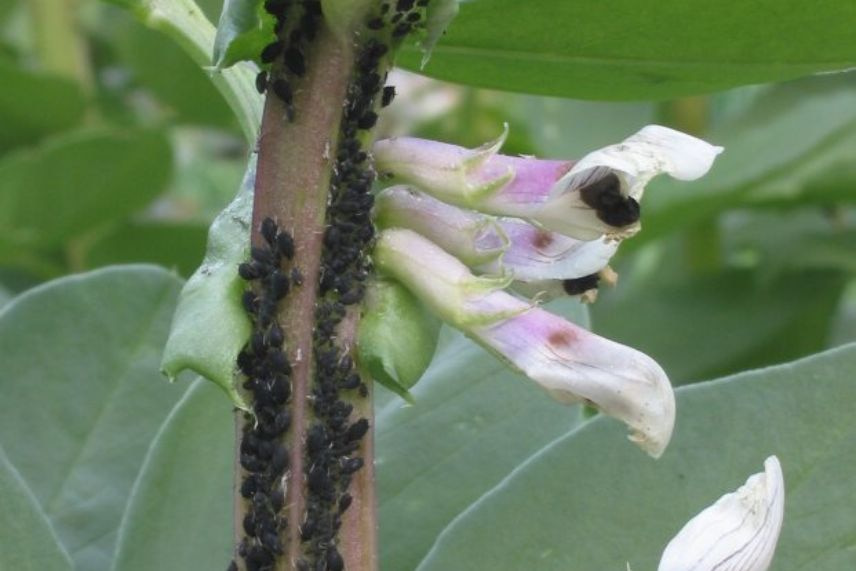
©Rasbak
Aphis fabea, a black aphid, particularly targets broad beans, often developing large colonies. Aphids concentrate on young shoots and forming pods, piercing them and sucking the sap. If attacks occur early, broad bean plants can be completely destroyed. However, aphids mainly affect the development of young shoots, causing them to curl, and the pods, which become stunted.
Aphids facilitate the onset of diseases.
To get rid of these pests, several solutions are available:
- Spray the aphids with a strong jet of water to knock them to the ground
- Remove infested stems
- Make a spray of water mixed with black soap
- Attract ladybirds, lacewings, or hoverflies, whose larvae are significant consumers of aphids. Simply plant melliferous flowers, leave some weeds, provide natural shelters (wood piles, stones, branches…) or build insect hotels. It is also possible to introduce ladybird larvae.
The Pea Weevil
The pea weevil (Sitona liteatus) is a light grey weevil. The insect flies in May and June during warm weather. It lays up to 100 tiny, invisible eggs on leaves and stems in October. The eggs, nymphs, and adults survive the winter.
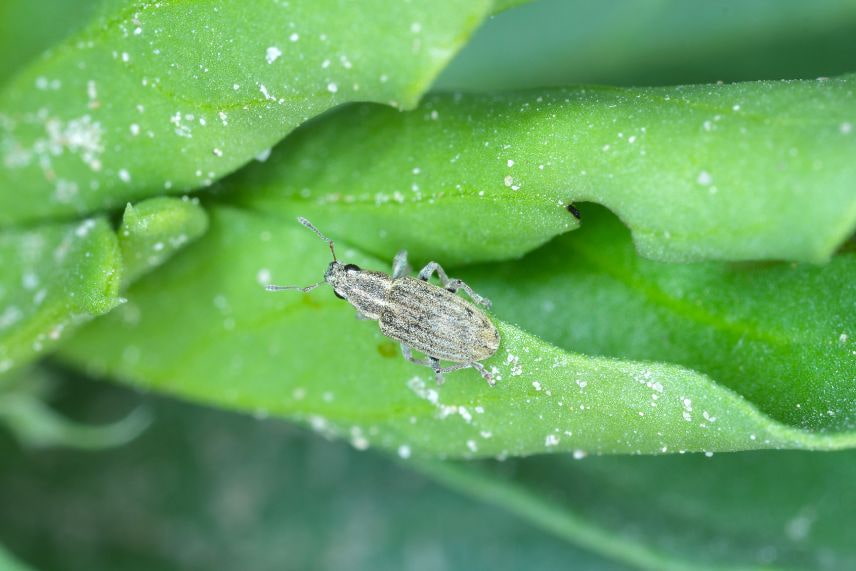 The pea weevil also attacks broad beans
The weevils eat the edges of the leaves, creating rounded notches. The larvae attack the roots, causing the plants to wilt.
To treat, it is possible to spray with an infusion of tansy or wormwood. For prevention, encourage rapid growth with nettle manure and apply a strict rotation of at least 2 to 3 years.
The Broad bean bruchid
Bruchus rufimanus is a beetle that lays its eggs on the surface of the pods in spring. Then, the larva burrows into the seeds of the broad bean and develops quietly for 3 months. It pupates inside the seed.
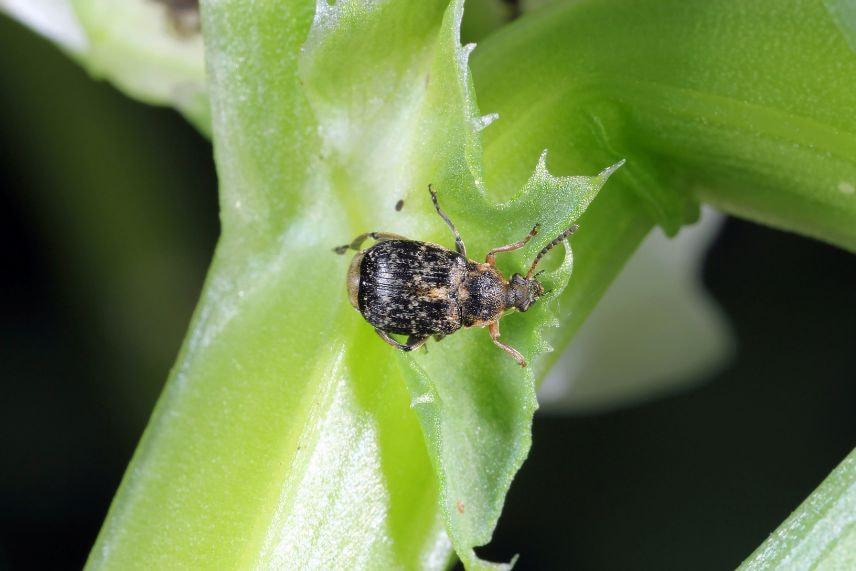 The broad bean bruchid
Seeds punctured by the bruchid are not consumable. They can be easily identified by a small hole. The bruchid can infest seeds.
The only way to protect against the bruchid is to freeze the seeds for 24 hours. The cold kills them.
→ Learn more in our article: Bruchid of legumes, what is it? How to get rid of it?
The pea midge
Contarinia pisi is a small midge, 2 mm long, invisible to the naked eye, but whose flights can be seen in groups at the end of the day. Eggs are laid in May-June on young shoots or between the sepals, which thicken and curl under the action of the young larvae. The larvae of the second generation, red in colour, attack the inner wall of the pods. The pupae then spend the winter in the soil.
During flights, it is recommended to spray with an infusion of tansy or wormwood. Then, removing affected flowers helps prevent the second generation.
To prevent the appearance of the midge, a rotation of at least 2 years is necessary. It is also important to thoroughly remove crop debris.
- Subscribe!
- Contents

Comments