




























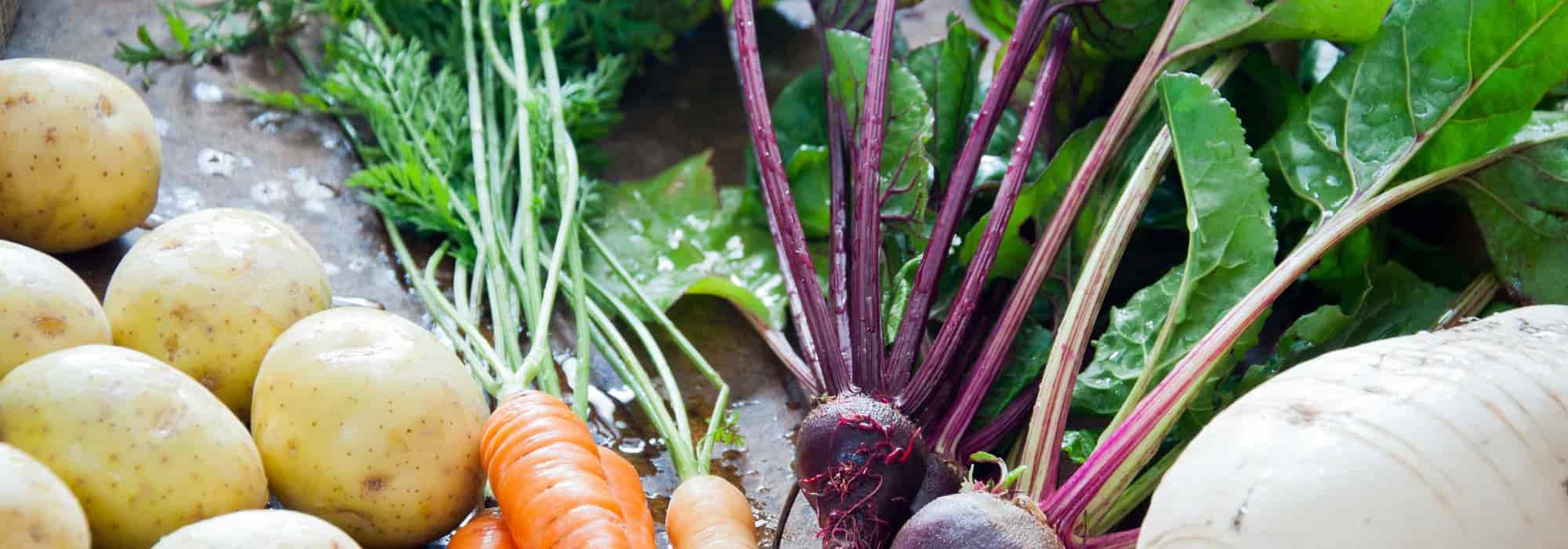
Colourful root vegetables
And what if you fell for these vegetable plants that are beautiful right down to their roots?
Contents
In the garden, it’s not just green that takes centre stage! While green dominates in the vegetable patch, gardeners can also add a touch of whimsy with aubergines, peppers, and tomatoes of all colours, not to mention the cucurbits that showcase a wide range of hues.
And then, there are those more secretive vegetables that only reveal their colours at harvest time, or even during peeling or cutting. I’m referring to those vegetables whose roots, tubercles, or even bulbs we consume. If you immediately think of the orange of carrots or the purplish-red of beetroots, colours derived from the pigments contained in their flesh, that’s perfectly normal. However, these same carrots or beetroots, as well as other vegetables, could hold some delightful surprises for you.
So, how about we set off on a journey to discover these root vegetables that are sure to dazzle you with their colours?

Carrot, colour, crunch, and flavour
When we mention the carrot (Daucus carota), we logically think of the colour orange. A colour that we owe to the carotene present in significant quantities in this root vegetable. But did you know that carrots have not always been orange? Indeed, through cross-breeding, human exploration, travels, and discoveries, the carrot has transitioned from purple to red, from white to yellow. And it was only in the 16th century that the Dutch fixed the colour of our carrot through the hybridization of varieties with red and white flesh.
However, the curious gardener can grow carrots in original and unusual hues that add a splash of colour to the plate. This brings joy to both children and adults, as the colours remain vibrant during cooking.
- The carrot ‘Purple Dragon’: this is an ancient variety that contains a very high level of lycopene, an antioxidant. This is why this carrot, with its conical and stout roots, displays a burgundy epidermis and yellow-orange flesh, with a sweet, mild, and spicy flavour.
- The carrot ‘Géante de Tilques’: this is a traditional variety notable for the size of its roots, which range from 20 to 30 cm, as well as its orange-red flesh.
- The carrot ‘Blanche de Küttingen’: this is an ancient variety from Switzerland that offers roots with a white epidermis and flesh. Its flavour is slightly less sweet than that of other carrot varieties.
- The carrot ‘Solar Yellow’: this is an early variety with bright yellow epidermis and flesh.
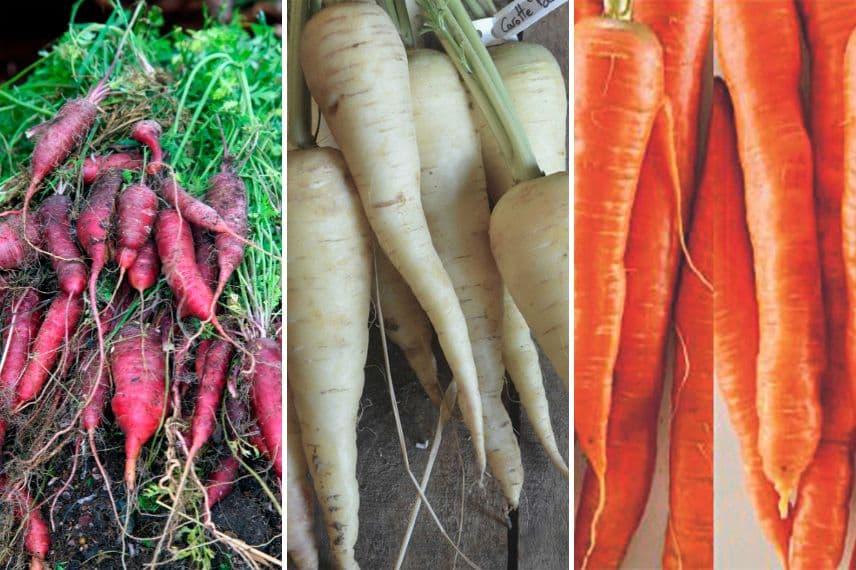
‘Purple Dragon’ (®Flora Press-Martin), ‘Blanche de Küttingen’ (©Ferme de Sainte-Marthe) and ‘Géante de Tilques’
You can also opt for the Harlequin mix, which offers various summer carrots in orange, yellow, purple, and white.
To learn more:
Beetroots, red but not just that...
Beetroots (Beta vulgaris) display a beautiful red colour derived from betalain, a very powerful pigment used as a natural food colouring. This pigment is so prevalent in the flesh of this root vegetable that it can naturally colour our urine and stools! The ‘Covent Garden’ variety, in particular, has a pronounced purplish-red hue. It also produces long, oval roots with a sweet flavour. As for the ‘Detroit Globe’, it boasts a deep dark red hidden beneath the thick skin of its round roots.
However, beetroot is not always red and can take on other distinctly unusual colours or wear original coats:
- The ‘Chioggia’ beetroot offers very graphic roots, as they are speckled with white and pink rings.
- The white beetroot ‘Albina Vereduna’ is a variety with round roots and tender, sweet white flesh.
- The ‘Burpee’s Golden’ has an orange skin and golden flesh that will certainly catch your attention, especially as it has a very mild and sweet flavour.
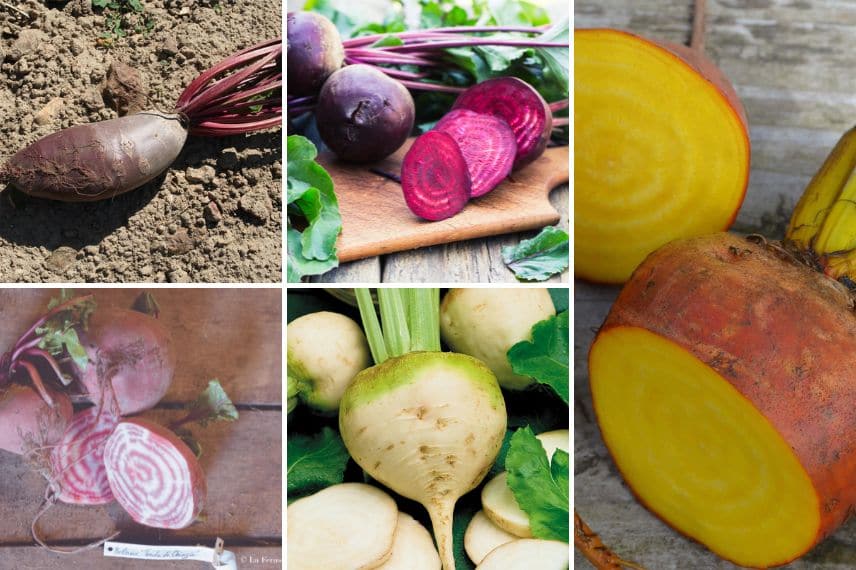
‘Covent Garden’, ‘Detroit Globe’ (©La Ferme de Sainte-Marthe), ‘Chioggia’ (©La Ferme de Sainte-Marthe), ‘Albina Vereduna’ and ‘Burpee’s Golden’
To fully embrace colour, opt for our mix of 4 organic coloured beetroots.
To learn more:
Discover other Vegetables by variety
View all →
Available in 1 sizes
Available in 1 sizes
Available in 1 sizes
Available in 1 sizes
Available in 1 sizes
Available in 1 sizes
Available in 1 sizes
Available in 1 sizes
Available in 1 sizes
Radishes, cute to nibble on
When discussing root vegetables, it’s hard to overlook the radish (Raphanus sativus) as this little vegetable holds a prominent place in our gardens and on our tables. Round, elongated, long, globe or Daikon, the radish confuses the issue by taking on various shapes and sizes, without any complexes. Nevertheless, biting into them raw, simply enhanced with a knob of butter and a pinch of salt, is a culinary delight.
Other radishes assert their uniqueness and dare to bring colour to surprise and delight our taste buds and eyes:
- The ‘Red Meat’ radish: this globe radish of Asian origin features bright pink-red flesh striped with white, firm and sweet when peeled.
- The purple radish ‘Viola’: this variety has well-rounded roots with a purple skin and white flesh.
- The long black market radish: this winter radish has a very rough black skin and a spicy flesh.
- The Chinese winter pink radish: its long root boasts a bright pink skin and slightly spicy white flesh.
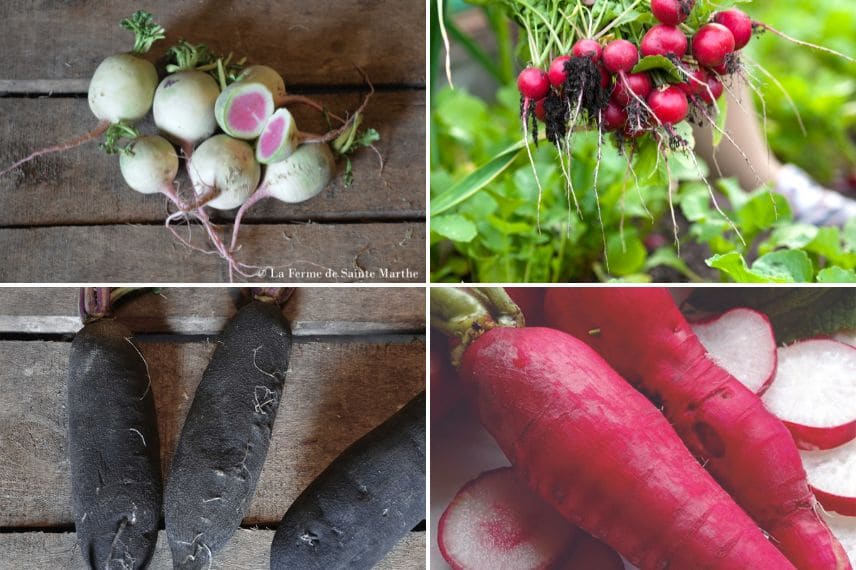
‘Red Meat‘ (©La Ferme de Sainte-Marthe), purple radish ‘Viola’, long black market radish and Chinese winter pink radish
To add colour to your plate, opt for our mix of 5 varieties of round radishes.
To learn more:
Read also
7 uncommon root vegetablesTurnips, long overlooked, are now valued for their delicate flavour.
Root vegetable from the Brassicaceae family, like radishes and cabbages, the turnip is best known for its spherical root. However, it can take on more cylindrical, flat, or even swollen shapes. Long regarded as a poor man’s vegetable, the turnip has regained some nobility. Especially since it is easy to grow, very hardy, and rich in unique flavours.
And like many other root vegetables, the turnip knows how to show its colours:
- The yellow turnip ‘Boule d’or’: this variety has yellow, round, fleshy roots that contain sweet flesh
- The white turnip ‘Globe collet violet’: its fleshy, spherical root offers firm, sweet flesh
- The flat turnip ‘of Holland’: this is an old variety that produces a turnip with immaculately white roots
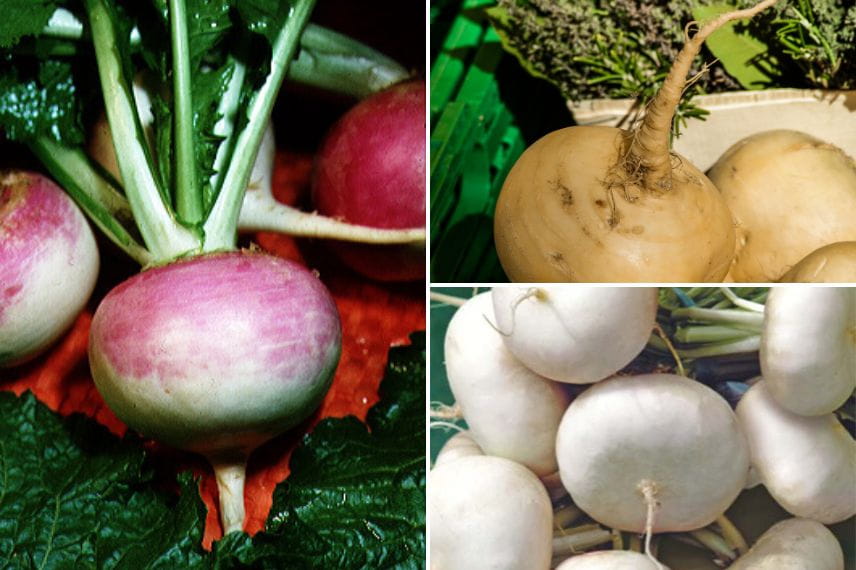 Turnip ‘White globe with purple collar’, turnip ‘Flat turnip of Holland’, turnip ‘Boule d’or’
For further reading:
Potatoes, those essential tubercles
How can one overlook potatoes (Solanum tuberosum) when they are such an integral part of our vegetable and culinary heritage? With firm or melting flesh, potatoes can be enjoyed in countless ways: boiled, steamed, sautéed, roasted, fried, in gratins, in soups, or jacket potatoes…
The choice of which potato to grow can be based on taste quality, productivity, earliness, storage, and resistance to diseases. Some gardeners will opt for a reliable variety like ‘Charlotte’, a versatile, highly productive potato that is resistant to blight and suitable for storage.
Other gardeners choose to add a splash of colour to their vegetable patch and grow potatoes that do not have a white skin and flesh. I invite you to discover an unusual selection: Original and Colourful Potatoes to add some zest and colour to your chips!
These colourful root vegetables that can also make their way into our vegetable garden
To add even more colour to the garden while discovering new flavours, some other root vegetables can join your vegetable beds:
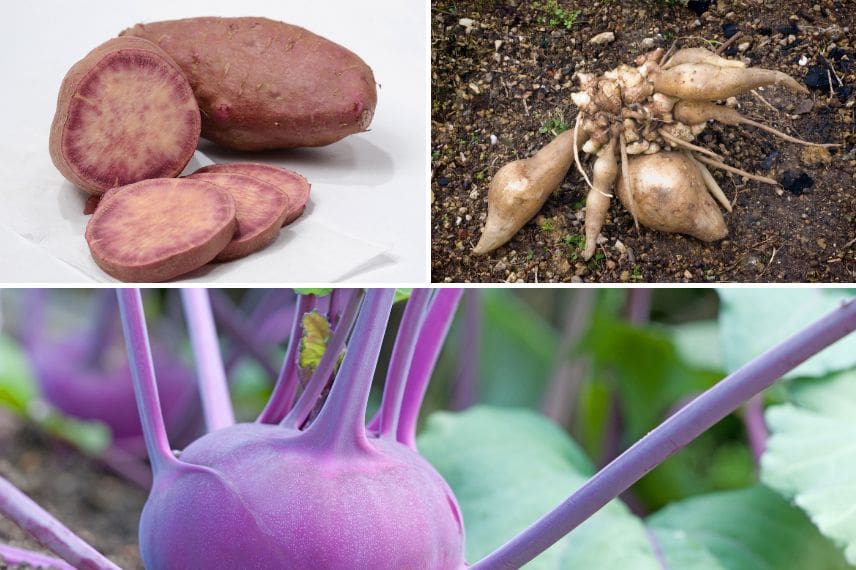
- Sweet potato (Ipomoea batatas): despite its tropical or subtropical origins, it grows very well in our latitudes, in rich, loose soil, provided it receives enough water and warmth. There are many varieties, but ‘Sakura’ is the most popular with its dark, almost black foliage and its tuber with purple, slightly sweet flesh.
- Kohlrabi (Brassica oleracea var. gongylodes) is making a big comeback on tables. It must be said that it has many advantages with its large, round, spherical root, its multiple flavours, and its medicinal properties. Among the different varieties, the kohlrabi ‘Azur’ stands out with its beautiful purple bulbs, exceptional tenderness, and taste quality.
- Earth pear or yacon: this is a plant from the dahlia family that produces tubers with white flesh whose granular texture resembles that of a pear. It can be eaten raw or cooked, prepared like potatoes. It can also be enjoyed as a dessert with chocolate.
For further reading, discover my selection of 10 unusual and curious vegetables, some of which dare to be colourful. Or check out Patricia’s article featuring 7 uncommon root vegetables.
- Subscribe!
- Contents
Comments