




























Choosing a Ranunculus: our buying guide
All you need to know to select Ranunculus botany or hybrid Ranunculus
Contents
Ranunculus include florist’s ranunculus, the most commercially grown, as well as botanical species such as the meadow buttercup or Ranunculus acris, found in our damp meadows, with cup-shaped flowers in bright golden-yellow.
In France, more than 300 wild botanical species are found in the wild.
They are herbaceous plants whose cup-shaped flowers, with petals of a glossy texture, yellow or white, attract numerous pollinating insects. The foliage of ranunculus is often palmately divided and very dissected. There are also aquatic ranunculus such as Ranunculus lingua or greater crowfoot, which form a group of their own. They flower in spring or summer.
Florist’s ranunculus are tuberous perennials with vibrant colours and flowers that are single or double, appearing from April to June. They are also known as Asian ranunculus, garden ranunculus or Oriental ranunculus. They originate from a species native to the Mediterranean region (Aegean Islands, Egypt, Crete, Greece and Libya) and therefore do not tolerate winters that are too harsh.
Discover our buying guide to differentiate ranunculus by height, the colour or shape of the flowers, the colour of the foliage, the flowering period, their hardiness and uses.
→ Also read our family sheet on florist’s ranunculus.

Based on its dimensions
Ranunculus often reach an average height of about 40 cm, though some only reach 10 or 20 cm in height, and even 5 cm in height.
The botanical species and their varieties:
- The Ranunculus lingua or Greater spearwort reaches 1 m in height at maturity.
- The lowest are the varieties derived from the species Ranunculus ficaria, such as ‘Flore Pleno’ and ‘Brazen Hussy’, very carpet-forming, reaching barely 5 cm in height. ‘Collarette’ reaches 10 cm in height.
- Barely taller, at 15 cm tall, are Ranunculus ficaria verna and ‘Ken Aslet’.
- Just above, at 20 cm tall, is Ranunculus flammula.
- Around 40 cm in height, you will find the varieties of the species Ranunculus acris, such as the cultivar Ranunculus acris ‘Multiplex’.
- Finally, at 60 cm in height, the Ranunculus repens ‘Mulitplex’.
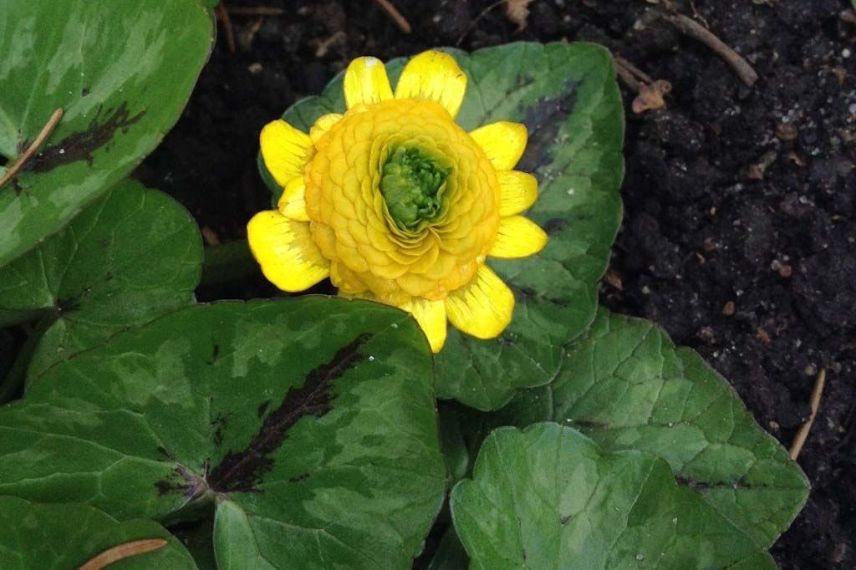
Ranunculus ficaria ‘Collarette’
The florist’s ranunculus or Asian ranunculus:
Hybrid ranunculus, florist’s ranunculus or Asian double ranunculus, stand around 20 to 30 cm tall, and up to 60 cm tall.
According to the colour of the flowers
All Ranunculus botanical species and their varieties are yellow — a bright, golden yellow, like the famous buttercup or Ranunculus acris. Except for the Ranunculus ficaria‘Ken Aslet’, a very pretty variety with white flowers and pale-yellow centres.
Hybrid varieties of florist’s ranunculus or Asian ranunculus, Ranunculus asiaticus, come in colours of red, orange, pink, yellow, green, mauve and white, or bi-colours. These ranunculus boast a multitude of vibrant colours.
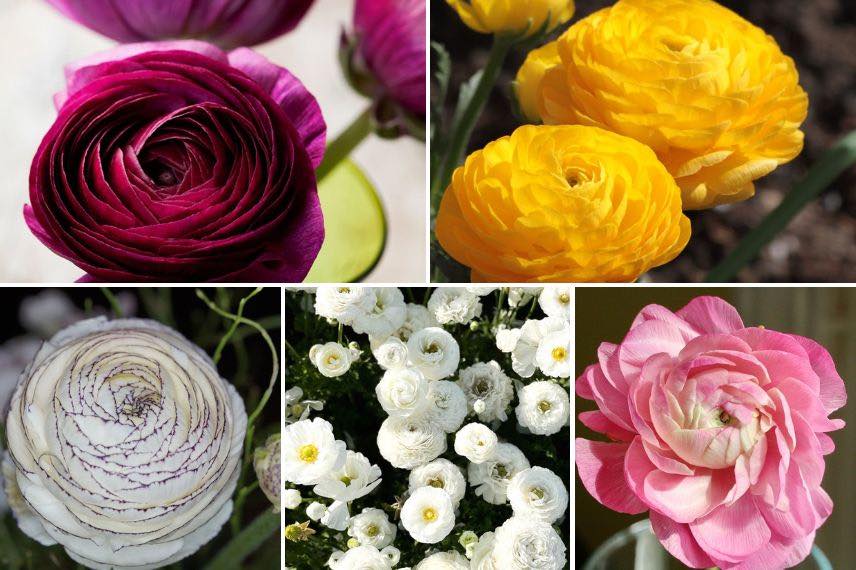
Asian ranunculus, clockwise: ‘Pauline Violet’, double yellow, double pink, double white, double white-edged pink
According to the shape of the flowers
Asiatic ranunculus form double flowers, and often very double and very plump, rounded and globe-shaped. Their numerous crumpled petals evoke the charm of old-fashioned roses.
Others are semi-double. Botanical species bear single flowers, but their varieties are frequently adorned with many petals, like the pretty double flowers of Ranunculus acris ‘Multiplex’ and of Ranunculus ficaria ‘Collarette’ or ‘Flore Pleno’.
The size of the flowers is around 3 cm for the botanical species. The florist’s ranunculus flowers are generally around 5 to 6 cm.
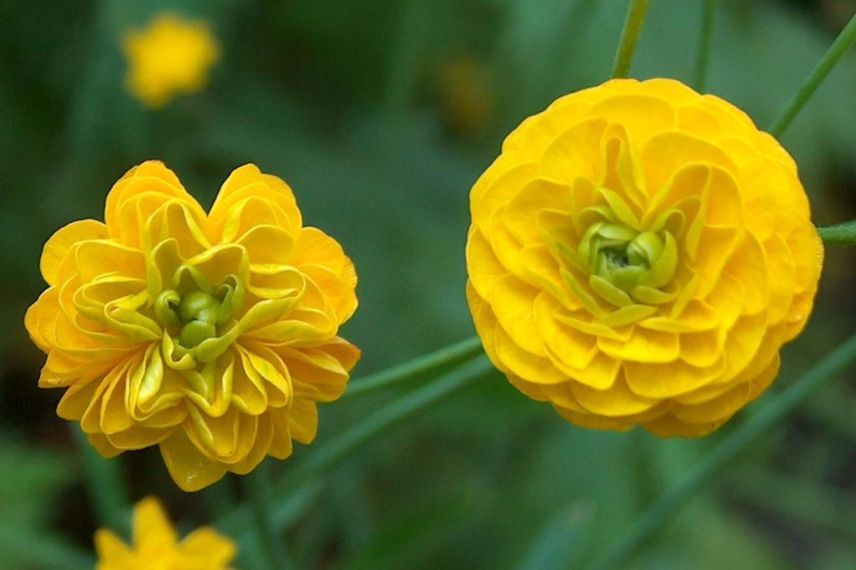
Ranuncula acris ‘Multiplex’
Read also
How to get rid of creeping buttercup?According to the colour of the foliage
Let’s showcase here the lovely, very dark and glossy foliage, purple-black in colour, with chocolate reflections, of the variety Ranunculus ficaria ‘Brazen Hussy’.
The variety ‘Collarette’ adorns its dark green foliage with black veins and silver marbling, very ornamental.
Leaf shape varies among botanical ranunculus, more or less triangular, lobed or dentate.
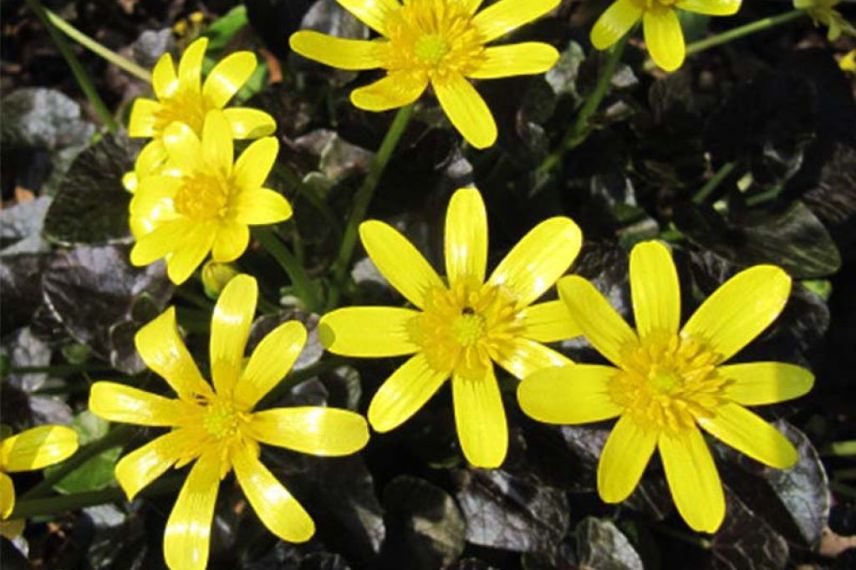
Ranunculus ficaria Brazen Hussy
According to the flowering period
The first to bloom are the botanical speciesRanunculus ficaria and Ranunculus flamulla and their varieties. They bloom from March to April.
The Asian buttercups bloom in two periods according to the varieties: either from March to May, or from April or May to June.
Then the buttercup appears in summer, between June and September, just like the greater water crowfoot or Ranunculus lingua.
According to their hardiness
There is a wide variation in hardiness:
Yellow-flowered botanical species and their varieties are very hardy across France, often down to -30 to -35°C.
Florists’ ranunculus or Oriental ranunculus are not very hardy. They tolerate light frosts, around -5 to -6°C. In areas where the winter climate is colder, they should be kept sheltered indoors.
According to habit and uses
Asiatic buttercups form dense clusters of flowers.
If Greater celandine and the buttercup form loose tufts and bear their flowers on the end of long, fairly flexible stems, the very low Ranunculus ficaria develop ground-hugging foliage, carpeting, and flowers only slightly higher.
Uses
The botanical buttercups are primarily intended for gardens, in meadow borders, or along damp banks, as they particularly favour damp soils, even marshy ones. Note that they also grow in partial shade and shade. The lowest and most compact varieties also establish themselves in pots on terraces or balconies.
The Asiatic buttercups, a little more sophisticated, place themselves in the foreground of more cultivated borders, at the edge or in a rock garden. They do very well in pots, which also allows overwintering them during the cold season. If they are in the ground, you can also lift the tuber. Consider composing beautiful bouquets for the home; they last a long time in a vase, several weeks.
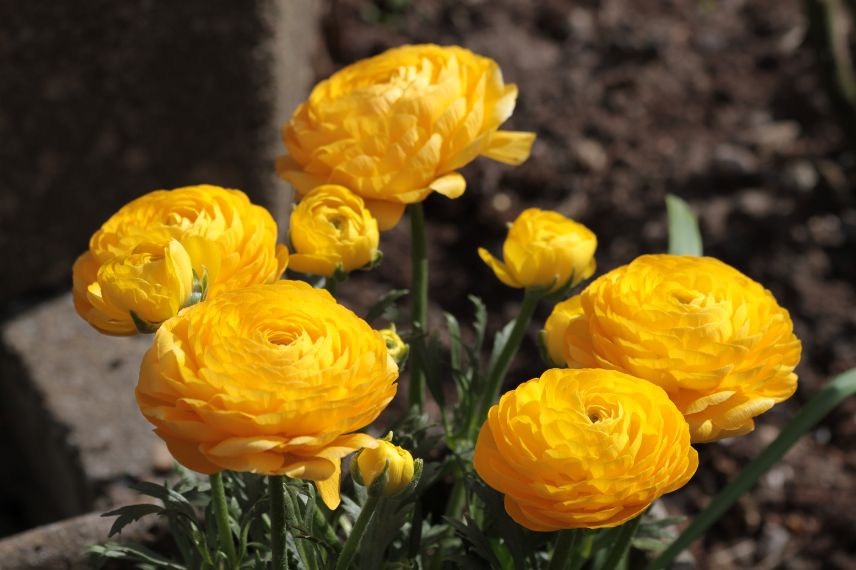
Florist’s buttercups form tight tufts of dense flowers, here: double yellow buttercup
- Subscribe!
- Contents
Comments