





























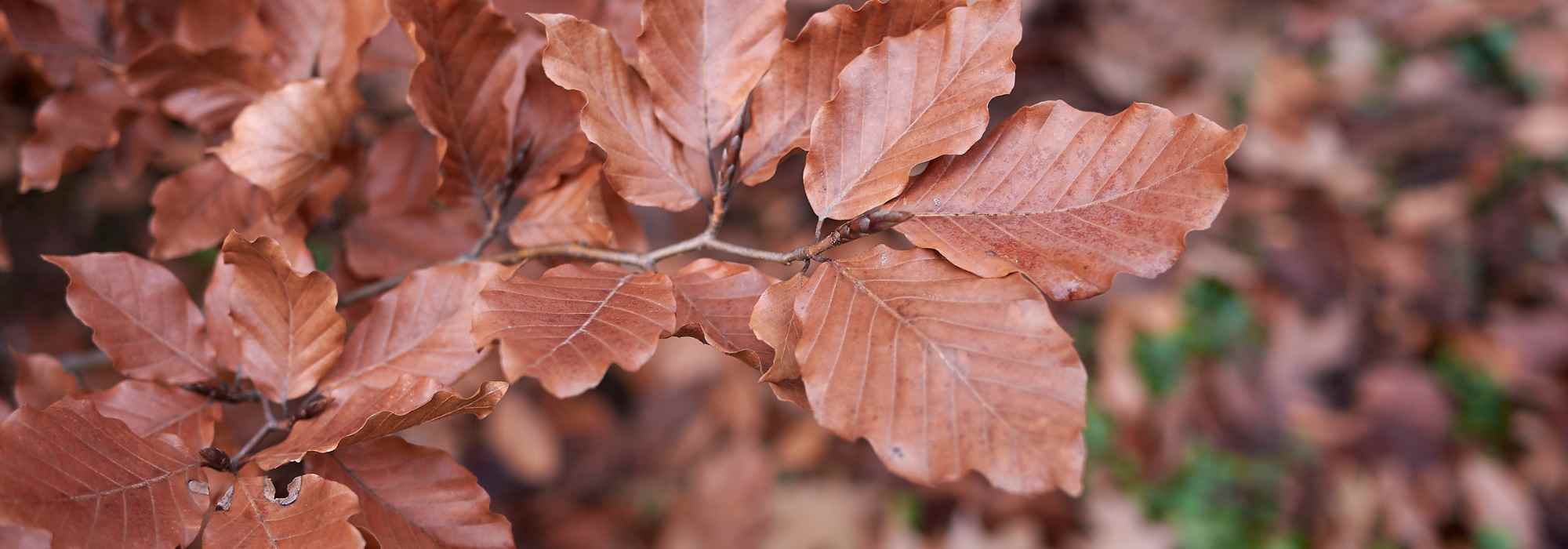
Choosing a beech tree for the garden
The right beech in the right place.
Contents
Are you dreaming of a majestic tree to elevate your outdoor space? the beech is an ideal option to add a touch of elegance and grandeur to your garden. Renowned for its lush foliage that changes colour with the seasons, its regular growth and impressive longevity, the beech is the quintessential tree for creating a shady corner or a natural hedge. In this guide, we will explore how to choose the beech that best fits your garden, which selection criteria to consider such as soil type, exposure or available space, but also the type of foliage or the desired shape.
Follow our buying guide to make an informed choice and fully enjoy this exceptional tree in your garden.

Pruning
Choosing a beech for your garden by size will, of course, depend on the space available and the aesthetic effect you wish to achieve. If you have a large space, you could opt for the beech from our forests, the common beech (Fagus sylvatica), which can reach up to 35 metres tall and offers dense, luxuriant foliage. If space is a little more restricted, the purple beech (Fagus sylvatica ‘Atropurpurea’) can be a good option with its ‘medium’ size (20 m tall by 15 m wide, even so!) and its dark purple leaves, bringing a touch of colour to your garden.
For small gardens (or for creating hedges), varieties with a very narrow habit, such as Fagus sylvatica ‘Dawyck’ (20 m tall by barely 3 m wide) are perfectly suited to controlled pruning and take up less space.
In short, the size of your beech should be in harmony with the dimensions of your garden and your landscaping needs.
But, in truly small gardens, there are also cultivars worth mentioning, such as the Beech ‘Callista’ which will not exceed 2 m in height by just over 1 m in width, or the striking Fagus ‘Mercedes’ with laciniate foliage that will form a ball of about 1.5 m in all directions.
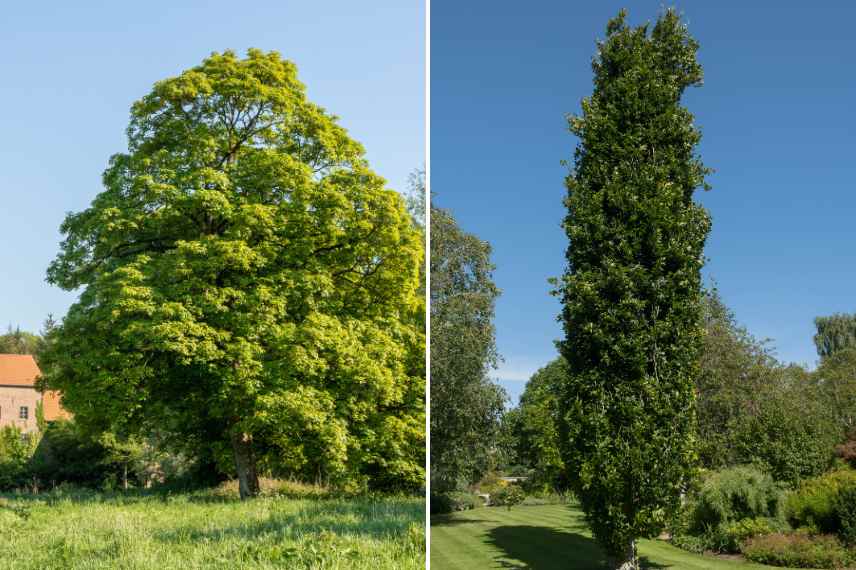
On the left Fagus sylvatica, on the right Fagus sylvatica ‘Dawyck’
Form and Silhouette
The shape or silhouette of a beech can greatly influence the mood and design of your garden. If you’re aiming to create a majestic and imposing effect, the common beech with its broad silhouette and spreading branches is ideal.
For a more contemporary look, a fastigiate beech, such as the the Fagus sylvatica ‘Dawyck Purple’ or its counterpart the beech ‘Midnight Feather’, offers a columnar and slender habit that adds verticality to your outdoor space.
If you have a preference for more winding and distinctive forms, the twisted beech, or Fagus sylvatica ‘Tortuosa’, with its twisted branches and irregular habit, is an option that inevitably attracts attention.
But there are also weeping forms of the common beech, such as the Fagus sylvatica ‘Purpurea pendula’, whose shoots hang gracefully toward the ground.
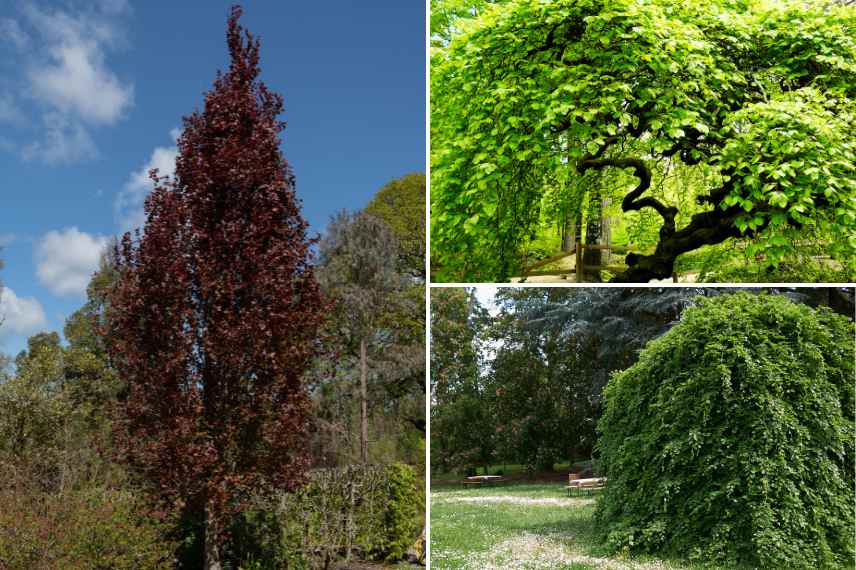
On the left, Fagus sylvatica ‘Dawyck Purple’. Top right, Fagus sylvatica ‘Tortuosa’, bottom right Fagus sylvatica ‘Pendula’
Colour of the foliage
Foliage isn’t always just green in beech trees. It can take other hues depending on the varieties.
Purple foliage
This is the most common shade after green for the foliage of the common beech. We know the classic Fagus sylvatica ‘Atropurpurea’ that is found in parks and in clipped hedges (sometimes alternating with green-leaved beech) with the beautiful purple-red hue. But there is now a purple beech whose leaves are even larger and a deep purple-red, almost violet. This marvel is named Fagus sylvatica ‘Riversii’.
Please note : a purple-leaved cultivar also exists in a weeping form (see above). It is Fagus sylvatica ‘Atropurpurea Pendula’.
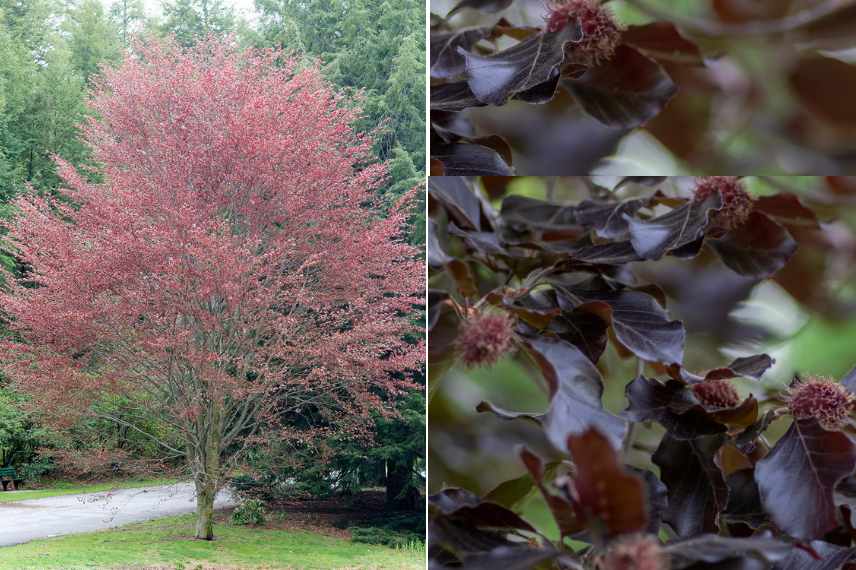
On the left, Fagus sylvatica ‘Riversii’ and on the right the purple beech foliage
Yellow-gold foliage
The Fagus sylvatica ‘Dawyck Gold‘ is an excellent cultivar of the common beech, with a slender, columnar habit and golden foliage in spring, becoming light green in summer and coppery yellow in autumn. It looks superb as a specimen or in a hedge. It adds structure and verticality to the garden.
The cultivar ‘Zlatia’, with a slender habit and a rounded crown, has young foliage with a yellow undulate margin, then green and finishing coppery in autumn. Finally, ‘Aurea Pendula’ reveals golden-yellow foliage in a weeping form.
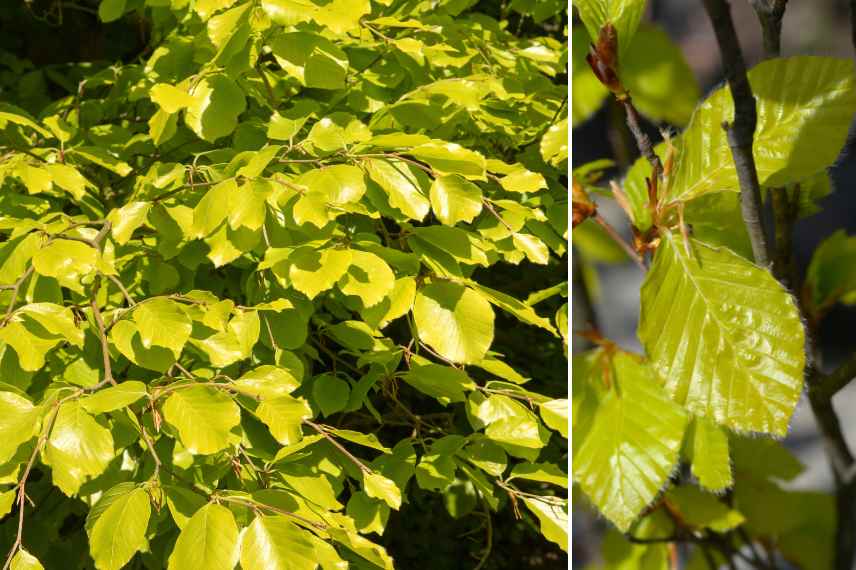
On the left, Fagus sylvatica ‘Zlatia’. On the right, Fagus sylvatica ‘Dawyck Gold’
Variegated foliage
The variety Fagus sylvatica ‘Franken’ displays new shoots almost white, then foliage largely variegated with cream white. It is a fairly slow-growing variety. There is also the cultivar Albomarginata whose leaves are margined with cream white.
Three-colour foliage
After all, why settle for two colours on a leaf when you can have three? This is the case of the Fagus sylvatica ‘Purpurea Tricolor’ (or ‘Roseomarginata’), which unveils purple foliage, but variegated with pink and white. The colours are particularly intense in spring. A marvel!
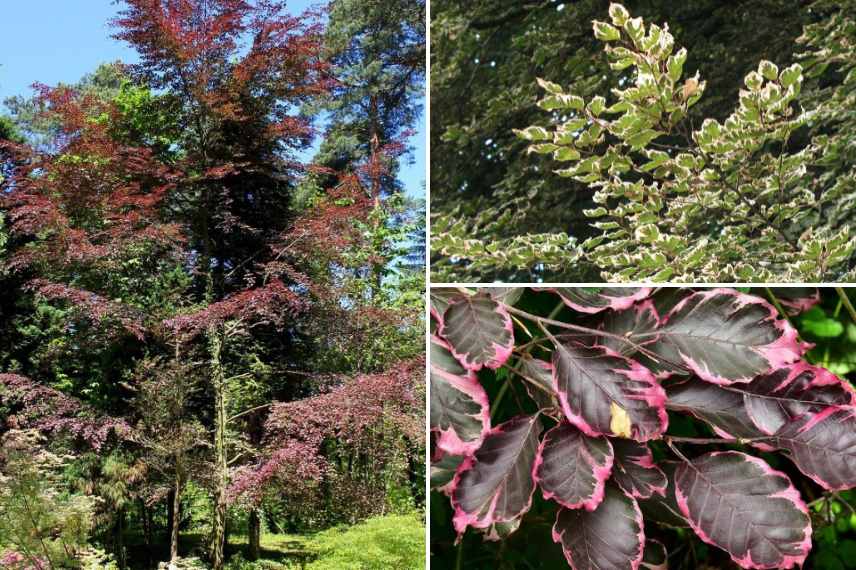
Fagus sylvatica ‘Tricolor’
Foliage shape
We tend to overlook the beech’s ‘banal’ oval leaves and linger on rarer, stranger and more spectacular aspects. For example, the laciniate-leaved beech, often designated by the cultivar Fagus sylvatica ‘Asplenifolia’ (or sometimes Fagus ‘Laciniata’), features finely cut foliage that adds a touch of elegance and lightness. But it’s not the only one! Indeed, the ‘Mercedes’ cultivar, besides being compact, bears very fine and light laciniate foliage. The Fagus ‘Midnight Feather’, with a narrow habit, has very finely cut purple leaves. Both recall the foliage of a beautiful Japanese maple.
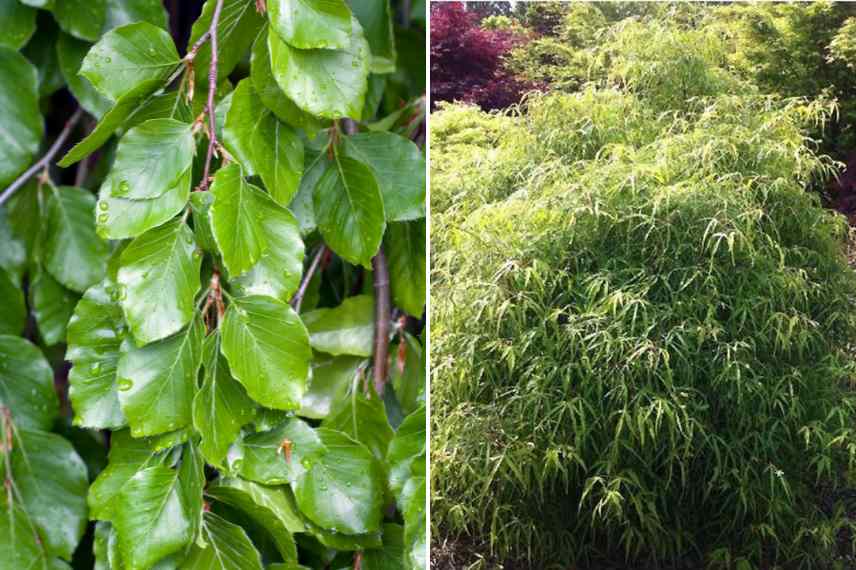
On the left, the typical foliage of the type species. On the right, the ‘Mercedes’ cultivar
For a hedge
Creating a beech hedge in your garden is an excellent way to structure space while providing natural privacy. If you want a dense and sturdy hedge, common beech lends itself particularly well to this purpose. With its regular growth and evergreen foliage in winter, it forms an effective visual and acoustic barrier. For a splash of colour, purple beech or Fagus sylvatica ‘Atropurpurea’ is an interesting alternative. Its dark purple leaves add a distinctive touch and can create a striking contrast with surrounding plants.
If your space is more limited, opting for a variety with a narrower habit, such as fastigiate beech, may be wise. The Fagus sylvatica ‘Dawyck’ (or ‘Dawick Gold’ with golden foliage or ‘Dawick Purple’ with purple foliage) takes up less width while offering a good height.
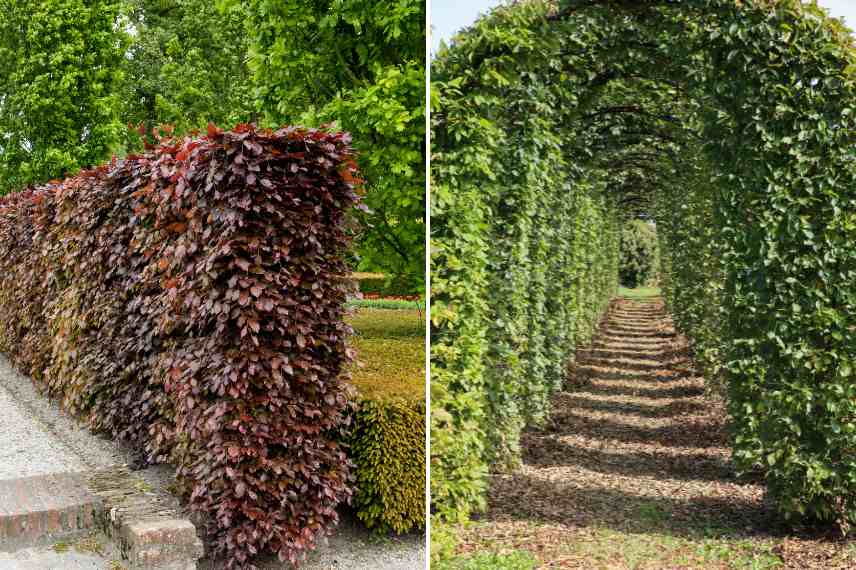
Fagus sylvatica ‘Atropurpurea’ and Fagus sylvatica trained into an arch
- Subscribe!
- Contents

Comments