






























Areca: what care is required throughout the seasons?
Our tips and tricks for a thriving and healthy plant from spring through winter
Contents
Areca (Dypsis lutescens) is certainly the most common and trendiest indoor palm on the market for houseplants. With its elegant, lush foliage, composed of several particularly fine stipes, and its graceful silhouette, it adds an undeniable exotic touch. Originating from Madagascar, it thrives in a tropical climate, enjoying warmth and humidity. That said, it adapts well to indoor pot cultivation, provided it is given the best growing conditions. To keep it in top form all year round, its care must be adapted to seasonal variations.
Discover how to care for your Areca throughout the four seasons of the year.

In spring, kickstart the Areca's growth.
Spring is the season of renewal, including for indoor plants. Indeed, brightness increases both indoors and outdoors, and the days are longer. As for temperatures, they are milder and the atmosphere less dry. The Areca will therefore resume its growth. It is therefore an ideal period to stimulate its growth and to provide it with the most favourable cultivation conditions.
Repotting: new pot and substrate for your Areca
Ideally, the Areca should be repotted every 2 to 3 years. If you feel that your Areca is starting to feel cramped in its pot (even if that is a situation it enjoys), spring is the right time to repot. Its root system develops rapidly, and a container only very slightly larger allows it to flourish more fully.
The choice of substrate is essential. A special potting mix for green plants provides good drainage and avoids excess moisture, the enemy of its roots. You can also give it ordinary garden soil, lightened with sand or with perlite for drainage. A handful of compost is welcome.
If repotting is not necessary or possible due to the pot size, top-dressing is enough : replacing the top layer of the potting mix with fresh substrate enriched with compost provides it with new nutrients.
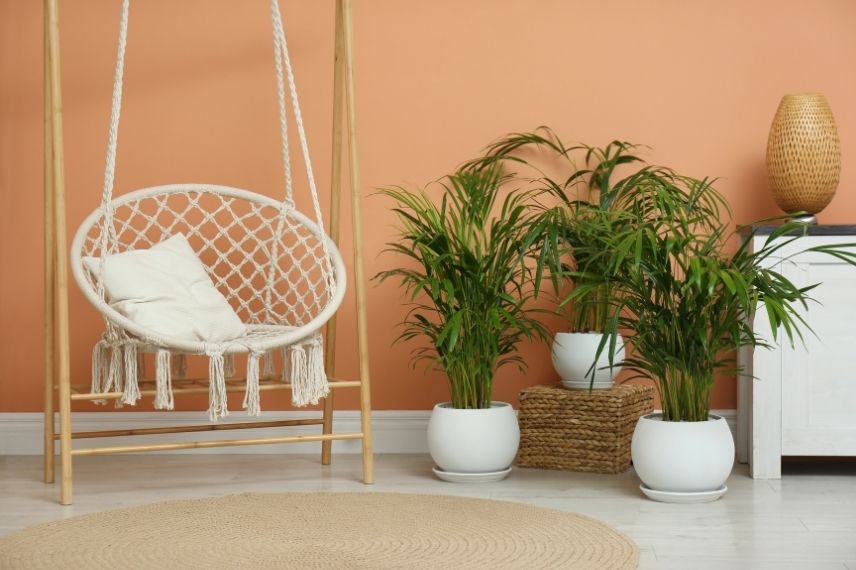
In spring, the Areca resumes its growth
Watering: water, but not too much!
With the restart of growth, the Areca’s water needs are greater. Watering should be regular, but not excessive. One to two times per week is a good average, ensuring the potting mix dries slightly between two waterings. It is also important to never leave residual water in the saucer or the cache-pot.
Watering with non-calcareous water at room temperature, for example rainwater, is always preferable. Tap water can be used, provided it is left to stand for a few hours.
Ambient humidity plays an important role. Too dry air causes leaf desiccation, which turn yellow and then brown. To avoid these issues, you should:
- Mist the foliage with non-calcareous water once or twice a week
- Place a tray with clay balls and water under the pot to maintain a more humid atmosphere.
Exposure: give your Areca light
Spring is also an opportunity to optimise the Areca’s exposure. It needs bright light but not direct sun. A spot near an east- or west-facing window is ideal. The light from a conservatory is also welcome for your Areca, provided it is not placed directly behind the glass.
Fertilisation: a boost for your Areca
After winter, the Areca needs a nutritional boost to restart well. A liquid fertiliser for green plants, rich in nitrogen, is recommended. An application every two weeks until the end of summer promotes dense and flashing foliage.
Read also
Indoor palm: how to grow Areca palm?In summer, manage the heat and humidity around the Areca.
During the hot months, the Areca palm enters its phase of maximum growth. Its foliage becomes more lush, but you must ensure it does not suffer from heat and a lack of humidity.
Watering and humidity: stepped up
The heat speeds up the evaporation of water, so watering must be more frequent. Two to three times a week may be necessary, especially if the Areca palm is placed in a warm spot. With the same precautions as in spring: do not let water stagnate. The water should be at room temperature and soft to avoid white spots on the leaves.
In terms of humidity, summer is a tougher season to manage. The air becomes dry, so you must intensify the misting on the foliage.
Exposure: sun, but not direct
Even though the indoor palm loves light, too strong sun burns its foliage. If brown spots appear, you should move it away from a window that is too exposed or filter the light with a light sheer curtain. Ideally, if you have a garden, a spell from June to September will benefit your Areca. Provided you place it in bright shade, for example under a tree with light foliage, or in dappled shade lit by the morning sun.

An outdoor stay in summer is beneficial for the Areca
Watch out for pests
Avec la chaleur et l’humidité, certains ravageurs comme les cochenilles et les araignées font leur apparition. Un contrôle régulier du feuillage permet d’agir rapidement. Découvrez comment lutter avec nos deux articles : mealybugs: identification and treatment et red spider mites: identification and treatment.
In autumn, prepare the Areca palm for its dormancy.
As temperatures gradually fall and daylight decreases, the Areca slows its growth to enter winter dormancy. Maintenance should be adjusted to avoid unnecessary stress.
Watering: ease off gradually
The Areca palm needs less water in autumn. You should start spacing out watering, moving to once a week, or even less if the room is cool. Misting can continue, especially if the indoor air is dry.
Fertilisation: stop
The nutrient supply should also be reduced so that your Areca palm enters dormancy. It is preferable to stop fertilisation by the end of October, as the plant enters dormancy and no longer needs an excess of nutrients.
Exposure: repositioning required
If the light becomes too weak, the Areca palm can be moved closer to a well-lit window. However, you should not place it near a heat source, such as a radiator, a stove or a fireplace. As for the ambient temperature, it should not fall below 15 °C. Remember that your indoor palm is native to Madagascar! A temperature of 18–24 °C is ideal.
In winter, protect the Areca palm from cold and lack of light.
Winter is a delicate period for the Areca, as for many houseplants. Its growth slows and it becomes more sensitive to a lack of humidity and to the dryness of the air caused by heating.
Watering: the bare minimum
During winter dormancy, the Areca palm should be watered only every two to three weeks. It is always necessary to wait until the surface of the potting mix is dry before adding water. Conversely, you must absolutely continue misting to counteract the negative effects of a dry atmosphere. And place the pot on a bed of clay pebbles and water.
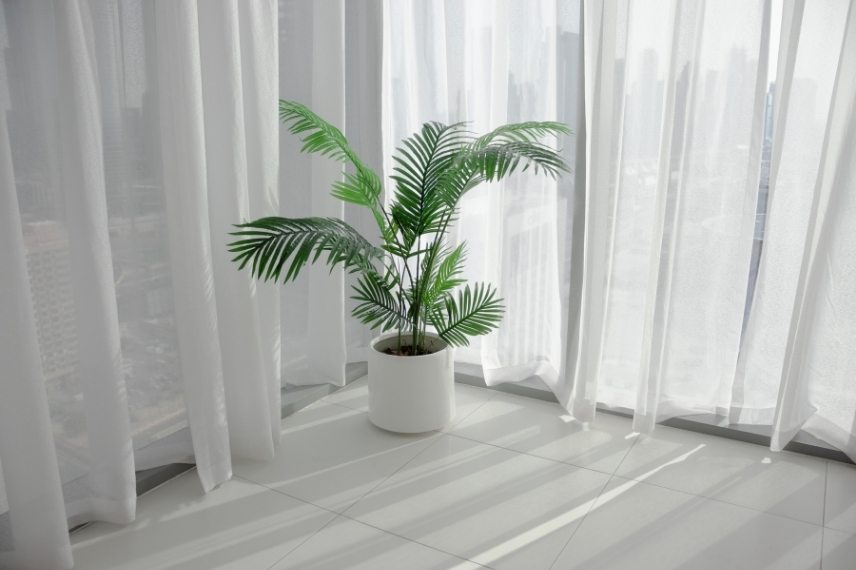
In winter, the Areca needs plenty of light
Be vigilant against cold and pests
If your Areca hasn’t joined its winter quarters, you should place it in a bright room, with a temperature above 15 °C. Be very vigilant about cold drafts and poorly insulated windows.
Winter can also favour the appearance of scale insects. Regular checks of the leaves allow for rapid action in case of an infestation.
Learn more about the Areca
Discover our other articles:
- Subscribe!
- Contents
Comments