




















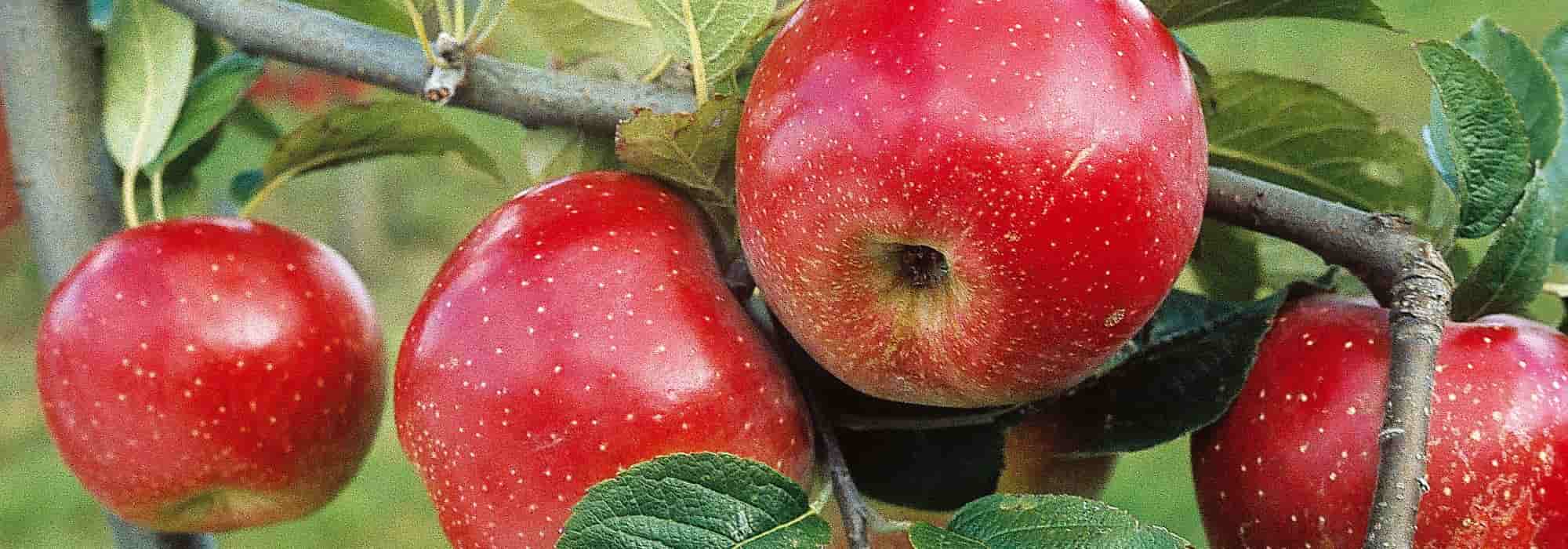
Apple tree: how to choose the right variety?
Our buying guide
Contents
The apple tree (Malus domestica) is certainly the most common fruit tree in the territory’s gardens. Perhaps because the apple is the most consumed fruit in France, but also because the apple tree is a relatively simple fruit tree to grow, extremely frost-hardy (down to -30°C), adaptable to all soil types (including calcareous soils), and above all requiring little maintenance.
The apple tree, a Rosaceae family seed-bearing fruit tree, accounts for nearly 6,000 species, among which a good dozen regularly appear on market and supermarket stalls. Alongside these popular apples, there are many other varieties, very tasty, often grown regionally, and little known to the general public. These varieties deserve attention for their adaptation to a given climate and their resistance to diseases.
That said, if you wish to plant one or more apple trees in your garden, the choice is quickly a dilemma. Should we stay with safe bets or venture into bolder choices that may conceal some pleasant surprises (or not!) at harvest. Discover with us our selection of apple trees based on different criteria related to flavour, productivity, fruiting and the colour of the fruit…
Depending on the fruiting and harvest period
The apple is quintessentially an autumn fruit, harvested between September and October for most varieties. Of course, apple harvest depends greatly on the weather and, above all, on the growing region.
Nevertheless, some apple trees are particularly precocious and can bear their first apples from August, or even July. While they are indeed lower in sugar, these apples will be a little more tart. But they are often very fragrant and perfect for summer fruit salads or delicious compotes. Among these early apple trees, one can cite ‘Astrakan rouge’, an old variety that yields handsome, well-coloured apples from mid-July. Their white flesh is juicy and fragrant. This mountain and summer apple also has the advantage of blooming in May and of resisting the cold very well.
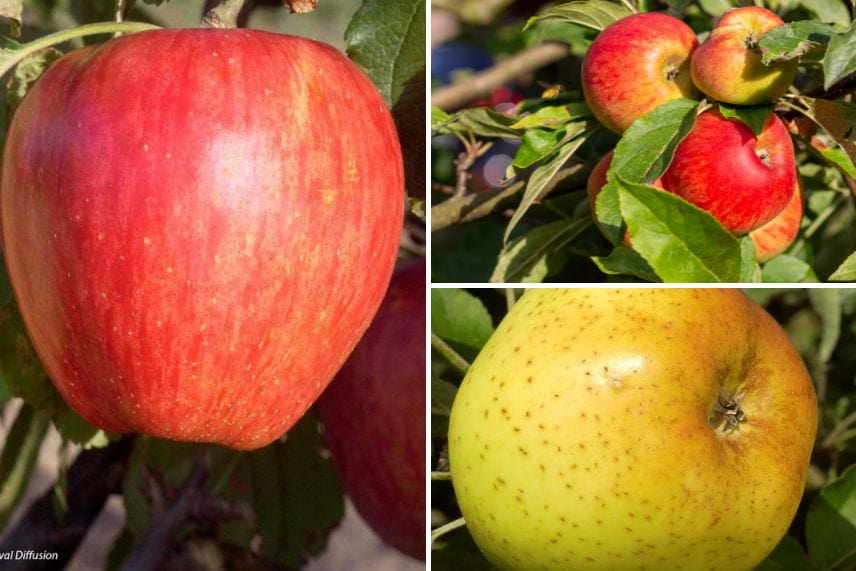
The ‘Transparente blanche’ is also a summer apple, known as a harvest apple. This apple tree, particularly hardy, yields large apples from July with a whitish-green epidermis and very pale and fragrant flesh. It is an excellent apple for pies or compotes and should be eaten promptly or it may become mealy. It is also a self-fertile tree with rapid fruit set. Its cousin, the ‘Transparente de Croncels’, can also be considered an early apple in the sense that harvest begins in late August. This variety yields large apples with a fine yellowish flesh, fairly tender and very sweet, tinged with a hint of acidity.
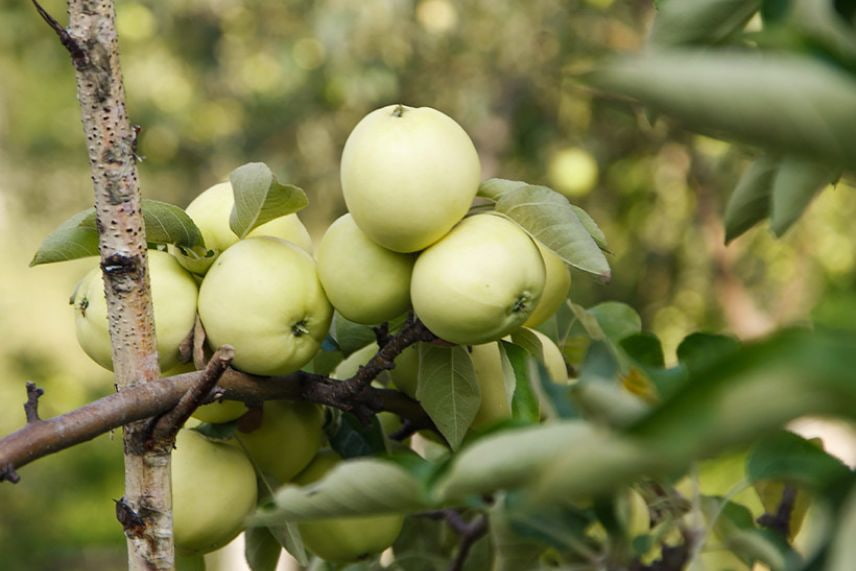
The ‘Transparente blanche’
Conversely, some apple trees offer much later harvests, from late October through November, even December. It should be noted, however, that harvest must always take place before frosts. These winter apples are storage apples with firm flesh. As the months pass, their flesh softens and becomes more fragrant. They are often eating apples, ideal for making tasty pies. Among these apple trees, one cannot fail to mention the variety Api étoilé, whose fruits mature from December to March. These are distinctive apples with a pentagonal shape and fragrant flesh, but not very juicy. The variety is old, very hardy and particularly fertile.
Among the late apple trees, one can also highlight the ‘Calville Rouge d’hiver’ with rosy flesh that stores very well. The ‘Pommier châtaignier’ yields in November and December beautiful coloured apples with white, tender flesh. It is a very fertile apple tree with a weeping habit. The variety ‘Drap d’or de Chailleux’ is ancient, very hardy and productive. It is a variety that produces apples with coloured skin and with crunchy, juicy, sweet and tangy flesh at once. The ‘Reinette Clochard’ is also an old variety that yields handsome apples with rough skin and yellowish flesh, very fragrant, with excellent keeping.
For more ideas of late apple trees, see Marion’s article: 6 late apple varieties.
Read also
Apple tree: planting, pruning and careAccording to the colour of the apples
Apples come in all colours!
If the flesh is often white or cream, the skin can take on all colours. That’s why you might prefer yellow-fleshed apples as well as red-fleshed apples, the two most common colours. I had already put together a small selection of the five best yellow apple varieties and the five best red apple varieties to plant in the orchard — two articles I invite apple enthusiasts to read.
However, apples are not limited to these two colours! Apples also come in:
- Green: hard to miss Granny Smith, which offers apples with tart, crisp flesh. But do not hesitate to discover ‘Court pendu’, with flat apples, a green-grey epidermis turning yellow as they ripen. It’s a very sweet and fragrant apple.
- Two-tone: with its yellow-to-green apples striped with brick-red, Braeburn stands out. With its tangy flavour, slightly sweet, it’s an excellent eating apple.
- Pink: the columnar apple tree Chinon combines practicality with delight with its pink-blue tinted fruits, violet-tinged, very easy to harvest. Ideal for small gardens.
Apples can also stand out by offering pink or red flesh marbled with cream white. These so-called blood-flesh apples deserve a place in the garden, especially as they are often very productive apple trees.
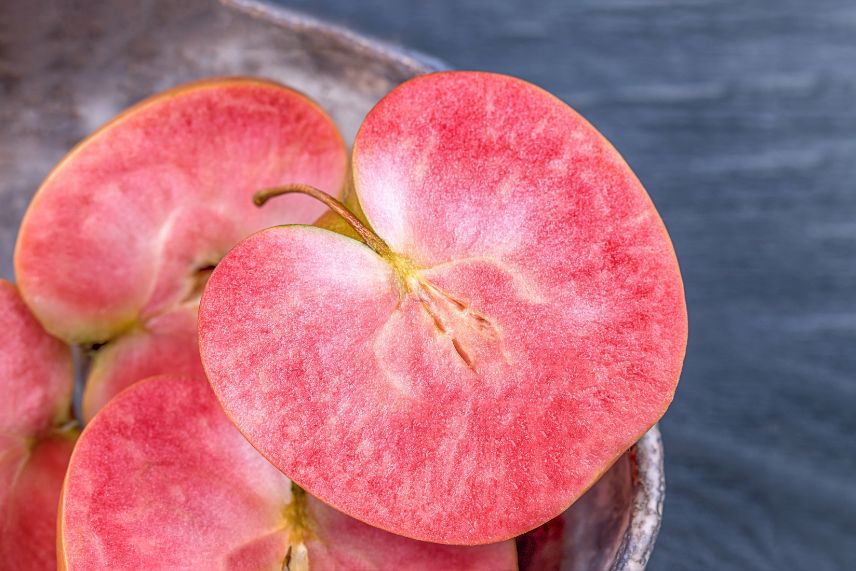 The blood apple ‘Pekacervenca’
Blush Rosette offers fruits with cherry-red skin and red flesh, Grenadine is a hardy and vigorous variety, Red Merylinn is one of the reddest and has virtually no pip. Pekacervenca offers a nicely crunchy red flesh.
Depending on the flavour and use of the fruits
In terms of flavour, apples often blur the lines. The apples are indeed often classified into three distinct flavours: sour, sweet and sugary, to be assessed at the apple’s ripeness. That said, as an apple ripens, its sugar level increases. Others can be both sweet and acidic. To choose your apple tree in relation to the flavour of its apples, I invite you to read the article below: Sweet apple or tart apple? Choosing an apple tree based on the flavour of its fruit.
The apples are also distinguished by taste characteristics : some are eating apples, perfect for biting into, others have flesh that breaks down when cooked, others still hold their shape better when cooking. Finally, there are juicing apples and cider apples.
Among eating apples, one can cite the delicious Chanteclerc with flesh that is simultaneously firm, melting, juicy, sweet and acidic, very aromatic. The Elstar is a very crunchy apple with sweet and refreshing flesh. As for the apple tree Fuji, widely grown in Japan, it yields apples with a fine and crisp flesh, well-sweetened. The Cox’s Orange Pippin also deserves its place among crunchy apples as its flesh is fine, juicy and perfumed.
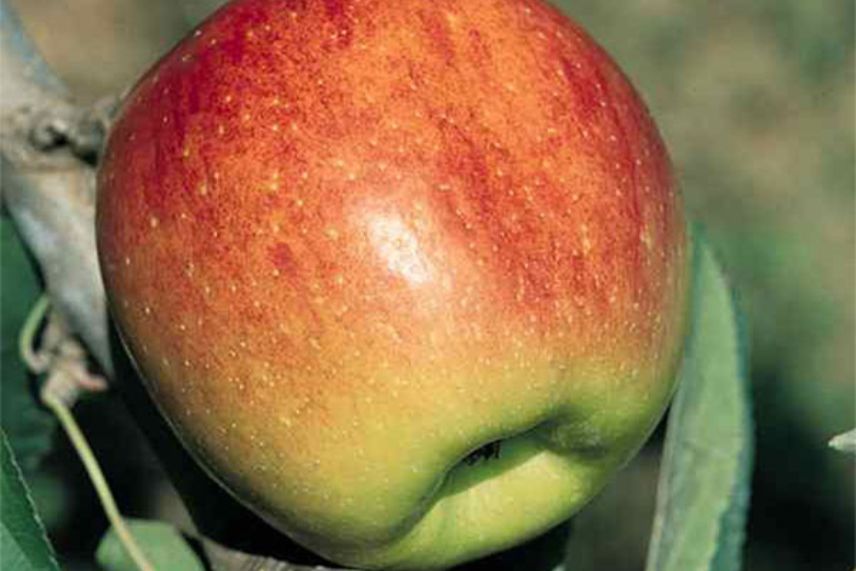
The Fuji tree Fuji
The apples whose flesh melts when cooked are perfect for making compotes or purées, or for inclusion in desserts. One can highlight the variety Belle de Boskoop with its grainy, juicy and acidic flesh. The “Reinette grise du Canada” with large irregular fruit, covered by a rough skin, also offers flesh that melts nicely.
Other apples are delicious when cooked, but their flesh, firmer, holds up well to cooking. These are apples used for fritters, pies and cakes, sautéed apples… The Ariane apple tree presents all the characteristics to belong to this category, since its red apples offer a crisp, lively mouthfeel. The Reinette du Mans stands out with its beautiful yellow-golden fruit and vanilla flavour.
For more information:
Best eating apples: tasty varieties to nibble on!
Read also
What are the best apple varieties?Depending on the size of the garden
If you have a large garden, planting an apple tree is no problem. The apple tree is a modest-sized tree that can reach up to 10 m in height and a spread of 4–5 m. However, these dimensions make it unsuitable for a compact garden, for example in town. In a small garden, other forms, less traditional than quarter-stem, half-stem or high-stem, can be considered.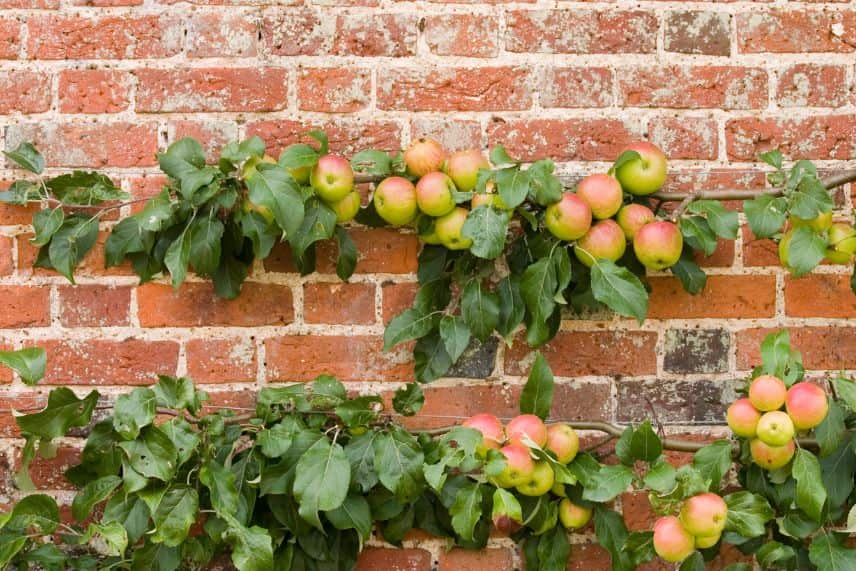
- Trellised forms in palmette, cordon or verrier allow apple trees to be grown on a framework made up of stakes and wires that act as supports. We find many varieties grown in palmette single U, in palmette double U, or in cordon single.
- Columnar apple trees are perfect for small spaces or for growing in pots
- Dwarf apple trees hardly exceed 1.5 m in height and 1 m in width, which makes them suitable for growing on a balcony or terrace.
- Subscribe!
- Contents
Comments