





























Alder diseases and parasitic pests
Identification and treatment
Contents
Alder is a handsome deciduous tree with rapid growth, typical of damp or even marshy areas. There are four spontaneous species that grow naturally in France, but the best known is the glutinous alder, Alnus glutinosa. They are valued for their natural habit, their pyramidal silhouette and their attractive textured leaves that turn yellow in autumn. They are often used, in particular, to stabilise riverbanks, but can also be planted as ornamental trees, as specimens or to form a dense hedge. Unfortunately, alders are sometimes attacked by diseases or parasitic insects: we present the most common ones, how to recognise them and how to treat your trees when they are affected.
For full details on its cultivation, consult our comprehensive guide Alder: planting and growing.

Alder Phytophthora
Alder Phytophthora (Phytophthora alni) is a disease caused by a fungus, which has spread across Europe since the early 1990s, leading to the decline and death of many trees, particularly glutinous alders along watercourses. This disease spreads by water, which allows the spores to disperse. It infects the plant by entering through the roots or through injuries in the bark, and then moving upwards to the tree’s aerial parts. Weakened or stressed trees are more susceptible to infection.
Symptoms: An alder infected by Phytophthora generally develops smaller, fewer leaves; they also tend to yellow and wilt. The crown is sparse. The base of the trunk often shows brown patches, sometimes oozing, and cambial necrosis (brown necrosis visible beneath the bark). Affected trees show reduced growth, gradually decline, and may eventually die.
Prevention measures: To limit the risks of Phytophthora infection, avoid damaging the tree’s roots during gardening work. If you prune the tree or work the soil nearby, the best time is winter, because spores are dispersed when it is warm, mainly in summer, giving the alder time to heal and reducing the risk of infection. When planting, space the plants sufficiently, as dense vegetation increases transmission risks.
Treatments: In the event of infection, there is no specific curative treatment. In some cases, coppicing can be undertaken to preserve the living stool and allow it to restart. The stump suckers that appear are generally healthy. Remember to disinfect cutting tools to prevent spreading the disease to other trees.
Our advice sheet: “Phytophthora: identify, prevent, control”
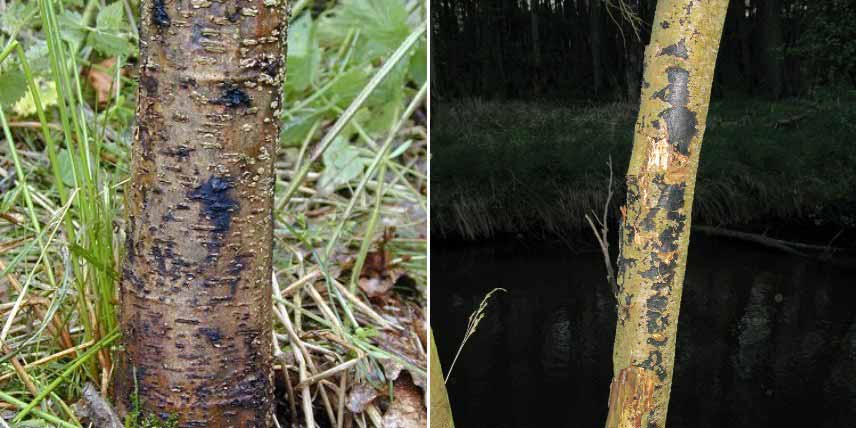
Brown patches at the base of the trunk or on branches, caused by Phytophthora alni (photos: Gerhard Elsner / Malte)
Read also
The alder: planting and growingAlder leaf beetle
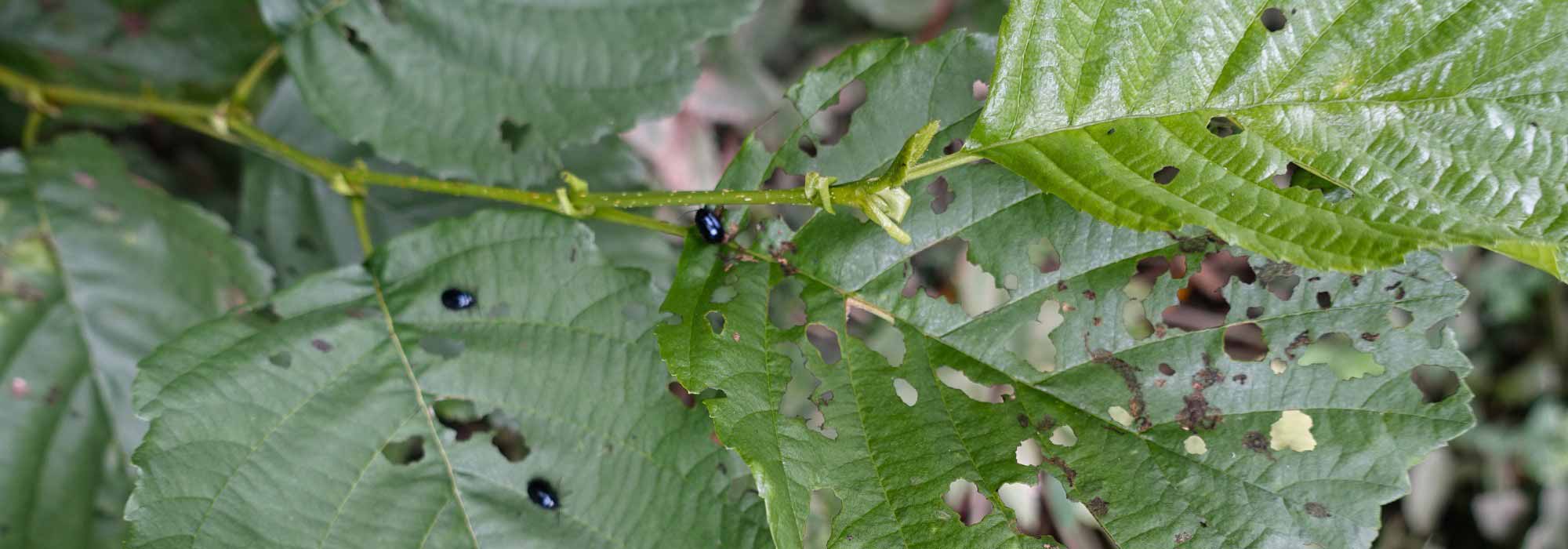
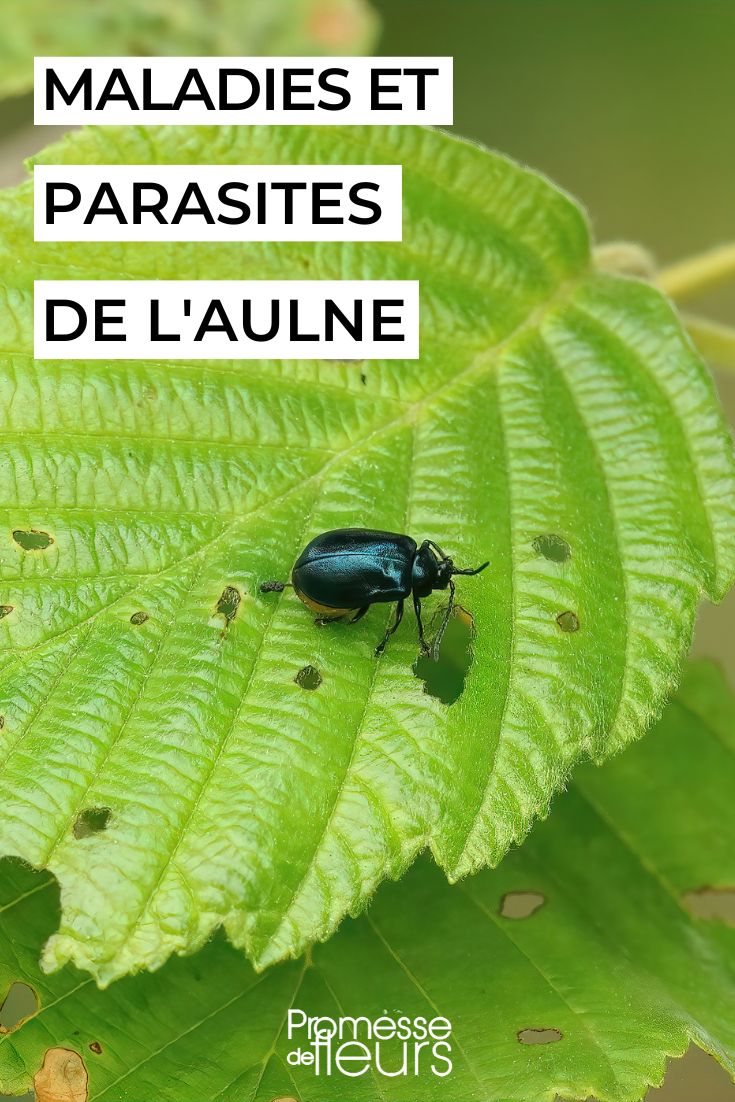
The alder leaf beetle (Agelastica alni) is a beetle that feeds on alder leaves.
In its adult form, it measures 7 to 8 mm long and is black-blue with a metallic sheen. Despite its name, it is not restricted to alder, and it also feeds on the leaves of hazel, hornbeam, beech, poplars, oaks and birches. There are one or two generations per year. Adults emerge in spring, usually in May, then lay eggs in early June under the leaves (you can see clusters of about fifty yellow eggs, sometimes more). The larvae hatch and feed on the upper surface of the leaves. They resemble small caterpillars and reach up to 1 cm in length. After 3 to 4 weeks, they drop off and pupate in the soil.
Symptoms : Adult beetles nibble the leaves, producing round or oval holes. In cases of severe attack, the leaves take on a lace-like appearance, as almost all tissue remains only the veins. The larvae feed on the upper surface of the leaves: these quickly turn brown, presenting a burnt and dry appearance. The damage is unsightly and weakens the tree, but does not directly threaten its survival. It tolerates such damage to some extent. A study has shown that affected alders emit plant hormones and produce molecules that make their leaves less palatable to beetles, which directly limits the infestation. Alders may therefore defend themselves if attacks are too severe.
Prevention measures : Ensure the alder’s general health by providing optimal growing conditions. Avoid accumulations of plant debris near the tree, as this can encourage the alder leaf beetle. If you notice signs of infestation, act quickly to limit spread. You can also encourage natural predators, such as insectivorous birds, that feed on leaf beetles. Install bird and bat boxes, as they will feed on the larvae of leaf beetles.
Treatments : Initially, you can manually remove the adults and larvae as soon as you spot them. Check the undersides of leaves for leaf beetle eggs and remove them. We also recommend spraying the foliage with black soap (one tablespoon of black soap diluted in one litre of water). In cases of severe infestation, a pyrethrum-based natural insecticidal spray may be considered.
Our advice sheet: Leaf beetles: identification, damage and treatment
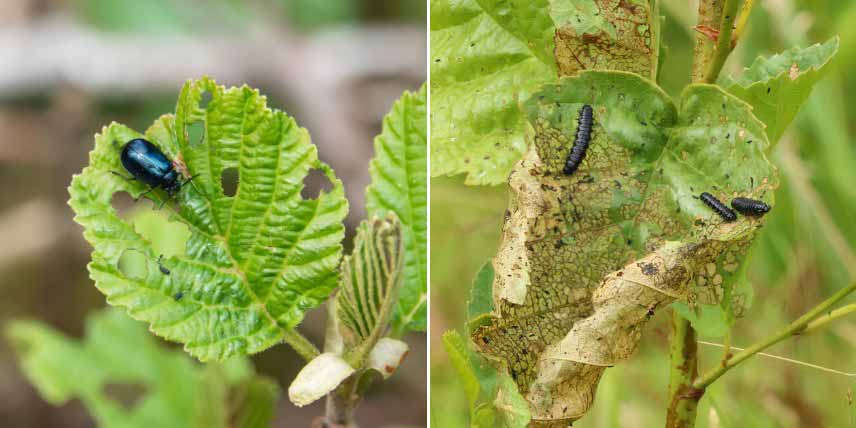
Leaf beetles: adults and larvae (photo on the right by Janet Graham)
The Willow Weevil
Willow weevil (Cryptorhynchus lapathi) is also a beetle. It measures 5 to 9 mm long, and has a black body speckled with small cream-coloured scales, particularly at the rear. It attacks willows, but also alders, poplars and birches. Adults bore small holes in the bark and lay their eggs (in groups of five or fewer). These hatch, then the larvae gnaw at the tree’s wood, boring galleries.
Symptoms: Adult weevils feed on the bark of twigs and young shoots, which can cause bud desiccation, the death of young shoots and some twigs. However, the greater damage is caused by the larvae, which bore galleries under the bark. Trees then show signs of decline, such as yellowing leaves, slowed growth and general weakening.
Treatments: Willow weevil larvae are difficult to eliminate since they are protected by the bark and wood of the tree. However, it is possible to use beneficial nematodes that specifically parasitise the weevil larvae. Another solution is to target the adults by spraying on the foliage a solution based on black soap, or a pyrethrum-based insecticide.
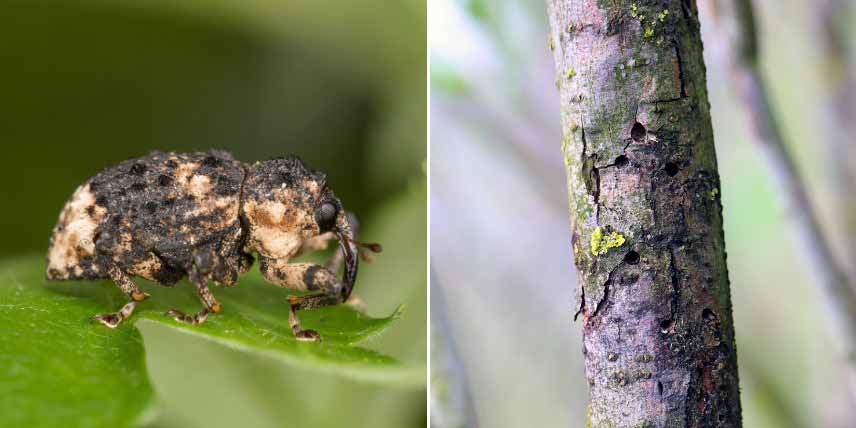
The willow weevil and the holes it bores in the trunks
Read also
Phytophtora : identify, prevent, controlFurther reading
- Discover our full range of alders
- To learn all about alder cultivation, discover our complete guide: “Alder: planting and growing”
- Our advice sheet: “Phytophthora: identify, prevent, control”
- “Leaf beetles: identification, damage and control”
- Subscribe!
- Contents
Comments