





























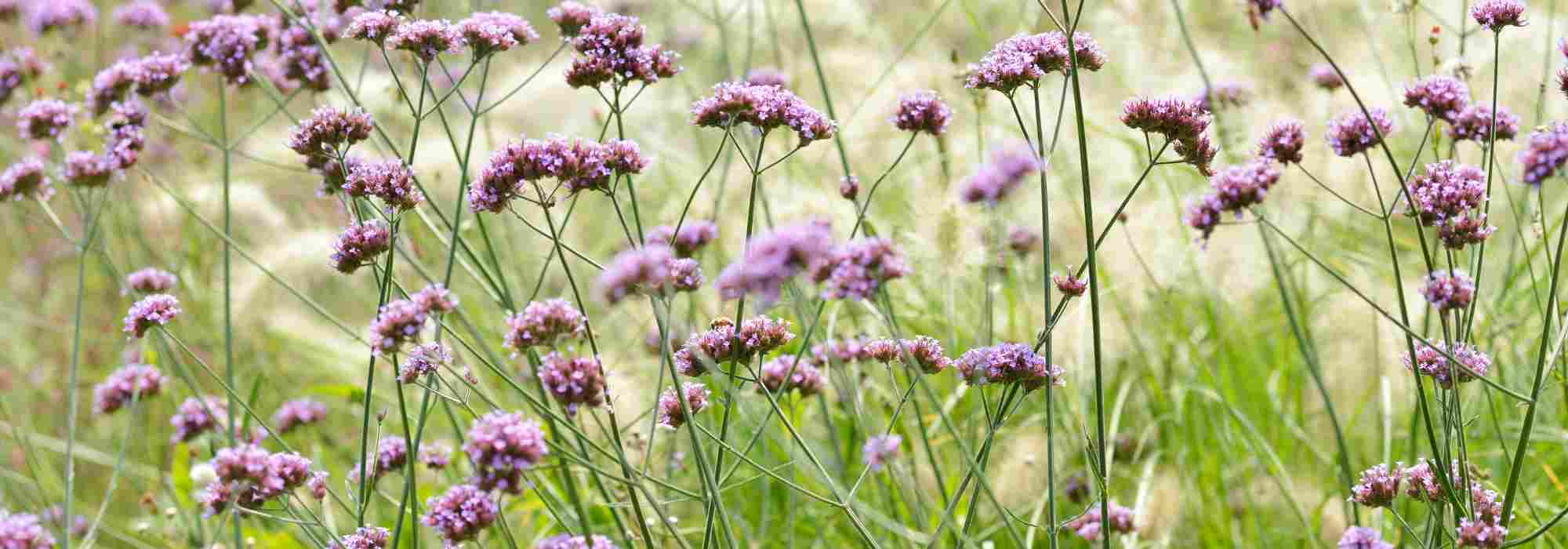
7 long-flowering perennials for sunny spots
for a vibrant garden in bloom all summer long
Contents
We all want a garden that flowers for a long time, with plants that will look beautiful for at least 4 months, if not much longer, to accompany the borders without worrying about their renewal. In full sun, some perennials are the champions of flowering duration and provide a summer spectacle, returning each year more beautiful. We reveal our summer favourites, the ones you must invite into sunny borders for an abundance of colours and an endless flowering!

Gaura lindheimeri
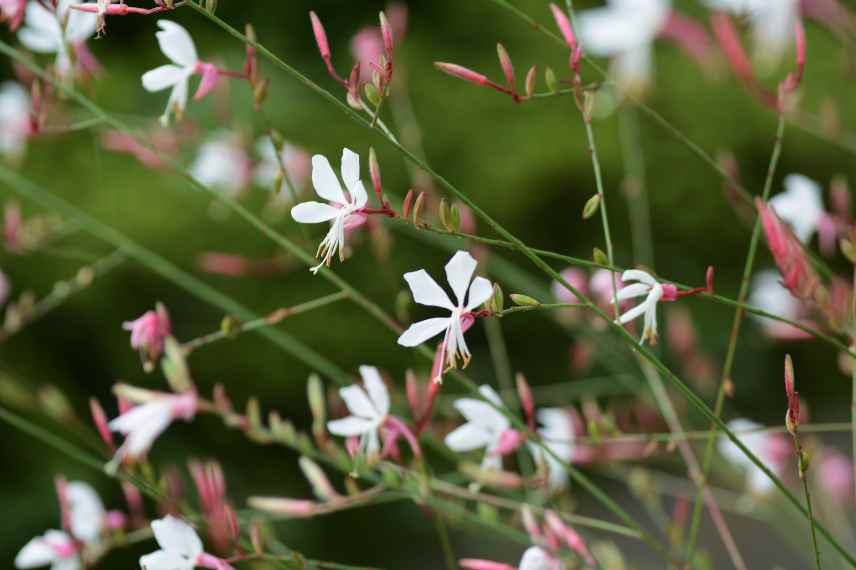
Gaura is one of the perennial plants valued for its very long flowering period. This perennial produces a flurry of small flowers that dance with their lightness, white, pinkish, or rose depending on the cultivars, developing at the tips of very fine stems. The plant is not very long-lived but self-seeds easily. Quite tall, reaching up to 1 m or more, it provides a lovely presence in borders despite its ephemeral nature. Preferring full sun, the gaura can also thrive in partial shade. Once established, it is quite hardy (though caution is advised with the variety ‘Siskuyu Pink’, which is more temperamental), and it has become an essential in the garden, flowering from May to November and proving to be drought-resistant!
Gaura lindheimeri pairs beautifully with perennials that have colourful foliage, such as Heuchera ‘Caramel’, or with Salvia ‘Caradonna’, for a volumetric effect. Whether in borders, pots, or as edging, it adds lightness and movement.
→ Learn all about Gaura in our comprehensive guide. Also, discover our ideas for pairing with gauras.
Read also
Perennial plants: how to choose?Penstemon
Here is another long-flowering star, charming in sunny gardens: Penstemon, also known as beard-tongue, is a delightful perennial that begins to flower in June, sometimes late May, until October, providing a colourful display in garden spaces. The Penstemon has the advantage of being available in numerous charming cultivars, showcasing pink, blue, white, mauve, purple, and even red flowers. The tubular flowers are exquisite, growing along a stem 60 to 90 cm tall, and continue to bloom until autumn if regularly pinched throughout the summer.
Check their hardiness if you decide on this summer plant, as some galanes can be a bit more tender than others.
Penstemon strictus, dressed entirely in blue, is stunning in a wild garden, while pink hybrid Penstemons like ‘Hidcote Pink’ or ‘Dark Towers’ with dark foliage pair perfectly in a romantic scene with some Digitalis and hardy geraniums.
→ Learn all about the Penstemon in our comprehensive guide. Also, discover our association ideas with Penstemons!
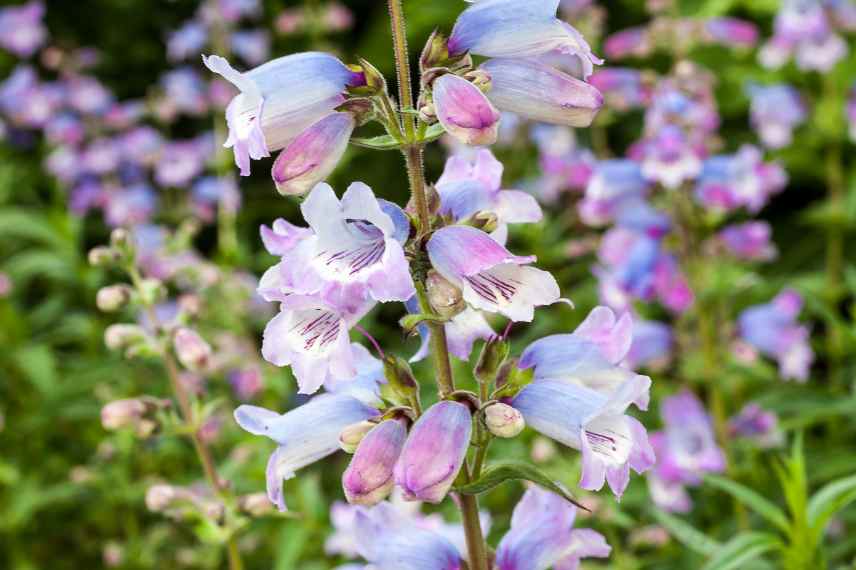
Penstemon ‘Stapelford Gem’
Sages
Planting sages in the garden ensures non-stop flowers from late spring to autumn. They are also champions in flowering duration, for very sunny areas, as they require warmth and plenty of light to bloom well. We rely on shrubby sages, and among the perennials, many herbaceous sages, from Salvia pratensis to Salvia nemorosa, or even Salvia splendens (all red), Salvia nubicola (yellow), white whorled sages or violet ones… Their small, bilabiate flowers are absolutely charming and come in many colours. Belonging to the family of Lamiaceae, they are very melliferous. Sages often take a little break during the summer but bloom again beautifully at the end of summer. There is even Salvia elegans (or pineapple sage) that can take over until November as it flowers later. They thrive in ordinary to sandy, well-drained soils. Herbaceous sages need to be pruned to encourage a second flowering.
When paired with hardy geraniums, hollyhocks, or nepeta, sages create captivating colour contrasts. In a border, mass, or pot, they add a touch of freshness and colour.
→ Learn all about sages in our comprehensive guide. Also discover our ideas for companion planting with herbaceous sages and with shrubby sages.
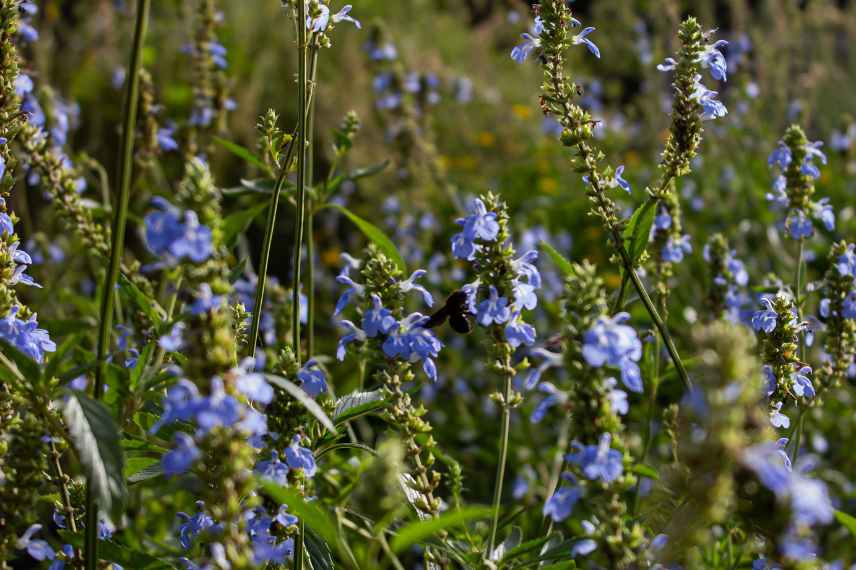
The Salvia uliginosa, with a rustic appearance, will need a cool, sunny soil
Verbenas
Here is another perennial that has become very popular in gardens and public spaces over the past few years, the Argentinean Vervain. This enthusiasm for the plant is completely justified, considering it is one of the longest flowering plants. Much like Gaura, it adds a lot of poetry to the garden with its numerous purple paniculate flowers on sturdy, tall stems. The Verbena bonariensis, as it is known in Latin, can grow up to 2 m and fits perfectly in large flower beds.
Other vervains are just as sun-loving, such as the graceful Verbena hastata, with its candelabra-like inflorescences in a deep mauve, or the much shorter Verbena rigida (50 cm), which is more frost-sensitive and well-suited to coastal areas, or the Verbena officinalis, with its lighter flowers. All these vervains thrive in very well-drained, even stony soil.
Pair vervains with Gauras, which they complement beautifully, as well as with Sedum for a textural contrast, Echinacea pallida, and light Cosmos, Kalimeris, etc.
→ Learn all about vervains in our comprehensive guide.
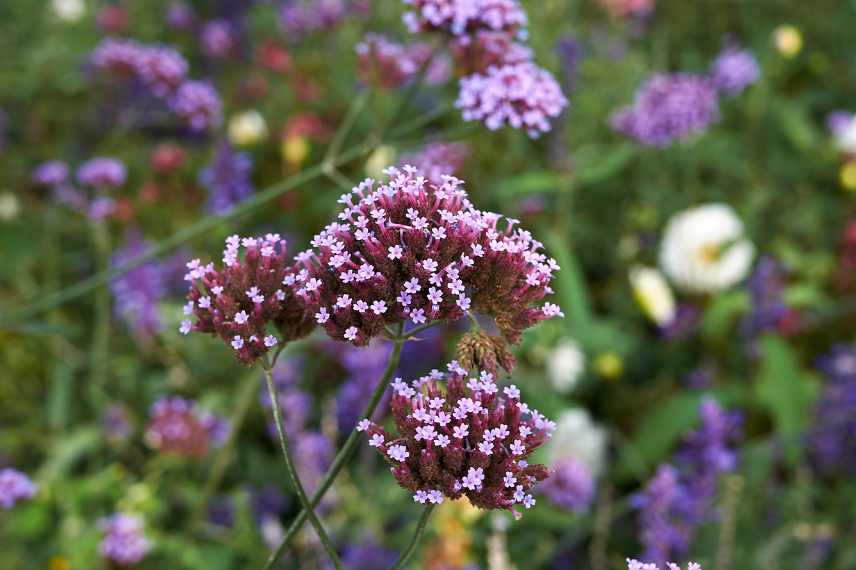
Verbena bonariensis
Agastache
Agastache, also known as hyssop, is a perennial plant from the Lamiaceae family, featuring spikes that are more or less long, lavender blue for Agastache foeniculum (the giant hyssop). It displays colours ranging from white to yellow, vibrant oranges, pinks, and violet blues across many varieties. Its long summer flowering period extends from mid-May to October. Its upright habit (60 to 150 cm tall) is interesting to insert among more flexible plants.
Like all the perennials in this selection, agastache requires sun and, above all, warmth to flower abundantly, although it can establish itself in partially shaded conditions. Aromatic, melliferous, and nectariferous, it also attracts butterflies and a host of insects, making it an excellent candidate for natural gardens. It adapts to many soil types, only truly fearing heavy, clayey soils.
Useful for flowering gardens from north to south of the hexagon, as it does not fear the cold, agastache is a dream plant for summer borders and flowering meadows.
It pairs wonderfully with flatter or round inflorescences such as echinaceas, asters, verbenas, Hydrangeas arborescens, or spike flowers like those of Veronica spicata, veronicastrums, as well as perovskias and grasses like calamagrostis or panicums.
→ Learn all about Agastache in our comprehensive file. Also, discover our companion planting ideas with agastaches.
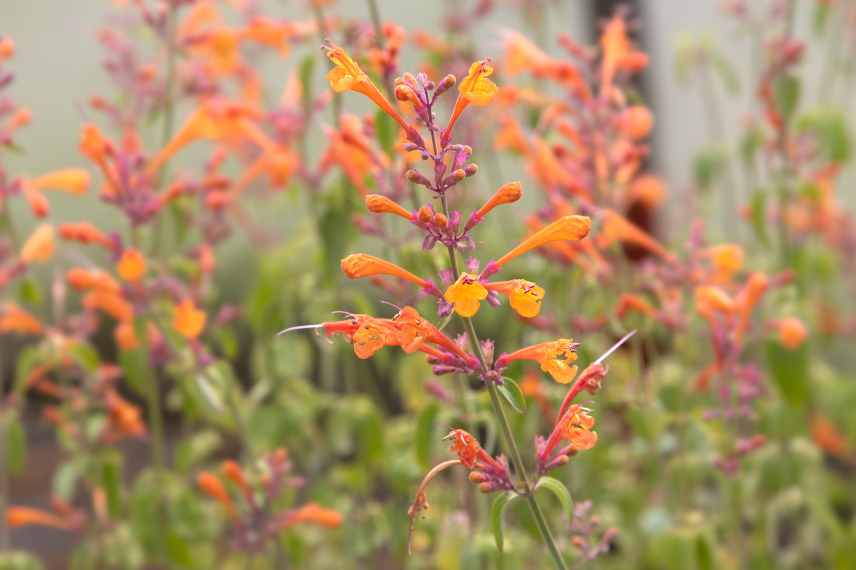
Agastache aurantiaca ‘Apricot Sprite’
Geranium 'Rozanne'
Is it still useful to introduce this iconic plant, found in many gardens? ‘Rozanne’, this blue flowered geranium with a white centre has become a classic, equally at home in border plantings or as a stunning pot display for summer. It flowers continuously, requiring minimal care, from June to October, before fading with the first frosts… it truly sets records for flowering. Like other perennials, this hardy geranium thickens year after year, ultimately forming a generous blue cushion about 50 cm high with a slightly wider spread. It becomes very floriferous in full sun, although it can also be planted in partial shade.
‘Rozanne’ fits beautifully into a blue garden, in English mixed borders, or on a terrace or balcony in a pot, even cascading over a wall. Pair it with some light grasses to create an interesting texture play (Pennisetum, Panicums…), or alongside peach or white blooms, or even next to old roses.
→ Olivier presents in a video the Geranium ‘Rozanne’, the star of the gardens. Also read: Hardy geraniums with long flowering
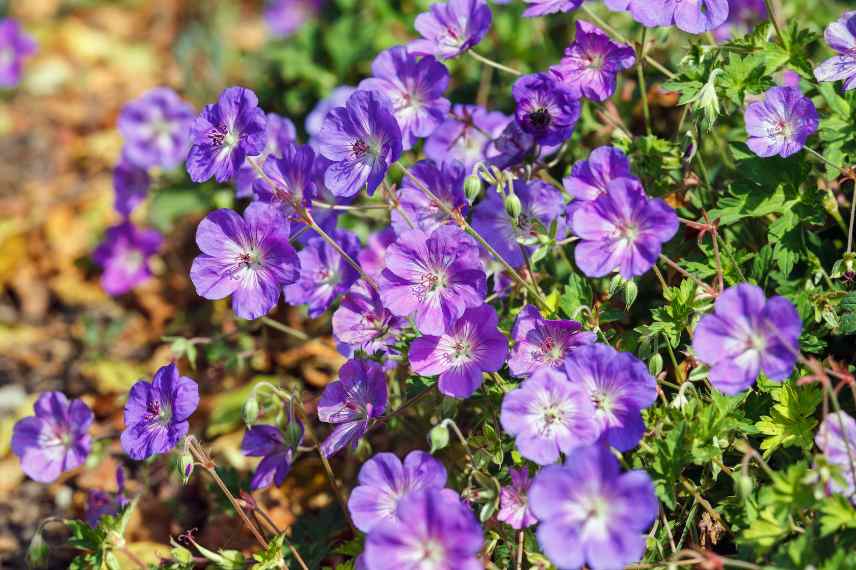
Geranium Rozanne
Coreopsis
All yellow, but sometimes also pink like Coreopsis rosea, Coreopsis is also one of the sun-loving plants with a long summer flowering period, blooming between June and September. Thriving and easy to grow, it resembles a small daisy, often with a purple-speckled centre. Planted in full sun, the low, compact species are perfect for borders, paths, or rockeries, while the taller varieties (up to 1m) will fill generous sunny beds.
Among the most attractive are Coreopsis verticillata ‘Moonbeam’, with pale yellow flowers and ultra-fine foliage like a fern, and Coreopsis ‘Mercury Rising’, with velvety red and yellow blooms.
When paired with purple or blue flowering plants, such as Salvia ‘Caradonna’, Eryngium planum or Echinops ritro, or Lobelia, Coreopsis creates a striking contrast. The yellow varieties pair beautifully with white Echinaceas and Crocosmias. As for the varieties with a purple centre, they make lovely duos with Heleniums, which they resemble.
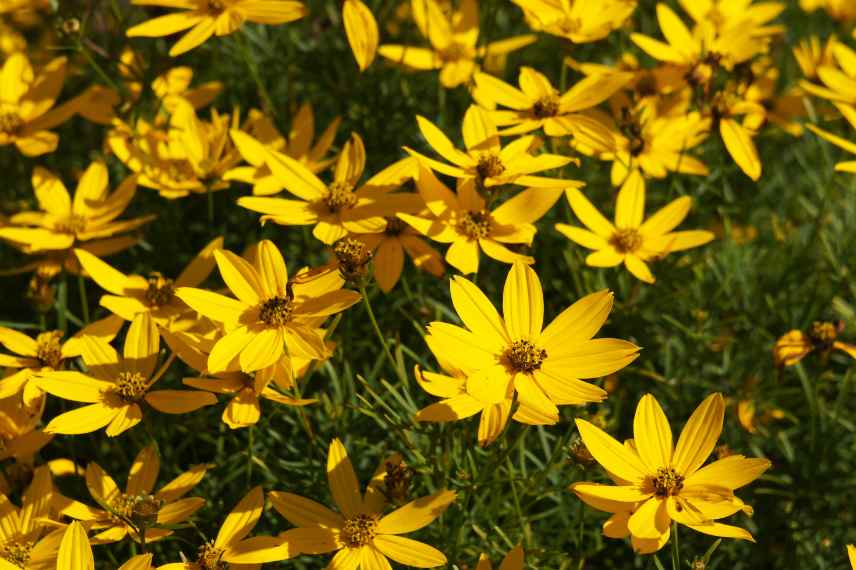
Coreopsis verticillata
- Subscribe!
- Contents
Comments