





























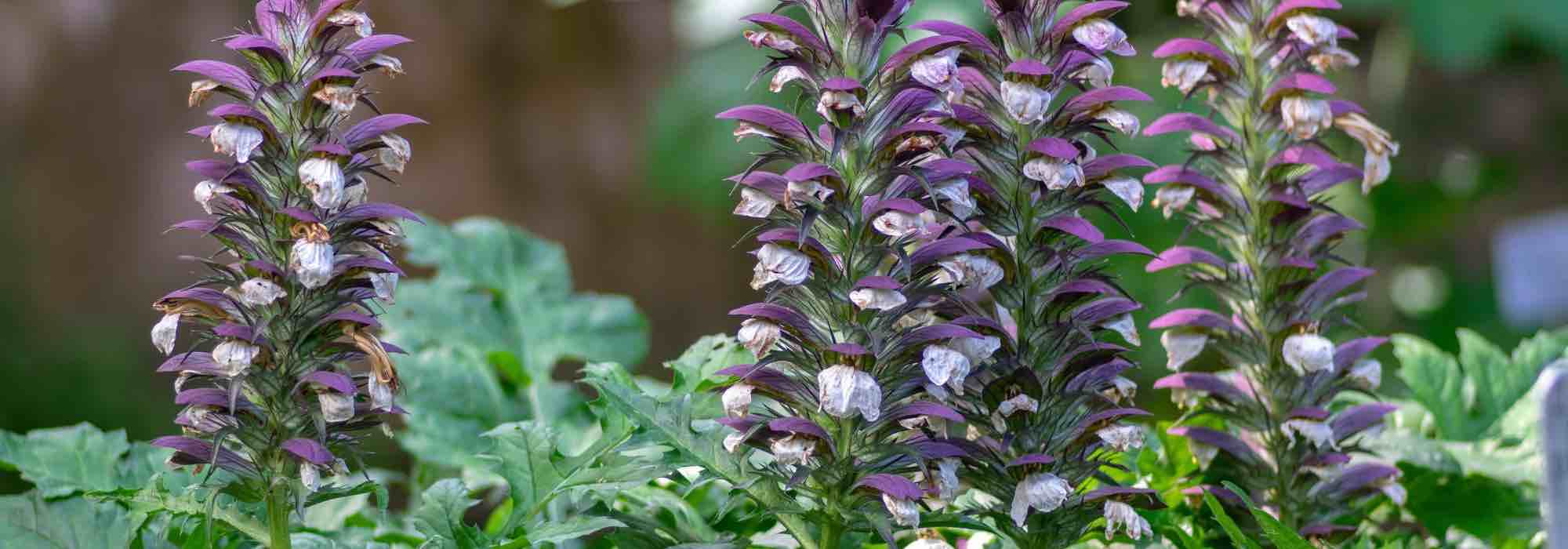
6 varieties of acanthus to grow in the garden
Discover our selection to add volume and structure to all types of gardens
Contents
Acanthuses are very architectural perennial plants that do not go unnoticed with their cut foliage and graphic flower spikes. They add volume and height to all types of gardens, from the wildest to the most modern.
Easy to grow and fast-growing, they thrive in full sun or partial shade, in well-drained soil to allow for proper water drainage.
Among the thirty existing species of acanthuses, only a small number are cultivated: here are our 6 favourites to adopt at home.

Acanthus mollis: the reliable choice with an impressive silhouette
The bear’s breech is one of the most popular species. This large perennial impresses with its tall flower spikes, reaching between 1.5 and 2 metres without the need for staking. They provide a stunning display from June to August, depending on the region. The tubular flowers with two lips blend white and pink, contrasting perfectly with the purple sepals. This flowering delights pollinating insects.
Acanthus mollis forms a dense clump, devoid of thorns. It consists of large, deeply lobed leaves, glossy dark green, which can reach up to 1 metre in length. The silhouette of this bear’s breech is thus one of the most spectacular! The foliage is semi-evergreen, remaining in place during mild winters, not experiencing frosts above approximately -8°C. The bear’s breech adapts to the climate, occasionally disappearing in regions with hot summers before re-emerging in autumn.
This hardy, vigorous, and generous perennial will add volume and structure to a lush border. Pair it with ornamental grasses like Stipas, which will bring lightness and flexibility. Add the other decorative foliage of Hostas, as well as that, evergreen, of a Japanese Aucuba.
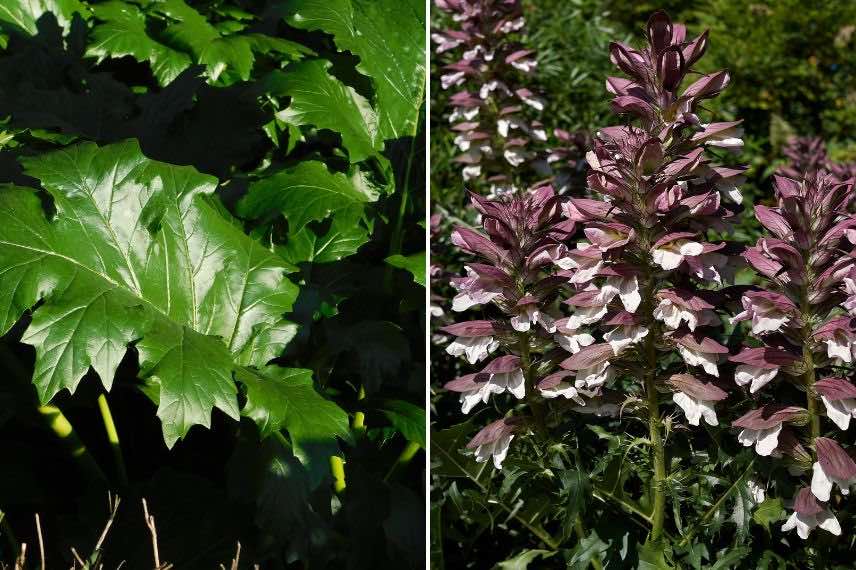
Foliage and flowers of Acanthus mollis
Read also
Acanthus: planting, growing and careAcanthus spinosus: a species with ornamental coloured thorns
The spiny bear’s breech (Acanthus spinosus) is a striking perennial, with its finely cut, glossy green foliage. As its name suggests, it is a spiny species. It quickly forms a dense clump, reaching about 1 metre in all directions. Its flowering, as decorative as its leaves, occurs in summer. It consists of large spikes bearing white flowers topped with spiny pink bracts, creating a lovely bicolour effect. This flowering is highly attractive to large pollinating insects.
Hardy down to around -10°C, it thrives in sunny locations, even in dry, stony, or calcareous soil.
A bit more invasive than the soft-leaved bear’s breech, it is ideal for greening up challenging areas or large spaces, for example, to dress a bank. In a dry garden bed, it will add a lot of character. Pair it with lavender or Perovskia, whose blue-violet flowering will beautifully complement the spikes of our bear’s breech. Add yarrow, spurge, and cosmos.
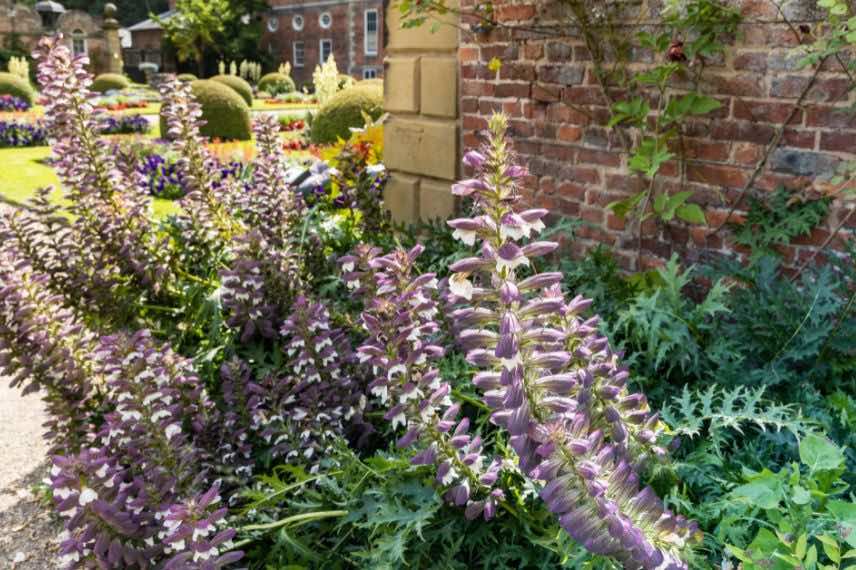
The Acanthus spinosus with its cut foliage
Acanthus hungaricus: a hardy species with beautiful large, lobed leaves
The Acanthus hungaricus or Hungarian bear’s breeches forms a lovely bushy clump of about 80 cm in all directions. Very generous during the summer flowering period, it is adorned with large spikes of white flowers, tinged with purplish pink and topped with dull pink spines bracts.
Its leaves, on the other hand, are thornless, highly dissected, and quite elongated in shape. They display a glossy dark green colour, and are of course as ornamental as those of other species of acanthus.
Its good hardiness is another of its strong points: it can withstand frosts down to -20°C. Easy to care for, it also tolerates drought and will appreciate sunny locations.
In a natural, country-style garden, place it alongside shrub salvias, echinaceas, and St John’s wort.
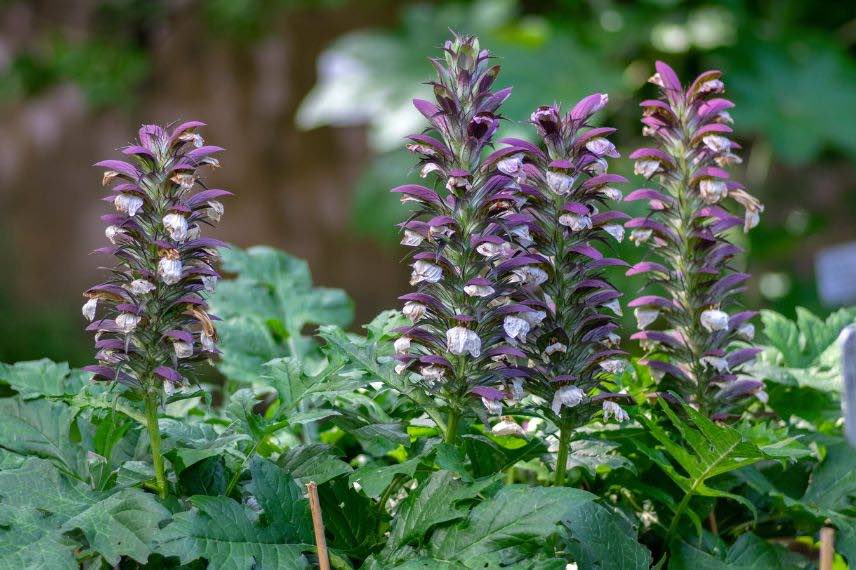
Acanthus hungaricus
Acanthus mollis ‘Hollards Gold’: a compact variety with very bright golden foliage
The cultivar ‘Hollards Gold’ stands out with its golden-yellow leaves, turning green as it matures. This bear’s breech will quickly form a bushy clump of 80 cm in all directions, brightening up the garden. In summer, its long and abundant flowering will catch the eye, with spikes of white flowers and purple bracts.
Quite hardy and easy to care for, it will thrive in full sun or partial shade.
Withstanding root competition, it will effortlessly dress the base of trees at the edge of woodlands, alongside Solomon’s seals and Dryopteris ferns.
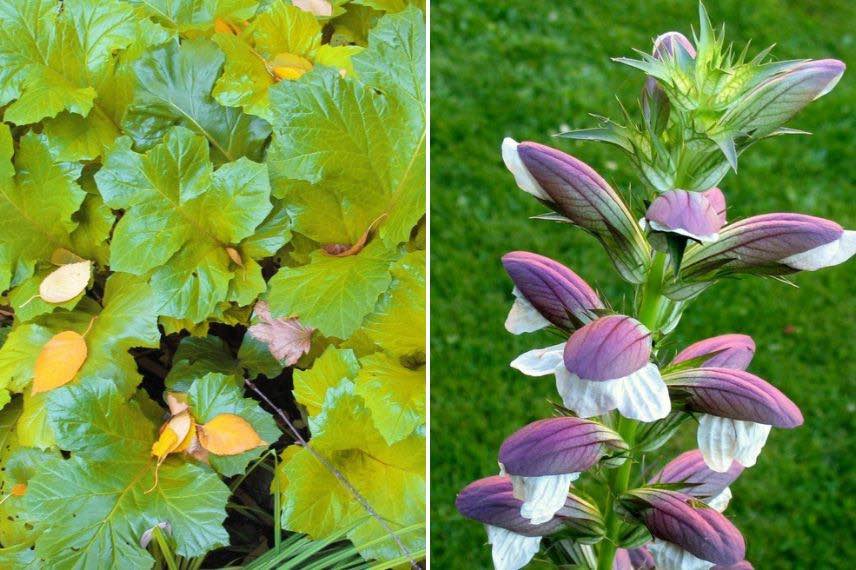
Acanthus mollis ‘Hollard’s Gold’
Acanthus mollis 'Whitewater': a white bear's breeches with variegated leaves
The Acanthus ‘Whitewater’ is an original variety, valued for its variegated white foliage, which is very decorative and bright.
This perennial blooms generously and for a long time throughout the summer. It produces pink-purple flower spikes, revealing cream-white flowers tinged with pink.
At maturity, it reaches about 1.20 m in height and 1 m in spread. This variety thrives in both full sun and partial shade. Like its counterparts, it will add volume, structure, and graphic appeal to any area of the garden.
While this acanthus is charismatic enough to be grown alone, it will also shine in a border or at the edge of a woodland. It will be perfect in a white garden. For this, plant it alongside old roses with white flowers, with hydrangeas, dahlias, ornamental alliums, foxgloves, or even agapanthus, all chosen in white.
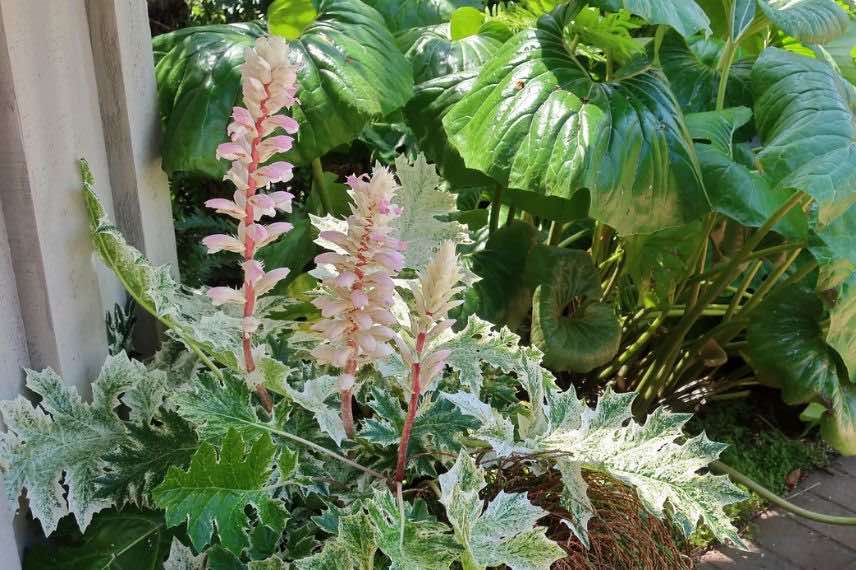
Acanthus mollis ‘White Water’
Acanthus sennii: a unique vermilion flowering
It is a lesser-known species, yet just as sculptural as its counterparts: Acanthus sennii, which originates from the Ethiopian highlands. Sometimes imposing, it can reach heights of between 1 to 2.5 m with a spread of 60 cm to 1 m at ripeness. Its size depends on the mildness of the climate.
Its foliage, resembling that of thistle, is deeply lobed. It is green tinged with silver and particularly spiky.
The flowering, also very decorative, occurs in late summer or early autumn. Our acanthus then reveals spikes of bright vermilion flowers, a colour rarely seen in acanthuses. They are topped with spiny bracts.
Its main drawback lies in its low hardiness, which only allows it to be grown in regions with occasional and mild frosts (around -5°C). In contrast, it tolerates drought well and can thrive in poor, stony, and sandy soils.
It will look wonderful in an exotic-looking garden, alongside alstroemeria, ‘Paprika’ yarrow and Eremurus.
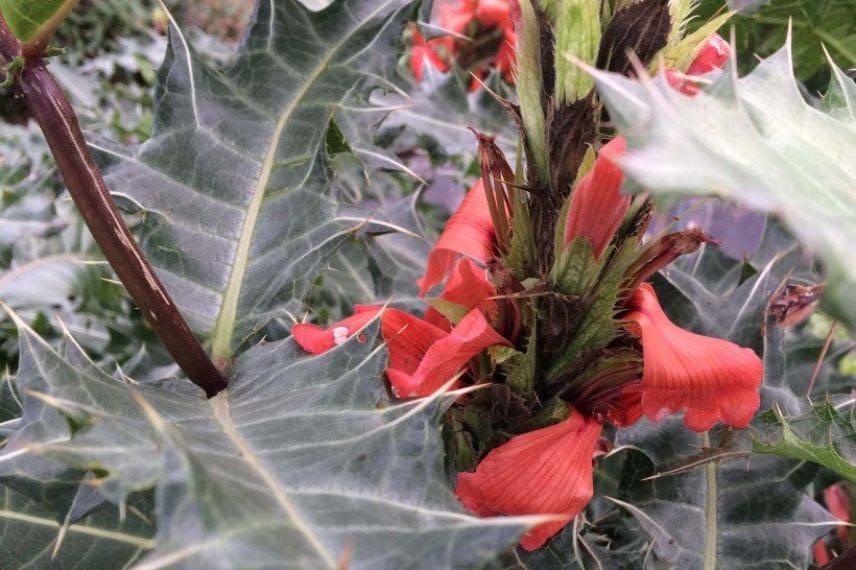
Acanthus sennii
- Subscribe!
- Contents
Comments