





























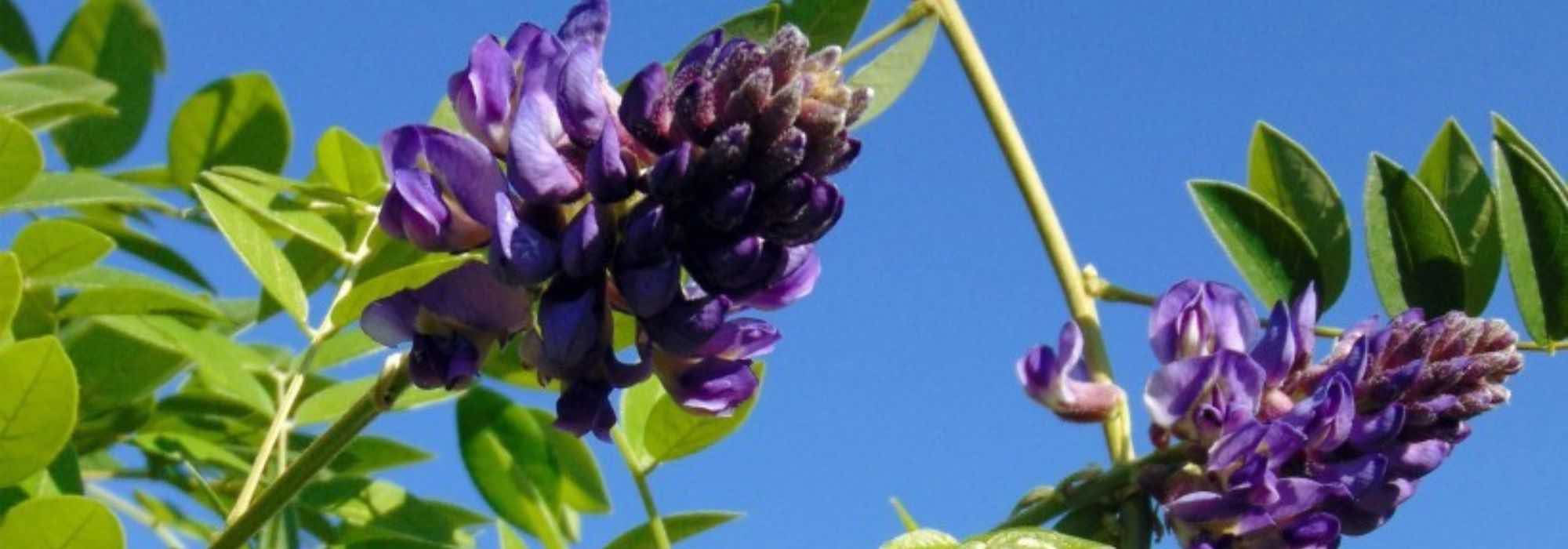
5 repeat flowering wisterias
Flowers from spring to autumn
Contents
The wisteria is a splendid climbing liana with magical flowering, highly appreciated. Particularly vigorous, it grows quickly and lives for a very long time, but requires supports that match its robustness to develop. The Chinese wisteria, Wisteria sinensis, and the Japanese wisteria, Wisteria floribunda, are the most commonly planted; however, other species exist, each with its own specific characteristics.
Wisterias predominantly offer a splendid spring flowering. However, when looking at the lesser-known American species, which develop less vigorously and are easier to control than the Chinese and Japanese species, one finds repeat-flowering climbers. After a main flowering at the end of spring, they return to enhance their foliage up to two times, in successive, more sporadic waves, but lasting until autumn. The varieties of Chinese wisteria are slightly repeat-flowering and often bloom more sporadically in summer.
Exposure plays a significant role in the flowering of wisterias. They appreciate receiving at least 6 hours of sunlight per day to flower abundantly. Pruning also stimulates flower production and their resurgence during the summer. Discover our varieties of repeat-flowering wisterias and the other aspects that characterise them.

Wisteria frutescens 'Amethyst Falls'
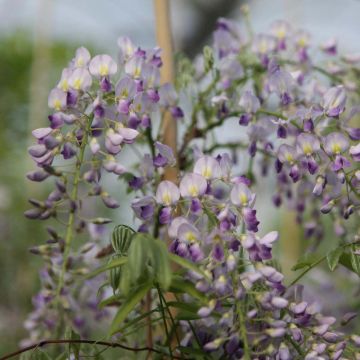
The Wisteria frutescens ‘Amethyst Falls’ is part of the less well-known hybrids of American Wisteria, compared to Chinese and Japanese Wisterias. Interesting for its more moderate growth, reaching about 4 to 5 m in height at ripeness, its flowering is very quick: it can bloom as early as the first or second year after planting. Its clusters of flowers are denser and more compact than those of Chinese Wisterias and slightly less fragrant. Wisterias derived from Wisteria frutescens or American Wisteria have the ability to produce repeat flowering: they bloom abundantly for the first time in spring, in May-June, among the foliage, and then again in successive waves from late summer to autumn.
‘Amethyst Falls’ stands out with its beautiful amethyst purple flowers. Easier to integrate into small spaces, it has a compact growth habit and differs from the botanical species by having longer and slightly fragrant flower clusters. Its stems naturally twist around supports in a counter-clockwise direction. This variety is propagated from cuttings, unlike most other Wisterias which are often grafted.
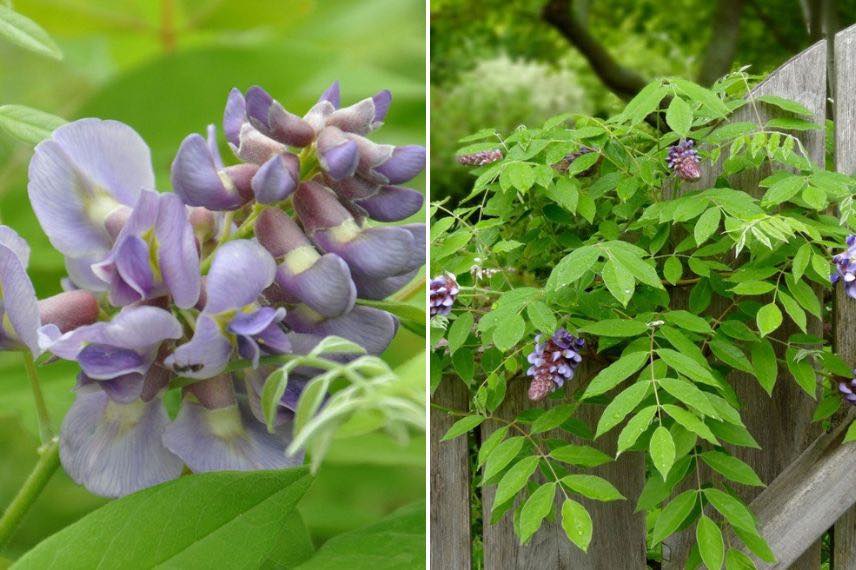
Wisteria frutescens ‘Amethyst Falls’
Read also
Wisteria: how to plant, prune and care?Wisteria sinensis 'Flore Pleno'
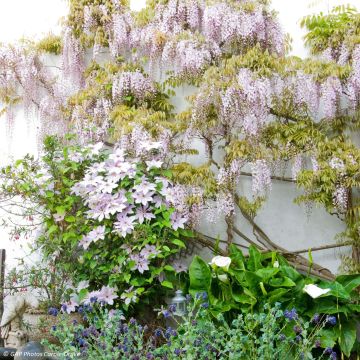
The Wisteria sinensis ‘Flore Pleno’ is, as its name suggests, a double-flowered form of Chinese Wisteria. Its wonderful and long clusters, measuring 30 to 40 cm in length, come in a gradient of mauve: from pale mauve, almost white, to intense and rich mauve, nearly violet. They emit a powerful fragrance with honeyed notes. The floribundity of this vigorous variety is enhanced, and while it blooms profusely for the first time in spring, in April-May, before the foliage appears, on almost naked stems, it then flowers again more lightly during the summer, among its light green leaves.
The stems of ‘Flore Pleno’ reach 9 to 10 m in length when mature. They twist around supports spontaneously in a counter-clockwise direction, a characteristic feature of Chinese Wisteria, as is its significant growth which requires a very sturdy support. The growth of new shoots, soft and villous, is very rapid, reaching several metres in a single season in cool soil. The young leaves, bronze in colour, appear at the end of flowering and then take on a light green hue. In autumn, they turn golden yellow before falling.
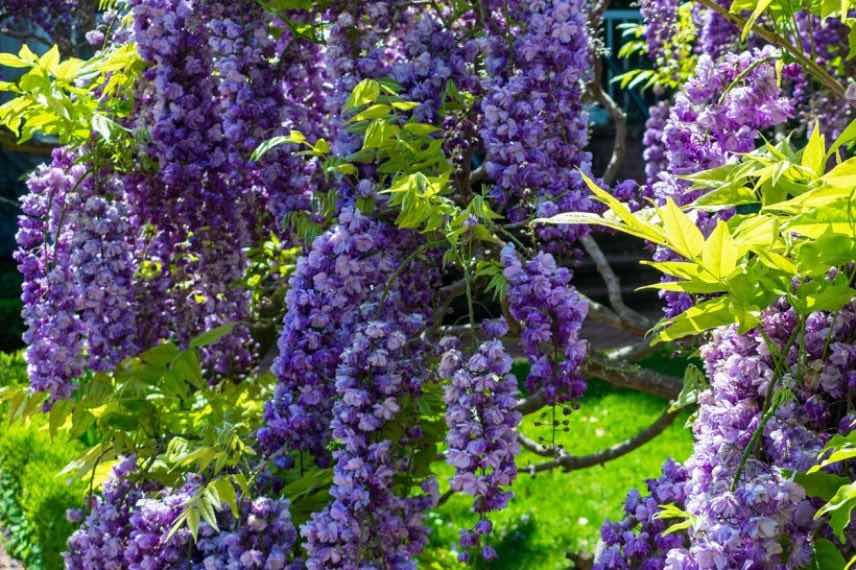
Wisteria sinensis ‘Flore Pleno’
Discover other Wisterias
View all →
Available in 0 sizes
Available in 2 sizes
Available in 0 sizes
Available in 0 sizes
Available in 0 sizes
Available in 2 sizes
Available in 1 sizes
Available in 0 sizes
Available in 1 sizes
Available in 3 sizes
Wisteria frutescens var. macrostachya 'Blue Moon'
The Wisteria frutescens var. macrostachya ‘Blue Moon’ is derived from the American Wisteria, Wisteria frutescens, but it descends from a subspecies, macrostachya, found in a more restricted geographical area, ranging from Missouri to Kentucky. The Wisterias of this subspecies, Wisteria frutescens var. macrostachya, are commonly known as Kentucky Wisterias. They bloom in late spring, in May-June, while the foliage is already present. Being repeat flowering, they can easily and sporadically bloom again up to twice during the summer, with their clusters always nestled among the dark green foliage.
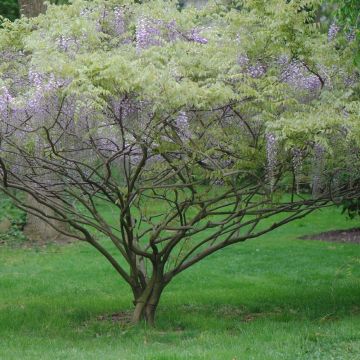
‘Blue Moon’, compact and highly floriferous, produces clusters of lavender-blue flowers, speckled with yellow-green. They measure 20 to 35 cm in length, are dense and fragrant. This variety reaches about 4 m in height at maturity, and its new shoots grow approximately 80 cm in a season under good conditions. Flowering occurs 3 to 4 years after planting, but it is a very beautiful plant, perfectly suited for training as a tree, given its small size, to showcase it beautifully.
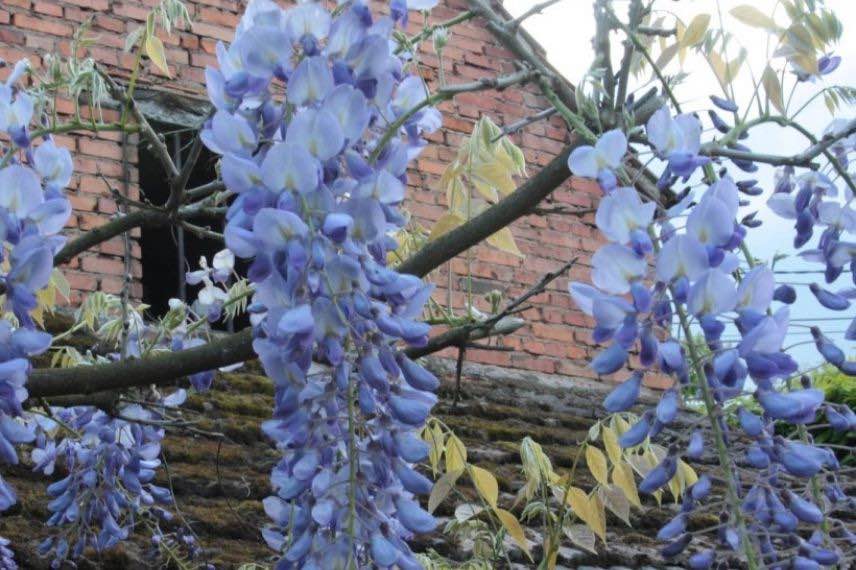
Wisteria macrostachya ‘Blue Moon’
Read also
Wisteria: how to train and prune it?Wisteria frutescens var. macrostachya 'Clara Mack'
Another hybrid of Kentucky Wisteria, the Wisteria frutescens var. macrostachya ‘Clara Mack’ features beautiful clusters of pure white flowers, also appreciated for its moderate growth, reaching about 5 to 6 m in length, and its ability to flower multiple times. It blooms for the first time in June, among foliage that is shinier and darker than that of Asian wisterias, and then sporadically in successive waves throughout the summer. Its flower clusters, 25 to 30 cm long and densely packed, bear up to 50 small papilionaceous flowers, exuding a sweet fragrance reminiscent of grapes and honey.
It is worth noting that wisterias of this American subspecies produce their flower buds on the wood of the year in spring. For this reason, they are very well suited to regions with cold, long winters and are considered more cold-resistant than Asian species, even though their hardiness zone is equivalent. Their quality as a repeat flowering climbing plant is further expressed if they are regularly pruned.
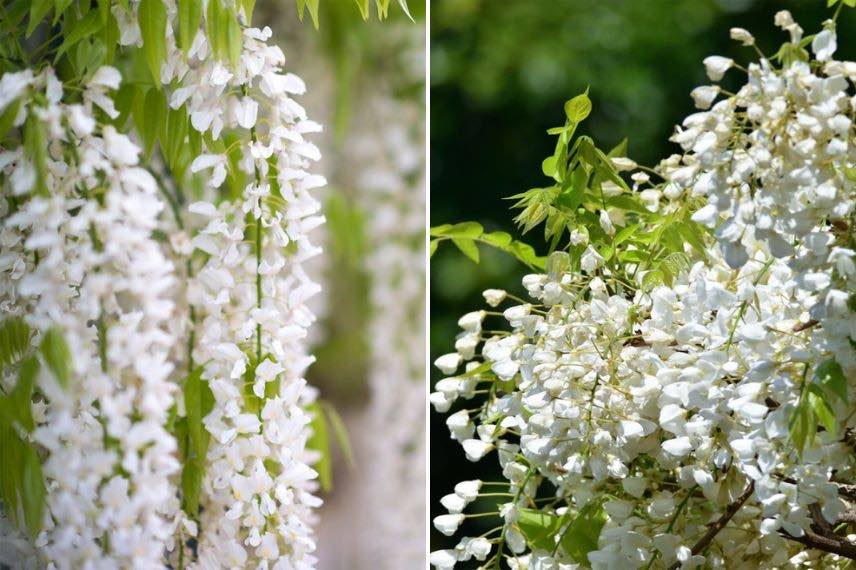
Wisteria macrostachya ‘Clara Mack’
Wisteria frutescens 'Longwood Purple'
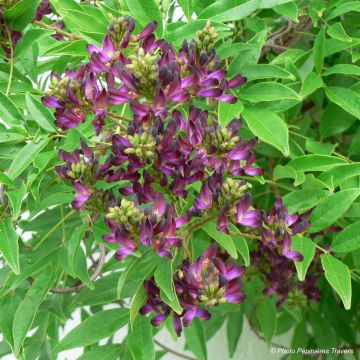
Latest hybrid of American Wisteria, the Wisteria frutescens ‘Longwood Purple’, selected from the famous Longwood Gardens in Pennsylvania, resembles the cultivar ‘Amethyst Falls’ but is distinguished by more colourful clusters of flowers, a deep purple mauve. It also has its main flowering period bloom later than that of Asian wisterias, in May-June, among the foliage. One or two additional flowerings may follow from late summer to autumn, though less abundantly, if the plant is well pruned.
Native to wet forests and riverbanks, American Wisteria is nonetheless tolerant of soil, as long as it is deep and can find moisture below. Under these conditions and in soil that is not too calcareous, it tolerates soils that are occasionally waterlogged as well as dry in summer. The voluble stems of ‘Longwood Purple’ reach 4 to 5 m in height at ripeness, with flower clusters measuring around 10 to 15 cm long. This wisteria can easily be trained as a bonsai or in a pot.
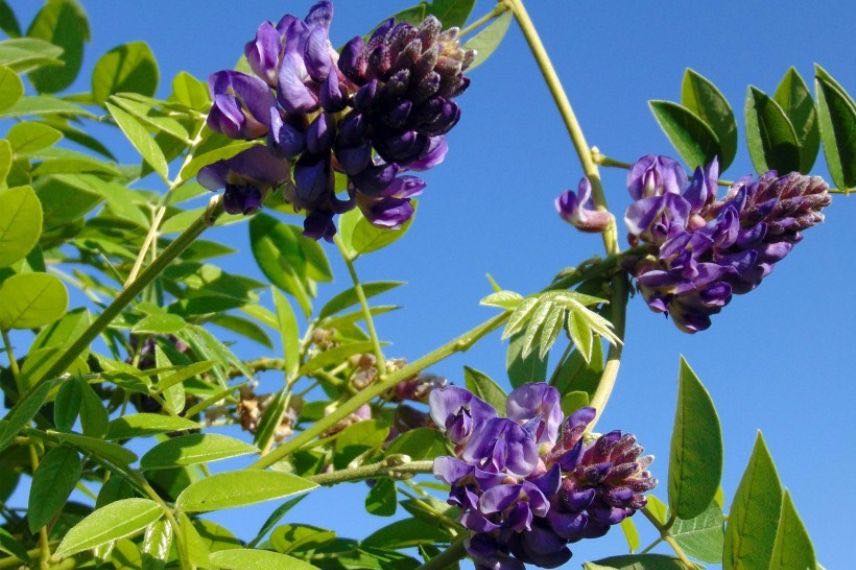
Wisteria frutescens ‘Longwood Purple’
- Subscribe!
- Contents

Comments