





























5 red-flowered penstemons
Our selection of red penstemons, to grow in the garden or in pots on the terrace and balcony
Contents
Penstemons are perennial plants with a long summer flowering period and evergreen foliage. They are grown in full sun, in dry to moist soil, but especially well-drained soil (that does not retain excess water).
The tubular flowers display beautiful bright colours, in shades of pink, blue, purple, yellow, or red. These add a warm and dynamic touch, creating focal points in the garden to draw the eye. Red comes in several shades among penstemons. You will have for example the choice between vibrant varieties, those with a dark burgundy almost purple, or those offering bicoloured flowers.
Here are our 5 favourite red-flowered penstemons, easy to grow in pots or in the ground.

Penstemon barbatus ‘Coccineus’: vibrant red flowers
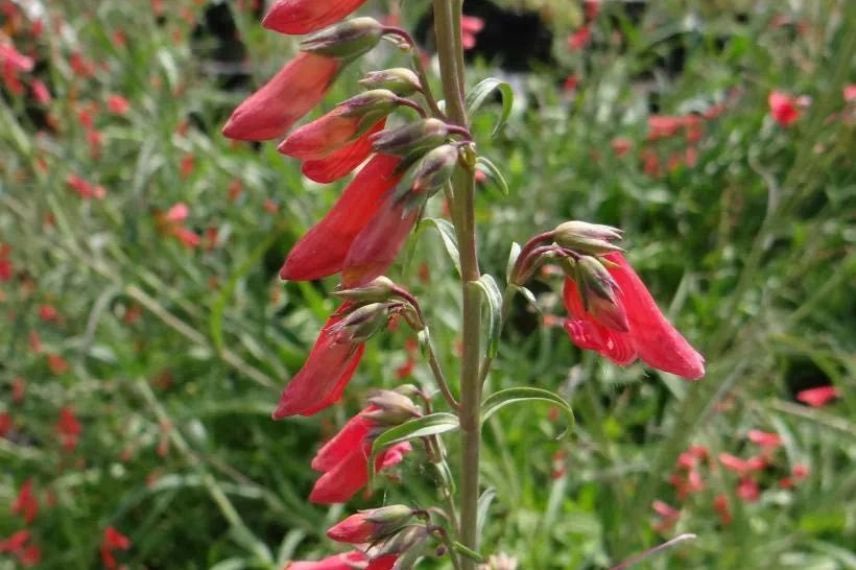
‘Coccineus’ is certainly one of the brightest red-flowering varieties of penstemons. From July to September, it reveals delicate bells measuring 4 cm, in a bright cherry red. These flowers contrast perfectly with the fine blue-green foliage. An elegant variety that has character without being visually overwhelming.
At maturity, this penstemon will reach about 1 metre in height and 40 cm in spread, making it suitable for both garden cultivation and potting, to green up sunny terraces and balconies.
Easy-going, robust and hardy (down to about -18°C), ‘Coccineus’ will mainly require well-drained soil, free from standing moisture. It will tolerate drought thanks to its deep root system. However, it will not be very tolerant of transplantation.
To enhance its rustic and natural appearance, pair it with grasses in golden tones, such as Pennisetum alopecuroides ‘Hameln Gold’ or ‘Lumen Gold’. Add annual flower varieties with a wild charm, such as poppies or love-in-a-mist.
Read also
Penstemon: planting, pruning and careThe hybrid Penstemon ‘Harlequin Red’: a small silhouette that blooms in raspberry red
‘Harlequin Red’ is a small hybrid penstemon, reaching about fifty centimetres in all directions. This small dense and compact shape allows it to fit easily anywhere, even in tight spaces.
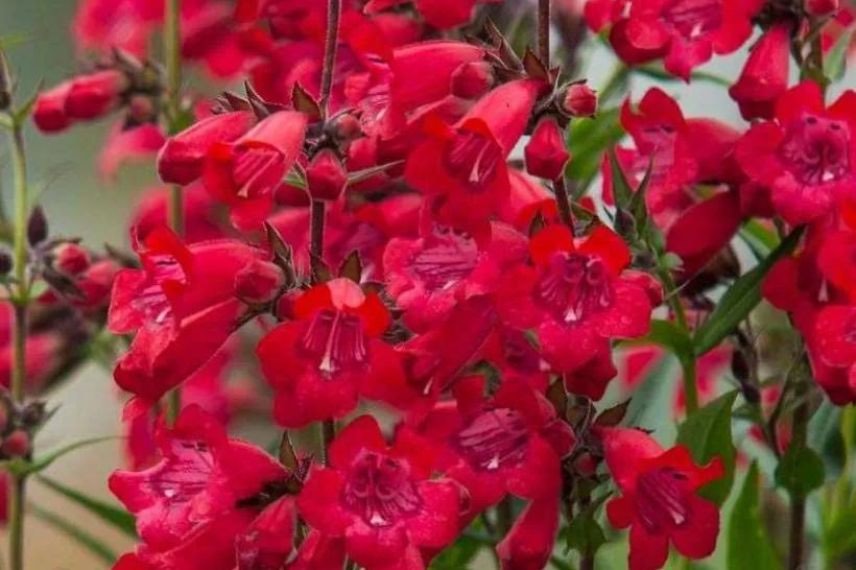
Generous, this penstemon flowers from July to October. It reveals beautiful spikes bearing numerous flowers in a vibrant raspberry red. This tubular flowering, reminiscent of foxgloves, is enhanced by a lovely tuft of narrow leaves.
This variety tolerates drought well once established, making it suitable for integration into a border or rockery alongside sun-loving plants, also appreciating well-drained soils. To accompany it, consider for example the graceful floral spikes of Briza media, the adorable pompom yellow flowers of santolina, or the natural charm of achilleas.
The hybrid Penstemon ‘Le Phare’: red flowers with a beautiful contrasting white throat
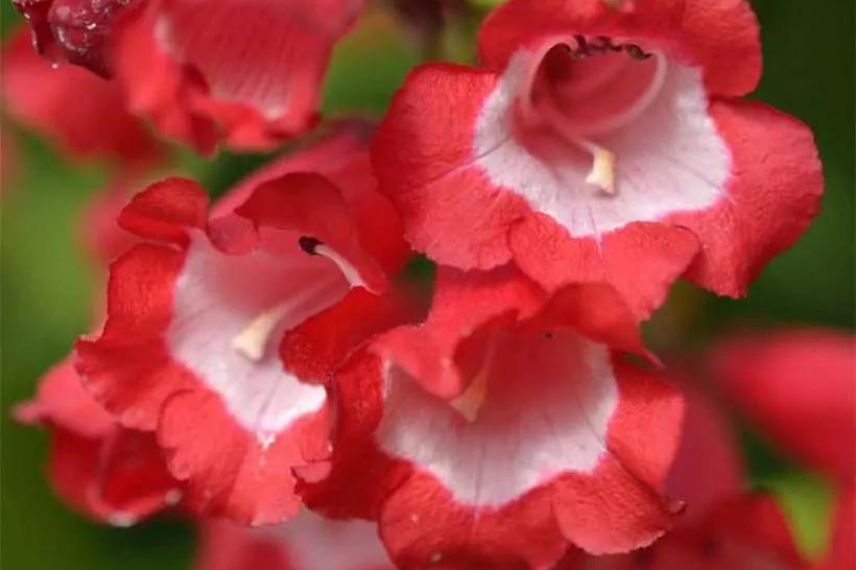
‘Le Phare’ is a beautiful plant with red flowers, distinguished by its bicoloured flowering. For almost the entire summer, from July to September, it produces large campanulate flowers shaped like bells. They display a particularly bright red in the sunlight, adding a true touch of brilliance to the garden. This colour is also enhanced by a pristine white throat, edged with light red. This well-defined centre, contrasting beautifully, helps to capture both light and attention.
The blue-green foliage serves as a backdrop to this flowering, which is truly worth admiring.
‘Le Phare’ is a fairly accommodating penstemon, thriving like its relatives in well-drained soil, in sunny positions, even if occasionally dry. Its hardiness may be seen as a drawback, as this variety cannot withstand frosts below -9°C.
Reaching about 60 cm in height and 40 cm in spread at maturity, it can be planted in borders, in a pot in a fairly deep container, or in colourful mixed borders. In the latter case, plant it alongside other long-flowering perennials, such as geraniums, asters, and purple rudbeckias.
Read also
5 lovely ideas to pair PenstemonsThe hybrid Penstemon ‘Blackbird’: a stunning burgundy flowering
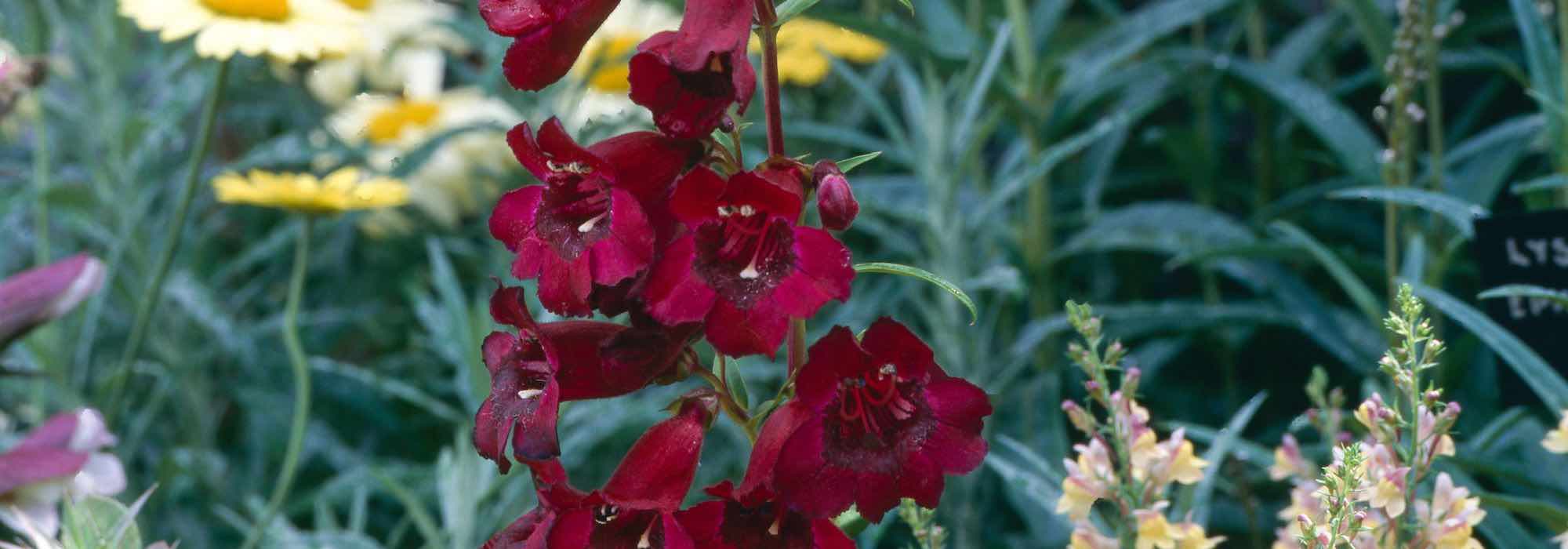
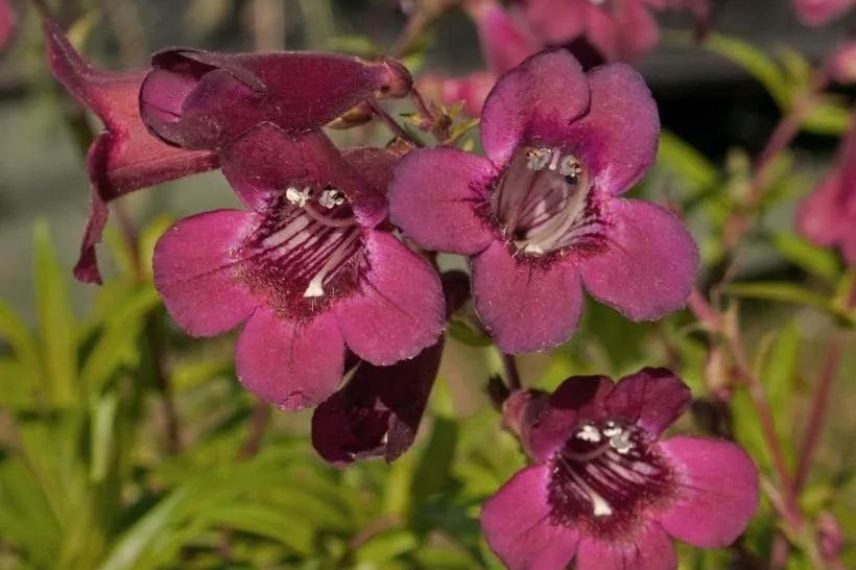
‘Blackbird’ appeals to us for its much darker red flowering, leaning towards burgundy. Throughout the summer and until the first frosts, it puts on a show almost continuously, thanks to its colourful trumpet-shaped flowers. The flowers measure about 5 cm in length and reveal a white throat, which highlights the colour of the petals. They are sometimes so numerous that they bend the flower stems under their weight!
At maturity, this penstemon reaches a height of between 60 and 70 cm with a spread of 50 cm. It will form a compact and bushy plant, consisting of light green lanceolate foliage.
Graceful and colourful, this penstemon will enliven your sunny borders, as well as your summer bouquets. Pair it with plants from the same family, such as foxgloves and snapdragons. To create a harmonious monochrome, cultivate for example alongside it the foxglove ‘Pam’s Choice’, with white bells highlighted by a burgundy throat, and the snapdragon ‘Black Prince’ with its dark red flowering.
The hybrid Penstemon ‘Schoenholzeri’: one of the easiest red-flowered penstemons to grow
Don’t be misled by its somewhat complicated name: ‘Schoenholzeri’ is a very easy-to-grow penstemon that withstands many harsh conditions: drought, rain, and cold down to -15°C…
From June to October, this perennial produces flexible spikes bearing tubular flowers about 4 cm long. In terms of colour, they display a lovely cherry red, complemented by a throat in shades of pink. The foliage is equally impressive. Evergreen, it offers a bright green that beautifully highlights the colour of the flowers.
This small bush will reach a height of 60 to 80 cm and a spread of about 40 cm. It will thrive in borders, beds, rockeries, and also in pots to brighten up terraces and balconies. It is also a stunning cut flower for colourful summer bouquets.
Like its relatives, it will require sunlight to bloom well. It will thrive in ordinary soil, even occasionally dry, as long as it is well-drained.
In a rockery, ‘Schoenholzeri’ will be planted alongside Sedum, Phlox, and Gaura.
- Subscribe!
- Contents
Comments