





























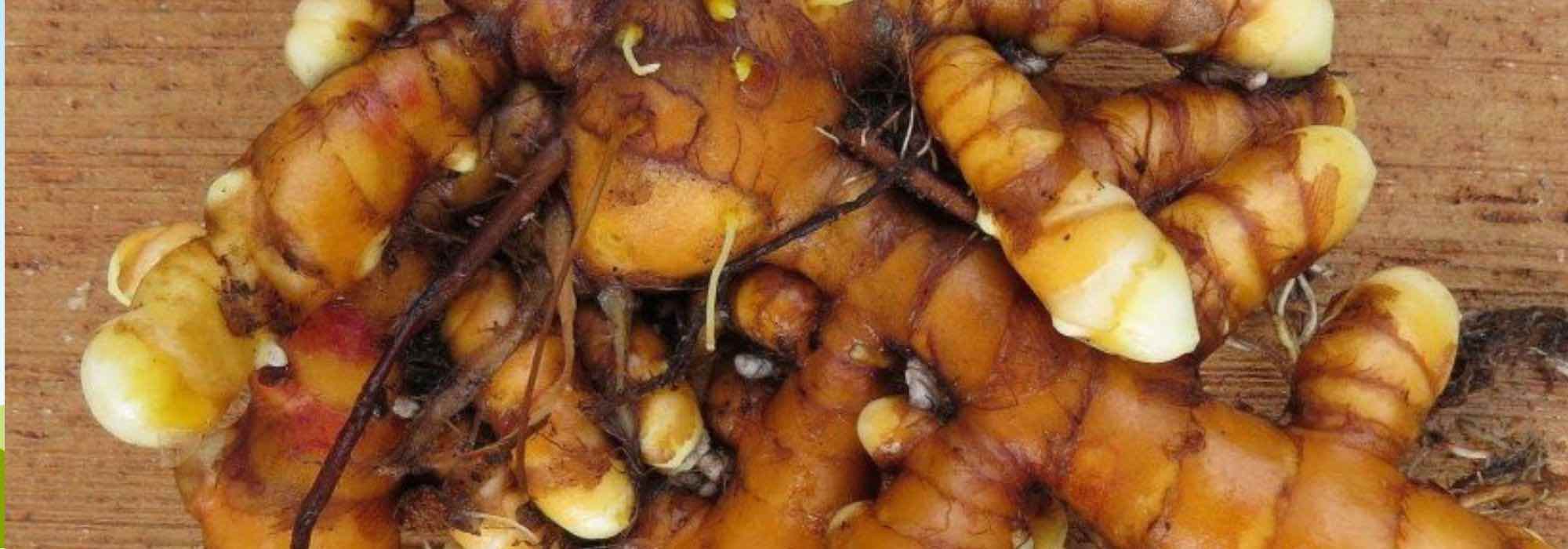
5 original edible roots to grow in the garden
Our selection to bring exoticism and new flavours to your cooking
Contents
To vary pleasures and flavours in the kitchen, but also sometimes to bring a new ornamental touch to the garden, there are many very original plants with bulbs, rhizomes or tubercles.
Whether they are ancient, exotic, or both, these root-vegetables have underground organs that allow them to store reserves. They are often quite easy to cultivate, even in our latitudes. So discover our selection of 5 edible plants that stand out and our associated cultivation tips.

Curcuma longa: a vibrant spice, valued for its spicy flavour and health benefits
Description
You are probably familiar with turmeric, this orange spice with a peppery flavour, prized for its numerous benefits. This key ingredient in curry enhances and colours many dishes, transporting the taste buds to Asia. This powder is extracted from the rhizomes of Curcuma longa, a herbaceous plant related to ginger, also known as Indian saffron or poor man’s saffron.
The rhizomes of Curcuma longa are also used for dyeing fabrics, and it’s easy to see why: their yellow-orange colour is bright and persistent, easily staining hands, utensils, and work surfaces! But this “magic spice” is also interesting for its medicinal properties, utilised in phytotherapy.
The plant grows between 60 cm and 1 metre tall, with a spread of 50 cm. It produces large lanceolate leaves with an exotic appearance. In summer, spikes of beautiful ornamental flowers emerge, blending cream-white, mauve, and yellow.
Harvesting and storing Curcuma longa
The aromatic rhizomes originate from an underground tubercle; they are harvested at the end of summer, when the foliage turns yellow and dries out. It is then time to cut the stems at ground level, and to extract the rhizomes by hand (remember to wear gloves!) or with a shovel. Clean them thoroughly.
You can consume them fresh, grated or cut into pieces. Simply remove the thin skin by scraping with a spoon, just like with ginger. For longer storage, boil them, remove the skin, cut them into pieces, and let them dry in a warm, dry place. They can then be ground into powder.
Cultivating Curcuma longa
In terms of cultivation, Curcuma longa prefers warm exposures and cool soils, reminiscent of the monsoon conditions of its origins. Not very hardy (-3 to -6°C approximately), it will only be grown in open ground in Mediterranean regions that experience little to no frost, and have relatively dry winters. However, pot cultivation will be entirely feasible elsewhere.
Ensure a well-draining substrate that is rich in organic matter. Care for the watering and mist the foliage, as the plant requires water and enjoys humidity during its growth. From spring to the end of summer, place your plant outside in a sunny spot, sheltered from prevailing winds. Stop watering in autumn and bring the plant indoors to a dry location.
Note: Curcuma alismatifolia (also known as Siam tulip and Thai tulip) is an ornamental, non-edible plant, appreciated mainly for its spectacular flowering.
To learn more:
- Turmeric: planting, harvesting, benefits
- Where does it come from? Turmeric
- How to harvest and use turmeric in cooking?
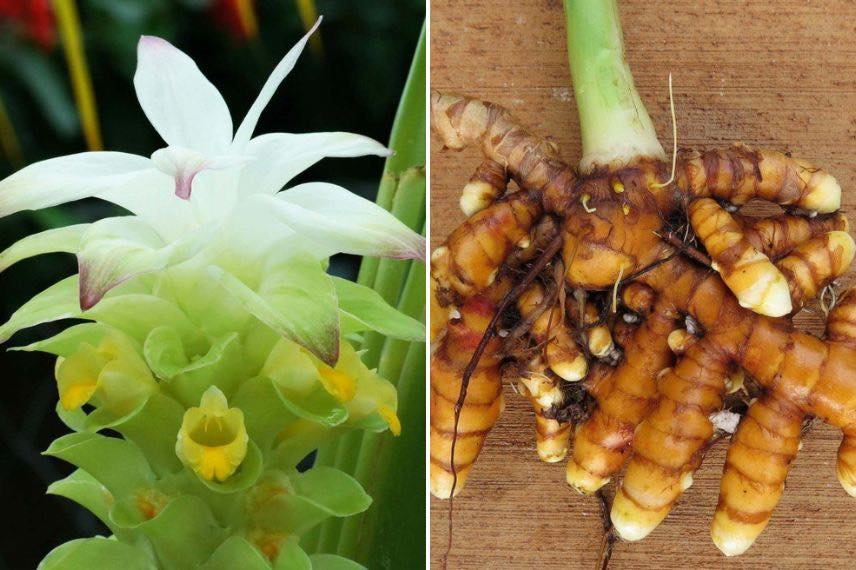
Plant and rhizome of Curcuma longa
Glycyrrhiza glabra: the famous liquorice
Description
If the name Glycyrrhiza glabra doesn’t ring a bell at first, it is almost certain that you are familiar with its edible root, which produces the liquorice prized in confectionery! It is also used for its medicinal properties in herbal medicine.
Also known as Sweet wood, Sweet root, or Liquorice, this Mediterranean herbaceous perennial produces aromatic edible roots. However, it is also interesting for its ornamental qualities. Over time, it will form a beautiful bushy clump of about 1.5 metres in all directions, composed of leaves divided into leaflets. Flowering occurs in summer, producing small clusters of papilionaceous flowers in shades of blue-purple, reminiscent of those of its relatives in the Fabaceae family.
Harvesting and storing Glycyrrhiza glabra
The harvest of liquorice sticks takes place after about 4 years of cultivation, in autumn, once the leaves have fallen. Dig up the roots of the suckers (secondary plants) using a spade, being careful not to disturb those of the mother plant.
Cut them into sections, brush them, and clean them under water to remove any soil residues and impurities. Then dry them in a warm, dry place. The liquorice sticks can be consumed as they are, chewed, or used in decoctions for herbal teas, soups, etc. You can also grind them into powder. Note that excessive and regular consumption may have side effects and is not recommended.
Cultivating Glycyrrhiza glabra
Fairly hardy for its origins (-12 to -15°C), liquorice will appreciate warm, sunny climates. Provide it with rich, deep, but well-drained soil. It will prefer cool soils (moist without excess) to dry soils. Note that its rootstock, composed of running rhizomes, can become invasive when it is happy: therefore, plan for a suitable location or container.
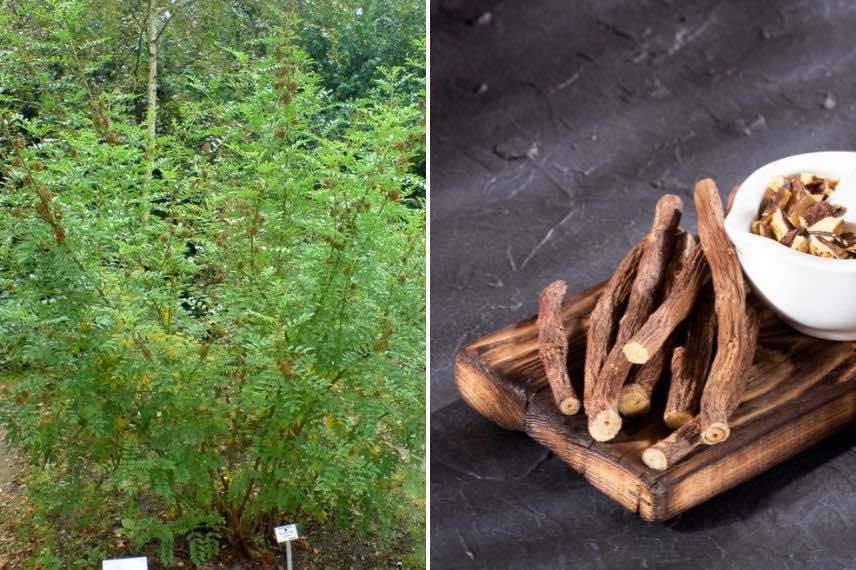
Plant and roots of liquorice
Peruvian Oca: colourful and tart tubers
Description
The Peruvian Oca (Oxalis tuberosa), or sour truffles, is an edible tuberous root that deserves to be more popular. It is a forgotten vegetable, due to its lower productivity compared to the potato. Native to South America, as its name suggests, this herbaceous plant is nonetheless interesting in terms of flavour.
It forms a charming little bush that does not exceed 50 cm in height, consisting of lovely clover-shaped leaves. The young shoots are indeed edible and original in salads. In summer, the Oca produces small, discreet golden-yellow flowers in our climates.
Underground, the plant develops astonishing little swollen and knobbly tubers, displaying vibrant colours ranging from pink to yellow, red, or purple. In terms of flavour, they offer an astonishing mix of the sweet and tangy notes of apple and sorrel.
Harvesting and storing Peruvian oca
The harvest of this vegetable takes place late in the season, from mid-November, when the foliage has withered. It requires about 8 months. Cut the aerial parts close to the ground and use a spade to dig up the tubers. Place them in a bright but frost-protected location to help reduce their acidity.
The tubers have the advantage of being consumed without the need for peeling, either raw or cooked. They can be used in the same recipes as potatoes or sweet potatoes.
Ocas can be stored in a dry place, away from light, for several weeks, possibly in sand.
Cultivating Peruvian oca
Peruvian Oca is not difficult to grow: it simply requires some regular care to thrive.
Provide it with a rich, deep substrate that allows water to drain without stagnating. The exposure can be sunny or partially shaded. Oca can be grown both in the vegetable garden and in containers, provided they are deep enough.
Regularly mound the plants (like potatoes) to stimulate production. Keep the soil moist (damp but not waterlogged). In case of early frosts, protect the aerial parts with a fleece and the base with mulch.
For more information: “Peruvian Oca: cultivation, planting, harvest.”
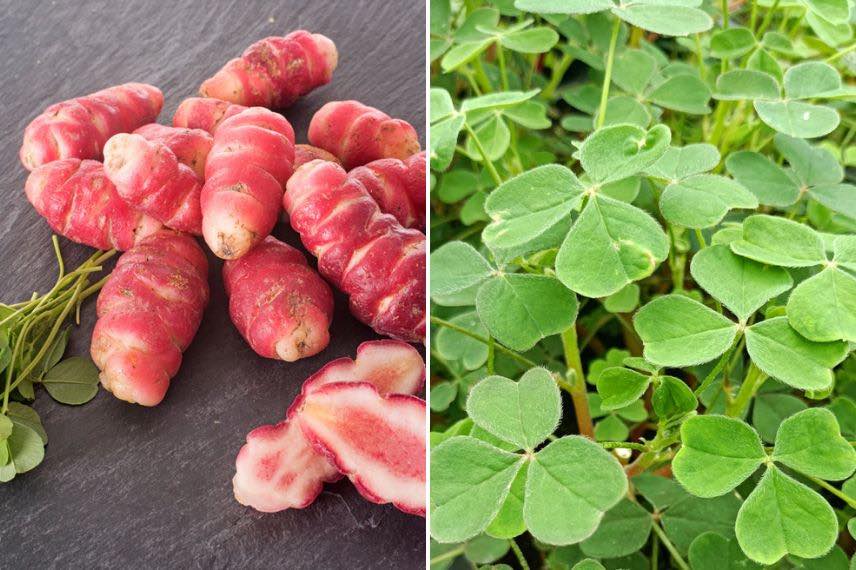
The tuber and the typical plant of Oxalis
Read also
7 exotic vegetables to discoverEarth Pear: an edible tubercle with an astonishing sweet taste
Description
The Earth pear or Yacon (Smallanthus onchifolius) is an original root vegetable from South America, producing fleshy edible tubercles. Their white flesh, granular and sweet texture resembles that of a pear, which justifies the name of this plant.
It quickly forms a clump reaching about 1.5 metres in height and spread, composed of triangular foliage. In summer, it produces yellow flowers reminiscent of miniature sunflowers.
Also discover the variety ‘Morado’, which has the particularity of producing reddish foliage and tubercles with purple skin.
Harvesting and storing Yacon
The harvesting of the tubercles occurs in autumn, when the foliage wilts. Using a spade, dig up the tuber stumps. Allow them to dry in a dry place. Clean them thoroughly before consumption. These roots can then be enjoyed both raw and cooked (like potatoes), in savoury or sweet dishes. They can be stored for several months, protected from light and moisture.
Growing Earth pear
The earth pear is a perennial that is not very hardy, grown as an annual in our climates. Planting occurs in spring once the last frosts have passed. Provide it with a rich, deep, and cool substrate (moist but not excessive), in a sunny position.
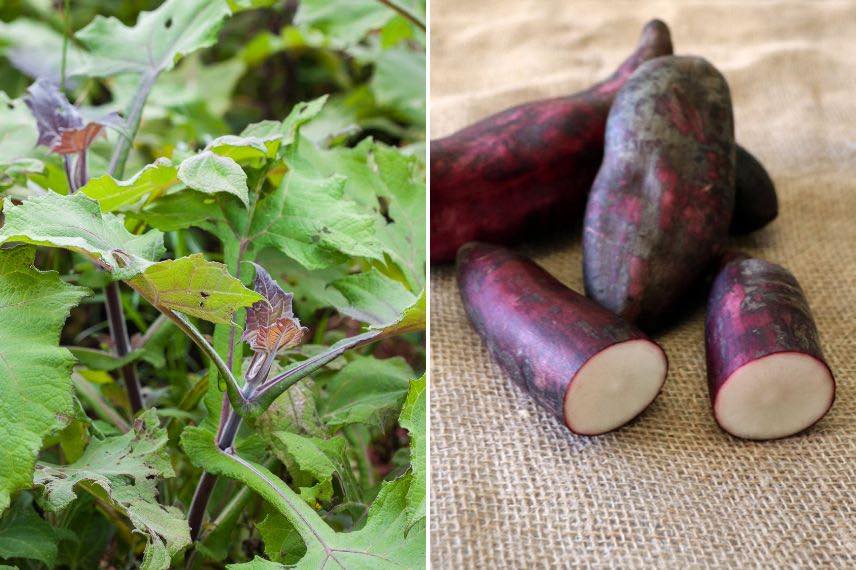
Yacon plant and tubercles of the ‘Morado’ variety
Tropaeolum tuberosum: flowers, leaves, and tubercles to use in cooking
Description
The tuberous nasturtium (Tropaeolum tuberosum) is a lovely climbing plant native to the Andes Mountains. This perennial plant, less known than its annual relatives, deserves to be rediscovered. Regarded as an ancient vegetable, it produces clusters of edible tubercles with a fine, fragrant flavour. However, all its aerial parts can also be used in cooking.
Floriferous, it produces tubular flowers in late summer with warm colours, blending yellow, orange, and red. The foliage, equally ornamental, is round and divided into 5 lobes, marked with light veins. Use the flowers and leaves raw in mesclun salads. The leaves can also be cooked.
The tubercles can be used raw or cooked to attenuate their spiciness and offer a milder flavour.
Fast-growing and vigorous, this nasturtium can reach up to 2.5 metres in height within a few months.
Harvesting and storing Tuberous Nasturtium
Harvest occurs 6 to 7 months after planting, in autumn, when the foliage has disappeared. Dig up the bulbs using a spade. Store them in the same way as potatoes.
Cultivating Tuberous Nasturtium
Plant your tuberous nasturtium in cool, light soil that does not allow water to stagnate. Hill up the stems to improve yield. Choose a sunny location.
Due to its relatively low hardiness (-6 to -9°C), it will be grown as an annual, or dug up to be overwintered frost-free, like dahlias. Pot cultivation is possible, but a deep container will be necessary.
For more information: “Nasturtium: planting, sowing, maintaining.”
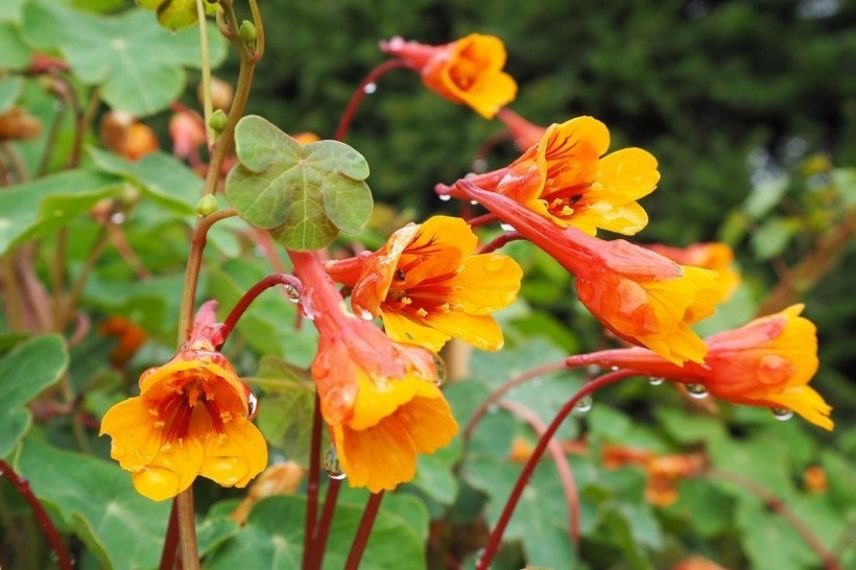
The lovely tuberous nasturtium plant
- Subscribe!
- Contents

Comments