






























5 cold and drought-resistant hedge shrubs
Plants that withstand harsh winters as well as drought
Contents
Establishing a garden hedge serves various functions: defining spaces, providing privacy, protecting an area from wind, and promoting biodiversity. To create your ideal hedge, the bushes should be chosen based on your growing conditions as well as your expectations: low or high hedge, carefully pruned or left natural, opaque all year round or allowing light in during winter, flowering or leafy, etc.
We are increasingly noticing that our gardens must adapt to current climate changes. Water management is one of the crucial issues, and plants capable of withstanding drought are becoming more and more popular. To adapt to a wide range of regions, we have selected bushes that can endure water scarcity as well as harsh winters. Discover 5 hedge shrubs that should meet all your needs!

Broom: for a floriferous and fragrant hedge
Broom genista (Cytisus scoparius) are sun-loving shrubs: they grow spontaneously in well-exposed coastal areas, in very well-drained, even poor and sandy soils. They can be confused with gorses, which thrive in the same growing conditions but have spiny stems.
Their ramified and compact silhouette allows them to form a lovely medium-sized hedge, reaching heights of between 1.5 metres and 2 metres. Broom genista are perfect for free-standing hedges or bocage hedges, with their wild and natural style.
They offer a generous, fragrant papilionaceous flowering that brightens the garden at the end of spring. While golden yellow is the most well-known colour, there are also varieties that bloom in red, pink, purple, white, or even multicoloured.
Consider, for example:
- the Cytisus scoparius ‘Roter Favorit’, with its bicolour flowering of carmine red and yellow;
- ‘Moyclare Pink’, for its small cream-pink flowers;
- ‘Lena’, which rewards us with a flowering of yellow, orange, and red;
- ‘La Coquette’, which produces pink and yellow-orange flowers;
- ‘Burkwoodii’, with its dark pink flowers leaning towards red;
- ‘Apricot Gem’, a golden yellow tinged with red-orange.
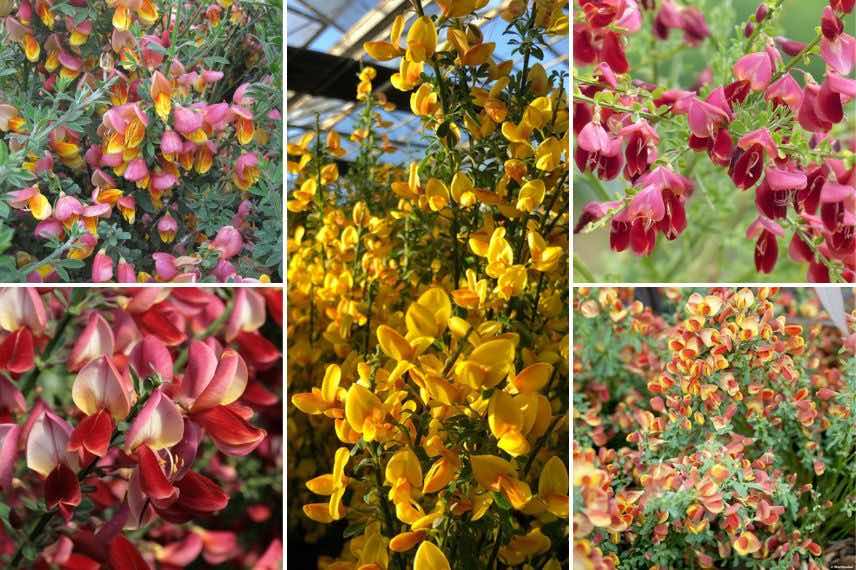
Clockwise: Cytisus scoparius ‘La Coquette’, ‘Apricot Gem’, ‘Burkwoodii’, ‘Lena’, ‘Roter Favorit’
Deciduous, the foliage disappears in winter, allowing light to pass through. However, the branches remain green for almost the entire year, which still adds a touch of aesthetics.
Drought-resistant and tolerant of temperatures below -20°C, broom genista are very easy to care for. Regular pruning will simply help maintain a compact silhouette and extend their lifespan.
To learn more:
Read also
Drought-resistant hedge shrubsBarberry: for a colourful defensive hedge
The Berberis or barberries are shrubs that boast numerous aesthetic advantages: a sunny flowering in spring, attractive autumn fruiting, and very colourful foliage in deciduous varieties. The flowers are also fragrant and melliferous, attracting valuable pollinating insects.
Their dense and compact silhouette is ideal for creating free or structured hedges. Their thorny stems are particularly useful for forming a defensive and deterrent hedge. The hardiest varieties have deciduous foliage, which allows for transparency and lightness in winter. However, they can easily be combined with other evergreen hedge shrubs to prevent complete bare patches.
For a low hedge, consider the Berberis thunbergii ‘Red Rocket’ (1.5 metres in height and 1 metre in spread). It features stunning purple foliage that turns light red over time. The yellow flowers are edged with red; they give way to small, bright red spherical fruits.
For a medium-sized hedge, try the Berberis ottawensis. ‘Auricoma’ (approximately 2 metres in all directions) has purple foliage that evolves into bright red. It beautifully highlights the pale yellow flowers, followed by fruiting. ‘Superba’ (2.5 metres in all directions) offers a reddish-purple foliage.
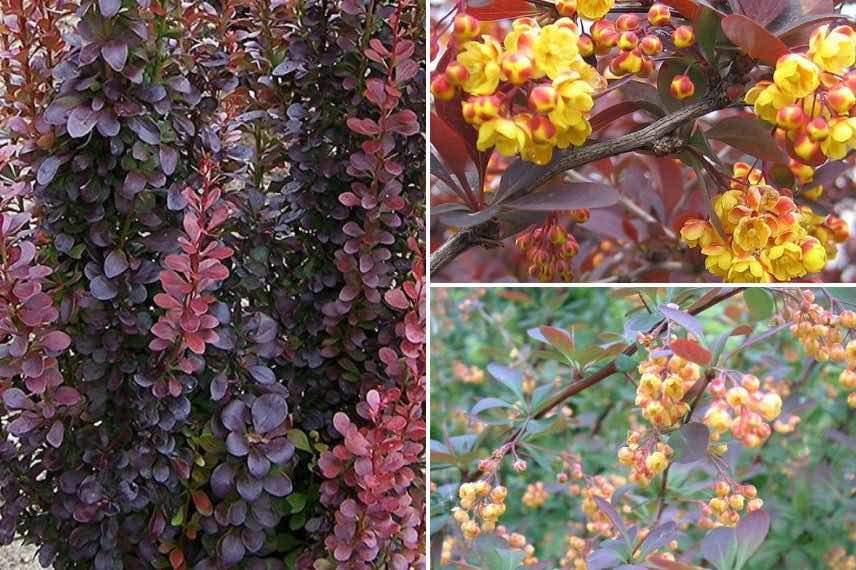
Berberis thunbergii ‘Red Rocket’, ‘Superba’ and ‘Auricoma’
These Berberis are resilient to both drought and severe frosts, down to -20°C.
My advice: even shrubs known for their drought resistance should be watered during the first two years after planting, while they establish and develop their root system.
Provide them with a sunny or partially shaded location, in all types of well-drained soils (that do not allow moisture to stagnate). For maintenance, simply plan for pruning if you desire a neat-looking hedge.
To learn more:
Discover other Hedge shrubs
View all →
Available in 0 sizes
Available in 1 sizes
Available in 1 sizes
Available in 1 sizes
Available in 1 sizes
Available in 1 sizes
Available in 1 sizes
Available in 1 sizes

Available in 1 sizes
Available in 1 sizes
Aucuba japonica: for creating a bright evergreen hedge in shade
Aucuba japonica are not difficult-to-manage shrub hedges. They withstand harsh winters (hardiness of approximately -15°C to -20°C), tolerate drought once well established, are not prone to diseases, and can endure pollution, wind, and salt spray.
They will brighten shaded or partially shaded areas all year round, thanks to their glossy foliage, which is sometimes variegated. They can be used to create various types of evergreen hedges, flowering in spring: privacy hedge, windbreak hedge, living hedge, or informal countryside hedge.
- In urban gardens or small spaces, choose the variety ‘Rozannie’, which grows to 1.10 metres in all directions. It features dark green foliage speckled with yellow.
- For a medium hedge, opt for ‘Variegata’ (1.75 metres in all directions), ‘Crotonifolia’, or ‘Golden King’ (1.80 metres in all directions), with their beautiful yellow-variegated foliage.
- For a tall hedge, the typical species of Japanese laurel will be ideal, with a silhouette reaching 3 metres in height and 2 metres in spread. It produces dark green, glossy leaves.
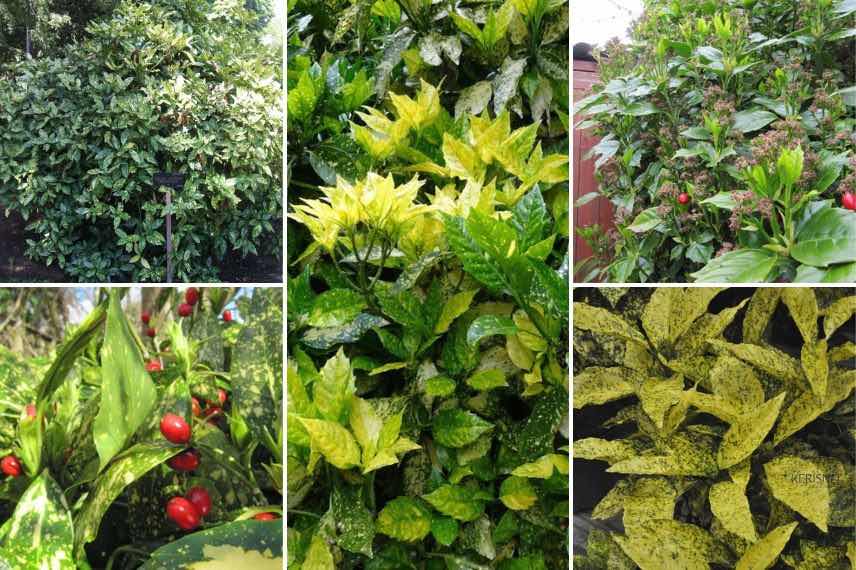
Aucuba japonica ‘Crotonifolia’, Aucuba japonica, then ‘Rozannie’, ‘Golden King’, ‘Variegata’
Flowering occurs in spring but is very discreet. On fertilised female plants, it is followed by attractive bright red fruit, which remains throughout winter and delights the birds.
Plant your Aucuba japonica in all types of ordinary soil, as long as it is well-drained, without standing moisture. These hedge shrubs tolerate pruning, which should be done at the end of winter.
To learn more:
Read also
How to plant a hedge?The different varieties of Buddleia davidii: for quickly creating a flowering hedge
The Buddleias davidii, also known by the poetic name “butterfly trees”, are very accommodating shrubs. They are valued for their generous summer flowering, featuring colourful and fragrant spikes.
While they make excellent hedge shrubs, it is due to their rapid growth that they can easily create a green screen, as well as their tolerance to pruning and their great ease of maintenance. They are perfect for creating a natural flowering hedge with a rustic appearance. Their deciduous foliage can be mixed with that of evergreen shrubs.
With Buddleia davidii, you will be spoilt for choice when it comes to flower colours:
- ‘Pink Delight’ blooms in pink;
- ‘Summer Beauty’ produces purple flowers;
- ‘White Profusion’ has white flowers with a yellow eye.
These varieties reach 3 metres in height and 4 metres in spread.
For smaller spaces, choose between ‘Berries and Cream’ with its bicolour blooms, ‘Butterfly Tower’ with its reddish-purple panicles, or ‘Santana’ with its variegated foliage.
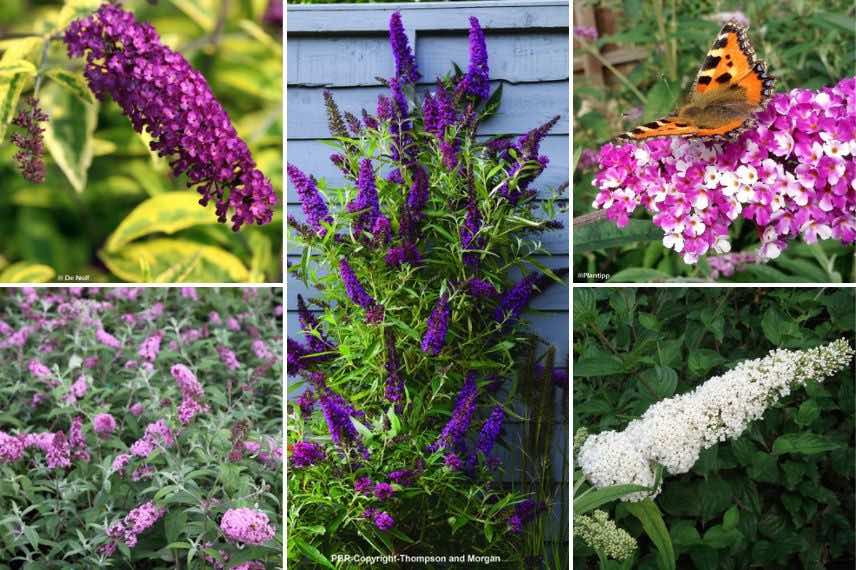
Clockwise from top: buddleia davidii ‘Santana’, ‘Butterfly Tower’, ‘Berries and Cream’, ‘White Profusion’, and ‘Pink Delight’
The species is quite hardy (down to -20°C), robust, tolerates occasional drought, and also pollution. In terms of cultivation, these Buddleias thrive in all soils, even poor and chalky ones, as long as they are deep. Plant them in a sunny position sheltered from prevailing winds. An annual maintenance pruning is recommended.
To learn more:
Pyracantha: a shrub for hedges that promotes biodiversity
The Pyracantha or firethorn is a reliable choice for creating a defensive hedge while providing shelter and food for wildlife. It has an evergreen foliage that remains in place all year round, as well as thorns that allow it to form a true impenetrable barrier.
The flowering with small white flowers occurs at the end of spring and diffuses a strong honey scent that attracts pollinating insects. In terms of colours, it is mainly the fruits that provide the spectacle: in autumn, the small berries can take on very bright hues and remain on the tree throughout winter, providing food for birds. In ‘Red Star’, the berries are a beautiful bright red, while ‘Saphyr Jaune’ produces berries of a bright golden yellow and ‘Orange Glow’ bears orange fruits.
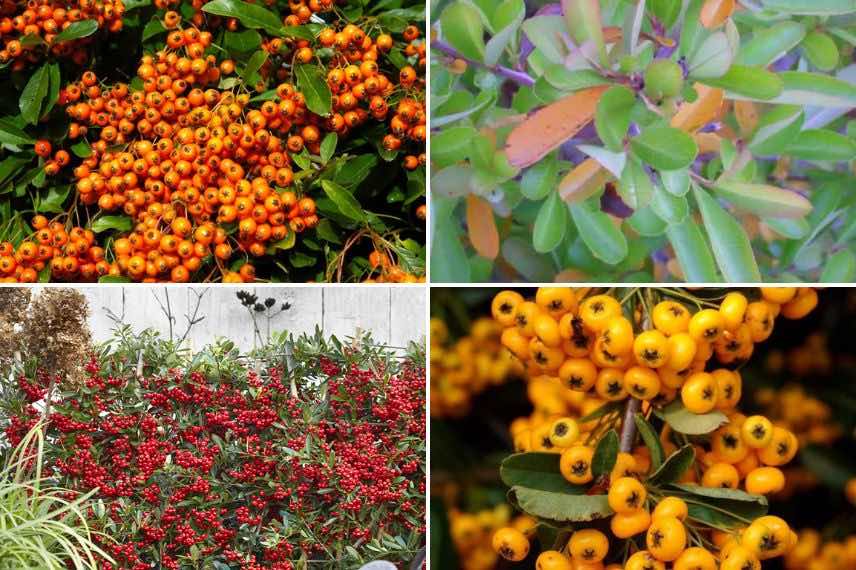
Pyracantha ‘Orange Glow’, fruits and foliage, followed by ‘Sapphyr Jaune’ and ‘Red Star’
Their silhouette measuring approximately between 2 and 4 metres can quickly serve to form a medium-sized hedge.
Not very demanding, they thrive in all soils, even poor ones, in full sun or partial shade. They may only require light pruning after flowering. Very hardy, they will withstand harsh winters. Once established, they will also tolerate summer drought. However, remember to water them during the first two years of cultivation to help them develop and become more resilient.
To learn more:
- Subscribe!
- Contents

Comments