






















11 fruit trees for dry soils
Some fruit trees need very little and also bear fruit in dry soils
Contents
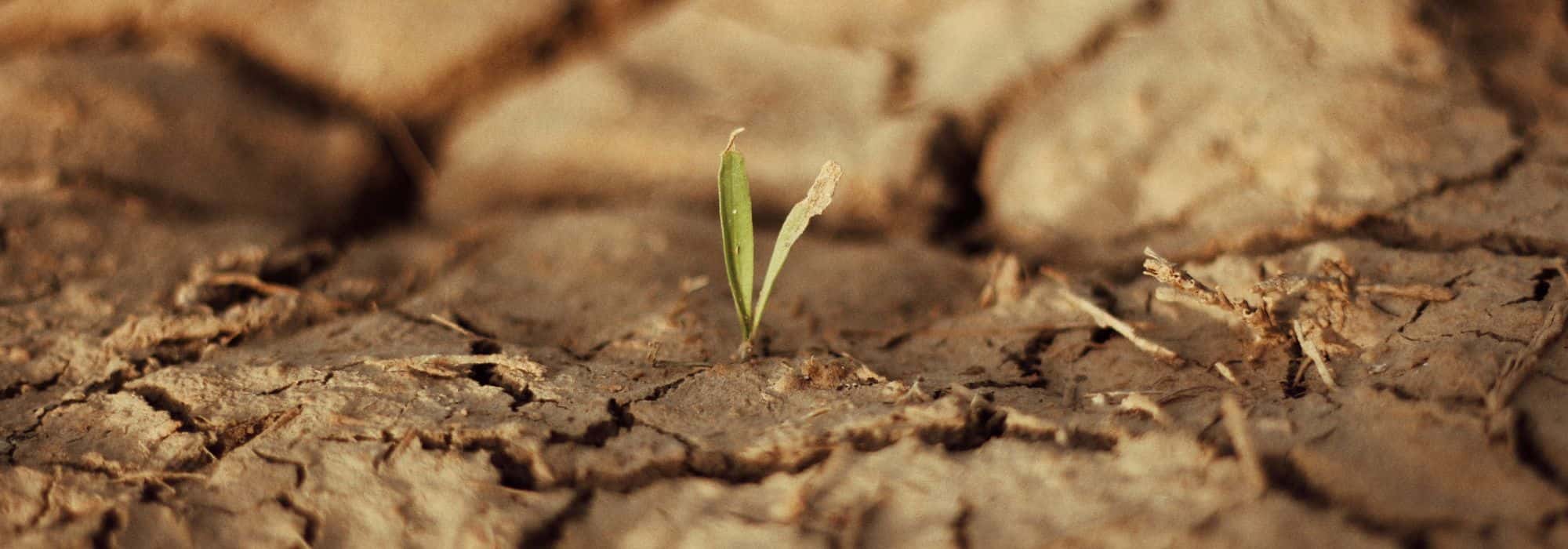
By definition, dry soil does not retain water. Rainwater or irrigation water soaks in quickly. That’s why, when you take a handful of soil, you feel no moisture, in any season. Dry soil is also poor in organic matter and nutrients. Which means that these soils are unproductive, often stony and calcareous.
At first glance, you might think it would be difficult for a fruit tree to bear fruit in dry soil. However, it is possible by choosing species capable of thriving in free-draining soils. Obviously, the typically Mediterranean fruit trees come to mind, but there are other undemanding species capable of bearing fruit in poor soils.
Discover our selection of 11 fruit trees suited to dry, free-draining soil.

Typically Mediterranean fruit trees
In southern France, heat is omnipresent in summer, sunshine is at its maximum for much of the year, severe weather is limited, and frosts are rare…The soils are dry, often calcareous and very stony. Needless to say, some fruit trees, native to the Mediterranean basin, are particularly well adapted to these cultivation and meteorological conditions. However, for the most part, these are trees very sensitive to cold and frost that cannot be grown beyond the south, that is roughly north of Valencia.
- The almond tree (Prunus dulcis): it is the typical fruit tree of southern France that needs dry, calcareous soils. Very resistant to wind, it dislikes humid climates and compact soils. However, its splendid flowering, white to pink, on naked shoots, is particularly early, since it occurs as early as February, which makes it particularly sensitive to frost.
- The olive tree (Olea europea): it is also an emblematic tree of the Mediterranean, recognisable by its twisted trunk and its small silvery-grey leaves. Undemanding, the olive thrives in stony, completely dry and poor soils. Although olive trees are grown (almost) everywhere in France, in the ground or in a pot, they will need heat and sun to fruit.
- The fig tree (Ficus carica): markedly more hardy than the previous congeners, the fig tree easily adapts to dry, stony soils, provided they are deep. It can be grown throughout France, ideally against a south-facing wall in regions with harsh winters. Nonetheless, it also needs heat to fruit. Note that there are uniferous varieties (one fruiting per year) and biferous (two fruitings per year). If you have little space, opt for a self-fertile variety.
- The pomegranate tree (Punica granatum): this fruit tree, typical of the Mediterranean basin, is capable of adapting to all soil types, including dry ones. However, to fruit it will need plenty of heat and water. It is also a very decorative fruit tree thanks to its summer flowers of a vivid orange-red. It can be cultivated beyond the Mediterranean basin thanks to its hardiness down to -15 °C, but only for its flowering and its gnarled silhouette.
- The loquat (Eriobotrya japonica): it is also a fruit tree that only produces fruit in warm, sunny regions. Indeed, its flowers are very sensitive to frost. That is why, if you want to harvest loquats, it is unthinkable to plant it in the ground anywhere other than the coast. Although the loquat appreciates rich, deep soils, it can perfectly manage with a dry soil.
- The jujube tree (Ziziphus jujuba): mainly cultivated in southern France, the jujube produces, in autumn, red fruits the size and shape of olives. It is a fruit tree that does very well in dry soil. Hardy down to -15 °C for short periods, it can be grown as far north as the Paris region. But it needs heat to fruit.
- The Arbutus (Arbutus): also called the strawberry tree, the Arbutus is a very ornamental fruit tree for its evergreen foliage and its brown bark. It flowers in clusters of white bells simultaneously with fruiting in autumn–winter. Its red fruits are particularly decorative thanks to their beautiful red colour. They are edible, mainly used for jellies. It is a tree that tolerates dry soils very well.
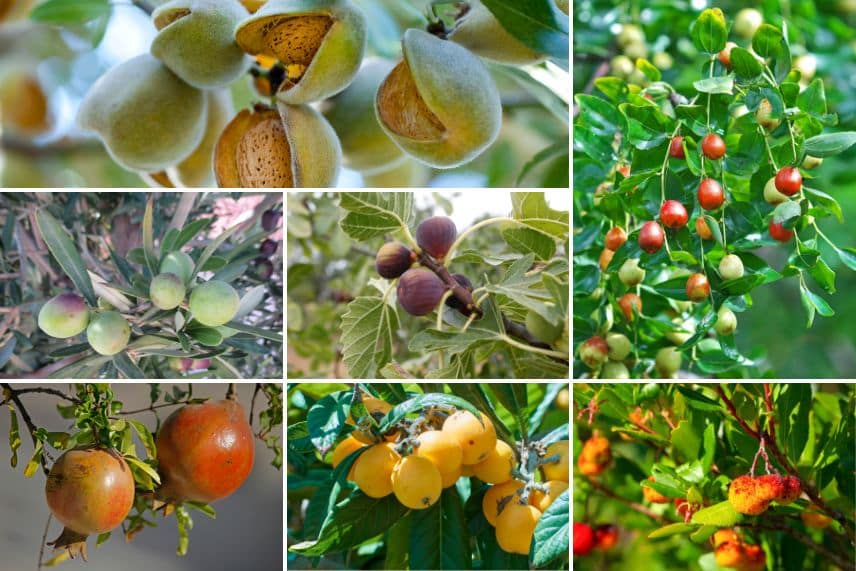
The almond tree, the olive tree, the fig tree, the pomegranate tree, the loquat, the jujube tree and the Arbutus appreciate dry soils
Read also
12 bushes for dry or free-draining soilFruit trees for dry soil that also like heat
Other fruit trees that tolerate dry soils and like warmth can grow (almost) anywhere in France. Perfectly hardy, these fruit trees often have flowering that is very sensitive to frost. That is why it is essential to plant them in a very sunny spot, well sheltered from cold winds and draughts, if you hope for any fruit. In regions with a climate less mild than in the south, training against a wall is an ideal cultivation method for these fruit trees.
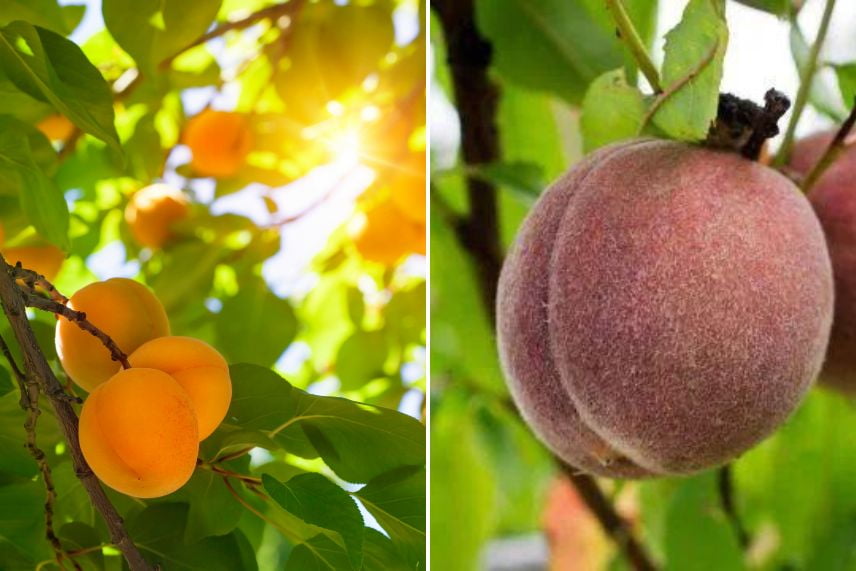
The apricot tree and the vine peach adapt very well to dry soils
- The apricot tree (Prunus armeniaca) : it is a fruit tree that loves warmth, tolerates drought and appreciates dry soils. Indeed, it dislikes above all rainy regions and damp, clay soils. Although the apricot tree is very hardy, its flowering is vulnerable to late spring frosts. To fruit optimally it needs a cold winter, a mild spring and a hot summer. Most varieties are self-fertile.
- The peach (Prunus persica) that produces the vine peach : this species of peach, once grown in vineyards to detect mildew, particularly appreciates well‑drained, light or even dry soils. It especially dislikes heavy, compact soils and excess water. Conversely, it needs sun. Thanks to its late flowering and fruiting, this peach can be grown in roughly all of France. There are vine peach varieties with white, yellow or blood‑red flesh.
Other lesser-known fruit trees suitable for dry soil
To finish, two fruit trees that tolerate dry soils with a tendency to be calcareous and that cope perfectly with drought. The first only fruits in regions with a warm climate, the second should be reserved for large gardens because of its growth :
- The true pistachio (Pistacia vera) : it is the fruit tree that produces the famous pistachios. It only fruits in regions with long, very hot summers. It particularly likes well-drained soils that tend to be calcareous and rather poor. Drought does not bother it once it is well rooted. To obtain fruit, you must necessarily plant a male and a female tree that flower at the same time
- The Turkish hazel (Corylus colurna) : it is the largest of the hazels and can reach 20 m in height with a spread of 9 m. Its small hazelnuts are surrounded by a bristly husk with curly points, which makes this hazel very decorative. This hazel prefers perfectly drained soils that tend to be calcareous
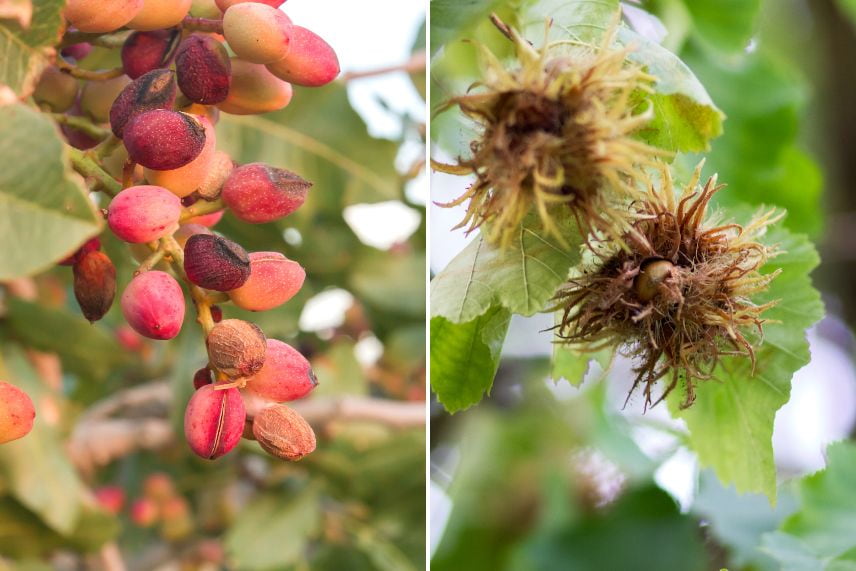
The true pistachio and the Turkish hazel favour dry soils with a tendency to be calcareous
- Subscribe!
- Contents
Comments