






























10 tips to successfully grow lilies
And enjoy their elegant and fragrant flowering
Contents
Lilies are beautiful bulbous plants valued for their spectacular, refined, and fragrant flowering. Majestic, stylised, and aromatic, lily flowers, whether trumpet-shaped or star-shaped, are essential in gardens. They are perfect for borders, rockeries, or even large pots, and look wonderful in vases. Lily bulbs are hardy and, if a few simple rules are followed, once well planted, they will require little care. Planting, watering, maintenance—here’s how to have beautiful lilies!


Tip No. 1: Properly Identify Your Lilies
Madonna Lily (Lilium candidum), botanical lilies (such as Martagon lilies) with reflexed petals, Asian hybrid lilies with tall flower spikes and vibrant colours, Lilium tigrinum with spotted flowers, longiflorum lily or Easter lily with large trumpet-shaped flowers, Oriental lily… there are many varieties of lilies. However, not all have the same adaptability. Some require full sun, others are better suited to humid climates, while some prefer drier soil. With the exception of the Madonna lily, Henry lily and Martagon lily, which tolerate lime well, most species prefer rather acidic soils and do not like calcareous substrates. Before planting, be sure to consider the different types of lilies and their respective growing conditions.
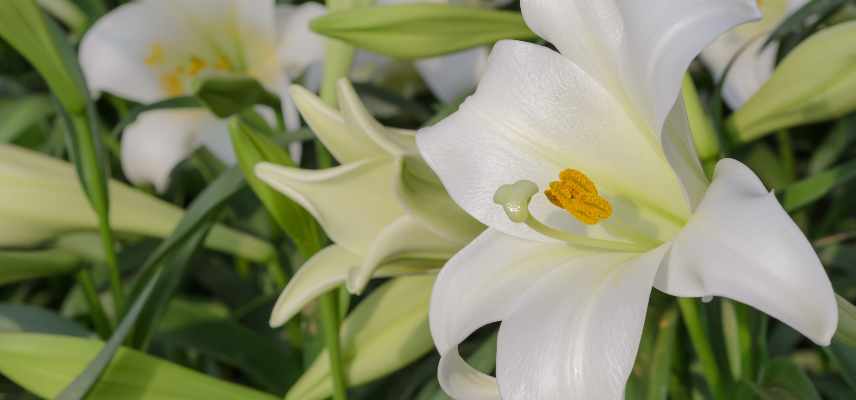
Lilium longiflorum
Read also
Lilies: the most fragrantTip No. 2: Plant them at the right time
Lilies prefer autumn planting: the ideal planting period extends from late September to January, with October being the best month for most varieties. Exceptions include the Madonna Lily, which prefers planting from August to September, and Asian lilies, which are better planted in spring. It is advisable to plant them as soon as you purchase them to prevent them from drying out.

Tip No. 3: Plant them deeply
Lilies are straightforward to grow, provided they are correctly installed. When planting, lily bulbs are generally planted quite deeply in the soil, burying them at 15 cm (which is a depth equivalent to three times their height), point upwards and using a bulb planter. Again, the Madonna Lily stands out, as it is only planted under 2 to 3 cm of soil.

Pay attention to the depth of the planting hole
Read also
How to choose a lily?Tip No. 4: Give them a place in the sun!
Plant them preferably in full sun (they need 6 to 8 hours of direct sunlight per day) but place their base in the shade. In our most exposed regions, they prefer light shade. Provide them with a sheltered spot from the wind. For the taller varieties, install stakes.

Lilies need enough sun to bloom well
Tip No. 5: Care for the soil
A suitable soil is the guarantee of healthy growth and vibrant flowering. Well-drained, loamy soil is ideal. Lilies appreciate soils rich in organic matter, loose, and well-draining. They require neutral or acid soil, as most are sensitive to lime. They enjoy coolness and light soils rich in humus. Plant lily bulbs in a mixture of soil, sand, and well-decomposed compost.
- In poor soil: add an organic fertiliser.
Most species prefer the soil to remain relatively cool in summer. However, avoid overly clayey or wet ground that could promote fungal diseases (such as Botrytis, also known as grey mould).
- In heavy soil: add clay balls, gravel, or perlite. The Madonna Lily, for example, can be planted in a pocket of sand.
- In calcareous soil, add heather soil.
Planting density: For a spectacular effect, plant in groups of at least five bulbs, maintaining a distance of 15 to 20 cm between bulbs.
For pot or container cultivation: spread a layer of drainage at the bottom (gravel, clay balls, broken pot shards…) and plant in a light, rich substrate made of coarse sand, compost, and garden soil. → For more information, check our advice sheet on growing lilies in pots.
 Group effects are always very beautiful!
Tip No. 6: Water wisely
Watering lilies must be well-balanced: an excess of water could lead to bulb rot. The soil should remain cool during growth and flowering. Ensure the soil is kept slightly moist with light but regular watering. As a general rule, weekly watering is sufficient, but during periods of intense heat, feel free to water twice a week. Always ensure the soil is well-drained to prevent water accumulation. Stop watering in autumn-winter, once the foliage has dried and the plant is dormant. We recommend installing a mulch to keep the soil cool for longer. You can use compost, bark, or fallen leaves to mulch your lilies.

Martagon lily
Tip No. 7: Feed them
A supply of liquid fertiliser every two weeks during the growth and flowering period can help your lilies thrive. Use a fertiliser rich in potassium and phosphorus to encourage flowering. Avoid fertilisers that are too high in nitrogen, as they promote leaf development at the expense of flowers.

Support flowering with a fertiliser
Tip No. 8: Make cut flower arrangements!
Pruning is not necessary for lilies, but removing faded flowers as they wilt helps prevent the bulb from unnecessarily exhausting itself producing seeds. Take the opportunity to create refined and fragrant bouquets while ensuring that you leave enough leaves during harvesting so that the bulb can replenish its reserves for the following season. In autumn, cut the clump back to ground level once the foliage has completely dried.

Tip No. 9: Leave lily bulbs in the ground
Lilies can stay in place for winter, as they are hardy and perennial, but a particularly cold and wet winter can damage them. In this case, consider covering them with an extra layer of mulch or bringing them indoors if you have planted them in pots.
Tip 10: Protect them from lily beetles and slugs!
Lily beetles are the main enemies of lilies. The larvae of this small beetle with a bright red shell devour their leaves, buds, and flowers. A massive infestation can lead to the death of the lilies. To combat these pests, regularly inspect your plants. The most effective method is to remove the black larvae, orange eggs, and adult insects manually. You can carry out sprays made from water, rapeseed oil, and dish soap or black soap.
As for slugs and snails, they also feast on the foliage of lilies. We recommend marking the location during planting and preventing their attacks as soon as the foliage emerges in spring. You can make a slug trap, or use a slug repellent. Discover all our natural solutions to keep them at bay.

The lily beetle
- Subscribe!
- Contents

Comments