





























Which bird feeder should you choose to attract which birds?
Our guide to choosing the right bird feeder.
Contents
Autumn has well and truly settled in, and winter is already on the way. In your garden, insects are thinning out, most having already entered their hibernation or diapause phase. And the birds are already crying out for food. While most bird conservation organisations advise filling the feeders from mid-November to the end of March, it goes without saying that everything depends on climate conditions and geographical area. In some regions, winter can arrive particularly early…
You have therefore decided to install one or more feeders, not only to support this winged wildlife, but also to enjoy a continually rewarding spectacle. There are many bird feeder models on the market, and you’re not sure which to choose.
Discover all my tips on the different types of feeders best suited to each bird species. Because not all birds feed in the same way.
Which birds frequent gardens, patios and balconies?
Throughout the year, your garden is visited by flocks of birds that come to feed there, drink there, sometimes seek shelter or nest there. In spring and summer, the garden indeed becomes a vast feeding ground, insectivorous birds finding food to feed their nestlings. Thus, larvae and caterpillars of all kinds provide a fine meal for tits. While a pile of branches, logs or even compost harbours numerous insects, spiders and other invertebrates that delight the garden birds such as the wren or the dunnock. The ivy-clad walls, berry-bearing shrub borders, fruit trees, a few plants such as sunflower, thistles and cardoons, or patches of wild herbs also delight these garden birds.
Around the feeding stations
But in winter, as insects become scarce, installing bird feeders helps offset the shortage of food. Indeed, most garden birds have a generalist diet that varies with the seasons, and with the geographical area of their habitat. During the breeding season, many become insectivorous to feed their young, while others are exclusively granivorous. But in winter, as prey choices become limited, many birds may potentially frequent the feeders.
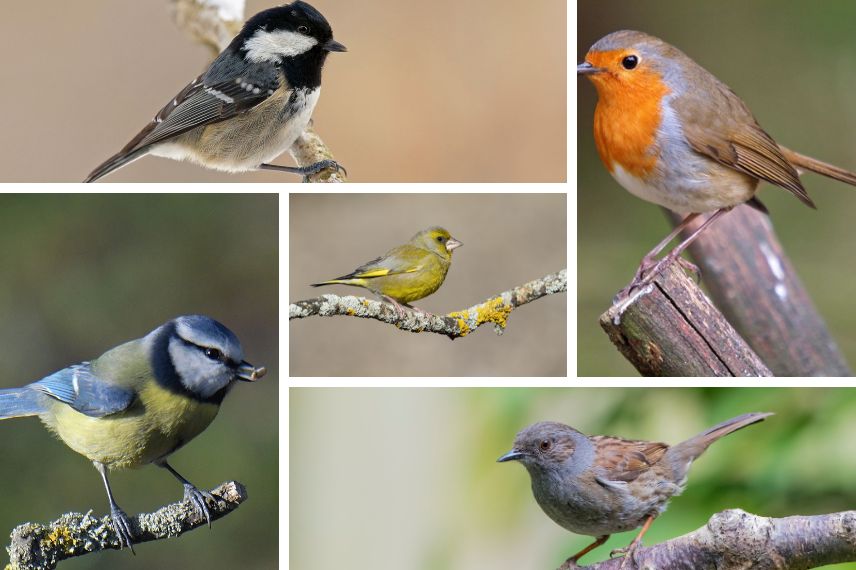
Great tit and blue tit, European greenfinch, robin and dunnock regularly frequent the feeders
Sous nos latitudes, à la campagne ou en milieu semi-urbain, les oiseaux les plus communs à fréquenter les mangeoires sont indéniablement la mésange charbonnière, bleue ou nonnette, le pinson des arbres, le verdier d’Europe, le rouge-gorge, le moineau domestique, l’accenteur mouchet… sans oublier la tourterelle turque, le pigeon ramier, la pie ou le merle noir, voire l’étourneau sansonnet. Dans les milieux plus ruraux, on rencontre plus facilement la sittelle torchepot, le chardonneret élégant, la mésange noire et la mésange huppée ou encore le rouge-queue noir… Plus rarement, le troglodyte mignon.
Des comportements différents
Tous ces oiseaux adoptent des comportements différents, souvent dictés par leur régime alimentaire. Ainsi, la mésange bleue possède un bec court, idéal pour capturer les insectes et larves sur les feuilles, mais aussi picorer à travers les mailles des mangeoires. Alors que le pinson des arbres a un bec fort et pointu, parfait pour extraire les graines de leurs enveloppes. Quant au rouge-gorge, il a tendance à se nourrir au sol.
Autour des mangeoires, en hiver, les oiseaux montrent aussi un comportement territorial. Ainsi, les rouges-gorges ont tendance à poursuivre tous les intrus entrant sur leur territoire, la bergeronnette grise et les verdiers d’Europe peuvent se montrer aussi très agressifs autour des mangeoires. Tout comme les moineaux domestiques. Alors que les chardonnerets sont plus calmes, passant souvent après les autres.
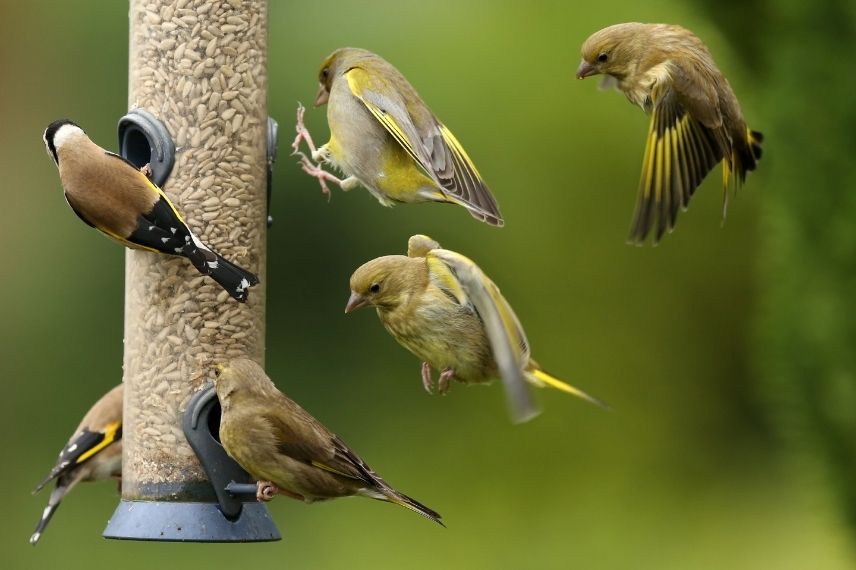
Autour des oiseaux éclatent souvent des chamailleries, les verdiers d’Europe se montrant souvent agressifs
C’est pourquoi, pour attirer le maximum de variétés d’oiseaux, il est judicieux de proposer plusieurs aires de nourrissage, de différents modèles et garnis de divers aliments, répartis sur toute la superficie du jardin.
Sur un balcon ou une terrasse, les espèces seront certainement moins nombreuses, mais les mésanges et les moineaux sont souvent au rendez-vous.
Read also
What do the birds in our gardens eat?Some tips for installing bird feeders.
To a bird, a garden is full of dangers from various sources. That is why a few precautions are essential when installing feeders:
- Do not install feeders too close to windows and glazed doors, where reflections from the glass can mislead the birds. If you only have a balcony, simply hanging curtains can resolve collisions with the glass.
- Place your feeders in a well-spaced, open location where the birds can spot danger. However, they should not be placed in the middle of an open space, as a Eurasian sparrowhawk could strike the birds during feeding. It is also advisable to avoid placing feeders in or near shrubs or in the branches of a tree, as cats—the birds’ main enemies—could hide there waiting for the right moment.
- Avoid placing feeders on the ground, unless your garden is fully protected against intruding cats.
- Not dangerous as such, squirrels (or even rats) can help themselves at the feeders and distract the birds. To avoid this nuisance, the simplest solution is to fix your feeder onto metal posts that squirrels and rodents cannot climb.
- Besides cats, the Eurasian sparrowhawk is a real menace for garden birds. To avoid a massacre (I’ve seen dozens of sparrowhawks swooping over my garden every day), the simplest solution is to install the feeders near thorny shrubs where the birds will shelter, but not the sparrowhawks. You should also regularly move the feeders and install decoys such as CDs, deterrent balloons or reflectors.
- Some feeders also attract large birds, more aggressive or voracious, such as seagulls along the coast, common starlings, the great spotted woodpecker, jackdaws and wood pigeons. Often, it is enough to multiply the feeding points. But the most effective approach remains placing the food in feeders that are difficult for the larger birds to access, for example, mesh feeders. You can also learn to love these birds, which have their own charm just like the others!
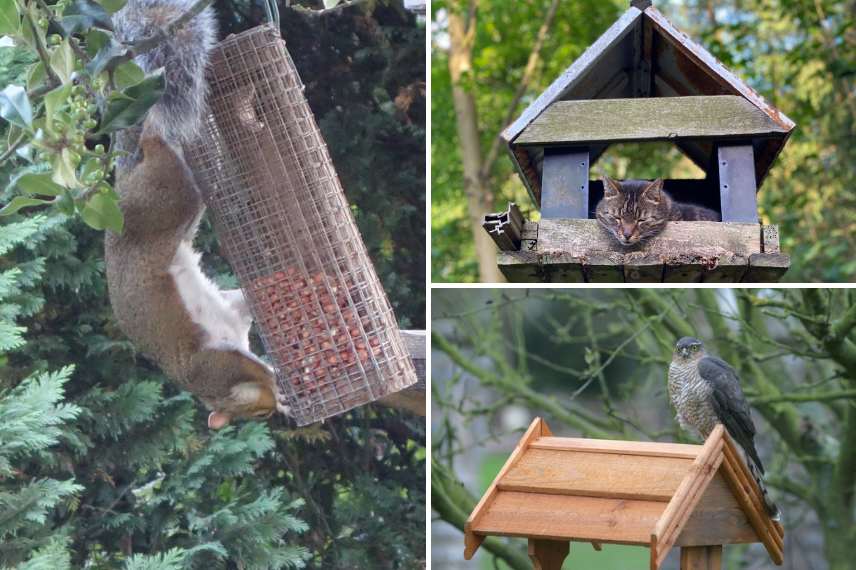
Around the feeders, competition is fierce and predators are plentiful
Otherwise, it is recommended not to put too much food at once, to avoid squabbles. It is better to scatter the seeds early in the morning and in the evening. With the arrival of spring, as temperatures rise, reduce feeding, but do not stop it abruptly. Finally, regular cleaning of feeders is essential to limit the spread of diseases.
Also consider installing waterers, even in winter.
Feeding tables, simple yet effective.
Among feeder models, feeding tables are the simplest. However, while they’re very practical for watching birds, they’re also attractive to predators. That is why they must be placed with care, following the guidance set out in the previous paragraph.
Ideally, these feeding tables will feature a perforated metal base to ensure rainwater drainage. Additionally, they will be easy to clean and perfect for seeds.
These feeding tables can be placed on the ground to feed birds such as robins, dunnocks, or blackbirds. Provided that no cats frequent your garden! They can also be mounted on the top of a post, against a wall or suspended from a branch. The feed can be protected from the weather by a roof (which may deter some shy species) or in a hopper-dispenser. The key is that this feeder has drainage spaces. And that it is robust, well anchored in the ground with a stake at least 10 cm long, driven in to one third.
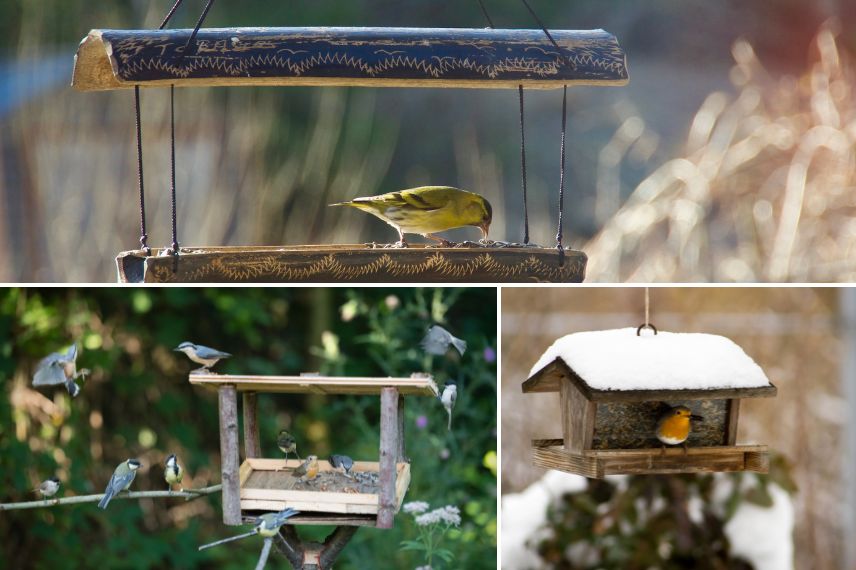
Tables or feeding tables with or without a hopper
Easy to make, these feeders attract blue tits, house sparrows, siskins, European greenfinches… but also larger birds such as the turtle dove or the wood pigeon.
The more handy DIY enthusiasts can build their feeding tables from wood, optionally with a perforated tray in metal or plastic, easier to clean. The wood can be protected with linseed oil.
Wire-mesh and tubular feeders, silo-style, somewhat more specialised.
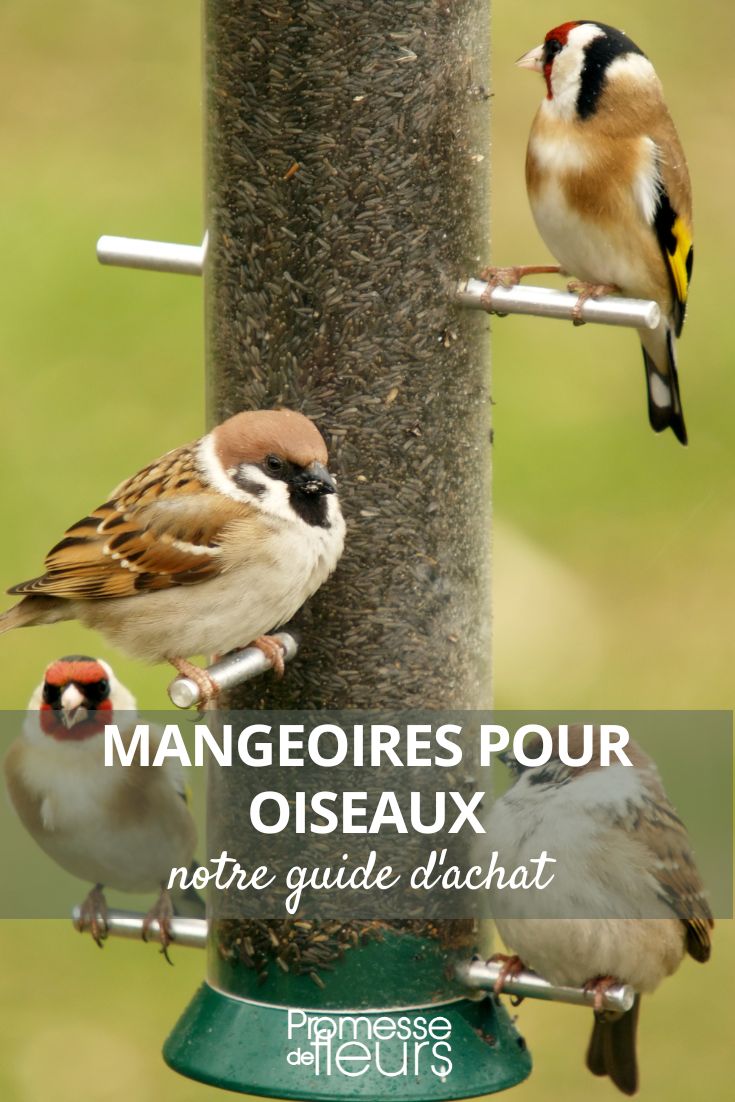
Let’s now consider the bird feeders proper, which come in two forms: tubular and wire-mesh. Tubular feeders are cylindrical silos, often made of plexiglass, of varying sizes, with several holes and perches. These feeders are very handy, as they’re easy to clean and watertight. They also help limit disease transmission. This type of feeder is particularly popular with finches (goldfinches, crossbills, tree finches…) as well as with tits.
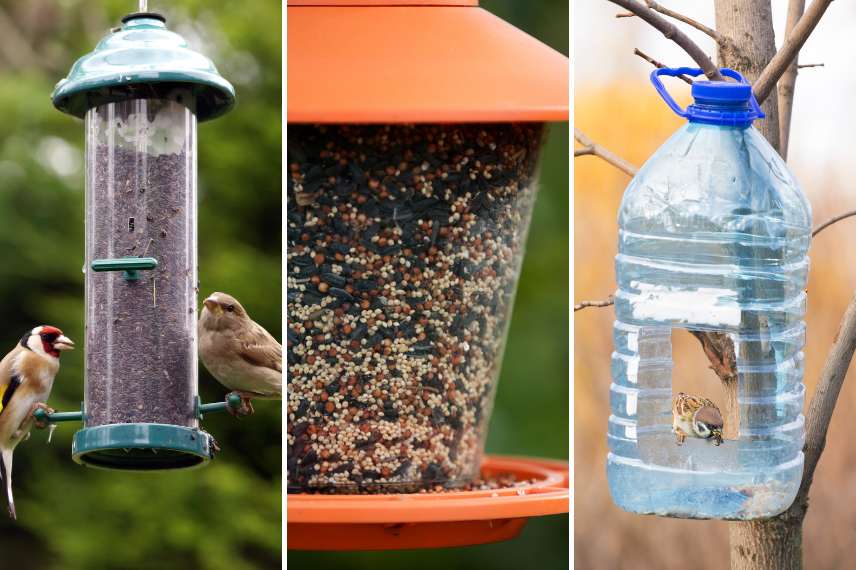
Tubular bird feeders: shop-bought or homemade
This type of feeder is not difficult to make, with a few simple items: a plastic pipe, a gutter, a plastic bottle or container, a tin can…
The second option is the hopper-style wire-mesh feeder, which comes in a variety of shapes and sizes. They differ mainly in the size of the mesh, small meshes allowing seeds to be offered, large meshes for peanuts or sunflower seeds. Blue tits, greenfinches and nuthatches appreciate this style of feeder, where they sometimes hang upside down. Again, with a bit of creativity, it’s fairly easy to make one with wire mesh.
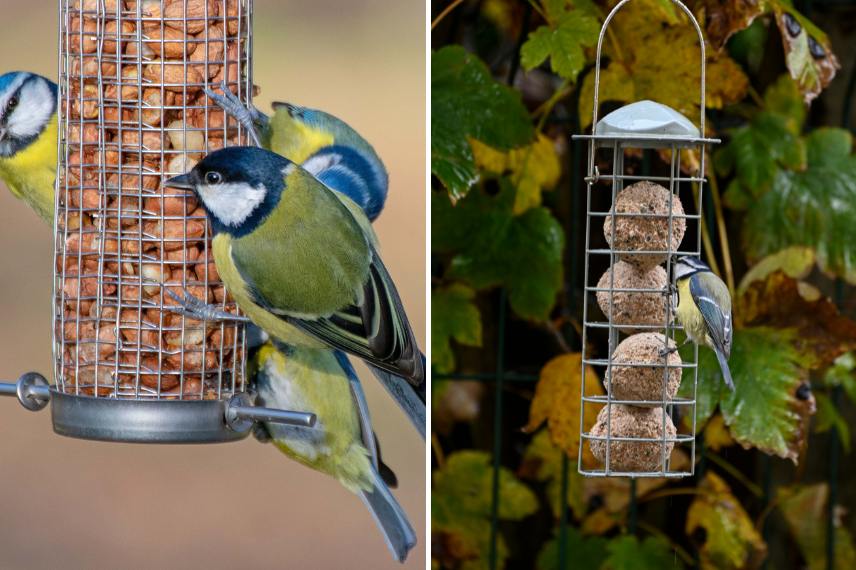
Wire-mesh feeders
Finally, there are other bird-feeding stations, hanging feeders, made from nets filled with seeds or peanuts, suet balls, bird cakes, millet stalks… Some, such as seed or fat nets, should be avoided, as birds tend to get their feet caught in them. That said, a simple log with holes drilled, a pine cone, or any container such as a cup, can be used to create hanging feeders that are both effective and original.
Ingrid also offers a few ideas in her articles:
- Subscribe!
- Contents
Comments