





























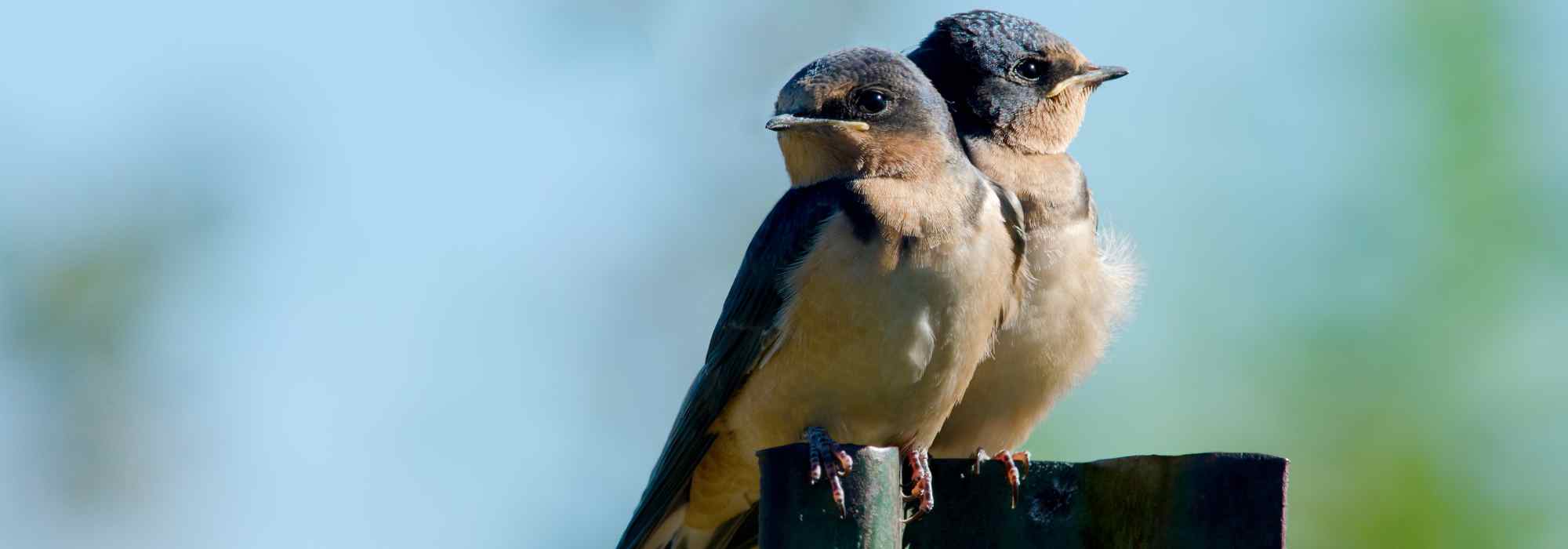
Garden Birds: Swallows
they accompany us all summer
Contents
Heralds of the approaching spring, swallows have been in serious decline in recent decades. The causes are numerous, including the loss of nesting sites, the disappearance of insects, and even poaching along migration routes. Once widespread in our countryside, both hardy swallows and house martins are now becoming increasingly rare. Can we do something on our small scale?
→ What are the different species of swallows in our area? Can we help them? And if so, how? We explore this in our advice sheet.

The different species of swallows
Swallows are birds belonging to the family Hirundinidae. They are migratory birds that return to us in spring to nest, often near human dwellings.
In France and Belgium, there are 3 main species of swallows (other species being more anecdotal):
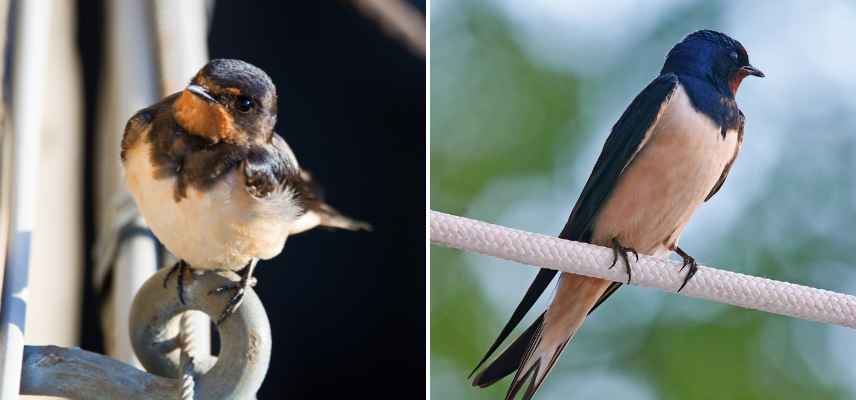
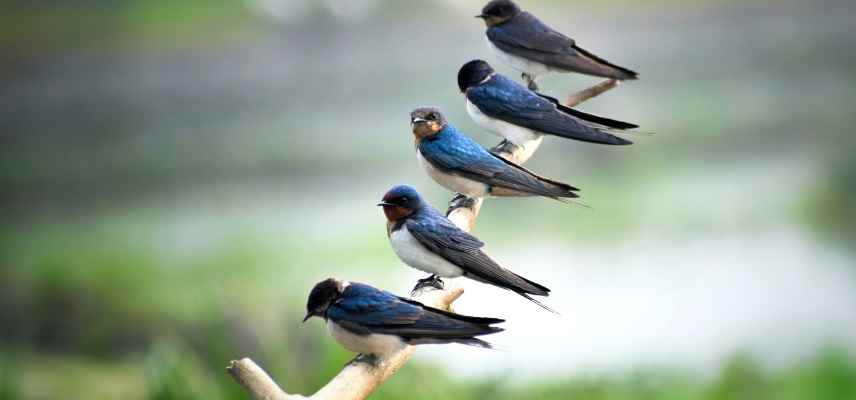
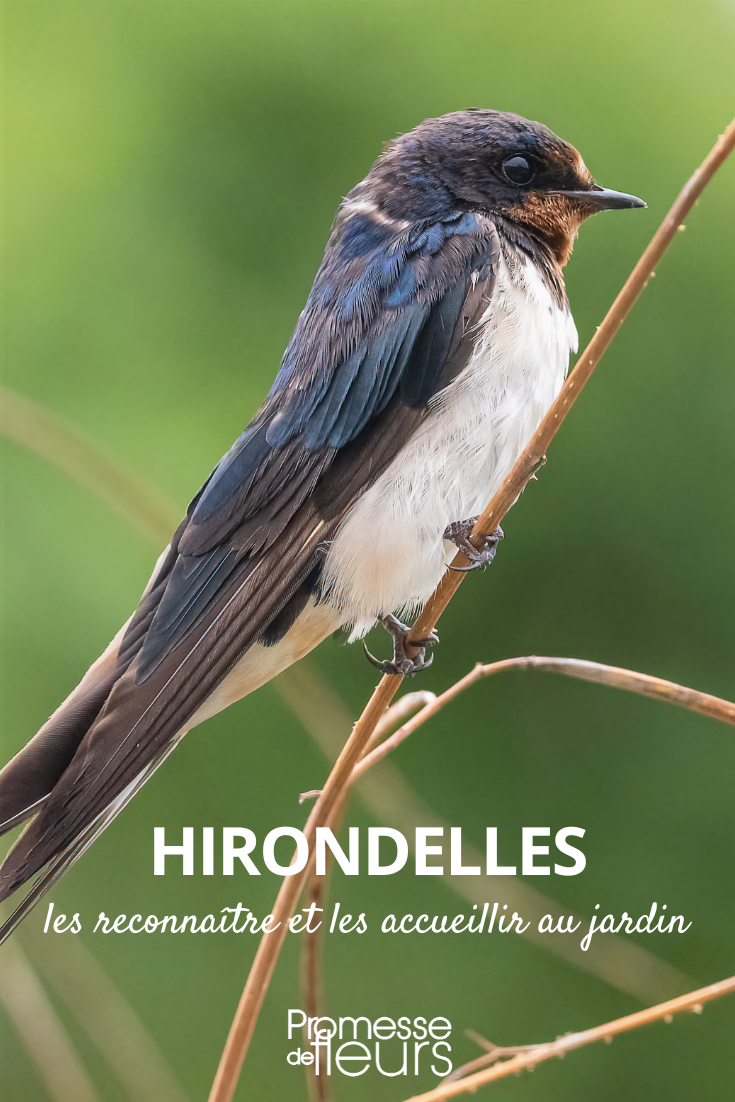
- The Barn Swallow (formerly known as the Chimney Swallow) or Hirundo rustica: the upper parts, from head to tail, are dark blue with a certain metallic sheen. The throat, cheeks, and the edges of the beak are brick-red, highlighted by a dark blue pectoral band, and the underside of the bird is cream-white with rufous reflections. The tail is widely notched, very tapered at both ends due to the tail feathers known as “filaments”;
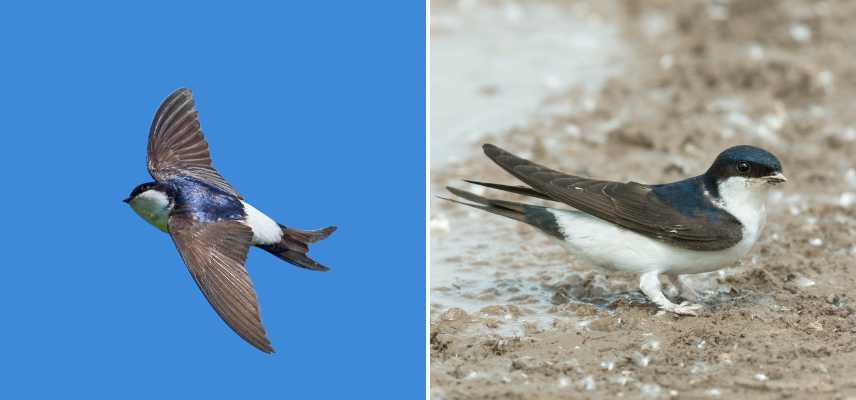
- The House Martin or Delichon urbicum: it has a bluish head and upper parts, a white rump, and pure white underparts;
- The Sand Martin or Riparia riparia: smaller than the Barn Swallow, it is adorned with a ash-brown pectoral band, and its throat and belly are white.
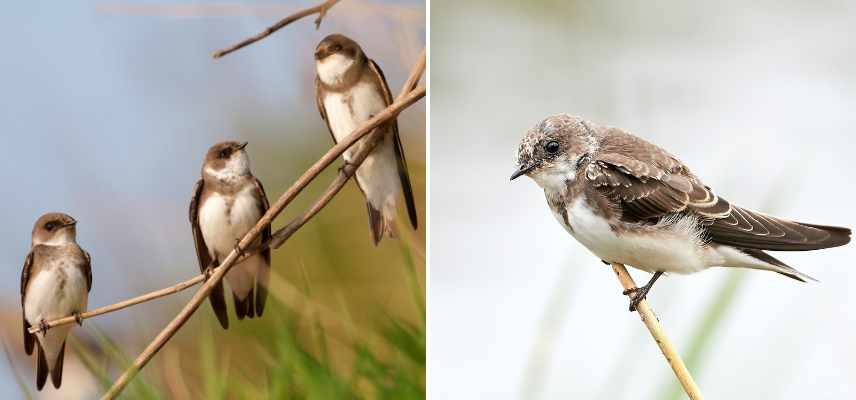
The Barn Swallow is the most common, but it is not rare to observe nests of House Martins near human dwellings. The Sand Martin is associated with sandy shores of the sea, lakes, or rivers.
Read also
Hedge for birds: which shrubs to choose?Habits and Habitat
Habitat and Distribution
The Swallow prefers open areas with low vegetation, such as meadows, bocages, marshes, as well as parks and gardens, especially when there is a water source nearby.
The distribution range of the Barn Swallow or Chimney Swallow is very vast. Indeed, they can be found in North America and throughout Eurasia during the summer, then they migrate to South America (for the “American” ones), Africa (for the “European” ones), and Southeast Asia up to Australia (for those from northern Asia). The distribution range of the Window Swallow is concentrated in Eurasia, then in Africa and Southeast Asia for wintering.
Migration
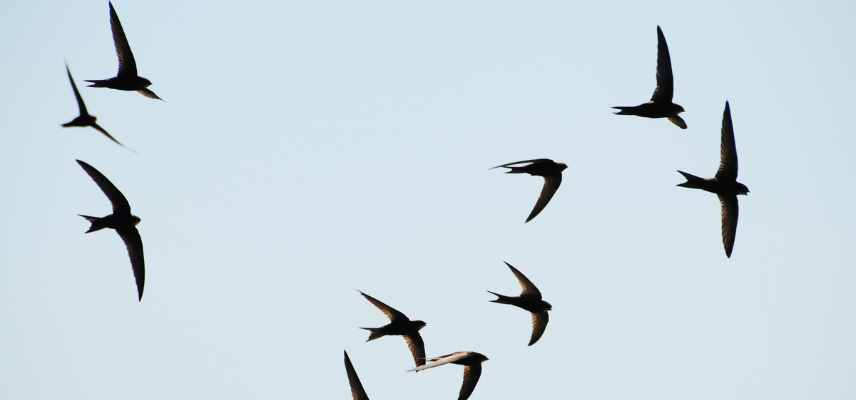
After the breeding season, swallows gather in groups of varying sizes, sometimes numbering in the hundreds. Before heading to Africa for wintering, they fatten up by consuming insects found in reed beds. Once their fat reserves are well stocked, they can finally embark on their long journey.
It is the lack of insects here that drives them to migrate to warmer climates. Subsequently, it is the competition from other bird species in Africa that prompts them to return to us to nest.
Food
Swallows are exclusively insectivorous. They generally feed at heights of 7 or 8 metres above the ground or shallow water. However, they also tend to follow animals, humans, or agricultural machinery to catch disturbed insects.
The Swallow also drinks while flying by scooping water in its open beak while skimming the surface.
Reproduction
Male Barn Swallows arrive at the breeding site first. To attract a female, they will fly in circles while singing. The longer the filaments (the tail feathers) are, a sign of good health and robustness, the more appealing the male will be to his mate.
The nest will be built near human dwellings (barns, bridges, stables) on the outside and sometimes on the inside for the Barn Swallow, but always on the outside for the Window Swallow, which can also nest on cliffs or in caves.
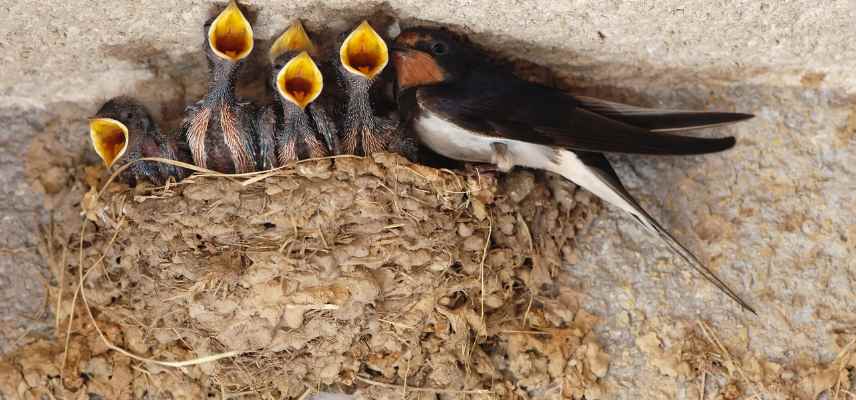
The nest of the Barn Swallow is a half-cup made from mud that the female shapes into small balls, then reinforces with grass or straw. In the case of the Window Swallow, the nest is a convex cup, almost closed, with only a small opening visible at the top.
The nest will be filled with feathers and down, after which the female will lay 4 or 5 small white eggs. Incubation lasts about twenty days, and the chicks can leave the nest after 18 to 23 days. There will be 2 broods during the summer, sometimes a third if there are enough insects.
Species in great danger
Swallows are protected species in many countries, including France and Belgium. Unfortunately, their population is declining each year. It is estimated that there has been a 40% loss of swallows in France over the past 20 years, compared to 20% in Belgium. In some regions of North America, there has been a 90% decrease in swallows since 1970.
The causes of this decline are numerous, and here are the main ones:
- reduction in the number of insects due to habitat loss and excessive use of insecticidal products
- poisoning from heavy metals and other pollutants through the consumption of insects
- climate change altering the climate, air currents, and certain mediums
- urban pollution
- reduction in the number of possible nesting sites, whether natural (caves, cliffs…) or artificial (modern human constructions that are incompatible)
- destruction of reed beds and drying up of water bodies
- and finally, poaching using nets, particularly in North Africa, is not negligible in the loss of migratory birds in general.
Read also
What do the birds in our gardens eat?What to do in the garden to help them?
Even on our small scale, we can try to help swallows a little.
- Attract insects to your garden with flowering plants, by allowing native plants to grow, by not mowing certain areas of your garden, by creating a small pond…
- Leave old swallow nests in place. The couple, which often returns to the same spot year after year, will be able to nest quickly and without tiring.
- In the same vein, you can install specific swallow nesting boxes in the right place (preferably shaded and protected from wind and rain).
- Swallows prefer to nest under overhanging eaves of a light colour. Consider refreshing these areas in winter with a coat of light, solvent-free paint.
- If possible, postpone roof repair work until after they have left.
- If you have the space, a pond will allow swallows to drink (and even feed) while in flight.
- Finally, leave clay in certain areas, or even a part of the soil bare if your soil is clayey, which will allow swallows to obtain the raw material for their nests without having to fly miles.
Please note: to avoid having your façade maculate with swallow droppings, you can fix a board 50 cm below the nest. Not any closer, otherwise this board will serve as a perch for predators…
- Subscribe!
- Contents
Comments