





























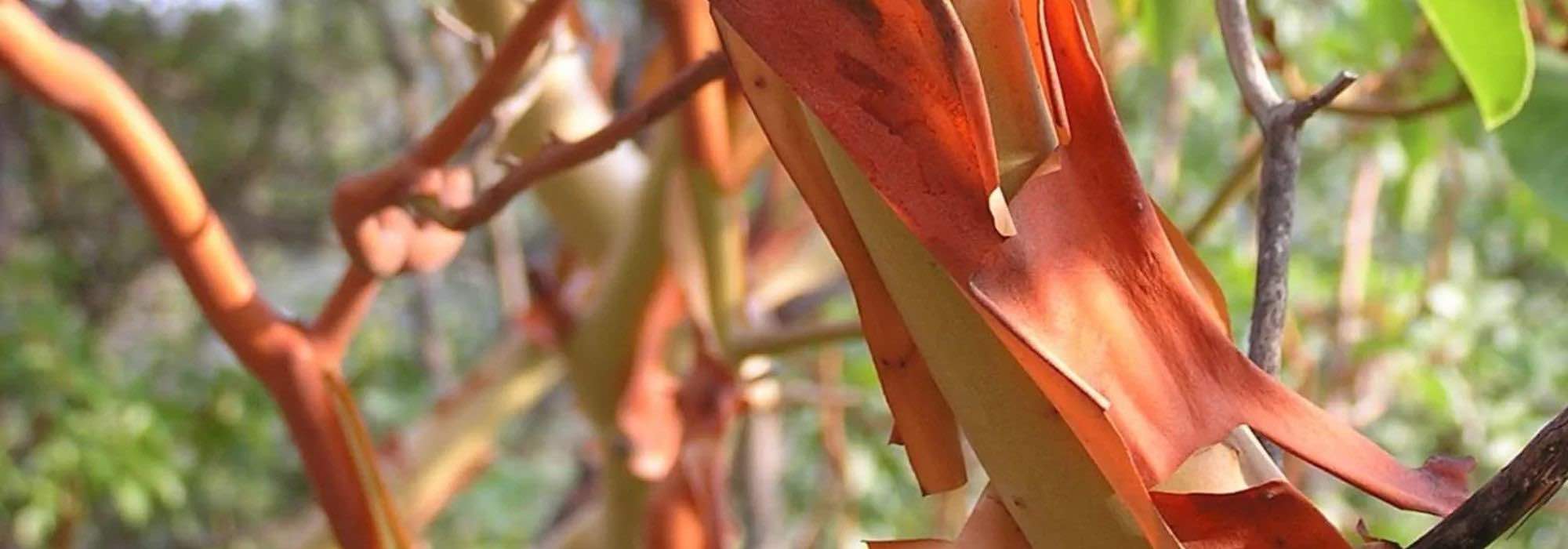
The best decorative wood bushes to brighten up winter
Species known for the aesthetics of their bark or branches
Contents
Winter is generally considered one of the least active times in the garden. It is true that many plants are in dormancy. However, many plants can add a splash of colour to warm up the cold season and make the atmosphere less dreary.
To achieve this, we immediately think of those bushes that brave the cold by flowering in winter, but why not also consider decoratively wooded shrubs? With their remarkably coloured or textured bark and branches, they show us that winter is far from uninteresting in the garden.
Discover here various species of bushes known for the ornamental quality of their wood, to bring an artistic and poetic touch to the garden.

Dogwoods – Cornus
In the large family of dogwoods, several species stand out due to their coloured wood. Clearly visible in winter, when the leaves have fallen and the garden is less rich in colours, they are perfect for adding animation. Under the sunlight or the effect of frost, they provide us with a true poetic touch.
These are shrubs known as “4 seasons”, as they indeed have the advantage of being ornamental throughout the year, whether through their nectariferous flowering, fruiting, the colours of their foliage, or their wood.
Among the decorative wood dogwoods, we can mention:
- the common dogwood, with its bright red stems;
- the yellow wood dogwood;
- the white dogwood, which also rewards us with bright red wood;
- the stoloniferous dogwood, always in the same reddening tones.
Each comes in numerous varieties, offering wood in shades of red, yellow, pink, or orange.
Robust, easy to care for, and low-maintenance, these shrubs are reliable choices for the garden.
To learn more about growing dogwoods, discover our guide Dogwood, decorative wood cornus: planting and pruning
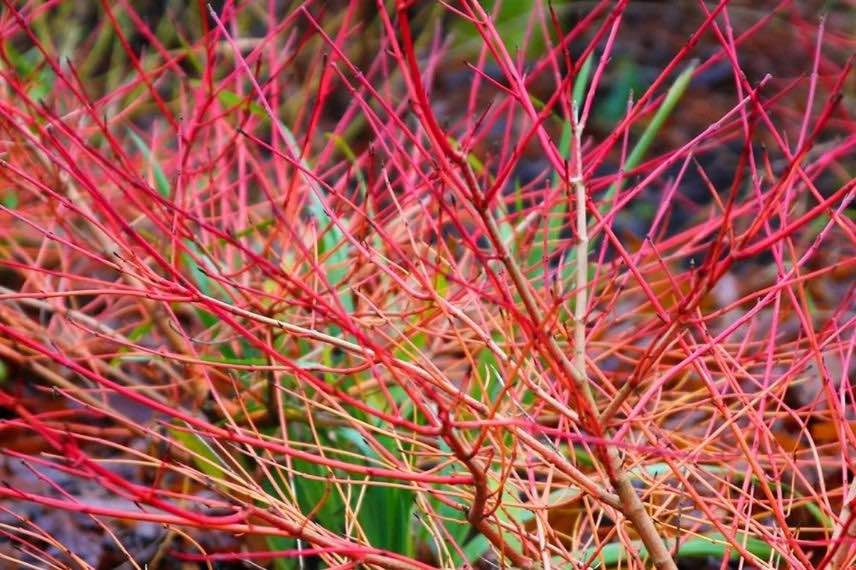
Cornus sanguinea
Eucalyptus
Eucalyptus is best known for its beautiful evergreen and aromatic foliage, but its bark is equally interesting. Often coloured, it has the unique ability to exfoliate in strips, creating a play of textures and shades that is particularly ornamental.
The most iconic species is the magnificent Eucalyptus deglupta, commonly known as the Rainbow Eucalyptus, whose bark resembles a true painting. However, it is best suited for gardens that do not experience winter frosts and for large spaces: it is, in fact, a massive tree capable of reaching nearly 70 metres in height.
For more modest-sized species, let’s mention the snow gum, with its young red shoots contrasting with the white bark. The Eucalyptus saxatilis or rock mallee has bark with variable colours, ranging from cream to grey, including coppery beige or salmon pink, sometimes greenish. The small silhouette of the varnished gum ‘Mt Hart’ (Eucalyptus vernicosa) fits into any garden, measuring 1 metre in all directions. This variety features silvery grey shoots that become nodose with age, making them very original. The bark also takes on a silver coffee brown colour. Finally, let’s mention the Eucalyptus apiculata or narrow-leaved mallee, whose bark exfoliates to reveal a lovely terracotta colour.
Easy to grow, these trees or bushes can tolerate poor soils, drought, or excess water, depending on the species. They undoubtedly add a touch of exoticism to the garden.
To learn more about growing eucalyptus, discover our guide Eucalyptus: planting, pruning, and care
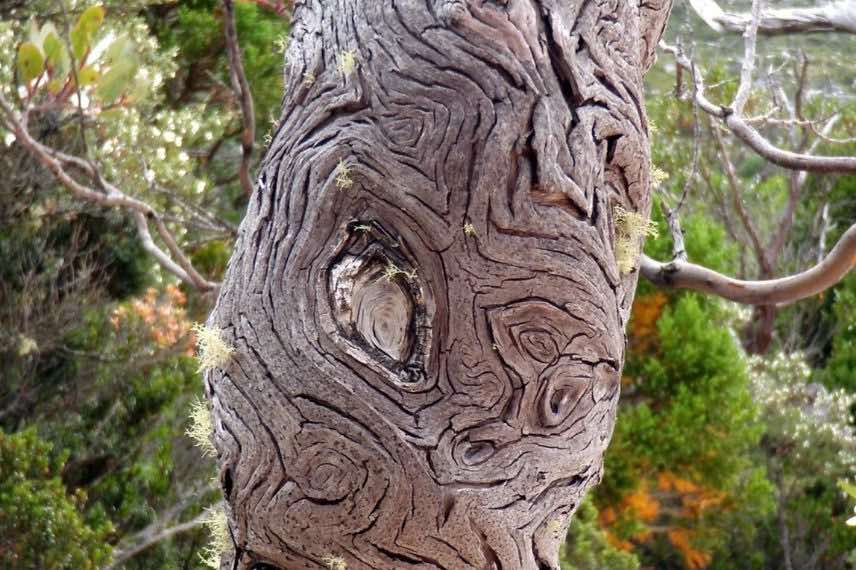
Eucalyptus vernicosa ‘Mt Hart’
Maples – Acer
Maples reward us with typical palmate foliage that takes on vibrant colours in autumn. These trees and bushes are quite common in gardens due to their many qualities.
But some species also stand out for their decorative bark, reminiscent of snake skin or appearing layered. This is the case with the Acer davidii ‘Viper’ or David’s maple, featuring a trunk marbled in green and white. The Pennsylvania maple also has bark striped in green and white. For its part, the Acer griseum has cinnamon-brown bark that exfoliates as it ages. Let’s also mention the Japanese maple, with its bright coral-red bark in winter.
Once again, these are relatively easy-going plants that thrive in a temperate, rather cool to humid climate.
To learn more about cultivating maples, discover our guide Maples: planting, pruning, and care.
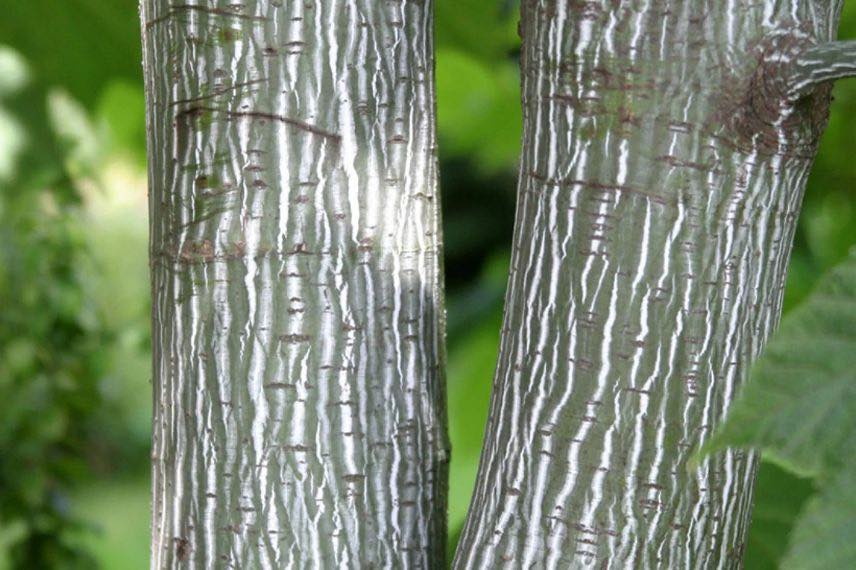
Acer pennsylvaticum
Read also
The most beautiful barksStrawberry trees – Arbutus
Strawberry trees combine ornamental qualities and remain beautiful all year round. They have evergreen foliage that is decorative in every season. Their flowering, with delicate bell-shaped blooms reminiscent of lily of the valley, coincides with a colourful fruiting in the form of berries, which are edible, although not always very tasty.
And to top it all off, they can also have an interesting bark. Scaly, it exfoliates with age, as seen in the Arbutus unedo. This is also true for the Arbutus andrachne, or Cyprus strawberry tree, with its twisted silhouette and astonishing smooth and shiny bark, blending orange-red and pistachio green. It constantly changes as it exfoliates in patches, which are even shinier when the atmosphere is humid. A spectacle that is ever-renewing.
These are shrubs suited to mild climates, low-maintenance, and can be planted in the garden or in pots.
To learn more about growing strawberry trees, check out our guide Strawberry tree, Arbutus: planting, pruning, and maintenance tips.
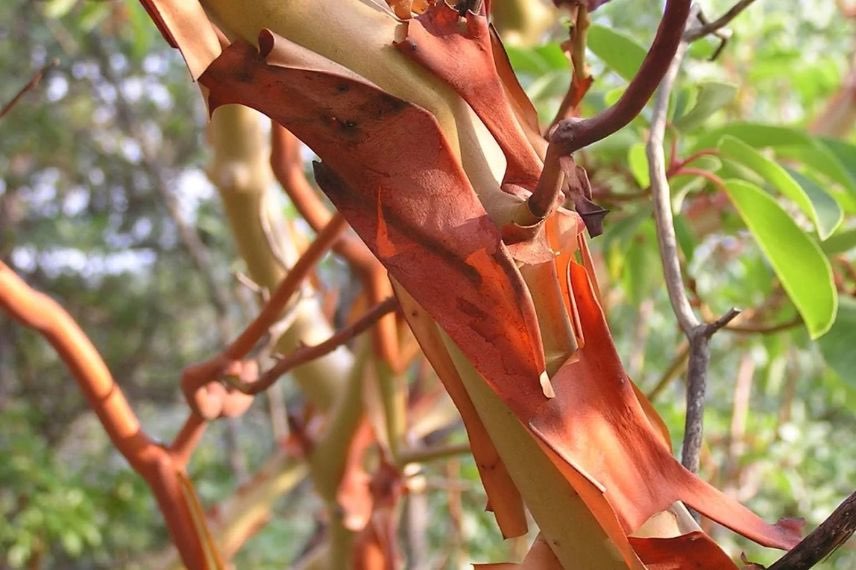
Arbutus andrachne
Birches – Betula
Very common in our territory, birches are recognised by their graceful silhouette and bright white bark, which adds brilliance in winter. Over time, it exfoliates in textured strips, in bronze-gold, pink, or even orange hues.
Birches adorn both roadsides and gardens. Their light foliage, which provides some shade and changes colour in autumn, along with their decorative aments, are also part of their appeal.
Among the species we particularly admire for their bark, we can mention the Himalayan birch (Betula utilis var. jacquemontii), which boasts pure white bark. We should also mention Betula pendula ‘Royal Frost’: its chocolate-purple foliage contrasts beautifully with the immaculate white wood, which exfoliates with age.
This tree adapts to all types of gardens in cool climates.
To learn more about birch cultivation, discover our guide Birches: planting, pruning, and maintenance.
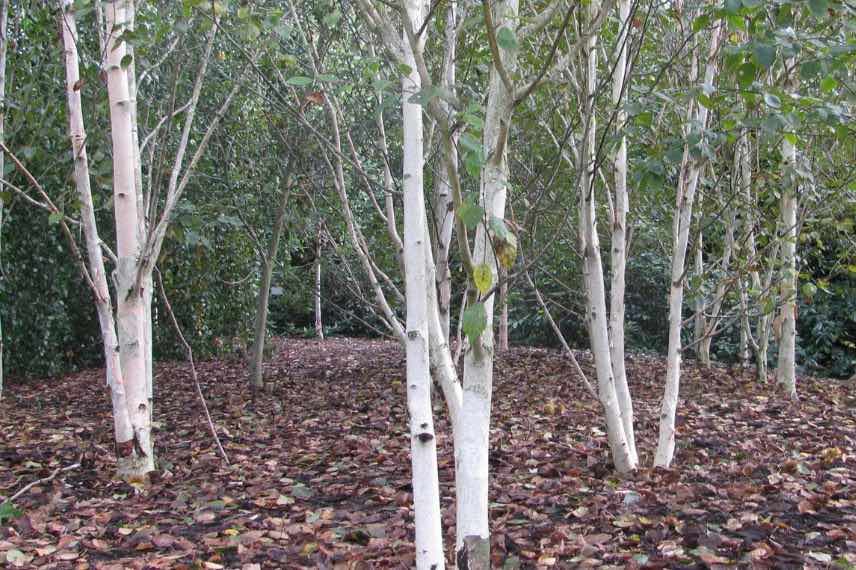
Himalayan birch
Japanese cherry trees or ornamental cherries – Prunus
Among the Prunus, it is primarily the early and generous spring flowering that constitutes the main decorative asset. However, they are also interesting for their foliage, which changes colour throughout the seasons, taking on beautiful red and orange hues in autumn.
The bark is not to be overlooked: smooth, marked with horizontal striations and lenticels (types of pores), it is also decorative in winter. The bark of the Prunus serrula or Tibetan cherry is certainly one of the most remarkable, with its very shiny caramel or mahogany colour. Over time, it peels off in long horizontal strips that twist upon themselves.
In the case of Prunus maackii or Manchurian cherry, it is glossy, with an amber to coppery hue. Let’s also mention the astonishing Prunus rufa or Himalayan cherry, with its shiny reddish-brown bark that has amber reflections, displaying a ring pattern on the trunk. It slightly exfoliates with age.
To learn more about cultivating Japanese cherries, discover our guide Japanese Cherry Trees: planting, pruning, and caring for.
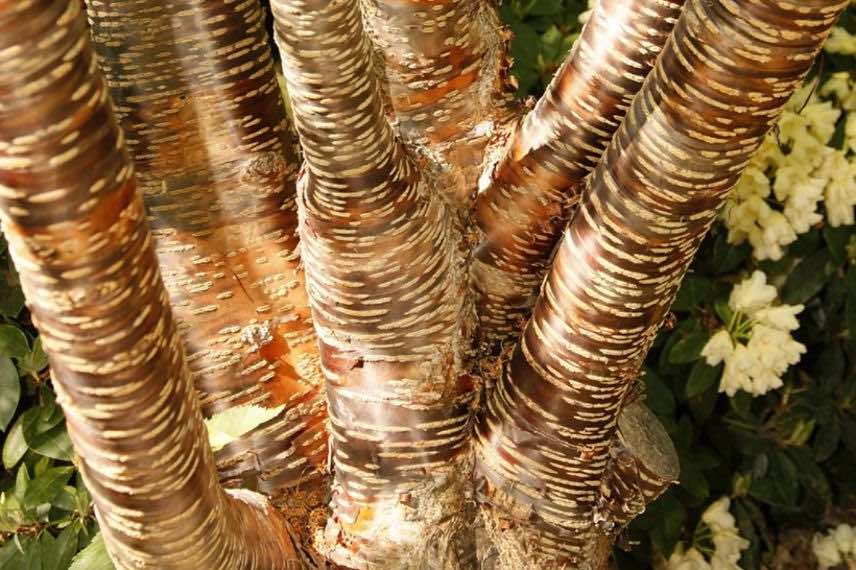
Prunus rufa
Willows - Salix
The bark of willow is known to have given rise to one of the most well-known synthetic medicines: aspirin. Its branches are also prized in basketry. But its wood can also be very decorative.
In the case of the purple willow, the branches are tinted with shiny red, making them particularly ornamental in winter. The same goes for the charming shrimp willow, which is sure to attract attention during the cold season. For its part, the golden willow produces branches of a warm, shiny coppery yellow. The white willow prefers grey-pink and pubescent branches when young. The variety ‘Golden Ness’ displays a beautiful coppery yellow. Finally, let’s mention the twisted willow ‘Caradoc’, with its astonishing spiralled branches in bright green to yellow: a true work of art!
Willows exhibit a great diversity of species, distinguished notably by their silhouette. Hardy and easy to care for, they thrive in fresh to waterlogged soil.
To learn more about growing willows, discover our guide Willow, Salix: plant, prune and maintain.
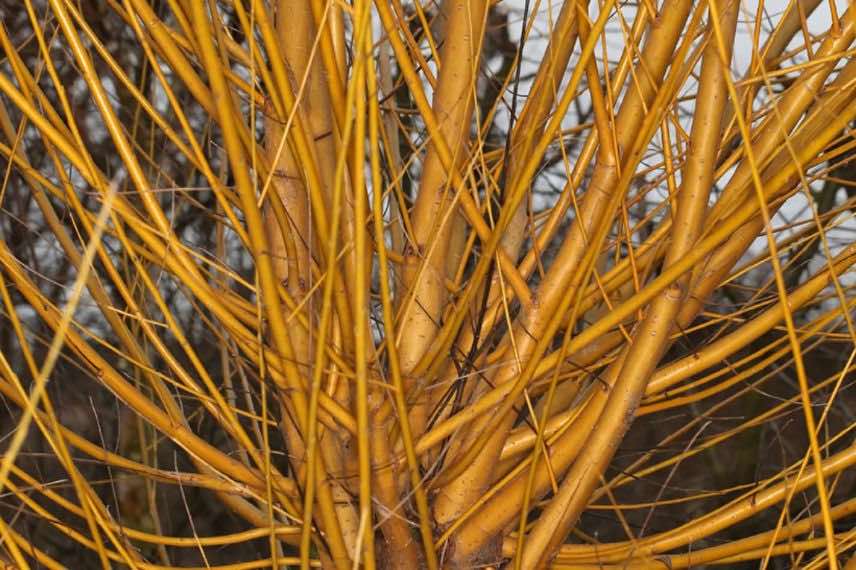
Salix alba ‘Golden Ness’
Bamboos
Graphical, elegant, and perfect for adding a zen and exotic touch to the garden, bamboos are always very popular. Their evergreen foliage provides a soft and relaxing sound when rustled by the wind. Their culms (the equivalent of the trunk), are already decorative, thanks to their shape and ringed pattern. However, some species go even further, offering particularly colourful wood.
Among them, we can mention:
- the Fargesia papyrifera ‘Blue Dragon’, with its stunning steel-blue culms;
- the Phyllostachys nigra featuring its surprising ebony-black canes;
- the Phyllostachys vivax ‘Aureocaulis’, with its yellow-ochre canes striped with green;
- the Fargesia nitida ‘Red Dragon’, with culms turning burgundy red;
- the Phyllostachys aureosulcata ‘Aureocaulis’, featuring bright yellow canes that turn pink or red in the sun.
Resilient, hardy, and easy to maintain, these are fast-growing plants. Note that Phyllostachys are running bamboos that can become invasive, while Fargesia are non-running. Choose carefully according to your garden and growing conditions.
To learn more about bamboo cultivation, discover our guide: Bamboos: planting, pruning, maintaining
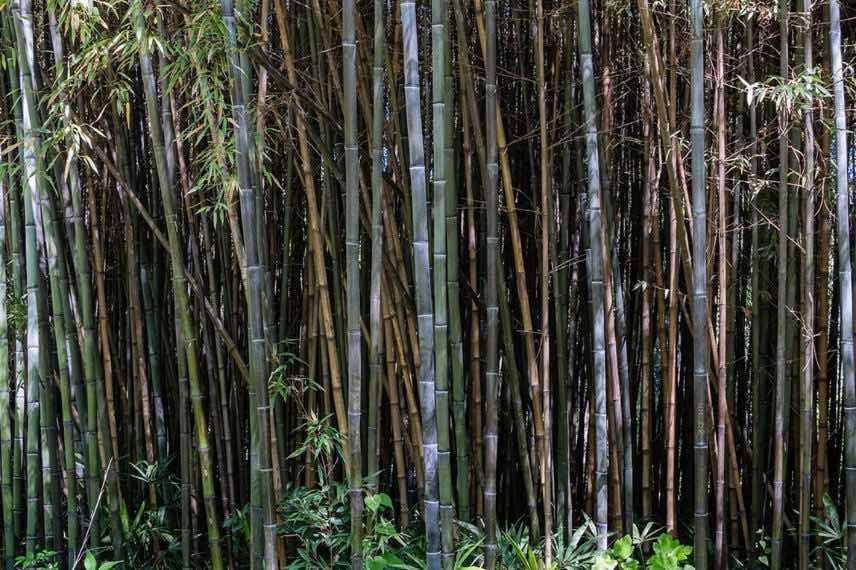
Phyllostachys nigra
- Subscribe!
- Contents

Comments