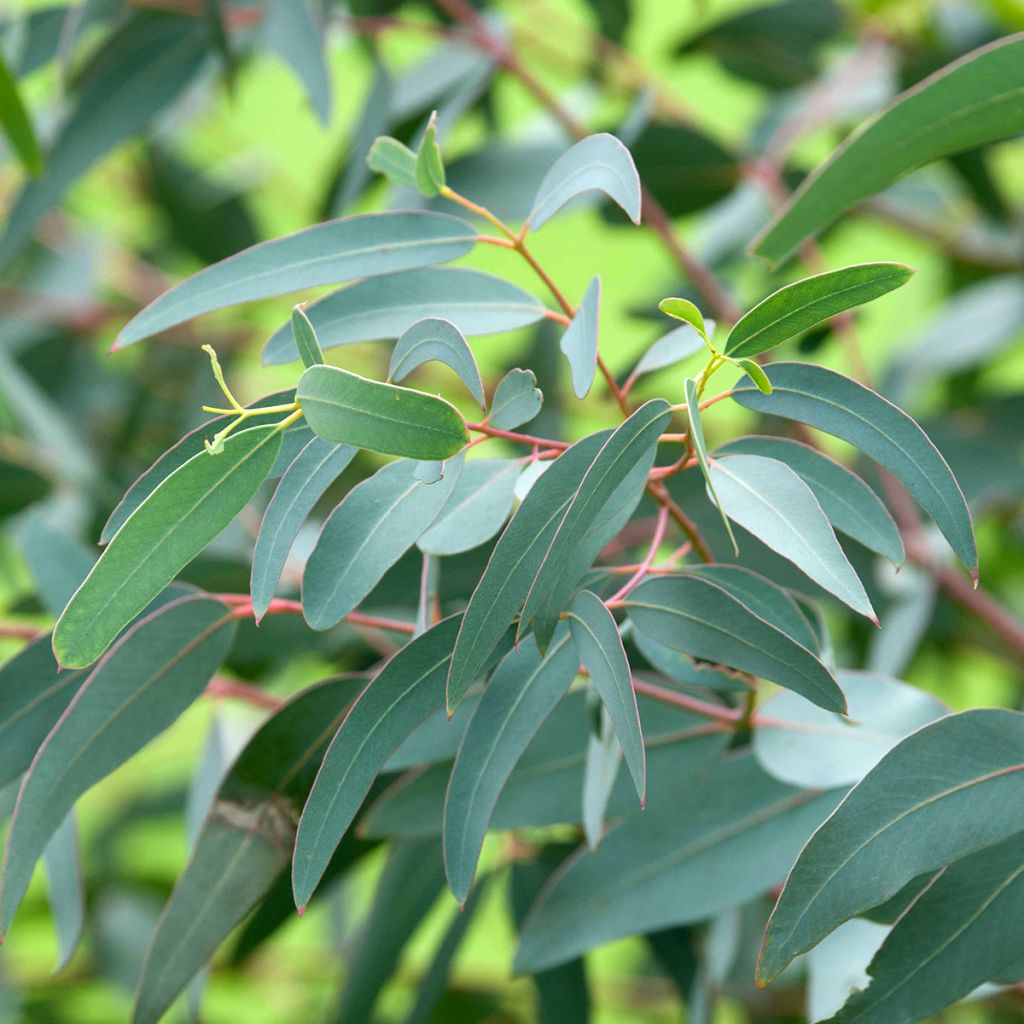
Eucalyptus saxatilis
Eucalyptus saxatilis
Eucalyptus saxatilis
Back-to-school special offer!
Get €10 off for every €50 you spend! And get up to €40 off on a single order.
How does it work?
1. Shop your favourites
Add your favourite plants to your basket. For every €50 you spend (excluding delivery charges, store credit and the plastic-free option), you’ll receive a €10 voucher.
€50 spent = €10 voucher
€100 spent = €20 voucher
€150 spent = €30 voucher
€200 spent = €40 voucher
2. Place your order
Once your basket reaches one of the spending thresholds, place your order. You can even choose your delivery date!
3. Receive your voucher
As soon as your order has been shipped, you’ll receive an email containing your personal voucher code and its value.
4. Use it on your next order
Your voucher is valid for 90 days from the date you receive it. It can be used once only, on a new order worth at least the value of the voucher, excluding delivery charges.
Please note: Vouchers can be combined with other offers, but cannot be split or refunded.
Why not try an alternative variety in stock?
View all →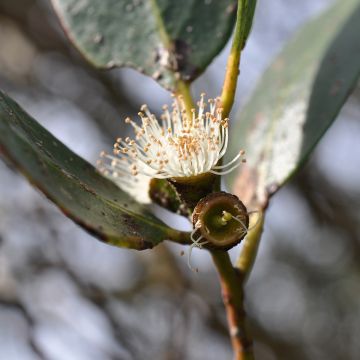
Available in 1 sizes
Available in 5 sizes
Available in 1 sizes
Available in 1 sizes
Available in 3 sizes
Available in 1 sizes
Available in 1 sizes

Available in 3 sizes
Available in 2 sizes
Available in 1 sizes
This plant carries a 24 months recovery warranty
More information
We guarantee the quality of our plants for a full growing cycle, and will replace at our expense any plant that fails to recover under normal climatic and planting conditions.
Does this plant fit my garden?
Set up your Plantfit profile →
Description
Eucalyptus saxatilis, or Rock Eucalyptus, is a species native to a small area of southern Australia. With limited growth, it generally forms a bush of a few metres high, sometimes a small tree. It has an airy habit, with several thin trunks starting from the ground and supporting moderately dense branches. Its bark is particularly decorative and takes on different hues depending on the plant, in light cream or grey tones, or coppery beige to salmon pink, and occasionally green. Its evergreen blue-grey to blue-green foliage is also ornamental all year round. It produces rather insignificant flowers in the form of small white pompoms. A rare species, interesting for small gardens, and quite hardy.
This plant belongs to the large Myrtaceae family, which includes about 130 genera with many common characteristics. Mostly originating from tropical or warm temperate climates, they are rich in essential oils and often have very ornamental flowers, some being decorative mainly because of their very colourful and protruding stamens. The Eucalyptus saxatilis, like the vast majority of the 800 species of this genus, is native to Australia. It is confined to a very limited area in the state of Victoria, in the far south of Australia, facing Tasmania, and to a few places in the neighbouring state of New South Wales. This Eucalyptus grows in fairly rocky environments, in a temperate zone, dominated by mild to hot summers, and fairly cold winters. These characteristics make it quite easy to acclimate, especially due to its good hardiness, estimated at around -12°C, or a little less, for a well-established plant.
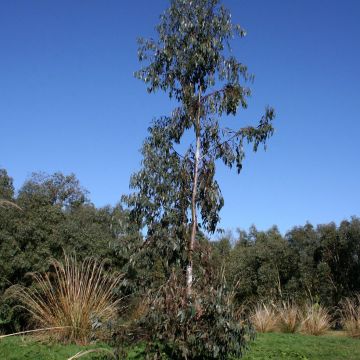
Eucalyptus saxatilis is part of the "mallee" group (it is nicknamed Suggan Buggan Malle, or Mount Wheeler Malle). This term designates plants with a bushy habit, less than 10 m (32 ft 10 in) high, within a genus that includes giants reaching 100 m (328 ft 1 in) in height (like E. regnans). This Eucalyptus forms a bush of about 5 m (16 ft 5 in) high by 3 m (9 ft 10 in) wide, often looking a bit ungainly in nature. Occasionally, it can also take on the appearance of a tree with multiple trunks of small diameter, with very decorative bark. Depending on the plant, this can be pale grey or cream-white, with a slightly powdery texture, or coppery tones, even salmon pink, or greener shades. This plant has a significant regeneration capacity thanks to its lignotuber. This is an underground swelling rich in starch, capable of producing numerous shoots if the above-ground part of the plant is destroyed (typically by a fire). The regrowth is denser than the original plant after this. This characteristic, possessed by several Eucalyptus, is particularly interesting from an ornamental point of view, as it allows severe pruning, which limits the development of the plant, and makes it branch well, which is particularly valuable when the bark is aesthetic.
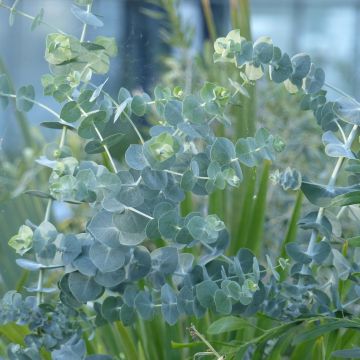
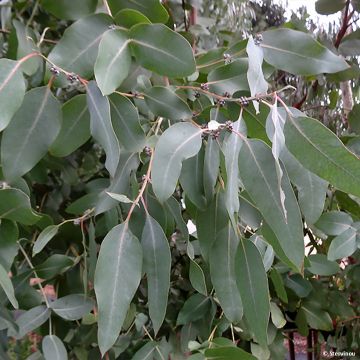
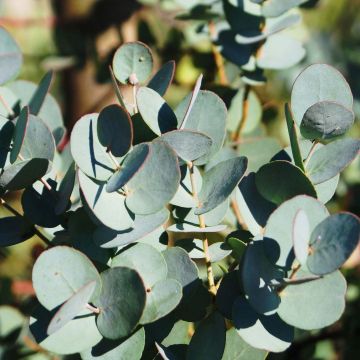
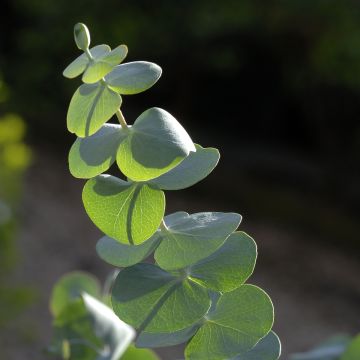
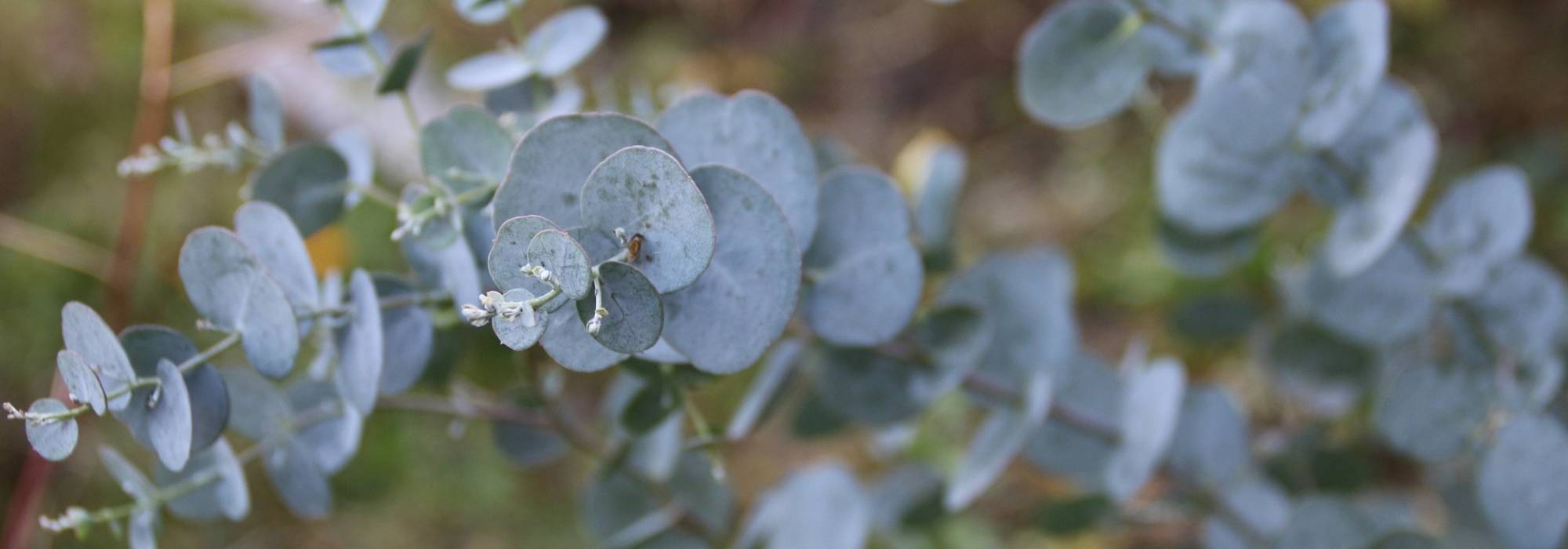
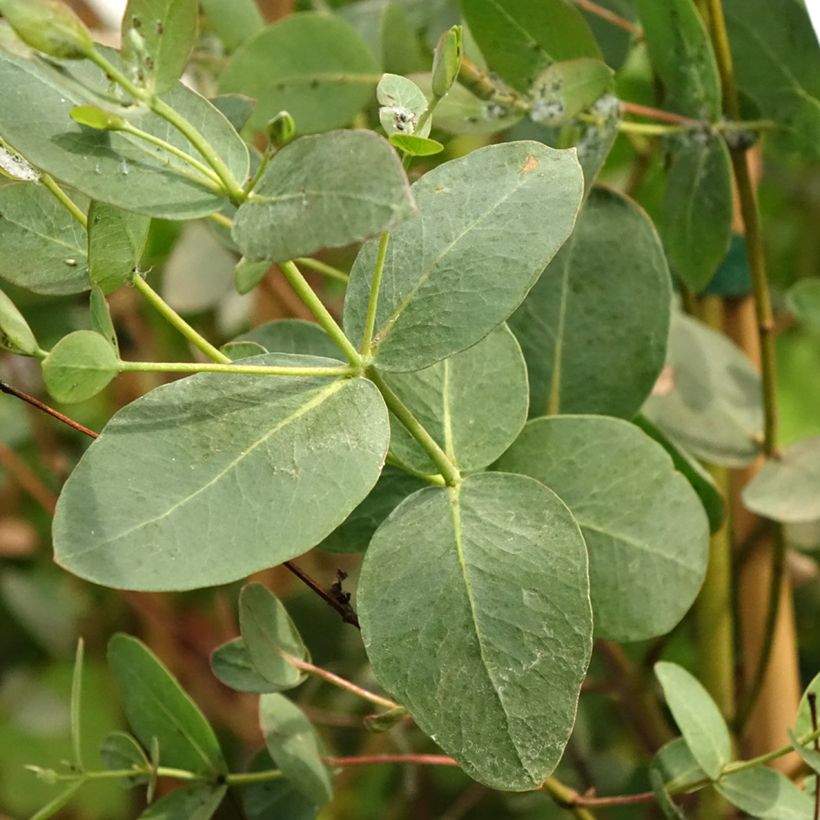
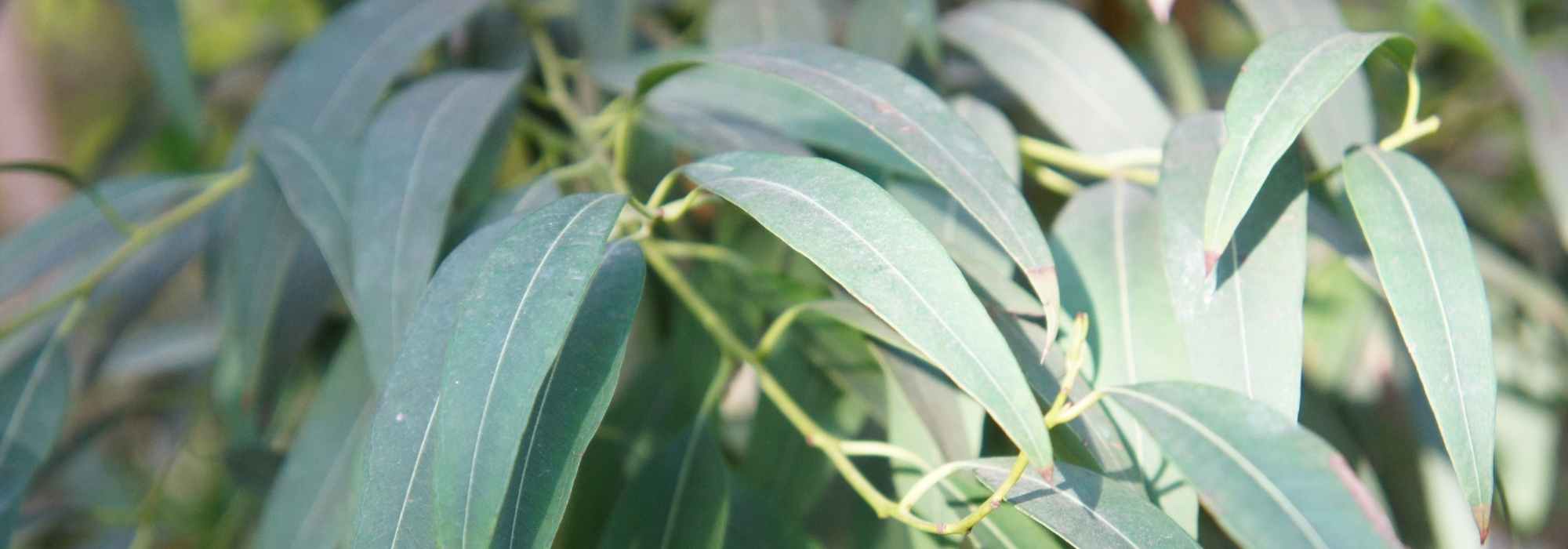
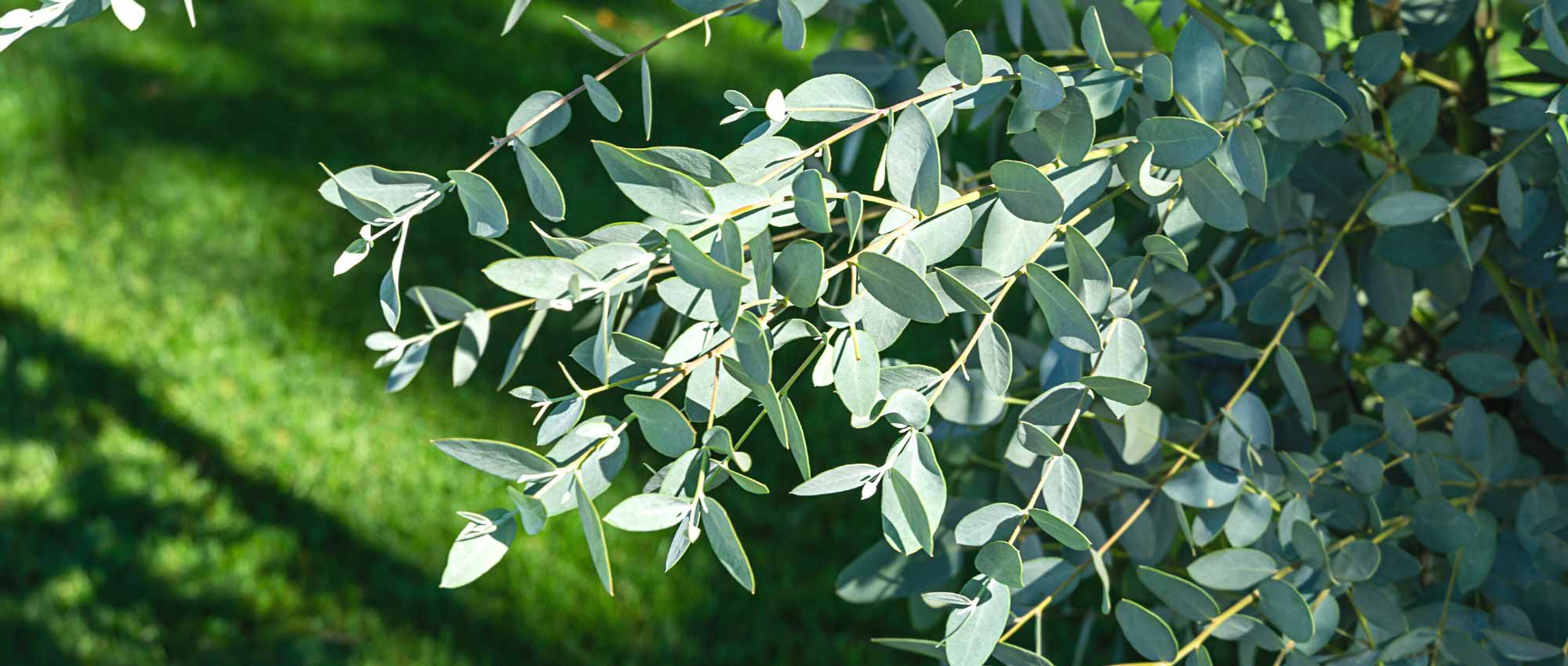
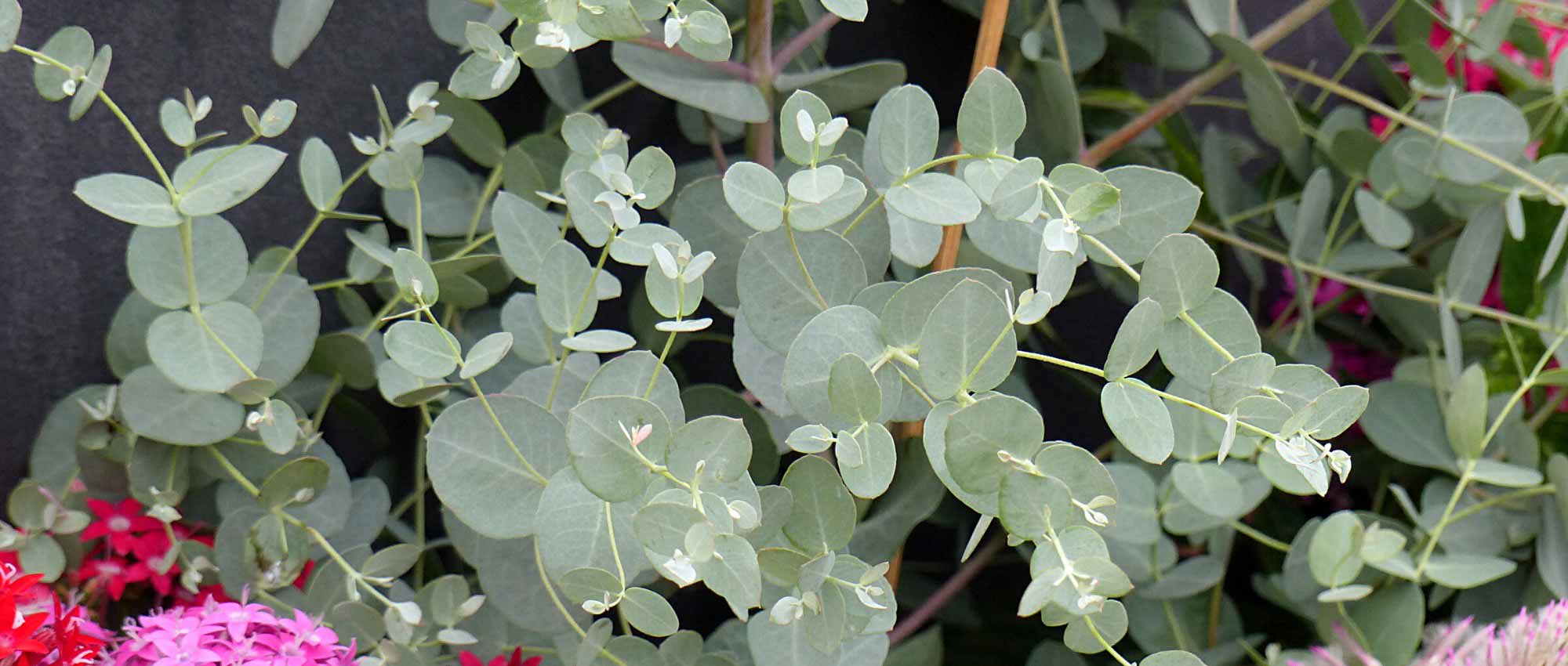
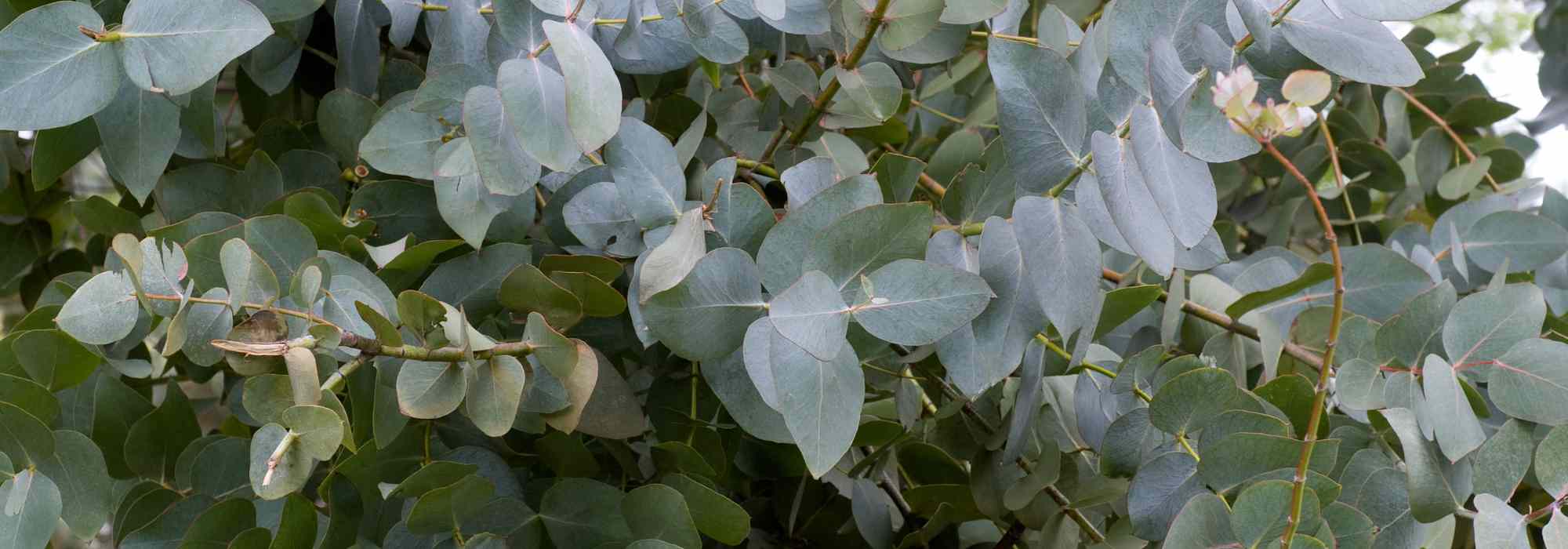
The evergreen foliage is very attractive with its bluish-grey or blue-green hue with juvenile foliage, consisting of small orbicular to elliptical leaves, 3.5 cm (1.4 in) long by 2.7 cm (1.1 in) wide, or even less and beautiful glaucous green, these sessile leaves are opposite, giving a very decorative aspect to the branches. The adult foliage is very different in appearance, with elongated, lanceolate to crescent-shaped leaves, much larger, up to 20 cm (7.9 in) long by 2 cm (0.8 in) wide. They are also petiolate and arranged alternately on the branches. They contain essential oil glands and are aromatic when crushed.
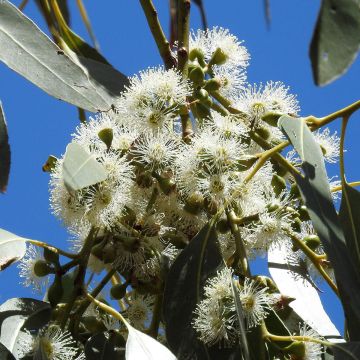
The insignificant flowering usually takes place in late summer, but this can vary depending on the climate and the plants. The floral buds are grouped by 3 in umbels making small white pompoms about 1 cm (0.4 in) in diameter, followed by equally insignificant fruits.
This Eucalyptus withstands summer heat and winter cold. Above all, it needs very well-drained soil, not tolerating excess water. Otherwise, it is not demanding about the nature of the soil, which can be neutral, acid and even moderately chalky. While it prefers moist soils, it can withstand dry periods once well established. Like its relatives, it should be planted in a sunny exposure.
Eucalyptus saxatilis is a rare species that deserves attention due to its ornamental qualities and adaptation capacities. It is a plant with low growth, which can find a place in gardens, even small ones in most regions. Decorative mainly for its beautiful bark and foliage, this exotic-looking bush will match many other plants to create an exotic scene in the garden. You can play with the contrast of foliage, planting it next to purple plants, like Cercis canadensis Merlot, a Canadian Judas tree that produces a superb pink flowering on the branches and trunk, before the cordate red leaves appear, then purple in season. Albizia julibrissin Summer Chocolate, with its very cut-out foliage, in purple and chocolate tones, and its tropical-looking pink pompom flowering, will also be an excellent companion. And to add a touch of gold, think of Choisya ternata Sundance, with its beautiful cut-out foliage, yellow in spring, then turning to tender green.
Eucalyptus saxatilis in pictures
Plant habit
Flowering
Foliage
Planting and care
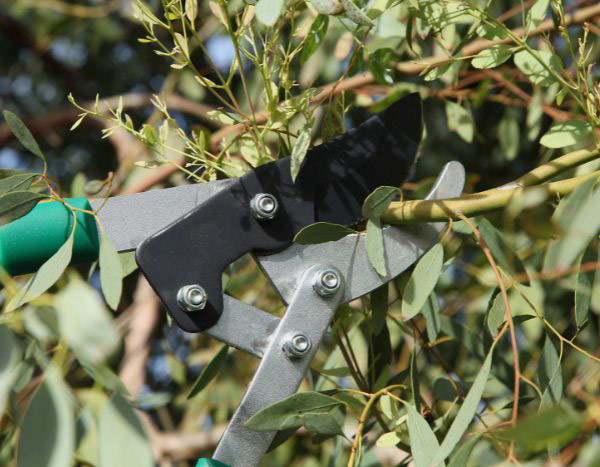
Eucalyptus saxatilis is best planted at the beginning of autumn, in a mild climate, or at the beginning of spring, after the last frosts, in slightly harsher areas (it can withstand frost down to about -12°C (10.4 °F)). It grows in soils that are well-drained, but preferably moist. This species is fairly tolerant of the chemical nature of the soil, even tolerating a bit of limestone. Like most species, it will grow better in a sunny exposure. Water well at planting, then regularly for the first two years, especially in dry weather. Once well-rooted, this Eucalyptus can withstand dry spells. No need for pruning, but the young plant tolerates pruning very well after 3 or 4 years of cultivation, which allows for a more branching bush.
Planting period
Intended location
Care
Planting & care advice


This item has not been reviewed yet - be the first to leave a review about it.
Recently viewed products
Haven't found what you were looking for?
Hardiness is the lowest winter temperature a plant can endure without suffering serious damage or even dying. However, hardiness is affected by location (a sheltered area, such as a patio), protection (winter cover) and soil type (hardiness is improved by well-drained soil).
In temperate climates, pruning of spring-flowering shrubs (forsythia, spireas, etc.) should be done just after flowering.
Pruning of summer-flowering shrubs (Indian Lilac, Perovskia, etc.) can be done in winter or spring.
In cold regions as well as with frost-sensitive plants, avoid pruning too early when severe frosts may still occur.
The harvesting period indicated on our website applies to countries and regions in USDA zone 8 (France, England, Ireland, the Netherlands).
In colder areas (Scandinavia, Poland, Austria...) fruit and vegetable harvests are likely to be delayed by 3-4 weeks.
In warmer areas (Italy, Spain, Greece, etc.), harvesting will probably take place earlier, depending on weather conditions.
The sowing periods indicated on our website apply to countries and regions within USDA Zone 8 (France, UK, Ireland, Netherlands).
In colder areas (Scandinavia, Poland, Austria...), delay any outdoor sowing by 3-4 weeks, or sow under glass.
In warmer climes (Italy, Spain, Greece, etc.), bring outdoor sowing forward by a few weeks.
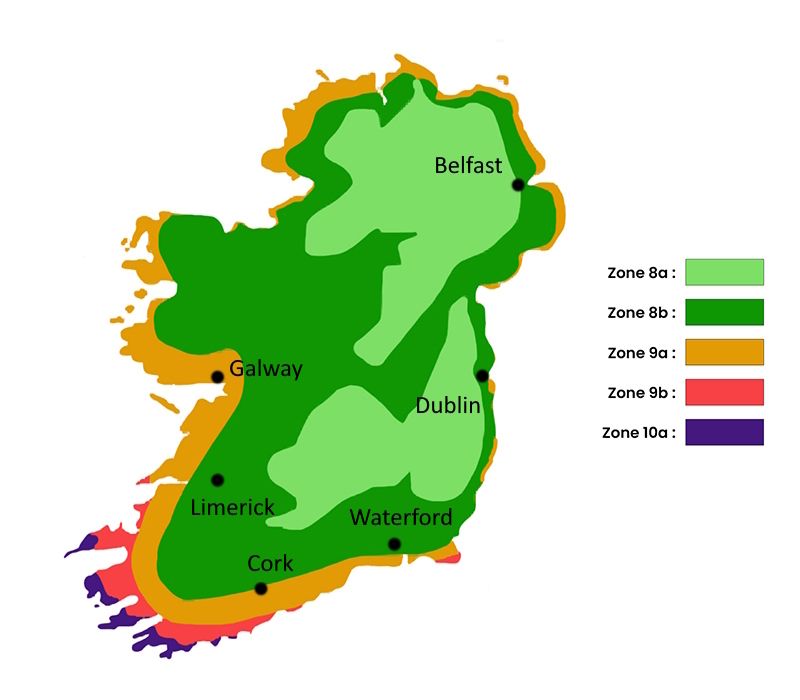
The planting period indicated on our website applies to regions in USDA Zone 9a (East Coast and Midlands: Dublin, Wexford, Waterford, Kilkenny, Portlaoise). It will vary depending on where you live:
- On the west coast and in the north-west (Galway, Limerick, Sligo, Donegal, Westport), delay planting by 1 to 2 weeks in spring and bring it forward by 1 to 2 weeks in autumn compared to the dates given, preferably choosing periods without strong winds.
- In the inland hills and plateaus (Wicklow Mountains, Macgillycuddy’s Reeks, Connemara, Killarney), it is best to plant in spring (April–May) or autumn (September–October), avoiding periods of waterlogged soil in winter and strong winds, which pose the main risk to newly planted trees in these areas.
The flowering period indicated on our website applies to regions in USDA Zone 9a, such as the East Coast and Midlands, including Dublin, Wexford, Waterford, Kilkenny and Portlaoise.
This will vary depending on where you live:
- On the west coast and in the northwest (Galway, Limerick, Sligo, Donegal and Westport), it will be delayed by one to two weeks compared to the given dates, due to stronger Atlantic winds and less spring sunshine.
- In the inland hills and plateaus (the Wicklow Mountains, the Macgillycuddy's Reeks, Connemara and Killarney), flowering will be delayed by two to three weeks. Flowering mainly occurs between May and July, with the limiting factors being less frost and more of the excessive humidity, strong winds and lack of sunshine that are characteristic of these areas.
Shipping country and language
Your country of residence may be:
Your country of residence is:
For a better user experience on our website, you can select:
Your shipping country:
-
 Austria
-
 Belgium
-
 Bosnia & Herzegovina
-
 Bulgaria
-
 Croatia
-
 Cyprus
-
 Czechia
-
 Denmark
-
 Estonia
-
 Finland
-
 France
-
 Germany
-
 Greece
-
 Hungary
-
 Iceland
-
 Ireland
-
 Italy
Italy
-
 Latvia
-
 Liechtenstein
-
 Lithuania
-
 Luxembourg
-
 Malta
Malta
-
 Netherlands
-
 Poland
-
 Portugal
-
 Romania
-
 Serbia
-
 Slovakia
-
 Slovenia
-
 Spain
Spain
-
 Sweden
-
 Switzerland
Language:
-
French
-
 English
-
Spanish
-
Italian
-
German
-
Portuguese
-
Dutch
-
Finnish
My Account
Hello
My wish lists
My cart
Log in / Register
Existing customer?
This form is protected by reCAPTCHA - the Google Privacy Policy and Terms of Service apply.
New customer?
Create an account to track your orders, access our customer service and, if you wish, make the most of our upcoming offers.