





























Perennials that withstand root competition
Which perennials to plant under trees?
Contents
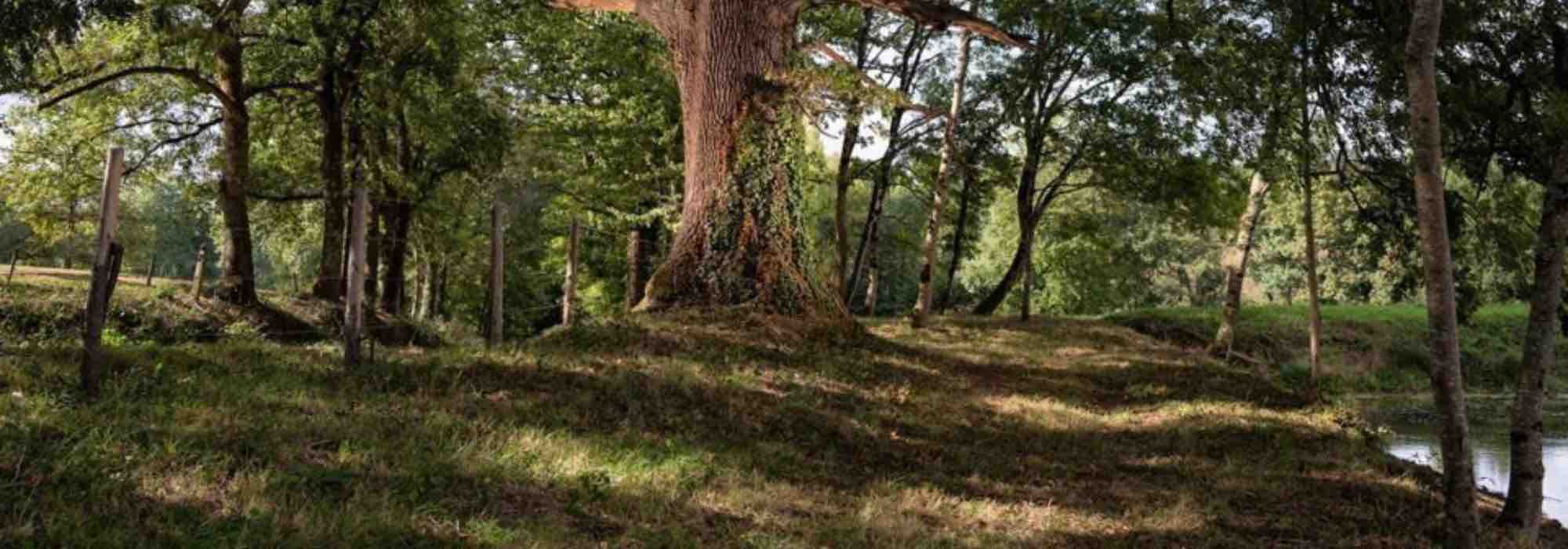
You may have noticed that not much grows under a tree; it’s too dark for the lawn, and you might spot a few adventive plants or grasses, but few deliberately planted ones thrive there. Indeed, the soil in this area is quite inhospitable: the tree develops powerful roots that offer little space and compromise, drawing up the available water and nutrients. Who would want to settle here? Surprisingly, a few plants, and in this article several perennials accept the conditions of this cohabitation contract, albeit to their disadvantage. They sometimes have a colonising temperament and are certainly not fussy about soil type and light conditions. Some can tolerate very dense shade, while most prefer a semi-shaded position, sheltered from the sun’s most intense rays. This doesn’t prevent them from having beautiful ornamental qualities, particularly in their foliage, which is often evergreen and dense, leaving little room for the development of adventive plants. A few also produce lovely flowers, just to add to the charm!
Discover a selection of perennials with a conquering or laid-back temperament, ready to accompany you where nothing else grows.
→ Also check out our article: Perennials for dry shade

Euphorbia amygdaloides var. robbiae
Euphorbia amygdaloides var. robbiae is a form of Spurge that thrives in woodlands, unlike most Euphorbias that prefer full sun. It develops beautiful, elegant, and graphic evergreen foliage, dark green and glossy, on a compact, rounded clump. Its spring flowering features acid green inflorescences that are very bright in shade or partial shade. It spreads via particularly vigorous running rootstocks. This is an advantage in challenging conditions for other plants, but it’s also good to know if you don’t want it popping up everywhere in a border, for example: you’ll need to monitor and limit its spread if it is near many other plants. This perennial tolerates even prolonged drought and dense shade: conditions that are often limiting for other plants. It can therefore grow under a tree or an evergreen bush, which allows little light to pass through and dries out the soil due to its significant roots, just as it keeps the nutrients for itself.
If you are concerned about the vigour of this beautiful Spurge, the Euphorbia amygdaloides ‘Purpurea’ is a less invasive variety, with purple foliage that contrasts nicely with the chartreuse flowers. It grows in the same conditions but is less vigorous if space is limited. Additionally, it tolerates sun. In summary, for a space in dry or moist shade, or partial shade, or in sun for the purple version, the Wood Spurge is a valuable ally.
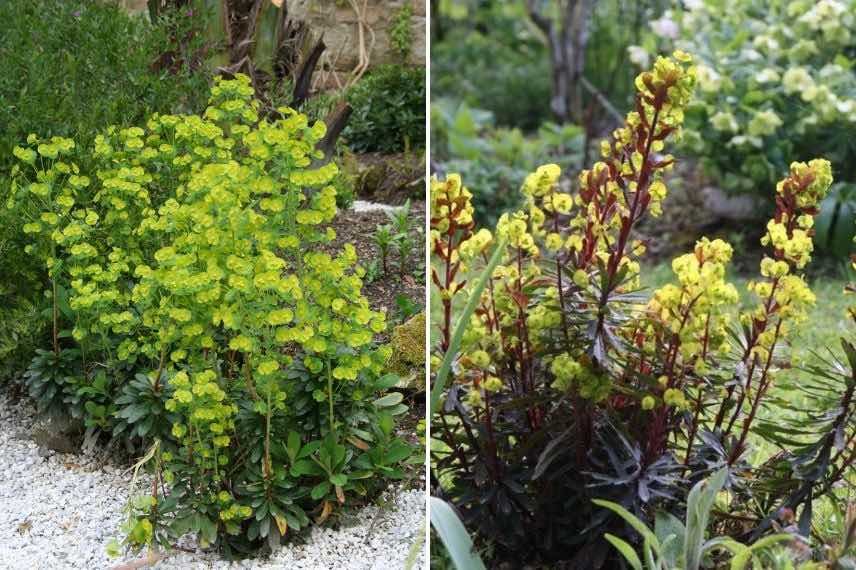
Euphorbia amygdaloides var. robbiae and ‘Purpurea’
Read also
Gardening in dry shadeLesser periwinkle or Vinca minor
If there is one perennial that tolerates shade, tree roots, and dry soil, it is the Periwinkle. Forming a low carpet, with no theoretical limit, the Vinca minor or lesser periwinkle spreads vigorously through its stolons and creates a dense cover of small, dark green, glossy evergreen foliage. While it flowers less in dense shade, it still blooms once or twice a year, in spring and autumn for some varieties, and is very floriferous in partial shade. It also tolerates sunny exposure and drought, but it is best not to combine these conditions! Its preferred exposure is indeed partial shade, and it tolerates drought better in shade or partial shade. It is not fussy about soil richness and does not fear lime.
Here too, if you mix it with other, more timid perennials, and hope it stays neatly in its place, it may not be the plant to choose. In the challenging conditions of tree bases, you need plants of great vigour. So, one must also be aware of their tendency to spread and their tenacity. Many varieties exist, with variegated foliage like ‘Ralph Shugert’ or ‘Argenteovariegata’, with white or purple flowers in addition to the periwinkle blue. For an extra boost of light, choose variegated foliage or white flowering varieties.
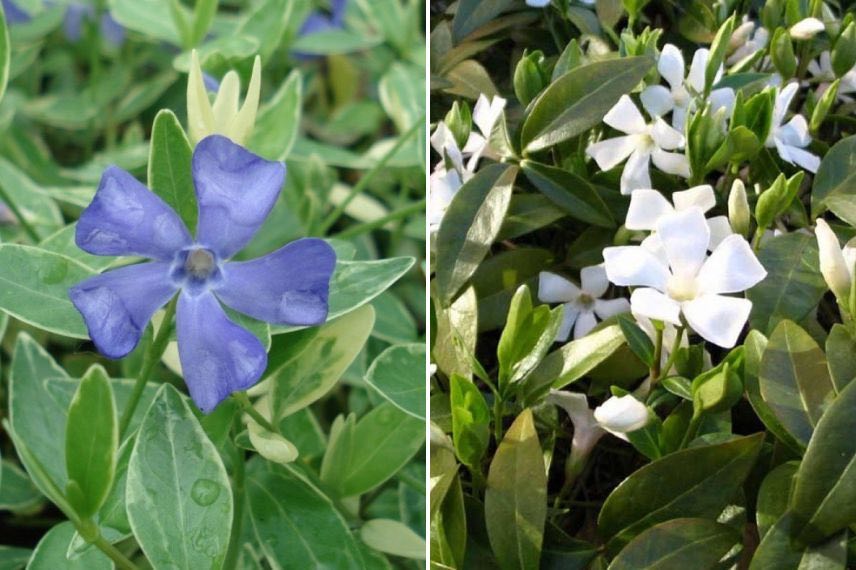
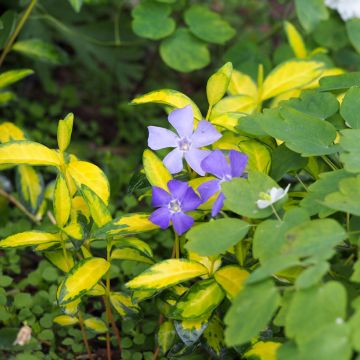
Vinca minor ‘Ralph Shugert’ with variegated foliage and ‘Gertrude Jekyll’ with white flowers
Discover other Dry shade perennials
View all →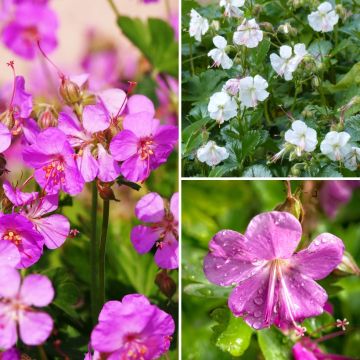
Available in 0 sizes
Available in 2 sizes
Available in 2 sizes
Available in 2 sizes
Available in 1 sizes
Available in 1 sizes
Available in 1 sizes
Available in 0 sizes
Available in 2 sizes
Available in 1 sizes
Ivy
Another useful plant at the base of a tree, Ivy readily colonises these less hospitable spaces for other plants. However, it can sometimes be difficult to find its ornamental qualities, as it may seem a bit mundane. Ivy is, however, characterised by its beautiful leaf with 5 lobes, and there are many forms with ornamental and vibrant foliage, frizzy and tapered, for example in ‘Ivalace’, or variegated varieties like ‘Kolibri’ or ‘Marginata elegantissima’. Ivy grows quickly, and its stems root upon contact with the soil. It forms a dense groundcover that requires little maintenance. Its allelopathic compounds spare you from weeding chores. If you plant it as groundcover, you need not worry about what has given it a bad reputation; just be careful that it doesn’t decide to climb a damaged wall, as that is the only place where it can cause damage. A very robust and low-maintenance plant, it thrives in shade or partial shade, in cool or drier soil, even poor soil.
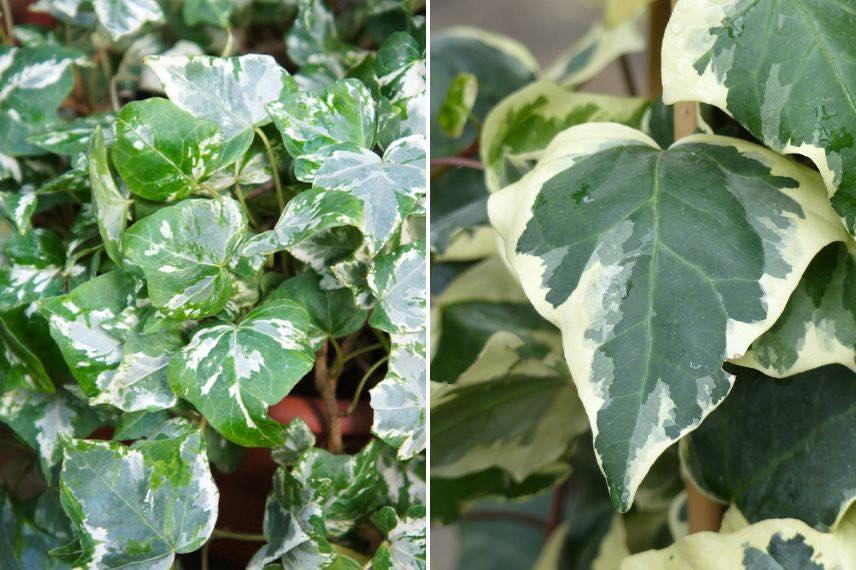
Hedera helix ‘Kolibri’ and ‘Marginata Elegantissima’
Pachysandra terminalis
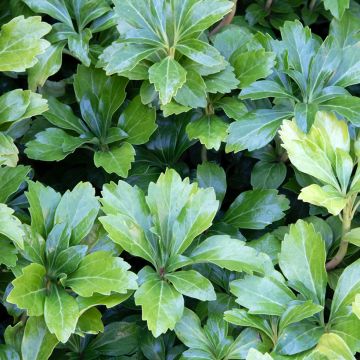
The Pachysandra terminalis is a lesser-known species, but those who use it appreciate its unwavering groundcover qualities. It takes a little time to establish, and although it spreads through a system of stolons, it is never invasive. It is best planted in shade or partial shade, leaning towards shade! Indeed, it tolerates dense shade better than midday sun in summer. It forms a dense carpet of 30 cm high dark green, oval, dentate leaves, clustered in terminal rosettes.
Some varieties offer very glossy foliage, such as ‘Green Carpet’ or ‘Green Sheen’, to bring brightness and light to dark areas. It blooms with discreet small white flowers in spikes, delicately scented, in May and June. However, it is truly cultivated for its lovely rosettes of evergreen foliage, beautiful all year round, and its suitability for difficult planting spots. It prefers cool soil but can adapt to drier soil, where it grows more slowly. It tolerates urban pollution, even thrives in heavy, damp soil, and is often found in the most unlikely places. There is also a variegated silver version: the Pachysandra terminalis ‘Variegata’.
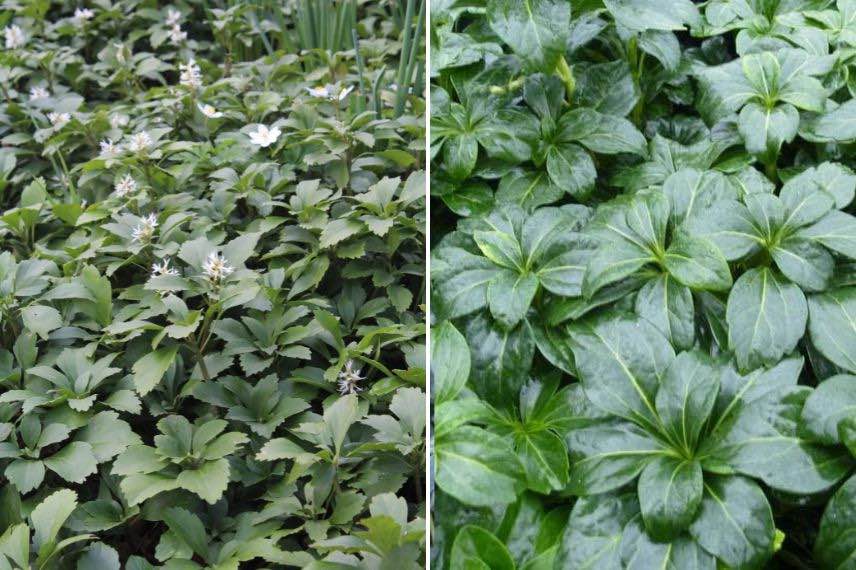
Pachysandra terminalis and variety ‘Green Sheen’
Epimediums
Epimediums make charming groundcovers for shade at the base of trees and bushes. In addition to beautiful foliage, often adorned with purplish hues in spring and, in some varieties, a second flush in autumn, it blooms in the spring in the most delightful way. However, its flowers are best observed up close. Sometimes they hide beneath the foliage, while at other times, they stand well above it. Small, they resemble curious and original little jewels. Back to the foliage: in some species, it is evergreen, while in others, it is deciduous. This is an important consideration when making a choice. It can be heart-shaped or very elongated. And while its colours vary throughout the seasons, it can also be more or less vivid or dark. Highly ornamental, it is also a point of interest when selecting.
As for the growing conditions, they are relatively similar for all epimediums: a position in light shade or partial shade, and cool soil. They tolerate dry soils once established. This may mean more attentive watering in the first few years of cultivation if planted under a tree. The species perralderianum, warleyense and perralchicum (and their cultivars) are more drought-tolerant than other species, but overall, epimediums are resilient; just be attentive to their establishment until they form a reasonably sized clump. They spread through their rhizomes and reach heights of 30 to a maximum of 60 cm depending on the varieties, with a similar spread. They are not invasive at all.
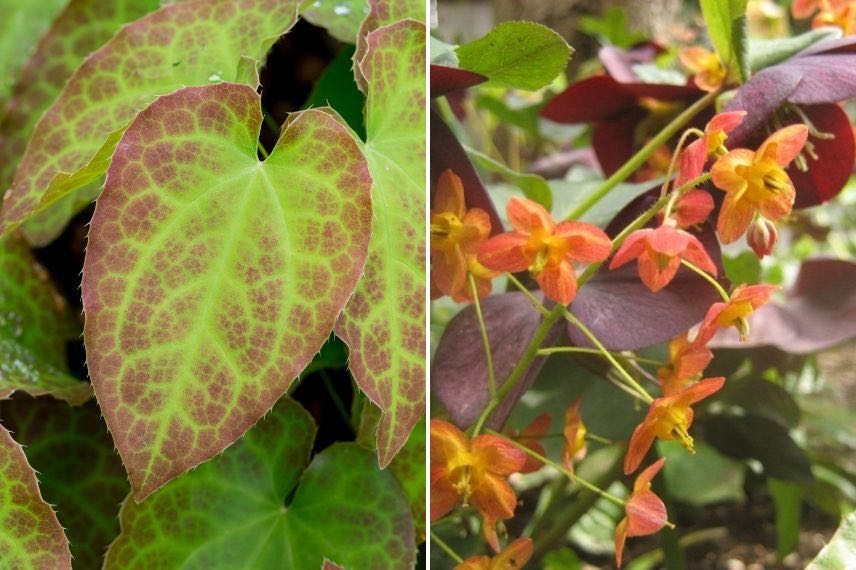
Foliage of Epimedium perralchicum and flowers of Epimedium warleyense
Aster divaricatus
Aster divaricatus is aster that thrives in woodlands and light shade, unlike many full sun asters. It grows near the roots of bushes or trees as long as they are not too vigorous. It enjoys partial shade or more sun, but not dense shade. It is a powerful groundcover that suppresses adventive plants; it is non-invasive and long-lasting. Deciduous, it develops its foliage in clumps quite late in the season, before being covered in a cloud of very bright white stars in summer and early autumn. The variety ‘Beth Chatto’ is more refined than the wild species, forming a more harmonious and floriferous clump. The stems of these asters are black, and the centre of the flower is yellow. They reach 50 cm in all directions. It is worth noting that the species Aster divaricatus has been renamed Eurybia divaricata.
Some Asters aregatoides seem to bravely withstand similar conditions: they grow in bright situations, even if not very sunny, leave no room for adventive plants, and tolerate competition from the roots of trees and bushes. Notable cultivars include ‘Asran’ and ‘Ezo Murasaki’.
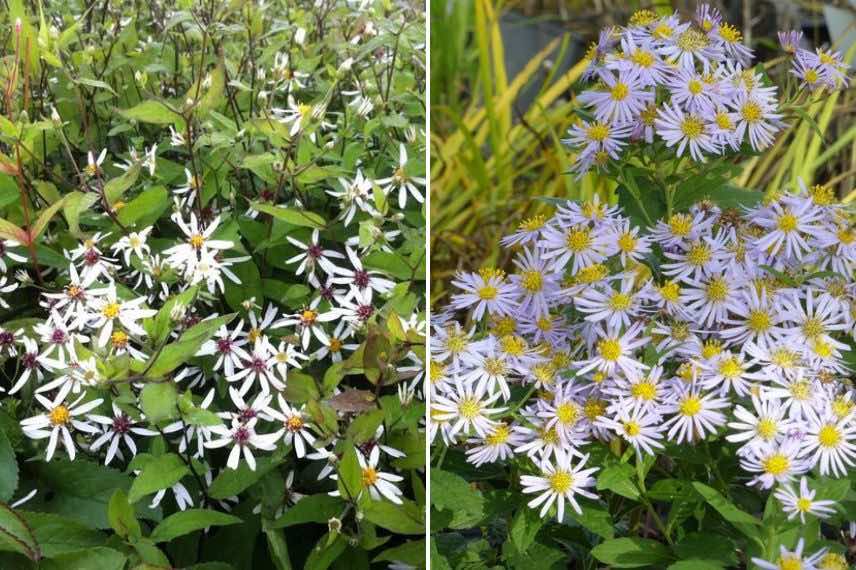
Aster divaricatus and Aster ageratoides ‘Asran’
In the southern regions
For regions that combine heat and strong sunlight, here are some perennials that can be planted at the base of southern tree species such as pines or holm oaks and cork oaks. These include Thymes, Acanthus mollis, or Achillea crithmifolia (the latter can be invasive). Ivy and Periwinkle are also options if the situation is well shaded and the soil is not too dry. For periwinkle, prefer Vinca major or Vinca difformis, a Mediterranean species that is not very hardy. Regarding ivy, Hedera algeriensis or Canary Ivy is quite sensitive to cold but suited to dry, hot climates.
Other perennials are best reserved for the base of deciduous trees: Achillea umbellata, Centaurea bella, Geranium sanguineum, Ceratostigma plumbagoides, Euphorbia myrsinites, and Algerian Iris (Iris unguicularis).
All these plants tolerate drought, sea spray, wind, poor and calcareous soil, typical conditions of garrigue and Mediterranean climate. Those releasing allelopathic compounds, common among these dry soil plants, also have the advantage of not leaving much hope for the growth of adventive species.
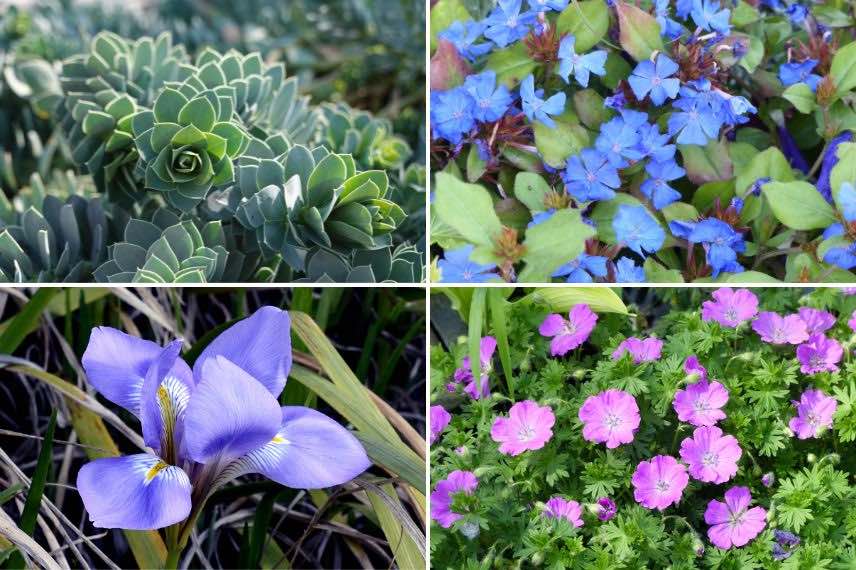
Clockwise: Euphorbia myrsinites, Ceratostigma plumbagoides, Geranium sanguineum, Iris unguicularis
- Subscribe!
- Contents
Comments