






























6 summer bulbs for creating cut flower arrangements
The most beautiful flowers for successful displays
Contents
Making bouquets with garden flowers is a beautiful way to decorate your home while enjoying their colour and fragrance. You can create a cutting garden, where you will delight in picking flowers to make stunning displays: gypsophila, roses, daisies, echinacea… Today, we are focusing on summer bulbs, whose impressive and vibrant flowers will easily become the centrepiece of a bouquet! For good vase life, we recommend picking flowers early in the morning, choosing those that are just starting to open, rather than those that are fully bloomed. Quickly place them in a vase filled with water, ideally with a piece of charcoal. Depending on the varieties you choose, these flowers will adapt to different styles of arrangement: rustic, chic, romantic, bohemian, vintage… Discover our selection of the best summer bulbs for making bouquets!

Gladioli
Gladioli produce large flowers in dense and imposing spikes during summer, very upright and rigid. There are thousands of varieties, with flowers available in a very rich palette of colours: red, orange, yellow, white, mauve, purple, pink… Their often vibrant hues are much appreciated. The flowers are funnel-shaped or trumpet-shaped, measuring between 2 and 5 cm in diameter. They open progressively from the bottom of the spike to the top. Gladioli flowers last well in a vase (about 15 days), and they have often been cultivated specifically for making cut flower arrangements.
In the garden, gladioli thrive in full sun, in well-draining soil. They are sensitive to stagnant moisture, as this can cause their corms (underground storage organs, equivalent to bulbs) to rot. If you live in a region with a cold climate, where temperatures frequently drop below -10 °C, we recommend digging up the bulbs in autumn to protect them from the cold. You can replant them the following spring.
In bouquets, their very vertical and graphic style is appreciated, making them ideal for “elevating” the arrangement alongside slightly shorter flowers. You can pair them, for example, with lilies, zinnias, snapdragons, grasses, cosmos, and heleniums.
For more information on their cultivation, discover our complete guide: “Gladioli: plant, grow, and maintain”
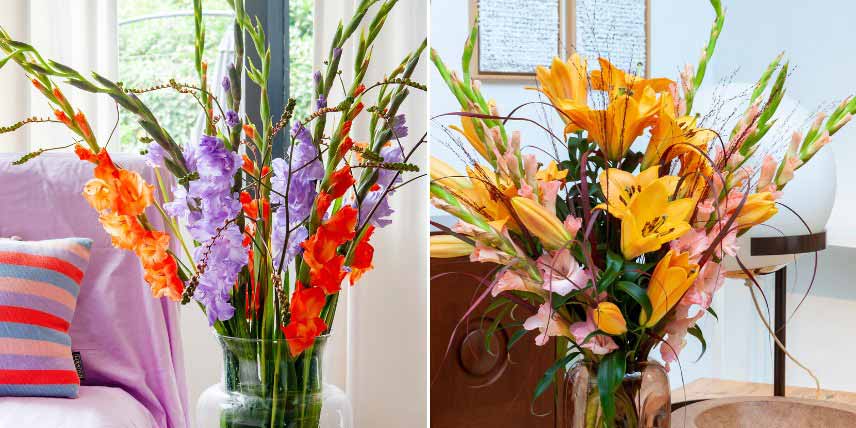
Gladioli ‘Prince of Orange’ and ‘Milka’ / Gladioli ‘Adrenaline’ and Lily ‘Saltarello’
Lilies
Lilies are distinguished by their large, majestic, and refined flowers. They also come in a wide variety of colours, often in warm and bright tones. Their trumpet-shaped flowers consist of six large, colourful petals, with long decorative stamens at the centre. There are also varieties with double flowers, featuring a greater number of petals. The flowers are often maculate with darker, purplish spots, adding a touch of depth and intensity to the flowering!
In the garden, lilies thrive in the sun (ideally with their roots in the shade), in rich, fertile, loose, and well-draining soil. Don’t hesitate to water them in spring and summer if it doesn’t rain, and to mulch to keep the soil cool for longer. Lilies are hardy, and their bulbs can remain in the ground during winter.
Choose varieties with white or pink flowers (‘Stargazer’, ‘Mona Lisa’, ‘Casablanca’…) to create a romantic bouquet in combination with gypsophila, roses, dahlias, gladioli, and sweet peas, and varieties with yellow or orange flowers (‘Golden Splendor’, ‘African Queen’…) for a vibrant bouquet, for example with crocosmias, rudbeckias, and marigolds… Lilies also make very beautiful bouquets on their own, by combining different varieties in similar tones.
Discover our complete guide: “Lilies: planting, cultivation, and maintenance”
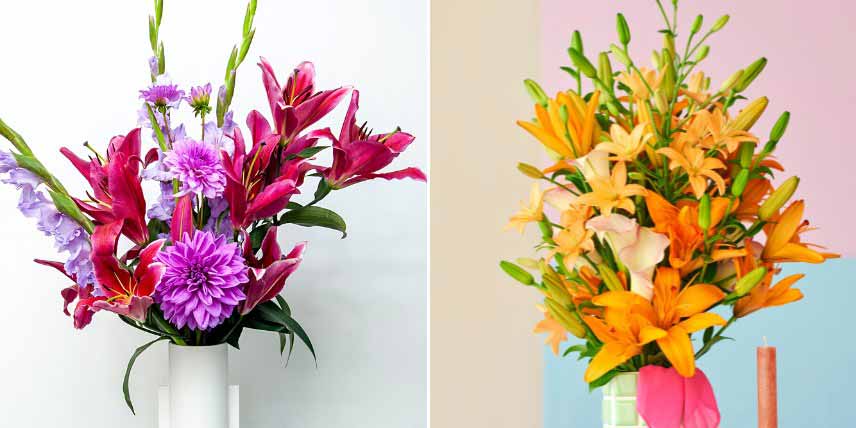
‘Indiana’ Lily, ‘Milka’ Gladiolus, ‘Lilac Time’ and ‘Blue Boy’ Dahlia / ‘Rosette’, ‘Orange Cocotte’, and ‘Regent Park’ Lilies
Discover other Summer flowering bulbs
View all →
Available in 1 sizes
Available in 1 sizes
Available in 1 sizes
Available in 1 sizes
Available in 1 sizes
Available in 1 sizes
Available in 1 sizes
Available in 1 sizes
Available in 1 sizes
Available in 1 sizes
Arums or Callas
Also known as Callas or Zantedeschias, Arums offer an elegant corn-shaped flowering. The flowers consist of a wide, flared bract (the spathe) enclosing a yellow or orange spike (the spadix). The flowers are typically white, but there are also many varieties with yellow, orange, red, pink, and purple flowers.
Arums thrive in full sun or partial shade, in rich, cool to moist soil, sheltered from the wind. The varieties with coloured flowers are quite tender (between –5 and –12 °C depending on the variety), so it may be wise to dig up the rootstocks in autumn to replant them in spring. For the hardiest species, a thick layer of mulch may be sufficient to protect them from the cold.
Purple-flowered Arums (such as ‘Captain Reno’ or ‘Schwartzwalder’) are perfect for adding depth and contrast to bouquets, while those with white or pink flowers (‘Crystal Blush’, ‘Captain Melrose’…) create stunning romantic and elegant bouquets, such as bridal bouquets (with gypsophila, roses, eucalyptus gunnii leaves, or ferns…). There are also varieties with yellow or orange flowers, ideal for a vibrant bouquet, combined with the red flowers of a dahlia or crocosmias, for example.
Our complete guide: “Arums: to plant, to grow, and to maintain”
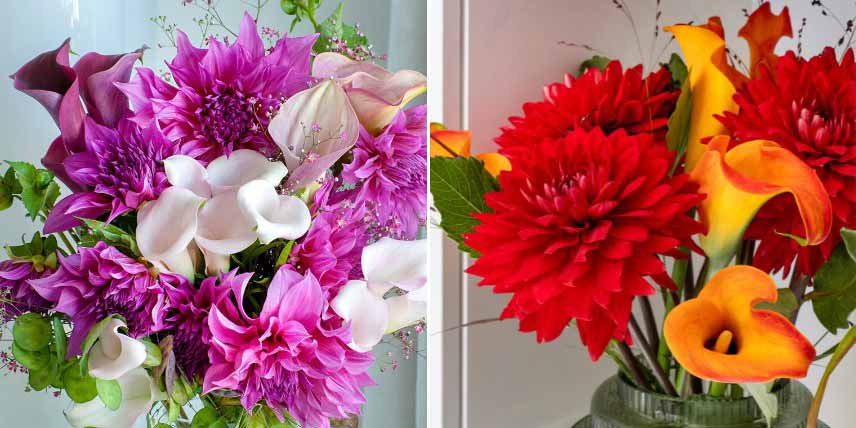
Arums ‘Captain Ventura’, ‘Captain Melrose’ and Dahlias / Arums ‘Callista’ and Dahlias
Read also
The best Dahlias for bouquetsFreesias
Freesias are bulbous plants native to South Africa. They offer pleasantly scented flowers! They release a sweet, heady fragrance reminiscent of jasmine, orange blossom, and neroli. Freesia flowers come in often very bright shades: they can be yellow, orange, red, pink, purple, blue, or white. The varieties with single, white, or yellow flowers are generally the most fragrant. Freesia flowers last up to three weeks in a vase.
Particularly suited to mild climates, freesias require a warm, sunny location and thrive in cool, well-drained, gravelly or sandy soil, free from lime. Not very hardy (-3 °C), their bulbs need to be wintered to protect them from the cold.
Freesias are perfect for creating vintage-style bouquets (feel free to pair them with roses and some grasses). The many varieties blend beautifully together for a vibrant display! Pink or white freesias can make a lovely romantic bouquet alongside gypsophila.
Discover our complete guide “Freesia: planting, cultivation, and care”
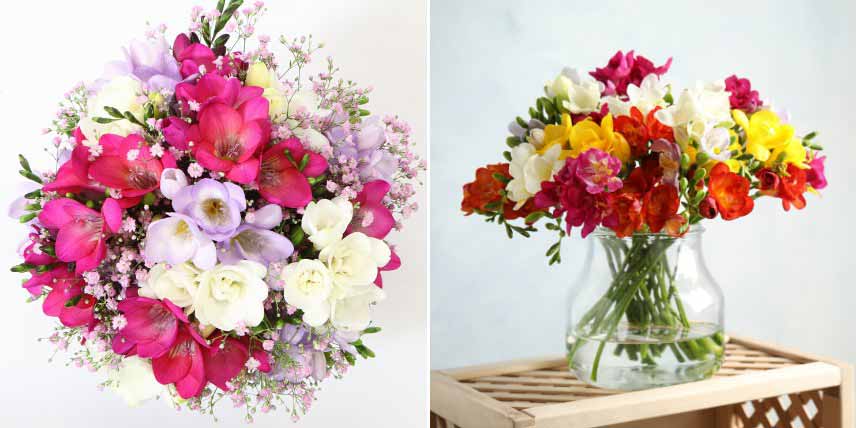
Freesias and Gypsophila / Bouquet with different varieties of freesias
Dahlias
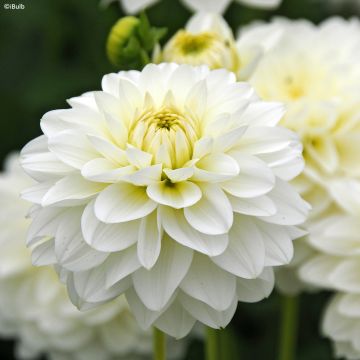
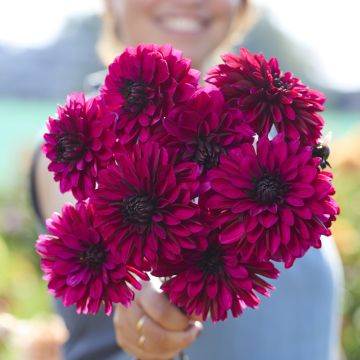
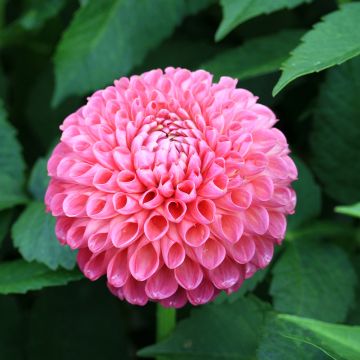
Dahlias offer opulent and generous flowers, available in a wide range of shapes and colours: there are dahlias with single flowers, which have a very natural style, and others with very double flowers, exuding extravagant charm. Their flowers come in the form of pom-poms, camellias, cacti, anemones, or peonies… The colour palette also seems endless: white, yellow, orange, salmon, apricot, red, burgundy, purple, violet, pink… The shades are particularly rich and delicate!
Dahlias thrive in full sun, in good fertile garden soil that is fresh and well-drained. Not very hardy, they are sensitive to temperatures below –5 °C. Therefore, it is necessary to winter the tubercles to protect them from the cold. Dig them up in autumn, store them in a frost-free place for winter, and then replant them in spring, as soon as there is no longer a risk of frost.
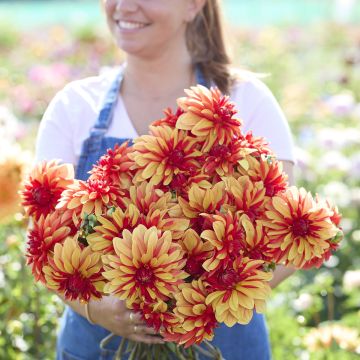
Dahlias are perfect for bohemian or country-style cut flower arrangements. Choose varieties with well-double flowers in orange tones (‘Karma Sangria’, ‘Renato Tosio’, ‘Motto’…), and pair them with Chinese fountain grass, rudbeckias, leucanthemums…
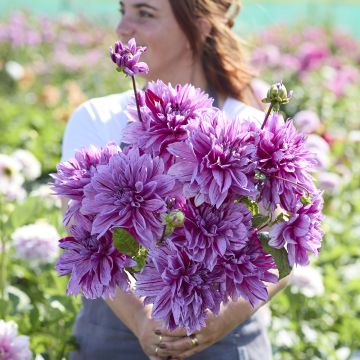
Some dahlias with pink or white flowers create a truly chic and romantic atmosphere (‘Café au Lait Royal’, ‘Lilac Time’, ‘Gallery Art Fair’…), in combination with lilies, carnations, arums, and delphiniums.
To learn more about their cultivation, discover our sheet: “Dahlia: planting, maintenance, and growing tips”
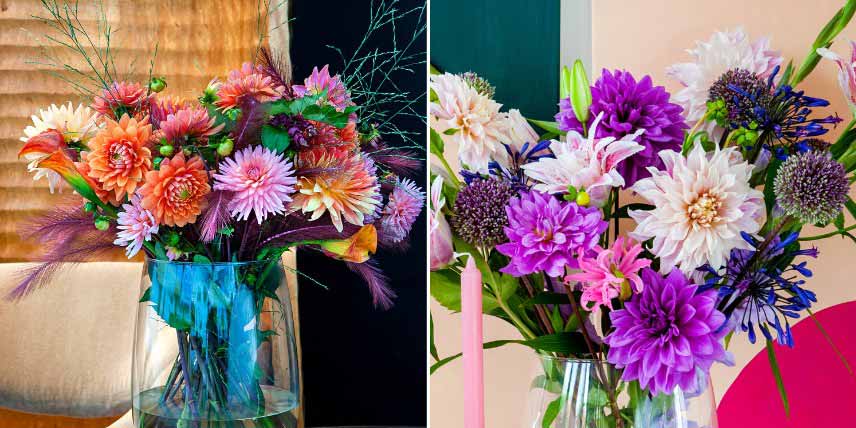
Dahlias ‘Renato Tosio’, ‘Preference’, ‘Motto’, Chinese fountain grass and Arums ‘Captain Safari’ / Dahlias ‘Lilac Time’, ‘Café Au Lait’, ‘Blue Boy’, Alliums ‘Summer Drummer’, Agapanthus ‘Susan’, Lilium ‘Isabella’, Amarine ‘Belladiva Emanuelle’
Crocosmias
A little less known and used than the previous plants, Crocosmias or Montbretias hold up very well in a vase (up to two weeks). These bulbous plants are native to South Africa, appreciated for their warmly coloured flowers: yellow, orange, or red. Their flowering is particularly graphic, featuring long, arching flower stems that bear around twenty tubular flowers.
Crocosmias thrive in full sun and prefer cool soils that do not dry out in summer, yet are well-drained. They are generally hardy down to -10 °C (and up to -15 °C for the species Crocosmia masoniorum), provided they are protected by a thick layer of mulch. However, if you live in a region with a cool climate where winter temperatures drop below -5 °C, it is wise to dig up the corms in autumn to protect them from frost.
Crocosmias benefit from being paired with other warm-flowering plants for an exotic-style bouquet! Consider combining them with the calla lilies ‘Captain Murano’ or ‘Flame’, as well as heleniums, zinnias, and freesias. You can even incorporate some palm leaves into your arrangement.
Our complete guide: “Crocosmia: planting, cultivation, and maintenance”
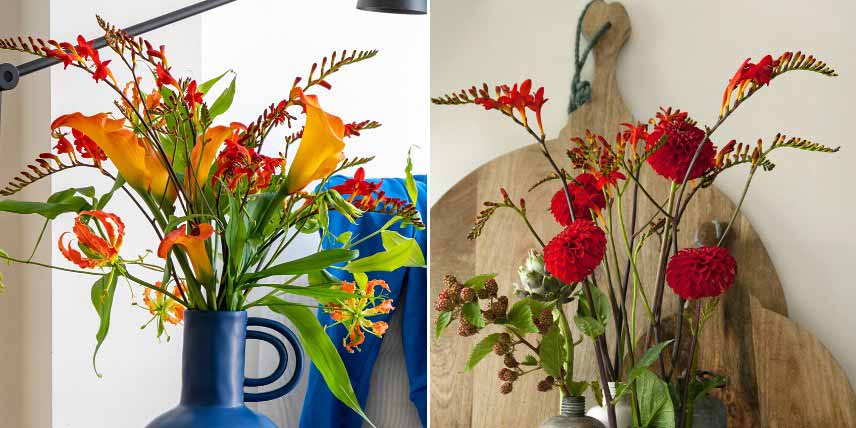
Crocosmias ‘Lucifer’, Callas ‘Callista’ and Gloriosa ‘Leonella’ / Crocosmias ‘Lucifer’ and Dahlias
To go further
Read also our articles:
- Our top 9 summer bulbs with orange flowers for full sun
- Subscribe!
- Contents

Comments